The Maṇḍala of Eight
Aṣṭamaṇḍalaka
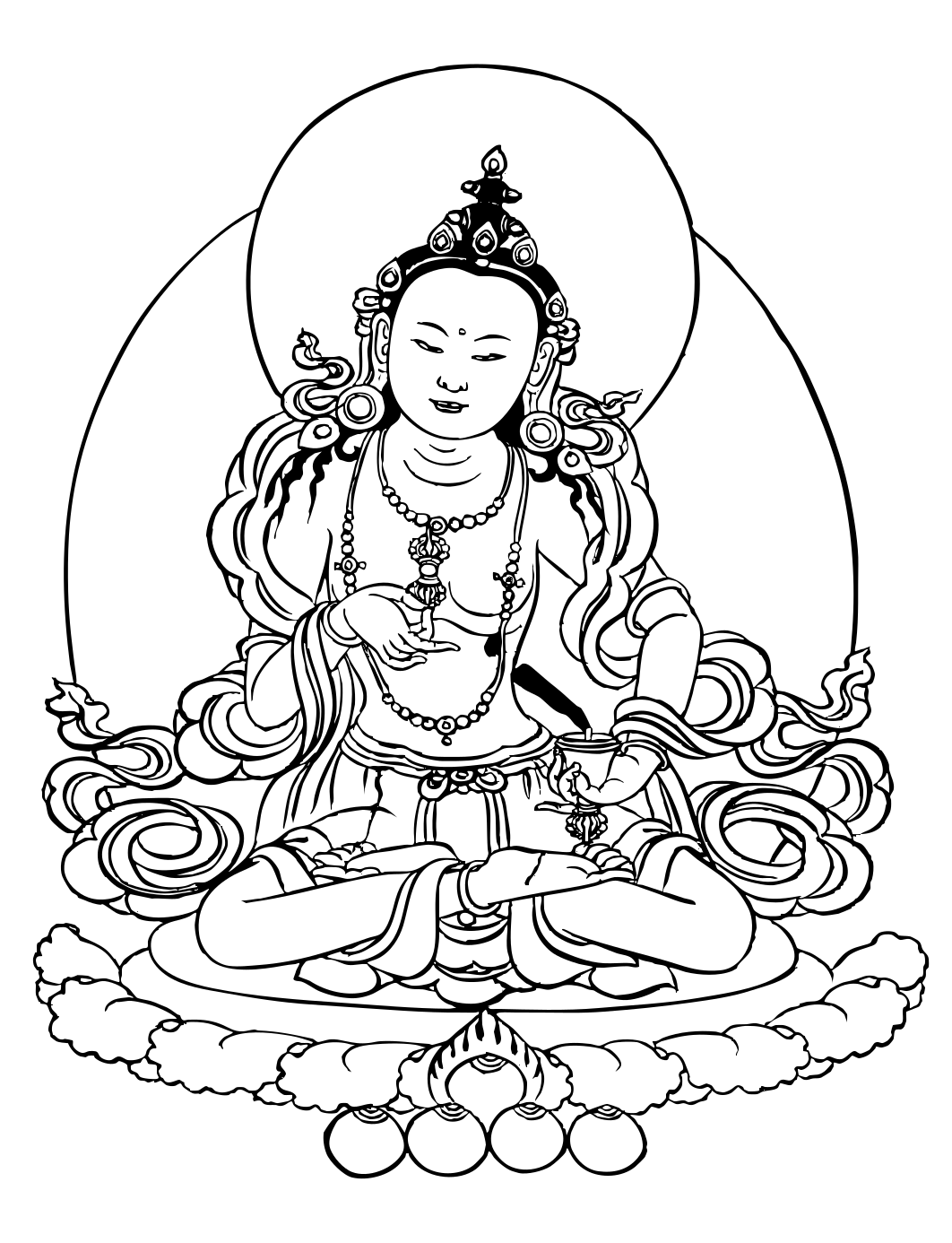
Accomplishment or success in general, as well as any particular magical power or ability. The supreme accomplishment is complete buddhahood.
One of the eight great bodhisattvas and the personification of the Buddha’s blessings.
One of the “eight close sons of the Buddha,” he is also known as the bodhisattva who embodies compassion. In certain tantras, he is also the lord of the three families, where he embodies the compassion of the buddhas. In Tibet, he attained great significance as a special protector of Tibet, and in China, in female form, as Guanyin, the most important bodhisattva in all of East Asia.
Yeshé Dé (late eighth to early ninth century) was the most prolific translator of sūtras into Tibetan. Altogether he is credited with the translation of more than one hundred sixty sūtra translations and more than one hundred additional translations, mostly on tantric topics. In spite of Yeshé Dé’s great importance for the propagation of Buddhism in Tibet during the imperial era, only a few biographical details about this figure are known. Later sources describe him as a student of the Indian teacher Padmasambhava, and he is also credited with teaching both sūtra and tantra widely to students of his own. He was also known as Nanam Yeshé Dé, from the Nanam (sna nam) clan.
In Buddhist literature, this is an epithet applied to buddhas, most often to Śākyamuni. The Sanskrit term generally means “possessing fortune,” but in specifically Buddhist contexts it implies that a buddha is in possession of six auspicious qualities (bhaga) associated with complete awakening. The Tibetan term—where bcom is said to refer to “subduing” the four māras, ldan to “possessing” the great qualities of buddhahood, and ’das to “going beyond” saṃsāra and nirvāṇa—possibly reflects the commentarial tradition where the Sanskrit bhagavat is interpreted, in addition, as “one who destroys the four māras.” This is achieved either by reading bhagavat as bhagnavat (“one who broke”), or by tracing the word bhaga to the root √bhañj (“to break”).
A being who is dedicated to the cultivation and fulfilment of the altruistic intention to attain perfect buddhahood, traversing the ten bodhisattva levels (daśabhūmi, sa bcu). Bodhisattvas purposely opt to remain within cyclic existence in order to liberate all sentient beings, instead of simply seeking personal freedom from suffering. In terms of the view, they realize both the selflessness of persons and the selflessness of phenomena.
The term can be understood to mean “great courageous one” or "great hero,” or (from the Sanskrit) simply “great being,” and is almost always found as an epithet of “bodhisattva.” The qualification “great” in this term, according to the majority of canonical definitions, focuses on the generic greatness common to all bodhisattvas, i.e., the greatness implicit in the bodhisattva vow itself in terms of outlook, aspiration, number of beings to be benefited, potential or eventual accomplishments, and so forth. In this sense the mahā- is closer in its connotations to the mahā- in “Mahāyāna” than to the mahā- in “mahāsiddha.” While individual bodhisattvas described as mahāsattva may in many cases also be “great” in terms of their level of realization, this is largely coincidental, and in the canonical texts the epithet is not restricted to bodhisattvas at any particular point in their career. Indeed, in a few cases even bodhisattvas whose path has taken a wrong direction are still described as bodhisattva mahāsattva.
Later commentarial writings do nevertheless define the term—variably—in terms of bodhisattvas having attained a particular level (bhūmi) or realization. The most common qualifying criteria mentioned are attaining the path of seeing, attaining irreversibility (according to its various definitions), or attaining the seventh bhūmi.
A Kashmiri
A teacher’s affectionate address to his female disciple on the bodhisattva path.
A mantra to invoke the deity and attract his or her attention to the practitioner.
Acts for which one will be reborn in hell immediately after death, without any intermediate state; they are (1) killing one’s father, (2) killing one’s mother, (3) killing an arhat, (4) causing a schism in the saṅgha, and (5) maliciously drawing blood from a buddha.
Jinamitra was invited to Tibet during the reign of King Tri Songdetsen (khri srong lde btsan, r. 742–98 ᴄᴇ) and was involved with the translation of nearly two hundred texts, continuing into the reign of King Ralpachen (ral pa can, r. 815–38 ᴄᴇ). He was one of the small group of paṇḍitas responsible for the Mahāvyutpatti Sanskrit–Tibetan dictionary.
One of the eight great bodhisattvas and the personification of the Buddha’s merit.
The bodhisattva Maitreya is an important figure in many Buddhist traditions, where he is unanimously regarded as the buddha of the future era. He is said to currently reside in the heaven of Tuṣita, as Śākyamuni’s regent, where he awaits the proper time to take his final rebirth and become the fifth buddha in the Fortunate Eon, reestablishing the Dharma in this world after the teachings of the current buddha have disappeared. Within the Mahāyāna sūtras, Maitreya is elevated to the same status as other central bodhisattvas such as Mañjuśrī and Avalokiteśvara, and his name appears frequently in sūtras, either as the Buddha’s interlocutor or as a teacher of the Dharma. Maitreya literally means “Loving One.” He is also known as Ajita, meaning “Invincible.”
For more information on Maitreya, see, for example, the introduction to Maitreya’s Setting Out (Toh 198).
Mañjuśrī is one of the “eight close sons of the Buddha” and a bodhisattva who embodies wisdom. He is a major figure in the Mahāyāna sūtras, appearing often as an interlocutor of the Buddha. In his most well-known iconographic form, he is portrayed bearing the sword of wisdom in his right hand and a volume of the Prajñāpāramitāsūtra in his left. To his name, Mañjuśrī, meaning “Gentle and Glorious One,” is often added the epithet Kumārabhūta, “having a youthful form.” He is also called Mañjughoṣa, Mañjusvara, and Pañcaśikha.
An epithet of the buddhas, used to distinguish them from beings of lesser realization such as arhats and solitary awakeners.
A mountain regarded as the abode of Avalokiteśvara.
A great bodhisattva in the Buddha’s following.
One of the eight great bodhisattvas and the personification of the Buddha’s aspirations.
An important bodhisattva, included among the “eight close sons of the Buddha.” His name means “One Who Completely Dispels All Obscurations” and, accordingly, he is said to have the power to exhaust all the obscurations of anyone who merely hears his name. According to The Jewel Cloud (1.10, Toh 231), Sarvanīvaraṇaviṣkambhin originally dwelt in the realm of the Buddha Padmanetra, but he was so touched by the Buddha Śākyamuni’s compassionate acceptance of the barbaric and ungrateful beings who inhabit this realm that he traveled to see the Buddha Śākyamuni, offer him worship, and inquire about the Dharma. He is often included in the audience of sūtras and, in particular, he has an important role in the The Basket’s Display, Toh 116, in which he is sent to Vārāṇasī to obtain Avalokitesvara’s mantra.
A teacher’s affectionate address to a male disciple on the bodhisattva path.
A frequently used synonym for buddha. According to different explanations, it can be read as tathā-gata, literally meaning “one who has thus gone,” or as tathā-āgata, “one who has thus come.” Gata, though literally meaning “gone,” is a past passive participle used to describe a state or condition of existence. Tatha(tā), often rendered as “suchness” or “thusness,” is the quality or condition of things as they really are, which cannot be conveyed in conceptual, dualistic terms. Therefore, this epithet is interpreted in different ways, but in general it implies one who has departed in the wake of the buddhas of the past, or one who has manifested the supreme awakening dependent on the reality that does not abide in the two extremes of existence and quiescence. It is also often used as a specific epithet of the Buddha Śākyamuni.
The awakening of buddhas as distinguished from the lesser realizations of arhats, solitary awakeners and the like.
One of the eight great bodhisattvas and the personification of the Buddha’s power.
Also known as “pristine awareness,” “primordial wisdom,” “primordial awareness,” “gnosis,” or the like. Typically refers to nonconceptual or unobscured states of knowledge.
According to Buddhist tradition, one who is worthy of worship (pūjām arhati), or one who has conquered the enemies, the mental afflictions (kleśa-ari-hata-vat), and reached liberation from the cycle of rebirth and suffering. It is the fourth and highest of the four fruits attainable by śrāvakas. Also used as an epithet of the Buddha.
dkyil ’khor brgyad pa’i mdo (Aṣṭamaṇḍalakasūtra). Toh 644, Degé Kangyur vol. 91 (rgyud, ba) folios 128.a3–129.a2.
dkyil ’khor brgyad pa’i mdo (Aṣṭamaṇḍalakasūtra). Toh 882, Degé Kangyur vol. 100 (gzungs, e) folios 122.a2–123.a2.
dkyil ’khor brgyad pa’i mdo. bka’ ’gyur (dpe bsdur ma) [Comparative Edition of the Kangyur], krung go’i bod rig pa zhib ’jug ste gnas kyi bka’ bstan dpe sdur khang (The Tibetan Tripitaka Collation Bureau of the China Tibetology Research Center). 108 volumes. Beijing: krung go’i bod rig pa dpe skrun khang (China Tibetology Publishing House), 2006–9, vol. 91, pp. 466–70.
dkyil ’khor brgyad pa’i mdo. bka’ ’gyur (dpe bsdur ma) [Comparative Edition of the Kangyur], krung go’i bod rig pa zhib ’jug ste gnas kyi bka’ bstan dpe sdur khang (The Tibetan Tripitaka Collation Bureau of the China Tibetology Research Center). 108 volumes. Beijing: krung go’i bod rig pa dpe skrun khang (China Tibetology Publishing House), 2006–9, vol. 97, pp. 358–61.
dkar chag ’phang thang ma. Beijing: Mi rigs dpe skrun khang, 2003.
Denkarma (pho brang stod thang ldan dkar gyi chos ’gyur ro cog gi dkar chag). Toh 4364, Degé Tengyur vol. 206 (sna tshogs, jo), folios 294.b–310.a.
Ngor Khenchen Kunga Zangpo (ngor mkhan chen kun dga’ bzang po). bya rgyud spyi’i rnam bshad legs bshad rgya mtsho [An Ocean of Excellent Explanation: A General Commentary on Kriyā Tantra]. In gsung ’bum kun dga’ bzang po, vol. 4, folios 101.a–208.b (pp. 204–418). Dehra Dun: Sakya Centre, 1990–9. BDRC WA0XL6CE0DF8069EE
Butön Rinchen Drup (bu ston rin chen grub). The Collected Works of Bu-Ston. Part 16 (Ma). Edited by Lokesh Candra. Śata-Piṭaka Series 56. New Delhi: International Academy of Indian Culture, 1969.
Dalton, Jacob, and Sam van Schaik, eds. Tibetan Tantric Manuscripts from Dunhuang: A Descriptive Catalogue of the Stein Collection at the British Library. Brill’s Tibetan Studies Library 12. Leiden, Boston: Brill, 2006.
de Visser, Marinus Willem. The Bodhisattva Ti-Tsang (Jizo) in China and Japan. Berlin: Oesterheld, 1914.
Herrmann-Pfandt, Adelheid. Die lHan kar ma: ein früher Katalog der ins Tibetische übersetzten buddhistischen Texte. Vienna: Verlag der Österreichischen Akademie der Wissenschaften, 2008.
Lin, Li-kouang. “Puṇyodaya (Na-t’i), Un Propagateur du Tantrisme en Chine et au Cambodge à l’Époche de Hiuan-Tsang.” Journal Asiatique volume 227 (July-September) 1935: 83–100.
Miyasaka Yūshō 宮坂宥勝. “Kōbō daishi Kūkai shōrai ‘Bonbon Hachi mandara kyō’ no kenkyū 弘法大師空海請来『梵本 八曼荼羅経』の研究” [A study of the Sanskrit version of the Ba manchaluo jing brought (to Japan) by Kōbō daishi Kūkai]. Indo kotenron インド古典論 [Indian classical studies]. Tokyo: Chikuma Shobō, 1983–84 [Shōwa 58–59]: v. 1 [上], 136–156.
Miyasaka Yūshō (1983–84). “Sanjūjōsasshi no bonbun ni tsuite 三十帖冊子の梵文について” [On the Sanskrit text of the Sanjūjōsasshi]. Indo kotenron インド古典論 [Indian classical studies]. Tokyo: Chikuma Shobō, 1983–84 [Shōwa 58–59]: v. 1 [上], 88–135.
Skilling, Peter. Buddhism and the Circulation of Ritual in Early Peninsular Southeast Asia. In Early Interactions between South and Southeast Asia, edited by Pierre-Yves Manguin, A. Mani, and Geoff Wade. Nalanda-Sriwijaya Series 2. Singapore: Institute of Southeast Asian Studies, 2011: 371–384.
Yaita Hideomi 矢板秀臣. “Kōbō daishi hissha ‘Hachi mandara kyō’ bonbun tekisuto ni tsuite 弘法大師筆写『八曼荼羅経』梵文テキストについて” [On the Sanskrit version of the Ba manchaluo jing in Kōbō daishi’s hand]. Gendai mikkyō 現代密教 18, 2005: 1–11.
Yoshimura, Shūki. The Denkar-Ma: An Oldest Catalogue of the Tibetan Buddhist Canons. Kyoto: Ryukoku University, 1950.