༄༅། །བྱམས་པ་འཇུག་པ།
Maitreya’s Setting Out
Maitreyaprasthāna
The five constituents of a living entity: form, feeling, perception, karmic formation, and consciousness.
A major śrāvaka disciple and personal attendant of the Buddha Śākyamuni during the last twenty-five years of his life. He was a cousin of the Buddha (according to the Mahāvastu, he was a son of Śuklodana, one of the brothers of King Śuddhodana, which means he was a brother of Devadatta; other sources say he was a son of Amṛtodana, another brother of King Śuddhodana, which means he would have been a brother of Aniruddha).
Ānanda, having always been in the Buddha’s presence, is said to have memorized all the teachings he heard and is celebrated for having recited all the Buddha’s teachings by memory at the first council of the Buddhist saṅgha, thus preserving the teachings after the Buddha’s parinirvāṇa. The phrase “Thus did I hear at one time,” found at the beginning of the sūtras, usually stands for his recitation of the teachings. He became a patriarch after the passing of Mahākāśyapa.
One of the “eight close sons of the Buddha,” he is also known as the bodhisattva who embodies compassion. In certain tantras, he is also the lord of the three families, where he embodies the compassion of the buddhas. In Tibet, he attained great significance as a special protector of Tibet, and in China, in female form, as Guanyin, the most important bodhisattva in all of East Asia.
In Buddhist literature, this is an epithet applied to buddhas, most often to Śākyamuni. The Sanskrit term generally means “possessing fortune,” but in specifically Buddhist contexts it implies that a buddha is in possession of six auspicious qualities (bhaga) associated with complete awakening. The Tibetan term—where bcom is said to refer to “subduing” the four māras, ldan to “possessing” the great qualities of buddhahood, and ’das to “going beyond” saṃsāra and nirvāṇa—possibly reflects the commentarial tradition where the Sanskrit bhagavat is interpreted, in addition, as “one who destroys the four māras.” This is achieved either by reading bhagavat as bhagnavat (“one who broke”), or by tracing the word bhaga to the root √bhañj (“to break”).
A high-ranking deity presiding over a divine world; he is also considered to be the lord of the Sahā world (our universe). Though not considered a creator god in Buddhism, Brahmā occupies an important place as one of two gods (the other being Indra/Śakra) said to have first exhorted the Buddha Śākyamuni to teach the Dharma. The particular heavens found in the form realm over which Brahmā rules are often some of the most sought-after realms of higher rebirth in Buddhist literature. Since there are many universes or world systems, there are also multiple Brahmās presiding over them. His most frequent epithets are “Lord of the Sahā World” (sahāṃpati) and Great Brahmā (mahābrahman).
The seven branches of awakening are mindfulness, analysis of the dharmas, diligence, joy, pliability, absorption, equanimity. These are included in the thirty-seven factors of enlightenment.
The name of a bodhisattva present in the Buddha’s retinue.
Dhyāna is defined as one-pointed abiding in an undistracted state of mind, free from afflicted mental states. Four states of dhyāna are identified as being conducive to birth within the form realm. In the context of the Mahāyāna, it is the fifth of the six perfections. It is commonly translated as “concentration,” “meditative concentration,” and so on.
A set of qualities of the bodhisattvas. These are explained in detail by the Buddha at 1.86.
The fourth of the six perfections.
The second of the six perfections.
Name of a monk and bodhisattva who was the previous incarnation of the bodhisattva Maitreya.
Eight qualities of water: sweet, cool, pleasant, light, clear, pure, not harmful to the throat, and beneficial for the stomach.
A set of circumstances that do not provide the freedom to practice the Buddhist path: being born in the realms of (1) the hells, (2) pretas, (3) animals, and (4) long-lived gods; in the human realm among (5) barbarians or (6) extremists, and (7) in places where the Buddhist teachings do not exist; and (8) without adequate faculties to understand the teachings where they do exist.
One way of describing experience and the world in terms of eighteen elements (eye and form, ear and sound, nose and odor, tongue and taste, body and touch, mind and mental objects, to which the six consciousnesses are added).
Emptiness denotes the ultimate nature of reality, the total absence of inherent existence and self-identity with respect to all phenomena. According to this view, all things and events are devoid of any independent, intrinsic reality that constitutes their essence. Nothing can be said to exist independent of the complex network of factors that gives rise to its origination, nor are phenomena independent of the cognitive processes and mental constructs that make up the conventional framework within which their identity and existence are posited. When all levels of conceptualization dissolve and when all forms of dichotomizing tendencies are quelled through deliberate meditative deconstruction of conceptual elaborations, the ultimate nature of reality will finally become manifest. It is the first of the three gateways to liberation.
The thirty-seven factors of awakening are the four applications of mindfulness, the four thorough relinquishments, the four bases of miraculous power, the five faculties, the five powers, the eightfold path, and the seven branches of awakening.
These are spiritual capacities to be developed: faith, diligence, mindfulness, absorption, and insight. These are included in the thirty-seven factors of awakening. They are the same as the five powers at a lesser stage of development.
Refers to the fourfold fearlessness or the four assurances proclaimed by the thus-gone ones: fearlessness in declaring that one has awakened, that one has ceased all illusions, that one has taught the obstacles to awakening, and that one has shown the way to liberation.
Acts for which one will be reborn in hell immediately after death, without any intervening stages; they include killing one’s mother, one’s father, or an arhat, causing a dissention in the saṅgha, and causing the blood of a thus-gone one to flow.
Refers to the five fundamental precepts of abstaining from killing, stealing, sexual misconduct, lying, and consuming intoxicants.
Four gods who live on the lower slopes (fourth level) of Mount Meru in the eponymous Heaven of the Four Great Kings (Cāturmahārājika, rgyal chen bzhi’i ris) and guard the four cardinal directions. Each is the leader of a nonhuman class of beings living in his realm. They are Dhṛtarāṣṭra, ruling the gandharvas in the east; Virūḍhaka, ruling over the kumbhāṇḍas in the south; Virūpākṣa, ruling the nāgas in the west; and Vaiśravaṇa (also known as Kubera) ruling the yakṣas in the north. Also referred to as Guardians of the World or World Protectors (lokapāla, ’jig rten skyong ba).
The four root downfalls are roughly synonymous with the four transgressions (pham pa, pārājika) that require expulsion from the monastic community. These four transgressions are applicable to the maintenance of monastic and lay vows alike, though their interpretations might differ depending on context. The four transgressions are (1) violating the vow of chastity (mi tshangs pa spyod pa, abrahmacarya); (2) stealing/taking what is not given (mi byin par len pa, adattadāna); (3) taking a life (srog gcod pa, prāṇātipāta); and (4) lying (rdzun du smra ba, mṛṣāvāda).
The first of the six perfections.
Genuine discrimination with respect to dharmas, meaning, language, and eloquence.
Name of a king who was the previous incarnation of the bodhisattva Maitreya.
The largest universe described in Buddhist cosmology. This term, in Abhidharma cosmology, refers to 1,000³ world systems, i.e., 1,000 “dichiliocosms” or “two thousand great thousand world realms” (dvisāhasramahāsāhasralokadhātu), which are in turn made up of 1,000 first-order world systems, each with its own Mount Sumeru, continents, sun and moon, etc.
The Sanskrit term śrāvaka, and the Tibetan nyan thos, both derived from the verb “to hear,” are usually defined as “those who hear the teaching from the Buddha and make it heard to others.” Primarily this refers to those disciples of the Buddha who aspire to attain the state of an arhat seeking their own liberation and nirvāṇa. They are the practitioners of the first turning of the wheel of the Dharma on the four noble truths, who realize the suffering inherent in saṃsāra and focus on understanding that there is no independent self. By conquering afflicted mental states (kleśa), they liberate themselves, attaining first the stage of stream enterers at the path of seeing, followed by the stage of once-returners who will be reborn only one more time, and then the stage of non-returners who will no longer be reborn into the desire realm. The final goal is to become an arhat. These four stages are also known as the “four results of spiritual practice.”
One of the six heavens of the desire realm.
One of the six heavens of the desire realm.
Tuṣita (or sometimes Saṃtuṣita), literally “Joyous” or “Contented,” is one of the six heavens of the desire realm (kāmadhātu). In standard classifications, such as the one in the Abhidharmakośa, it is ranked as the fourth of the six counting from below. This god realm is where all future buddhas are said to dwell before taking on their final rebirth prior to awakening. There, the Buddha Śākyamuni lived his preceding life as the bodhisattva Śvetaketu. When departing to take birth in this world, he appointed the bodhisattva Maitreya, who will be the next buddha of this eon, as his Dharma regent in Tuṣita. For an account of the Buddha’s previous life in Tuṣita, see The Play in Full (Toh 95), 2.12, and for an account of Maitreya’s birth in Tuṣita and a description of this realm, see The Sūtra on Maitreya’s Birth in the Heaven of Joy, (Toh 199).
One of the six heavens of the desire realm.
One of the six heavens of the desire realm.
One of the six heavens of the desire realm.
The six perfections: the perfection of generosity, the perfection of discipline, the perfection of patience, the perfection of diligence, the perfection of concentration, and the perfection of insight.
The sixth of the six perfections. In the context of this sūtra, this term can also denote insight in general.
One of the first Buddhist monasteries, located in a park outside Śrāvastī, the capital of the ancient kingdom of Kośala in northern India. This park was originally owned by Prince Jeta, hence the name Jetavana, meaning Jeta’s grove. The wealthy merchant Anāthapiṇḍada, wishing to offer it to the Buddha, sought to buy it from him, but the prince, not wishing to sell, said he would only do so if Anāthapiṇḍada covered the entire property with gold coins. Anāthapiṇḍada agreed, and managed to cover all of the park except the entrance, hence the name Anāthapiṇḍadasyārāmaḥ, meaning Anāthapiṇḍada’s park. The place is usually referred to in the sūtras as “Jetavana, Anāthapiṇḍada’s park,” and according to the Saṃghabhedavastu the Buddha used Prince Jeta’s name in first place because that was Prince Jeta’s own unspoken wish while Anāthapiṇḍada was offering the park. Inspired by the occasion and the Buddha’s use of his name, Prince Jeta then offered the rest of the property and had an entrance gate built. The Buddha specifically instructed those who recite the sūtras to use Prince Jeta’s name in first place to commemorate the mutual effort of both benefactors.
Anāthapiṇḍada built residences for the monks, to house them during the monsoon season, thus creating the first Buddhist monastery. It was one of the Buddha’s main residences, where he spent around nineteen rainy season retreats, and it was therefore the setting for many of the Buddha’s discourses and events. According to the travel accounts of Chinese monks, it was still in use as a Buddhist monastery in the early fifth century ᴄᴇ, but by the sixth century it had been reduced to ruins.
An Indian Kashmiri paṇḍita who was resident in Tibet during the late 8th and early 9th centuries. He worked with several Tibetan translators on the translation of several sūtras. He is also the author of the Nyāyabindupiṇḍārtha (Toh 4233), which is contained in the Tibetan Tengyur (bstan ’gyur) collection.
A type of cymbal.
A synonym for ultimate reality, and also a near-synonym for nirvāṇa.
The name of a bodhisattva present in the Buddha’s retinue.
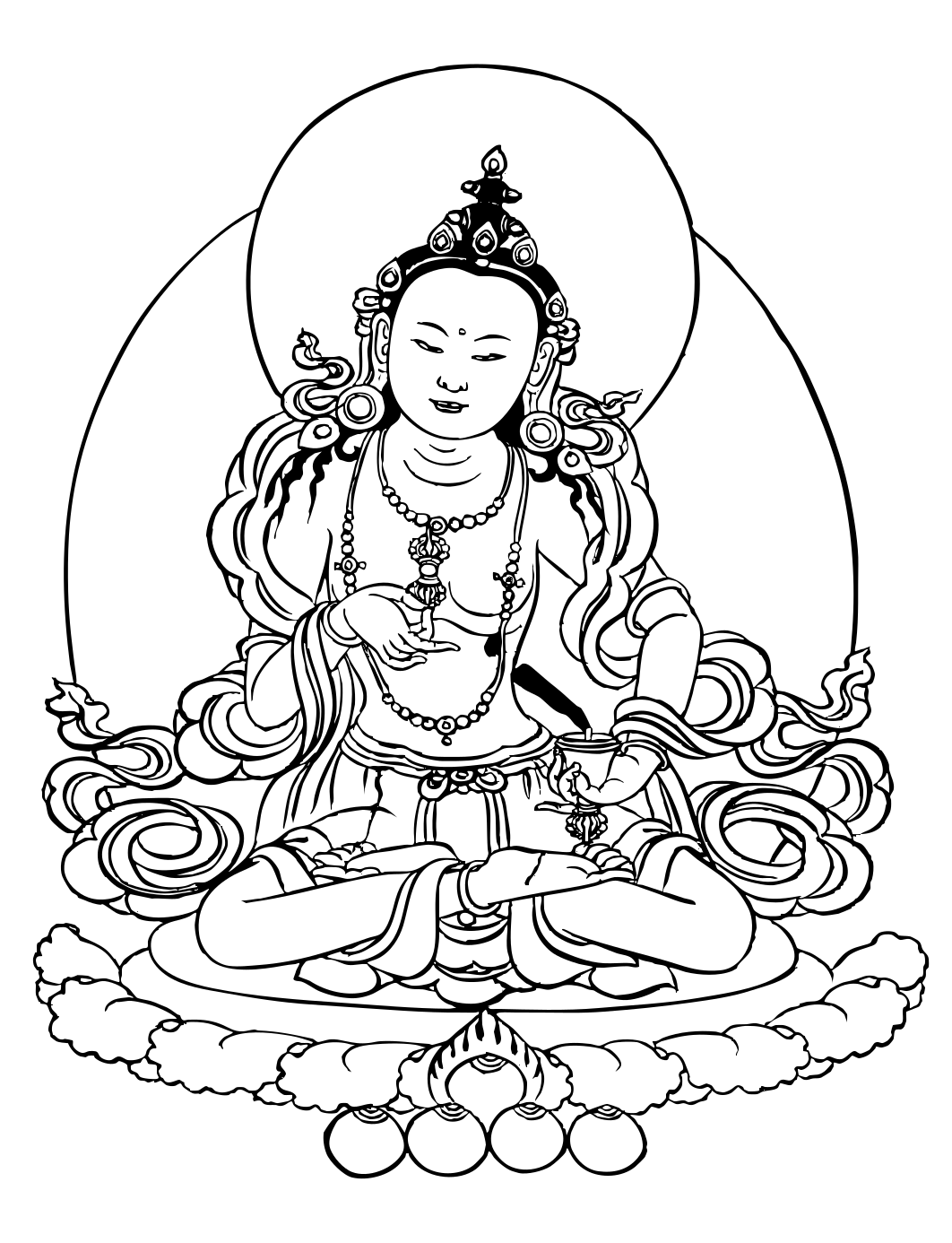
The bodhisattva Maitreya is an important figure in many Buddhist traditions, where he is unanimously regarded as the buddha of the future era. He is said to currently reside in the heaven of Tuṣita, as Śākyamuni’s regent, where he awaits the proper time to take his final rebirth and become the fifth buddha in the Fortunate Eon, reestablishing the Dharma in this world after the teachings of the current buddha have disappeared. Within the Mahāyāna sūtras, Maitreya is elevated to the same status as other central bodhisattvas such as Mañjuśrī and Avalokiteśvara, and his name appears frequently in sūtras, either as the Buddha’s interlocutor or as a teacher of the Dharma. Maitreya literally means “Loving One.” He is also known as Ajita, meaning “Invincible.”
For more information on Maitreya, see, for example, the introduction to Maitreya’s Setting Out (Toh 198).
One of the names of the bodhisattva Mañjuśrī which means, “the youthful Mañjuśrī.”
A term meaning acceptance, forbearance, or patience. As the third of the six perfections, patience is classified into three kinds: the capacity to tolerate abuse from sentient beings, to tolerate the hardships of the path to buddhahood, and to tolerate the profound nature of reality. As a term referring to a bodhisattva’s realization, dharmakṣānti (chos la bzod pa) can refer to the ways one becomes “receptive” to the nature of Dharma, and it can be an abbreviation of anutpattikadharmakṣānti, “forbearance for the unborn nature, or nonproduction, of dharmas.”
See “six perfections.”
Name of a bodhisattva, the main interlocutor of Maitreya’s Setting Out.
Can refer to the five powers—faith, diligence, mindfulness, absorption, and insight—or to the ten powers.
An Indian Bengali paṇḍita resident in Tibet during the late 8th to early 9th centuries. Arriving in Tibet on an invitation from the Tibetan king, he assisted in the translation of numerous canonical scriptures. He is also the author of a few philosophical commentaries contained in the Tibetan Tengyur (bstan ’gyur) collection.
The name of a bodhisattva present in the Buddha’s retinue.
Can refer to celibacy in its narrowest sense; in a broader sense it refers to the conduct of those who have renounced worldly life to devote themselves to spiritual study and practice.
’phags pa byams pa ’jug pa zhes bya ba theg pa chen po’i mdo (Āryamaitreyaprasthānanāmamahāyānasūtra). Toh 198, Degé Kangyur vol. 61 (mdo sde, tsa), folios 274.b–296.a.
’phags pa byams pa ’jug pa zhes bya ba theg pa chen po’i mdo. bka’ ’gyur (dpe bsdur ma) [Comparative Edition of the Kangyur], krung go’i bod rig pa zhib ’jug ste gnas kyi bka’ bstan dpe sdur khang (The Tibetan Tripitaka Collation Bureau of the China Tibetology Research Center). 108 volumes. Beijing: krung go’i bod rig pa dpe skrun khang (China Tibetology Publishing House), 2006–2009, vol. 61, pp. 751–801.
Denkarma (pho brang stod thang ldan dkar gyi chos ’gyur ro cog gi dkar chag). Toh 4364, Degé Tengyur, vol. 206 (sna tshogs, jo), folios 294.b–310.a.
’phags pa byams pas zhus pa zhes bya ba theg pa chen po’i mdo (Āryamaitreyaparipṛcchānāmamahāyānasūtra). Toh 85, Degé Kangyur vol. 44 (dkon brtsegs, cha), folios 104.b–116.b. Translation in Liljenberg 2016a.
’phags pa byams pas chos brgyad zhus pa zhes bya ba theg pa chen po’i mdo (Āryamaitreyaparipṛcchādharmāṣṭanāmamahāyānasūtra). Toh 86, Degé Kangyur vol. 44 (dkon brtsegs, cha), folios 116.b–119.a. Translation in Liljenberg 2016b.
Bhaiṣajyavastu Translation Team, trans. The Chapter on Medicines (Bhaiṣajyavastu, Toh 1-6). 84000: Translating the Words of the Buddha, 2021.
Dharmachakra Translation Committee, trans. The Sūtra on Maitreya’s Birth in the Heaven of Joy (Toh 199). 84000: Translating the Words of the Buddha, 2021.
Dharmasāgara Translation Group, trans. The Rice Seedling (Śālistamba, Toh 210). 84000: Translating the Words of the Buddha, 2018.
Hartmann, Jens Uwe. “Maitreyavyākaraṇa.” In Buddhist Manuscripts Volume III, edited by Jens Braarvig, 7–11. Manuscripts in the Schøyen Collection. Oslo: Hermes Publishing, 2006.
Herrmann-Pfandt, Adelheid. Die lHan kar ma: ein früher Katalog der ins Tibetische übersetzten buddhistischen Texte. Vienna: Verlag der österreichischen Akademie der Wissenschaften, 2008.
Jaini, Padmanabh S. “Stages in the Bodhisattva Career of the Tathāgata Maitreya.” In Maitreya, the Future Buddha, edited by Alan Sponberg and Helen Hardacre, 54–90. New York: Cambridge University Press, 1988.
Lévi, Sylvain. “Maitreya le Consolateur.” In Etudes d’Orientalisme publiées par le Musée Guimet à la Mémoire de Raymonde Linossier 2: 355–402. Paris: Ernest Leroux, 1932.
Liljenberg, Karen, trans. (2016a). The Question of Maitreya (1) (Maitreyaparipṛcchā, Toh 85). 84000: Translating the Words of the Buddha.
Liljenberg, Karen, trans. (2016b). The Question of Maitreya (2) on the Eight Qualities (Maitreyaparipṛcchādharmāṣṭa, Toh 86). 84000: Translating the Words of the Buddha.
Roberts, Peter Alan, trans. (2018a) The King of Samādhis Sūtra (Samādhirājasūtra, Toh 127). 84000: Translating the Words of the Buddha.
Roberts, Peter Alan, trans. (2018b). The White Lotus of the Good Dharma (Saddharmapuṇḍarīka, Toh 113). 84000: Translating the Words of the Buddha.
Roberts, Peter Alan, trans. (2021) The Stem Array (Gaṇḍavyūha, Toh 44-45). 84000: Translating the Words of the Buddha.
Roberts, Peter Alan, trans. (2023) The Sūtra of the Sublime Golden Light (1) (Suvarṇaprabhāsottamasūtra, Toh 555). 84000: Translating the Words of the Buddha.
Roberts, Peter Alan, trans. (2024a) The Sūtra of the Sublime Golden Light (2) (Suvarṇaprabhāsottamasūtra, Toh 556). 84000: Translating the Words of the Buddha.
Roberts, Peter Alan, trans. (2024b) The Sūtra of the Sublime Golden Light (3) (Suvarṇaprabhāsottamasūtra, Toh 557). 84000: Translating the Words of the Buddha.
Sponberg, Alan, and Helen Hardacre, eds. Maitreya, the Future Buddha. New York: Cambridge University Press, 1988.
Thurman, Robert A. F., trans. The Teaching of Vimalakīrti (Vimalakīrtinirdeśa, Toh 176). 84000: Translating the Words of the Buddha, 2017.