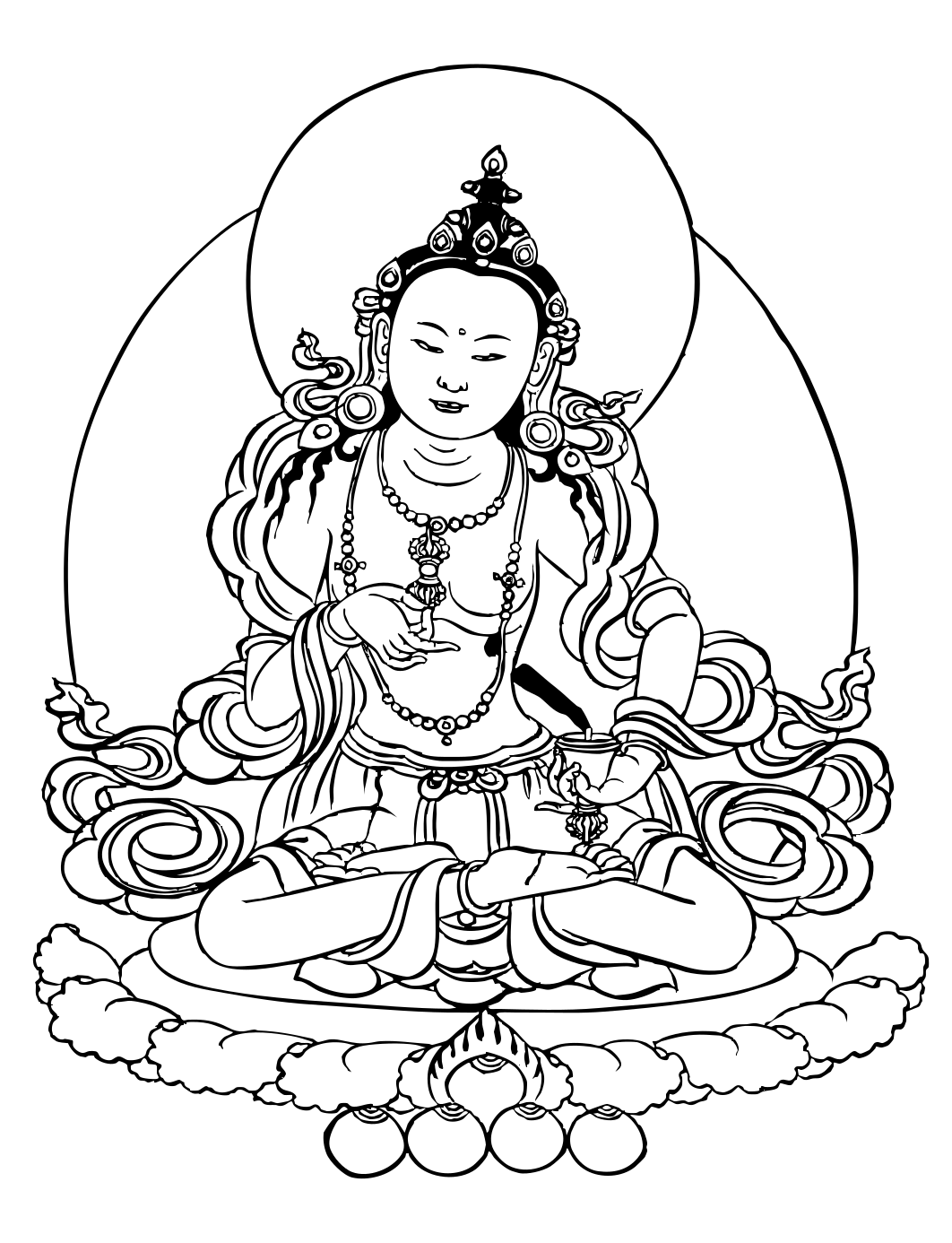
General Sūtra Section
The Jewel Cloud
Toh 231
Imprint
Summary
Acknowledgements
Introduction
The Translation
Colophon
Notes
Glossary
Bibliography
Abbreviations
n.

Notes

n.1

For details and other examples, see Pagel 2007, pp. 156–57.

i.1
n.2

This attribution is tentative. Regarding Taishō 659, Jonathan Silk (2010, p. 900) writes, “translated by *Maṇḍalasena (Mantuoluoxian 曼陀羅仙) and *Saṅghabhara (? Sengjiapoluo 僧伽婆羅).”

i.1
n.3

Butön, F.124a (for English translations, see Obermiller 1999, p. 185, and Stein and Zangpo, p. 279); Zhonnu Pal, F.20b (for English, see Roerich, p. 39); De’u José, p. 117. See also Sakya Pandita Translation Group 2011.

i.2
n.4

For example, the dba’ bzhed; see Wangdu and Diemberger, p. 27. See also the “Treasury of Lives” entry on Tönmi Sambhoṭa.

i.2
n.5

Few details of the history of the early Tibetan kings can be materially verified, and even the earliest traditional accounts were written several centuries later. However, as Cristina Scherrer-Schaub notes (2002, pp. 298–9), “[The Ratnamegha and Laṅkāvatāra sutras’] presence is attested during the ᴠɪɪ th and ᴠɪɪɪ th century in China and as far as Turfan, Khotan and North West India; the idea they might have been translated into Tibetan at an early date should not be hastily rejected.”

i.2
n.6

Chönyi Tsultrim was the translator of ten or so important sūtras including the Aṣṭa­sāhasrikā­prajñā­pāramitā (Toh 12), the Samādhi­rāja (Toh 127), the Vimala­kīrti­nirdeśa (Toh 176) and the Saṃvṛti­paramārtha­satya­nirdeśa (Toh 179); Rinchen Tso is credited as having translated, apart from The Jewel Cloud, only one other sūtra, the Sarva­dharma­pravṛtti­nirdeśa (Toh 180).

i.3
n.7

In this context, referring almost certainly to the great eighth–ninth century Tibetan translator (lo chen) Vairotsana. There is another, later Vairocanarakṣita, a twelfth century Indian scholar and yogi who spent his later years in Tibet, introducing there and translating mainly tantric and Mahāmudrā texts. He was not a contemporary of Chönyi Tsultrim and as an Indian would not have been referred to as zhu chen lo tsa ba.

i.3
n.8

Scherrer-Schaub 2002, pp. 302–3, 317.

i.3
n.9

On the influence of The Jewel Cloud in the compilation of the Mahāvyutpatti, see Pagel 2007. See also Scherrer-Schaub 2002, especially pp. 302–4. The Mahāvyutpatti is included in the Tibetan Tengyur (Toh 4346).

i.4
n.10

In the notes to the translation, we have marked these occurrences as they appear.

i.4
n.11

Along with its specific mention of the translation and revision of The Jewel Cloud, the introduction to the Drajor Bampo Nyipa also mentions the Laṅkāvātarasūtra. The Drajor Bampo Nyipa is included in the Tibetan Tengyur (Toh 4347).

i.5
n.12

The dating of the Drajor Bampo Nyipa is complex. Its final form corresponds to what is known as the third imperial decree, or “authoritative decision” (bkas bcad), of 814, but there was at least one earlier promulgation, and probably two, the second most likely between 783 and 795, and the first dating back as far as the middle of the eighth century or possibly even earlier. See Scherrer-Schaub 2002, pp. 292–3, 302–3, 327.

i.5
n.13

The section on the element wind starts at 1.225 and its sixth topic at 1.231, continuing with many further lists right down to where the seventh topic starts at 1.275.

i.8
n.14

See Stages of Meditation II, F.47a and F.49b, and Stages of Meditation III, F.53a.

i.11
n.15

The Great Treatise on the Stages of the Path, F.306b, F.355b–356a, and F.503b–504a (English translation in Tsong-kha-pa 2004, pp. 17, 89–90, and 347). In the course of this treatise Tsongkhapa cites or refers to The Jewel Cloud seven times.

i.11
n.16

Kongtrul, F.5.a–5.b.

i.12
n.17

For example, this passage is cited in the opening section of Dakpo Tashi Namgyal’s (Tib. dwags po bkra shis rnam rgyal, 1399–1458) renowned treatise, Mahāmudrā: The Moonlight (p. 8). The same treatise also cites (p. 26) The Jewel Cloud’s definition of śamatha and vipaśyanā mentioned above.

i.13
n.18

Perhaps future research may be able to determine whether (and if so, to what extent) the editors of D favored the Thempangma line for their edition of this text. Note, however, that D differs from S in the opening line and the colophon, where a reading common to the Tshalpa group is adopted.

i.14
n.19

IOL Tib J 161–4, 233, and Pelliot tibétain 77 (see bibliography).

i.14
n.20

C, K, S and Y additionally have: dang ’phags pa nyan thos dang / rang sangs rgyas/ (“…noble hearers, and solitary buddhas!”). H and N have another instance of thams cad before the first dang. Other witnesses, including the Dunhuang manuscript IOL Tib J 161, agree with D.

1.1
n.21

Translated based on S: yang dag pa’i shes pas. D: bka’ yang dag pas.

1.2
n.22

With the exception of a few very minor variations (including only one member slightly out of sequence), this whole section (starting with “brought the defilements to exhaustion”) reflects the terms and sequence at the beginning of the Mahāvyutpatti section, “terminology for the qualities of hearers” (nyan thos kyi yon tan gyi ming la), entries 1075–95.

1.2
n.23

With the exception of a few very minor variations (including only one member slightly out of sequence), this whole section (starting with “obstructed by only a single birth”) precisely reflects the terms and sequence at the beginning of the Mahāvyutpatti section, “terminology expressing the qualities of bodhisattvas that appears in the sūtras” (mdo sde las ’byung ba’i byang chub sems dpa’i yon tan thog thog smos pa’i ming la), entries 806–29.

1.3
n.24

The following list of bodhisattva names was likely the source for many of the entries 654–92 in the Mahāvyutpatti as the names appear there in almost identical order and with only a few exceptions to their presentation in this sūtra. We have therefore given priority to the Tibetan spellings and Sanskrit equivalents as listed in the Mahāvyutpatti and noted any differences relevant to this sūtra in the notes.

1.4
n.25

Translated based on S: rin po che tog. D: rin po che’i dpal.

1.4
n.26

Translated based on S: lag na rin po che. D: phyag na rdo rje rin po che.

1.4
n.27

Translated based on D: rnam par grol ba’i zla ba. S: rnam par grol ba’i snying po. Note that here D follows the entry in Mahāvyutpatti no. 674.

1.4
n.28

Translated based on S: spyan ras gzigs dbang phyug. D: spyan ras gzigs dbang po. Here S reflects Mahāvyutpatti no. 645.

1.4
n.29

Translated based on Mahāvyutpatti no. 686: zab mo’i dbyangs kyi nga ro sgrogs pa. D: sgra dbyangs brjod pa zab mo sgrog. S: sgra dbyangs brjod pa zab mo sgra sgrog.

1.4
n.30

S has the revised terminology reflected in Mahāvyutpatti no. 3080: ’thab bral. D: gnod bral.

1.5
n.31

S has the revised terminology reflected in Mahāvyutpatti no. 3138: rab ’thab bral. D: shin tu gnod bral.

1.5
n.32

S has the revised terminology reflected in Mahāvyutpatti no. 3137: yongs su dga’ ldan. D: kun tu dga’ ldan.

1.5
n.33

According to D and the other Kangyurs recorded in the Comparative Edition: dbang byed. S has the less common: gzhan ’phrul dbang byed.

1.5
n.34

S has the revised terminology reflected in Mahāvyutpatti no. 6242: shin rta’i ’phang lo tsam. D: shin rta’i ’khor lo tsam.

1.6
n.35

This verse is extant in Sanskrit in the form of a citation in Candrakīrti's Prasannapadā (dbu ma rtsa ba’i ’grel pa tshig gsal ba, Toh 3860): ādiśāntā hy anutpannāḥ prakṛtyaiva ca nirvṛtāḥ | dharmās te vivṛtā nātha dharmacakrapravartane ||. See the edition in de La Vallée Poussin 1913, p. 225.9-10. We thank Prof. Anne MacDonald for alerting us to the existence of this Sanskrit verse.

1.47
n.36

The last three categories indicate that certain members of the saṅgha focused on mastering a particular section (piṭaka) among the three sections of the Dharma (sūtra, vinaya, abhidharma). However, there is no passage corresponding to the third of these in the Buddha’s answers.

1.61
n.37

This sentence seems to reflect the following citation from the sūtra presented in the Śikṣasamuccaya: tena ca dānena nonnato bhavati. Mahoney’s edition of the Sanskrit text of Śāntideva’s Śikṣasamuccaya (see bibliography) is the source of all the citations from the sūtra subsequently presented in notes.

1.65
n.38

This famous statement is quoted in the Śikṣāsamuccaya: dānaṃ hi bodhisatvasya bodhir.

1.67
n.39

Translated based on S: skyang nul. C, J, and N: brkyang nul. D: skyong nul.

1.72
n.40

The passage from the beginning of this paragraph to here is cited nearly verbatim in the Śikṣāsamuccaya: kathaṃ ca kulaputra bodhisatvā bodhisatvaśikṣā saṃvara saṃvṛtā bhavanti | iha bodhisatvaḥ evaṃ vicārayati | na prātimokṣasaṃvaramātrakeṇa mayā śakyam anuttarāṃ samyaksaṃbodhim abhisaṃboddhuṃ | kiṃ tarhi yāni imāni tathāgatena teṣu teṣu sūtrānteṣu bodhisatvasamudācārā | bodhisatvaśikṣāpadāni prajñaptāni teṣu teṣu mayā śikṣitavyam ||.

1.77
n.41

The passage from “What, then, are the genuine bodhisattva practices” to here reflects with some minor variation a corresponding citation from the sūtra in the Śikṣāsamuccaya: yenā­samuccaḥ satvānāṃ tad yatnena vivarjayed iti || yath­samuccaḥ satvānāṃ tad yatnena vivarjayeḥ | yāvad iha bodhisatvo nāsthāne viharati nākāle | nākāla­bhāṇī bhavati nākālajño bhavati nādeśajño bhavati | yato nidānam asyāntike satvā aprasādaṃ prative­dayeyuḥ | sa sarva­satvānurak­ṣayā | ātmanaś ca bodhi­saṃbhāra­paripūraṇārthaṃ saṃpanneryāpatho bhavati mṛdubhāṇī mandabhāṇī | asaṃ­sarga­bahulaḥ | pravivekā­bhimukhaḥ | supra­sannamukha||.

1.77
n.42

This paragraph from “They apply the remedy for desire” was rendered in consultation with a corresponding citation from the sūtra in the Śikṣāsamuccaya: sa rāsa­muccayathe sṣaṃ bhajate | rāgot­patti­pratyayāṃś ca varjayati | katamaś ca sa rāgasya pratipakṣaḥ | katame ca te rāgotpattipratyayāḥ | aśubhābhāva­nārāgasya pratipakṣaḥ | janapada­kalyāṇīrāgot­patti­pratyayaḥ | katamā ca sāśu­bhābhāvanā | yad uta santy asmin kāye keśā romāṇi nakhā dantā rajo malaṃ tvak māṃsāsthi snāyuḥ śirā vṛkkā hṛdayaṃ plīhakaḥ klomakaḥ | antrāṇy antraguṇa āmāśayaḥ pakvāśayaḥ | audaryakaṃ yakṛt purīṣam aśru svedaḥ kheṭaḥ siṅghāṇakaṃ vasā lasikā majjā medaḥ pittaṃ śleśmā pūyaṃ śoṇitaṃ mastakaṃ masta­kaluṅgaṃ prasrāvaḥ | eṣu ca vastuṣu bodhisatva upaparīkṣaṇajātīyo bhavati | tasyaivam upaparīk­ṣamāṇas­yaivaṃ bhavati  | yo ’pi tāvat syād bālo mūḍhaḥ abhavyo ’kuśalaḥ so ’pi tāvad etāni vastūni jñātvā rāga­cittaṃ notpādayet | prāg eva sa­prajña­jātīyaḥ | evaṃ hi bodhisatvo ’śubhā­bhāvanā­bahulo bhavati ||.

1.79
n.43

This paragraph closely corresponds to the citation from the sūtra in the Śikṣāsamuccaya: kathaṃ ca kulaputra bodhisatvo ’yoniśomanaḥkārāpagato bhavati | iha bodhisatva ekākī rahogataḥ pravivekasthito naivaṃ cittam utpādayati | ahaṃ asaṃkīrṇavihārī | ahaṃ pravivekasthitaḥ | ahaṃ pratipannas tāthāgate dharmavinaye | ye tv anye śramaṇā vā brāhmaṇā vā sarve te saṃkīrṇavihāriṇaḥ | saṃsargabahulā uddhurās tāthāgatād dharmavinayāt || evaṃ hi bodhisatvo ’yoniśomanaḥkārāpagato bhavati ||.

1.83
n.44

This passage corresponds closely to the citation from the sūtra in the Śikṣāsamuccaya: yae ime uccayacorrḥ śokaparidevaduṣkhadaurmanasyopāyāsās tān kṣamate ’dhivāsayat.

1.91
n.45

Translation based on S, K, and C: rgyun chad pa. D: rgyud chad pa.

1.93
n.46

The passage from “Bodhisattvas are diligent” to the end of the paragraph reflects the corresponding citation of the sūtra in the Śikṣāsamuccaya: iha bodhisatvaḥ sarveryāpatheṣu vīryam ārabhate | tathā ca ārabhate yathā na kāyakhedaṃ saṃjanayati | na cittakhedam | idam ucyate bodhisatvasya sāṃtatyavīryam iti |.

1.111
n.47

This paragraph from “In this regard, a bodhisattva will never think” to here closely corresponds to a citation from the sūtra in the Śikṣāsamuccaya: iha bodhisatvo naivaṃ cittam utpādayati | duṣprāpā bodhir manuṣyabhūtena satā | idaṃ ca me vīryaṃ parīttaṃ ca kusīdo ’haṃ bodhiś cādīptaśiraścailopamena bahūn kalpān  | bahūni kalpaśatāni bahūni kalpa­sahasrāṇi samudānetavyā | tan nāham utsahae īdṛśaṃ bhāram udvoḍhuṃ || kiṃ tarhi bodhisatvenaivaṃ cittam utpādayitavyaṃ | ye ’pi te ’bhisaṃ­buddhās tathāgatā arhantaḥ samyak­saṃbuddhā ye cābhisaṃ­buddhyante ye vābhisaṃ­bhotsyante ’pīdṛśenaiva nayena īdṛśyā pratipadā | īdṛśenaiva vīryeṇābhisaṃuddhā abhisaṃ­budhyante ’bhisaṃ­bhotsyante ca | yāvan na te tathāgata­bhūtā evābhisaṃbuddhāḥ | aham api tathā tathā ghaṭiṣye tathā tathā vyāyaṃsye sarva­satva­sādhāraṇena vīryeṇa sarva­satvā­rambaṇena vīryeṇa yathāham annuttarāṃ samyak­saṃbodhim abhisaṃ­bhotsyae iti ||.

1.114
n.48

This paragraph from “When bodhisattvas practice diligence” to here reflects the source phrase from the sūtra cited as follows in the Śiḳsāsamuccaya: iha bodhisatvo vs practice dilṇo na tan mahad vīryam āsvādayati | na ca tena vīryeṇātmānam utkarṣayati | na parān paṃsayati | tasyaivaṃ bhavati | ko hi nāma saprajña­jātīyaḥ svakarmā­bhiyuktaḥ parāṃś codayet || evaṃ hi bodhisatvo ’nnunnatavīryo bhavati ||.

1.115
n.49

The passage from the beginning of this paragraph to here is cited nearly verbatim from the sūtra in the Śikṣāsamuccaya: kathaṃ ca kulaputrātra bodhisatvo mārakarmaparihāropāyakuśalo bhavati | iha bodhisatvo ’kalyāṇamitraṃ sarveṇa sarvaṃ parivarjayati  | apratirūpadeśavāsaṃ lokāyata­mantra­sevanabhāva­nāṃ lābhasatkārapūjo­pasthānabahumānaṃ sarveṇa sarvaṃ parivarjayati | ye cānye upakleśā bodhi­pakṣyamārgānta­rāyikās tān sarveṇa sarvaṃ parivarjayati |.

1.143
n.50

This section, from “without any sense of personal ownership” to here partially reflects a corresponding citation from the sūtra in the Śikṣāsamuccaya; the Sanskrit citation is missing only the two instances of, “all the roots of virtue they dedicate toward the attainment of unexcelled and complete awakening.” The Sanskrit citation is as follows: iha bodhisatvo yāni imāni bhavanti puṣpajātāni vā phalajātāni vā amamāny aparigrahāṇi | tāni triṣkṛtvā rātrau triṣkṛtvā divase buddha­bodhi­satvebhyo niryātayati || pe || sayathīme [doubtful] dhūpavṛkṣā vā gandhavṛkṣā vā ratnavṛkṣā vā kalpavṛkṣā vā amamā aparigrahās tān api triṣkṛtvā rātrau triṣkṛtvā divase buddha­bodhi­satvebhyo niryātayati ||.

1.147
n.51

This sentence reflects, with some variation, the following citation of the sūtra in the Śikṣāsamuccaya: sa yāni imāni sūtrānte­ṣūdārodārāṇi tathāgata­pūjopasthānāni śṛṇoti | tāny āśayatas tīvreṇādhyāśayena buddha­bodhi­satvebhyaḥ pariṇāmayati.

1.147
n.52

Here and throughout the translation, the Tibetan mchod rten has been rendered “shrine,” since the Sanskrit found in the Śikṣāsamuccaya (see the following note) makes it clear that the Sanskrit term was caitya, rather than stūpa.

1.147
n.53

This passage, from “Shrines devoted to the thus-gone ones and statues of the thus-gone ones they worship” to here, was rendered in consultation with the corresponding citation from the sūtra presented in the Śikṣāsamuccaya: sa tathāgatacaitye vā tathāgata­vigrahe vā puṣpaṃ vā dhūpaṃ vā gandhaṃ vā dadat sarvasatvānāṃ dauḥśīlya­daurgandhya­malāpanayanāya tathāgata­śīlapratilambhāya ca pariṇāmayati | sa sanmārjanopalepanaṃ kurvan sarvasatvānām aprāsādikeryāpatha­vigamāya | prāsādikeryā­pathasaṃpade ca pariṇā­mayati | sa puṣpa­cchatram āropayan sarva­satvānāṃ sarva­kleśa­paridāhavigamāya pariṇā­mayati | sa vihāraṃ praviśann evaṃ cittam utpādayati | sarva­satvān nirvāṇapuraṃ praveśayeyaṃ | sa niṣkramann evaṃ cittam utpādayati | sarvasatvān saṃsāracārakān niṣkrāmayeyaṃ | sa labhanadvāram udghāṭayann evaṃ cittam utpādayati | sarva­satvānāṃ lokottareṇa jñānena nirvāṇa­sugatidvāram udghāṭayeyaṃ | sa pithad evaṃ cittam utpādayati  | sarva­satvānāṃ sarvā­pāyadvārāṇi pidadhyāṃ | sa niṣīdann evaṃ cittam utpādayati | sarva­satvān bodhi­maṇḍe niṣādayeyaṃ | sa dakṣiṇena pārśvena śayyāṃ kalpayann evaṃ cittam utpādayati | sarvasatvān eva pari­nirvāpayeyaṃ | sa tato vyuttiṣṭhann evaṃ cittam utpādayati | sarva­satvān vyutthāpayeyaṃ sarva­kleśa­paryutthānebhyaḥ | sa śarīragatyā gacchann evaṃ cittam utpādayati | sarvasatvā mahā­puruṣagatyā gacchantu | sa tatropaviṣṭae evaṃ cittam utpādayati  | sarvasatvā niḥśalyakriyā yad uta rāgadveṣamohebhyaḥ | sa śaucaṃ kurvann evaṃ cittam utpādayati | sarva­satvānāṃ kleśa­malāt prakṣālayeyaṃ |sa hastau prakṣālayann evaṃ cittam utpādayati | sarva­satvā­nāṃ sarva­kleśa­vāsanām apanayeyaṃ |sa pādau prakṣālayann evaṃ cittam utpādayati sarva­satvā­nām annekaprakārāṇi kleśa­rajāṃsy apanayeyaṃ | mukhaṃ prakṣālayann evaṃ cittam utpādayati | sarva­satvānāṃ sarva­dharma­mukhāni pariśodhayeyaṃ | sa dantakāṣṭhaṃ bhakṣayann evaṃ cittam utpādayati | sarva­satvānāṃ nānāvidhān kleśa­malān apanayeyaṃ | sarvāṃ kāyāvasthāṃ sarva­satvahitasukhāya pariṇāmayati | tathāgata­caityaṃ vandamāna evaṃ cittam utpādayati | sarva­satvā vandanīyā bhavantu sadevakasya lokasya ||.

1.147
n.54

Translated based on C, J, K, N, and Y: byang chub sems dpa’ dag la rgyal bar ’dod pa. D and S: byang chub sems dpa’ dag la brgyad par ’dod pa (“intent on criticizing bodhisattvas”).

1.152
n.55

This paragraph from “If bodhisattvas obtain a heap of jewels” to here corresponds to a citation from the sūtra in the Śikṣasamuccaya: iha kulaputra bodhi­satvaḥ sumeru­mātram api ratnarāśiṃ labhamānaḥ pratigṛhṇāti | pratyavaram api vastu pratilabhamānaḥ | tat kasya hetoḥ | tasyaivaṃ bhavati | ete satvā matsariṇo lubdhā lobhābhibhūtāḥ | taddhetoḥ tatpratyayaṃ tannidānaṃ mahā­vāri­skandhā­vaṣṭabdā iva saṃsārasāgare unmajjanimajjanaṃ kurvanti | tad eṣāṃ bhaviṣyati dīrgharātram arthāya hitāya sukhāya | sarvaṃ pratigṛhya na svīkaroti | na lobhacittam utpādayati | anyatra sarva­satva­sādhāraṇāṃ buddha­dharma­saṃgheṣu kārāṃ karoti | yathā duṣkhitānāṃ ca sarva­satvānām upajīvyaṃ karoti |taṃ ca dānapatiṃ samuttejayati saṃpraharṣayati ||.

1.155
n.56

The passage from “Bodhisattvas aware of beings…” until here closely reflects the corresponding passage from the sūtra cited in the Śikṣāsamuccaya as follows: na bodhisatvaḥ satva­khaṭuṅkatāṃ satva­durdāntatāṃ jñātvā | alam ebhiḥ satvair evaṃ khaṭuṅkair evaṃ durdāntair iti | tato nidānaṃ parikhinnaḥ parāpṛṣṭhībhūtaḥ | pari­śuddhāyāṃ loka­dhātau praṇidhānaṃ karoti | yatra īdṛśānāṃ satvānāṃ nāma api na śṛṇuyāt | na ca satvārthavaimukhyasya bodhi­satvapariśuddhāyāṃ lokadhātāv upapattir bhavati | tatra prājño bodhisatva evaṃ cittam utpādayati | tasmāt satvadhātor ye satvāḥ syuḥ pratyavarā dhajaḍaiḍamūkajātīyāḥ | aparinirvāṇa­dharmakāḥ kṛtsnā satva­dhātau na cikitsitāḥ sarvabuddhaiḥ sarva­bodhisatvaiś ca pratyākhyātāḥ | teṣāṃ madīye buddhakṣetre saṃnipātaḥ syāt | tān ahaṃ sarvān bodhimaṇḍe niṣīdya anuttarāṃ samyak­saṃbodhim abhisaṃ­bodhayeyaṃ || evaṃ hi bodhi­satvasya cintayataś cittotpāde cittotpāde sarva­mārabhavanāni prakampante | sarva­buddhāś ca asya varṇavādino bhavanti ||.

1.168
n.57

This sentence corresponds to a citation from the sūtra in the Śikṣāsamuccaya: na sa satvaḥ satva­nikāye saṃvidyate yo bodhisatvasya balena balaṃ mardayed.

1.172
n.58

“Dharma form” here translates the Tibetan chos kyi lus. This expression appears related to the more common term “Dharma body” (chos kyi sku, dharmakāya) that elsewhere in this translation in used to describe the body of the buddhas.

1.226
n.59

Translated based on S, N, K, Y, and H: mi snang. D: mi sngar. J and C: ma snang.

1.228
n.60

Translated based on N and H: glu rol. D and S: klung ro.

1.229
n.61

A similar statement of the enormous merit (and presumably importance) underlying the Buddha’s voice, presented in terms of a similar exponential comparison with the merit of different categories of powerful beings and then of the other marks of a tathāgata, is the main theme of the sūtra Manjuśrī­paripṛcchā, Toh 172. See Kīrtimukha Translation Group, The Question of Mañjuśrī (84000: Translating the Words of the Buddha, 2021).

1.234
n.62

Here and immediately below, the translation is based on S: bskyed pa. D: ma bskyed pa.

1.236
n.63

The last eleven entries in this list of bodhisattva grounds correspond to entries no. 886–96 in the Mahāvyutpatti.

1.236
n.64

Much of this paragraph, with pronounced variations, corresponds to a passage cited from the sūtra in the Śikṣāsamuccaya. The Sanskrit passage is as follows: sarva­bāla­caritavipattisamatikrāntaḥ paṭhyate asaṃkhyeya­samādhi­dhāraṇī­vimokṣā­bhijñā­vidyā­vikrīdito | A­nantadharmā­rāmaratinirā­miṣāparānta­kalpakoṭy anābhoga nirvikalpaprītivegāloka­pratilabdhaś ca aprameya­kalpa koṭīniyutaśata­sahasraparama­mahā­yāna­prasthānavicitrabhāvanā­saṃpūrṇa parārthaprati­pattiniryāṇa puṇya­jñāna­saṃbhārā­bhinihārābhinirvṛttiḥ pūrvayogaśata­sahas­rasamṛddhaś ca paṭhyate||.

1.238
n.65

The first nine entries in the following list of the bodhisattva’s absorptions were most likely the source for the entries 739–47 in the Mahāvyutpatti. See Pagel 2007, p. 158.

1.240
n.66

The following list of the bodhisattva’s twelve retentions was most likely the source for the entries 749–60 in the Mahāvyutpatti. See Pagel 2007, p. 159.

1.241
n.67

The following list of the bodhisattva’s ten masteries was most likely the source for the entries 773–82 in the Mahāvyutpatti. See Pagel 2007, p. 159.

1.243
n.68

This and the two subsequent lists of qualities of bodhisattvas are not to be confused with the similarly named lists of qualities of tathāgatas taught in the next passage. This list of the bodhisattva’s ten powers was most likely the source for the entries 762–71 in the Mahāvyutpatti. See Pagel 2007, p. 160.

1.244
n.69

The following list of the bodhisattva’s four fearlessnesses was most likely the source for the entries 784–87 in the Mahāvyutpatti. See Pagel 2007, p. 160.

1.245
n.70

The following list of the bodhisattva’s eighteen unique qualities was most likely the source for the entries 789–806 in the Mahāvyutpatti. See Pagel 2007, p. 161.

1.246
n.71

This set of twelve categories, or more literally, “limbs” (Skt. aṅga, Tib. yan lag) of the scriptural teachings subsume all the “Words of the Buddha” (Skt. buddhavacana). They are applied primarily in the Sanskrit literature, whereas a set of nine categories is typical in the Pāli tradition. For a discussion of the twelve categories, see Lamotte 1988, pp. 145–47.

1.279
n.72

The passage from “acting like an outcast” to here reflects a corresponding citation from the sūtra in the Śikṣāsamuccaya: caṇḍāla­kumāropamāś ca loke viharanti nīcanīcena manasā | mānamadadarpādhigatāś ca bhavanti paiśunyasaṃjñāyāḥ satatasamitaṃ pratyupasthitatvād||.

1.321
n.73

This paragraph from “They understand” was rendered in consultation with the corresponding citation from this sūtra in the Śikṣāsamuccaya: atraiva cccaya ṇa­mitra­lakṣaṇam uktaṃ  | śīlavipanna­pudgala­vivarjanatayā pāpamitra­parivarjanā veditavyā | evaṃ dṛṣṭivipannācāra­vipannājīvavipanna­pudgalavivarjanatayā | saṅgaṇikārāma­pudgala­vivarjanatayā | kuśīdapudgalavivarjanatayā | saṃ­sārābhirata­pudgala­vivarjanatayā | bodhi­parāṅmukha­pudgala­parivarjanatayā | gṛhisaṃ­sarga­vivarjanatayā pāpa­mitra­parivarjanā veditavyā | tena ca kula­putraitāni sthānāni parivarjayatā na teṣāṃ pudgalā­nām antike duṣṭacittam utpādayitavyaṃ na pratigha­cittaṃ nāvamanyanā­cittam utpādayitavyam | evaṃ ca anena cittam upasthā­payitavyam | uktaṃ hi bhagavatā dhātuśaḥ satvāḥ kāmādi­dhātuṃ āsravanti jāyante saṃ­syandante saṃsargāc ca vinaśyanti  | tasmād ahaṃ saṃsargaṃ varjayiṣyāmīti ||.

1.450
n.74

Translated based on S: ’phyan pas gtses pa. D: ’chan pas gtses pa; C: ’chom pos gtses pa.

1.463
n.75

The pithy statement from “The mind precedes all phenomena” to “With control of their own minds they gain control of all phenomena” corresponds to the following passage from the sūtra cited in the Śikṣāsamuccaya: cittapūrvaṅgamāś ca sarva­dharmāḥ | citte parijñāte sarva­dharmāḥ parijñātā bhavanti | api tu cittena nīyate lokaḥ cittaṃ cittaṃ na paśyati | cittena cīyate karma śubhaṃ vā yadi vā aśubham || cittaṃ bhramate alātavat | cittaṃ bhramate turaṅgavat | cittaṃ dahate devāgnivat | cittaṃ harate mahāmbuvat || sa evaṃ vyupaparīkṣamāṇaś citte sūpasthitasmṛtir viharati na cittasya vaśaṃ gacchati | ap tu cittam eva asya vaśaṃ gacchati | cittena asya vaśībhūtena sarva­dharmā vaśībhavanti||.

1.476
n.76

This passage from “If they become famous” reflects a corresponding citation from the sūtra in the Śikṣāsamuccaya: yadi punar asya taddhetos tatpratyayaṃ tannidānaṃ kīrtiśabda­śloko bhavati tatra nonnāmajāto bhavati na mānajāto na madajātaḥ | evaṃ cāsya bhavati | na cireṇa kālena yasya cāyaṃ kīrtiśloka­śabdaḥ samutthito yaiś ca samutthāpito yaś ca kīrtiśabda­ślokas trayam apy etat sarveṇa sarvaṃ na bhaviṣyati  | tatra kaḥ paṇḍitajātīyo ’nityeṣu na ca sthiteṣu dharmeṣv adhruveṣv annāśvāsikeṣv anunayacittam utpādayed unnato bhaven mānadarpito vā | evaṃ hi bodhisatvo lābhasatkāra­kīrtiśabda­ślokeṣu sūpasthitasmṛtir viharati ||.

1.481
n.77

The passage from “Rather, they begin” until here was rendered with reference to a corresponding passage from the sūtra cited in the Śikṣāsamuccaya: tāvat piṇḍāya carati yāvad asya kāryasya prāptir bhavati | anyatra yeṣu sthāneṣu caṇḍā vā kukkurās taruṇavatsā vā gāvaḥ prakṛtiduḥśīlā vā tiryagyonigatā | viheṭhanābhiprāyā vā strīpuruṣa­dārakadārikā jugupsitāni vā sthānāni  | tāni sarveṇa sarvaṃ varjayati iti ||.

1.498
n.78

The passage from “divide the alms” to here is cited from the sūtra, with some variation, in the Śikṣāsamuccaya: tasmāsa­muṇḍapātrād ekaṃ pratyaṃśaṃ sabrahma­cāriṇāṃ sthāpayati | dvitīyaṃ duṣkhitānāṃ tṛtīyaṃ vinipatitānāṃ caturtham ātmanā paribhuṅkte | paribhuñjāno na raktaḥ paribhuṅkte asakto ’gṛddho ’nnadhyavasitaḥ | anyatra yāvad eva kāyasya sthitaye | yāpanāyai | tathā paribhuṅkte yathā nātisaṃlikhito bhavati | nātigurukāyaḥ | tat kasya hetoḥ | atisaṃlikhito hi kuśala­pakṣaparāṅmukho bhavati | atigurukāyo middhāvaṣṭabdho bhavati | tena taṃ piṇḍapātaṃ paribhujya kuśala­pakṣābhimukhena bhavitavyam ||.

1.499
n.79

The section from “They stay in places that are neither too far nor too close,” four paragraphs above, to here, corresponds to the following citation from the sūtra presented in the Śikṣāsamuccaya. The Sanskrit does mention the Ratnamegha as the course of this citation, but the Tibetan edition of this śāstra does. It is as follows: tadṛśāni ca sthānāni āśrayet | yeṣu ca sthāneṣu nātidūre piṇḍapātagocaro bhavati nātisaṃnikṛṣṭe | yeṣu pānīyāni bhavanty acchāni śucīni nirmalāny alpāyāsāni mukhaparibhogāni yāni ca sthānāni vṛkṣa­saṃpannāni bhavanti puṣpa­saṃpannāni phala­saṃpannāni pattra­saṃpannāny apagataduṣṭaśvāpadāni guhā­saṃpannāni prāgbhāra­saṃpannāni sukha­parisarpyakāṇi śāntāny advitīyāni tādṛśāni sthānāny āśrayet | sa teṣu sthāneṣv āśrito yad anena pūrva­paṭhitaṃ bhavati tat tribhī rātrais trirdivasasya svādhyāyati nātyuccena svareṇa nātinīcena noddhatair indriyair na bahirgatena cittena prasādam upajīvan grantham upadhārayan nimittāny udgṛhṇan middham apakrāman | saced āraṇyakasya bhikṣo rājā vopa­saṃ­krāmati rājamātro vānye vā brāhmaṇa­kṣatriya­naigamajānapadāḥ | tena teṣām ādareṇa svāgatakriyā kartavyā | evaṃ cānena vaktavyaṃ | niṣīda mahārāja yathā prajñaptae āsane | saced upaviśati dvābhyām apy upaveṣṭavyaṃ | sacen nopaviśati ubhābhyām api nopaveṣṭavyaṃ | sacec cañcalendriyo bhavati utkarṣayitavyaṃ | tasya te mahārāja lābhāḥ sulabdhā yasya te bhūpradeśe śīlavanto guṇavanto bahuśrutāḥ śramaṇa­brāhmaṇāḥ prativasanti | annupadrutāś caurabhaṭādibhiḥ || sacet sthiro bhavati vinayeḥ praśāntendriyaḥ bhavyaś ca bhavati dharma­deśanāyāḥ tato ’sya vicitrā dharma­deśanā upasaṃhartavyā | saced vicitrāṃ na priyāyate | saṃvegānukūlā dharma­deśanā upasaṃhartavyā | sacet saṃvegānukūlāṃ na priyāyate udārodārāṇi tathāgata­māhātmyāni upadeṣṭavyāni | brāhmaṇa­kṣatriya­naigamajāna­padānām apy upasaṃ­krāmatāṃ yathānurūpāḥ kriyā upasaṃhartavyā | sa evaṃ bahuśrutaḥ san pratibalo bhavati dhārma­śravaṇikānāṃ cittam ārādhayituṃ | te ca satvās tasyāntike prītiṃ ca prasādaṃ ca prāmodyaṃ ca pratilabhantae iti ||.

1.509
n.80

The passage from “However, if shelterless bodhisattvas are physically unable to endure that” to here reflects a corresponding citation from the sūtra that appears in the Śikṣāsamuccaya: yadi bhaved abhyavakāśiko bodhisatvo glānakāyo apratibalakāyas tena vihārakṣitena evaṃ cittam utpādayitavyaṃ | kleśa­pratipakṣārthaṃ tathāgatena dhutaguṇāḥ prajñaptāḥ | tathāhaṃ kariṣyāmi yathā vihārasya eva kleśānāṃ prahāṇāya ghaṭiṣyāmi | tatra ca vihāre na gṛddhim utpādayāmi nādhyavasānaṃ | evaṃ cāsya bhavati | kartavyo dānapatīnām anugraho nāsmābhir ātmambharibhir bhavitavyam iti ||.

1.513
n.81

The Tibetan Degé has sha dang ’bags pa med par bya as a rendering for nirāmiṣeṇa bhavitavyam. The Śikṣāsamuccaya reflects this in its citation of the sūtra: śmāśānikena nirāmiṣeṇa bhavitavyam.

1.515
n.82

The passage from “When sleeping” to here corresponds closely to a citation from the sūtra in the Śikṣasamuccaya: te ṣasamṃ kalpayanto dakṣiṇena pārśvena śayyāṃ kalpayanti | pādasyopari pādam ādhāya cīvaraiḥ asaṃ­vṛtakāyāḥ smṛtāḥ | saṃprajānānā utthāna­saṃjñina āloka­saṃjñinaḥ śayyāṃ kalpayanti | na ca nidrāsukham āsvādayanti | na pārśvasukham anytra yāvad evaiṣāṃ mahā­bhūtānāṃ sthitaye jāpanāyai | ity anayā diśā sarva­paribhogāḥ satvārtham adhiṣṭhātavyāḥ | ātmatṛṣṇopabhogāt tu kliṣṭāpattiḥ prajāyate  ||.

1.518
n.83

This is the passage on tranquility and special insight that has often been cited in commentarial literature dealing with this subject (see introduction i.11).

1.526
n.84

Following Sarva­nīvaraṇa­viṣkam­bhin’s questions, the next item should be on “lists,” i.e. the abhidharma (see 1.61 and n.36), but that topic is missing from the answers here.

1.528
n.85

Translated based on S, K, and Y: nyid. D: snyed.

1.529
n.86

This passage, from “Bodhisattvas depart from their households” to here, was rendered in consultion with the following citation from the sūtra in the Śikṣāsamuccaya: iha kulaputryaconsṣkrāntagṛha­vāsaḥ pravrajito bodhisatvo mṛtakasadṛśo ’haṃ mitrā­mātyajñātisālohitānām iti nihatamāno bhavati | vaironsṣṃ me ’bhyudgataṃ vivarṇāni ca me vāsāṃsi prāvṛtāny anyaś ca me ākalpaḥ saṃvṛtta iti nihatamāno bhavati | muṇḍaḥ pātrapāṇiḥ kulāt kulam upasaṃ­kramāmi bhikṣāhetor bhikṣānidānam iti nihatamāno bhavati | nīcanīcena cittena caṇḍāla­kumāra­sadṛśena piṇḍāya carāmīti nihatamāno bhavati | paiṇḍiliko ’smi saṃvṛtaḥ | parapratibaddhā ca me jīviketi nihatamāno bhavati | avadhūtam avajñātaṃ pratigṛhṇāmīti nihatamāno bhavati | ārādhanīyā me ācārya­gurudakṣiṇīyā iti nihatamāno bhavati | saṃtoṣaṇīyā me sabrahmacāriṇo | yad uta tena tenācāragocarasamudācāreṇeti nihatamāno bhavati | apratilab­dhānubaddha­dharmān pratipatsyae iti nihatamāno bhavati | kruddhānāṃ vyāpanna­cittānāṃ satvānāṃ madhye kṣāntibahulo vihariṣyāmīti nihatamāno bhavati||.

1.537
n.87

This paragraph was rendered with reference to the corresponding citation from the sūtra in the Śikṣāsamuccaya: daśabhiḥ kulaputra dharmaiḥ samanvāgatā bodhisatvā ananuliptā garbhamalena jāyante | katamair daśabhiḥ | yad uta | tathāgata­pratimākaraṇatayā | jīrṇacaityasaṃskaraṇatayā | tathāgata­caityeṣu gandhavilepanānupradānena | tathāgata­pratimāsu gandhodakasnānānupradānena | tathāgata­caityeṣu saṃmārjanopalepanānupradānena | mātāpitṝṇāṃ kāya­paricaryācaraṇena ācāryopādhyāyānāṃ kāya­pari­caryācaraṇena | sabrahmacāriṇāṃ kāya­paricaryācaraṇena | tac ca nirāmiṣeṇa cittena na sāmiṣeṇa | tac ca kuśalam evaṃ pariṇāmayanti | anena kuśalamūlena sarvasatvā nirupaliptā garbhamalena jāyantām iti | tac ca tīvreṇa āśayena cintayanti | ebhiḥ kulaputra daśabhir dharmair ||.

1.577
n.88

The entire section from “When bodhisattvas see a donor or a benefactor,” six paragraphs above, to here corresponds to a long citatation from the sūtra presented in the Śīkṣāsamuccaya: na bodhisatvo dion fṃ dānapatiṃ dṛṣṭveryāpatham āracayati | kathaṃ neryāpatham āracayati | na śanair mandaṃ mandaṃ kramān utkṣipati na nikṣipati yugamātraprekṣikayā saviśvastaprekṣikayānnābhogaprekṣikayā | evaṃ kāyakuhanāṃ na karoti  | kathaṃ vākkuhanāṃ na karoti | na bodhisatvo lābhahetor lābhanidānaṃ mandabhāṇī mṛdubhāṇī na priyabhāṇī bhavati | nānuvartanavacanāni niścārayati | pe || kathaṃ na cittakuhanāṃ kuroti | bodhisatvo dāyakena dānapatinā vā lābhena pravāryamāṇo vā cālpecchatāṃ darśayati | citte na spṛhām utpādayati | antardāha eṣa kulaputra yad vācālpecchatā cittena lābhakāmatā | evaṃ hi kulaputra bodhisatvaḥ kuhanalapanalābhāpagato bhavati | pe | na bodhisatvo dānapatiṃ vā dṛṣṭvā nimittaṃ karoti | vighāto me cīvareṇa | vighāto me pātreṇa | vighāto me glānabhaiṣajyena | na ca taṃ dāyakaṃ dānapatiṃ vā kiṃcit prārthayate | na vācaṃ niścārayati | evaṃ hi bodhisatvo nimittalābhāpagato bhavati | yāvan na bodhisatvo dāyakaṃ dānapatiṃ dṛṣṭvā evaṃ vācaṃ niścārayati | amukenāmukena vā me dānapatināmukaṃ vastu pratipāditaṃ tasya ca mayāmuka upakāraḥ kṛtaḥ  | tena me śīlavān ayam iti kṛtvā idaṃ cedaṃ ca dattaṃ bahuśruta iti  | alpeccha iti kṛtvā | mayā ca tasya kāruṇyacittam upasthāpya parigṛhītaṃ | pe || tatra kna cṣatir yad uta lābhahetor lābhanidānam ādhāvanaparidhāvanaṃ dauḥśīlyasamudācaraṇaṃ ca | cittakṣatir yad uta prārthanā | lābhināṃ ca brahmacāriṇām antike vyāpādabahulatā | evaṃ hi bodhisatvo viṣamaparyeṣṭilābhāpagato bhavati | pe || iha bodhisatvo na tulutaṭena na mānakūṭena na visraṃbhaghātikayā na dhūrtatayā lābham upārjayati | evaṃ hi bodhisatvo ’dharmalābhāpagato bhavati | pe | ye te lābhā staupikasaṃsṛṣṭā vā dhārmikasaṃsṛṣṭā vā sāṃghikasaṃsṛṣṭā vādattā vānnanujñātā vā | tān na pratīcchati na svīkaroti | evaṃ hi bodhisatvo ’pariśuddhalābhāpagato bhavati | yāval labdhā lābhaṃ na mamāyate | na dhanāyate | na saṃnidhiṃ karoti  | kālānukālaṃ ca śramaṇabrāhmaṇebhyo dadāti | mātāpitṛmitrāmātyajñātisālohitebhyaḥ kālānukālam ātmanā paribhuṅkte paribhuñjānaś cāraktaḥ paribhuṅkte | svanadhyavasito na cālabhyamāne lābhe khedacittam utpādayati | na paritapyati na ca dāyakadānapatīnām antike ’prasādacittam utpādayati||.

1.586
n.89

This is according to D and all other versions in Kangyurs belonging to the Tshalpa group. The colophon in S, along with other versions in Kangyurs belonging to the Thempangma group, read: zhu chen gyi lo tsa ba ban dhe be ro tsa na rag shi ta dang / dharma shi las zhus te / gtan la phab pa/ skad gsar chad gyis kyang bcos lags so (“This was edited, finalized, and revised according to the new terminological register by the chief editor-translators venerable Vairocanarakṣita and Dharmatāśīla”). The version of this text in the Phukdrak (phug brag) Kangyur has the additional repetition of gtan la phab pa, after bcos nas, which would read: “This was edited and finalized‍—finalized based on revision done according to the new terminological register‍—by the chief editor-translators venerable Vairocanarakṣita and Dharmatāśīla”. See introduction i.3 and n.7.

c.1

Glossary

A­martyā
  • mi ’chi ba
  • མི་འཆི་བ།
  • a­martyā

A goddess residing at Gayāśirṣā.

, , , , , ,
Ā­nanda
  • kun dga’ bo
  • ཀུན་དགའ་བོ།
  • ā­nanda

A major śrāvaka disciple and personal attendant of the Buddha Śākyamuni during the last twenty-five years of his life. He was a cousin of the Buddha (according to the Mahāvastu, he was a son of Śuklodana, one of the brothers of King Śuddhodana, which means he was a brother of Devadatta; other sources say he was a son of Amṛtodana, another brother of King Śuddhodana, which means he would have been a brother of Aniruddha).

Ānanda, having always been in the Buddha’s presence, is said to have memorized all the teachings he heard and is celebrated for having recited all the Buddha’s teachings by memory at the first council of the Buddhist saṅgha, thus preserving the teachings after the Buddha’s parinirvāṇa. The phrase “Thus did I hear at one time,” found at the beginning of the sūtras, usually stands for his recitation of the teachings. He became a patriarch after the passing of Mahākāśyapa.

A­nanta
  • mtha’ yas
  • མཐའ་ཡས།
  • a­nanta

A king of the nāgas.

A­nava­tapta
  • ma dros pa
  • མ་དྲོས་པ།
  • a­nava­tapta

A king of the nāgas.

A­nupa­lipta
  • gos pa med pa
  • གོས་པ་མེད་པ།
  • a­nupa­lipta

A great bodhisattva.

accomplishment of all objectives
  • don thams cad grub pa
  • དོན་ཐམས་ཅད་གྲུབ་པ།
  • sarvārthasiddha

One of the ten absorptions of the bodhisattvas.

accomplishment of the colors of the buddha body
  • sangs rgyas kyi sku’i kha dog yongs su rdzogs pa mngon par sgrub pa
  • སངས་རྒྱས་ཀྱི་སྐུའི་ཁ་དོག་ཡོངས་སུ་རྫོགས་པ་མངོན་པར་སྒྲུབ་པ།
  • buddhakāyavarṇapariniṣpattyabhinirhārā

One of the twelve retentions of the bodhisattvas.

affliction
  • kun nas nyon mongs
  • ཀུན་ནས་ཉོན་མོངས།
  • saṃkleśa

The process of karma and affliction leading to suffering.

, , , , , , , , , ,
anointment
  • dbang bskur ldan
  • དབང་བསྐུར་ལྡན།
  • abhiṣecanī, abhiṣecavatī

One of the twelve retentions of the bodhisattvas.

Avalo­kiteś­vara
  • spyan ras gzigs dbang phyug
  • སྤྱན་རས་གཟིགས་དབང་ཕྱུག
  • avalo­kiteś­vara

One of the “eight close sons of the Buddha,” he is also known as the bodhisattva who embodies compassion. In certain tantras, he is also the lord of the three families, where he embodies the compassion of the buddhas. In Tibet, he attained great significance as a special protector of Tibet, and in China, in female form, as Guanyin, the most important bodhisattva in all of East Asia.

Balin
  • stobs can
  • སྟོབས་ཅན།
  • balin

A ruler of the demigods.

Bhadra­pāla
  • bzang skyong
  • བཟང་སྐྱོང་།
  • bhadra­pāla

A great bodhisattva.

Bhadraśrī
  • bzang po’i dpal
  • བཟང་པོའི་དཔལ།
  • bhadraśrī

A great bodhisattva.

blessing of the buddha ornaments
  • sangs rgyas kyi rgyan byin gyis rlabs pa
  • སངས་རྒྱས་ཀྱི་རྒྱན་བྱིན་གྱིས་རླབས་པ།
  • buddhālaṃkārādhiṣṭhitā

One of the twelve retentions of the bodhisattvas.

Candra­prabha
  • zla ba’i ’od
  • ཟླ་བའི་འོད།
  • candra­prabha

A great bodhisattva.

Candra­śrī
  • zla ba’i dpal
  • ཟླ་བའི་དཔལ།
  • candra­śrī

A great bodhisattva.

carakas
  • spyod pa pa
  • སྤྱོད་པ་པ།
  • caraka

In Buddhist usage, a general term for non-Buddhist religious mendicants, often occurring together with parivrājakas and nirgranthas in stock lists of followers of non-Buddhist movements.

,
Chönyi Tsultrim
  • chos nyid tshul khrims
  • ཆོས་ཉིད་ཚུལ་ཁྲིམས།
  • dharmatāśīla

A translator and editor active in the late eighth and early ninth centuries, he translated a dozen important sūtras in the Kangyur including this text and was a contributor to the Drajor Bampo Nyipa, an early ninth century edict and manual defining translation methodology.

, , , ,
Cloud of Dharma
  • chos kyi sprin
  • ཆོས་ཀྱི་སྤྲིན།
  • dharmameghā

The tenth ground of the bodhisattvas.

demon
  • bdud
  • བདུད།
  • māra

A demonic being opposed to the spread of the Dharma and the happiness of beings.

, , , , , , , , , ,
Dhan­ada
  • nor sbyin
  • ནོར་སྦྱིན།
  • dhan­ada

A ruler of the demigods.

Dharma­mati
  • chos kyi blo gros
  • ཆོས་ཀྱི་བློ་གྲོས།
  • dharma­mati

A great bodhisattva.

direct encounter with the buddhas of the present
  • da ltar gyi sangs rgyas mngon sum du bzhugs pa
  • ད་ལྟར་གྱི་སངས་རྒྱས་མངོན་སུམ་དུ་བཞུགས་པ།
  • pratyutpannabuddhasaṃmukhāvasthita

One of the ten absorptions of the bodhisattvas.

doubtless entry to the correct understanding
  • so so yang dag par rig pa nges pa la ’jug pa
  • སོ་སོ་ཡང་དག་པར་རིག་པ་ངེས་པ་ལ་འཇུག་པ།
  • pratisaṃvinniścayāvatārā

One of the twelve retentions of the bodhisattvas.

eloquence
  • spobs pa
  • སྤོབས་པ།
  • pratibāna

The quality of intelligence, inspiration, and confident knowledge that allows one to teach and talk in the most appropriate way, even for very long stretches of time.

, , , , , , , , , ,
Endurance
  • mi mjed pa
  • མི་མཇེད་པ།
  • sahaloka

The name for our world system, the universe of a thousand million worlds, or trichiliocosm, in which the four-continent world is located. Each trichiliocosm is ruled by a god Brahmā; thus, in this context, he bears the title of Sahāṃpati, Lord of Sahā. The world system of Sahā, or Sahālokadhātu, is also described as the buddhafield of the Buddha Śākyamuni where he teaches the Dharma to beings.

The name Sahā possibly derives from the Sanskrit √sah, “to bear, endure, or withstand.” It is often interpreted as alluding to the inhabitants of this world being able to endure the suffering they encounter. The Tibetan translation, mi mjed, follows along the same lines. It literally means “not painful,” in the sense that beings here are able to bear the suffering they experience.

, , , , ,
entry to the unobstructed gate
  • chags pa med pa’i sgor ’jug pa
  • ཆགས་པ་མེད་པའི་སྒོར་འཇུག་པ།
  • asaṅgamukhapraveśā

One of the twelve retentions of the bodhisattvas.

Excellent Intelligence
  • legs pa’i blo gros
  • ལེགས་པའི་བློ་གྲོས།
  • sādhumatī

The ninth ground of the bodhisattvas.

Far Reaching
  • ring du song ba
  • རིང་དུ་སོང་བ།
  • dūraṃgama

The seventh ground of the bodhisattvas.

firm abode
  • shin tu gnas pa
  • ཤིན་ཏུ་གནས་པ།
  • supratiṣṭhita

One of the ten absorptions of the bodhisattvas.

Flaming
  • ’od ’phro ba can
  • འོད་འཕྲོ་བ་ཅན།
  • arciṣmatī

The fourth ground of the bodhisattvas.

Gambhī­raghoṣa­svaranā­dita
  • zab mo’i dbyangs kyi nga ro sgrogs pa
  • ཟབ་མོའི་དབྱངས་ཀྱི་ང་རོ་སྒྲོགས་པ།
  • gambhī­raghoṣa­svaranā­dita

A great bodhisattva.

gandha­mādana
  • ri spos kyi ngad ldang ba
  • རི་སྤོས་ཀྱི་ངད་ལྡང་བ།
  • gandha­mādana

One of ten “kings of mountains” according to Abhidharma cosomology.

Gayā
  • ga ya
  • ག་ཡ།
  • gayā

City in Magadha, now in the Indian state of Bihar, on the left bank of the River Nairañjanā (parts of which are now called the Lilaja and Phalgu), a tributary of the Ganges.

, , , , ,
Gayā­śīrṣa Hill
  • ga yA mgo’i ri
  • ག་ཡཱ་མགོའི་རི།
  • gayā­śīrṣa

A sacred hill immediately to the south of the city of Gayā. Its name means “Gayā head,” and may derive from pre-Buddhist legends of a buried, reclining giant‍—in one version, a demon king called Gayāsura who was immoblised by Viṣṇu, and in another a saintly prince called Gaya; this hill marks the position of his head, with other features of the landscape in the region associated with other parts of his body.

, , , , , , ,
Hard to Conquer
  • shin tu sbyangs dka’ ba
  • ཤིན་ཏུ་སྦྱངས་དཀའ་བ།
  • sudurjayā

The fifth ground of the bodhisattvas.

hearer
  • nyan thos
  • ཉན་ཐོས།
  • śrāvaka

Someone who practices the teachings of the Hearers’ Vehicle to achieve liberation from saṃsāra through direct perception of the absence of a personal self.

, , , , , , , , , ,
Heaven Free from Strife
  • ’thab bral
  • འཐབ་བྲལ།
  • yāmā

The third of the six heavens of the desire realm.

Heaven of Delighting in Emanations
  • ’phrul dga’
  • འཕྲུལ་དགའ།
  • nirmāṇarati

The fifth of the six heavens of the desire realm.

Heaven of Joy
  • dga’ ldan
  • དགའ་ལྡན།
  • tuṣita

The fourth of the six heavens of the desire realm. In Buddhist thought it is where all future buddhas dwell prior to their awakening.

, , , ,
Heaven of Making Use of Others’ Emanations
  • gzhan ’phrul dbang byed
  • གཞན་འཕྲུལ་དབང་བྱེད།
  • paranirmitavaśa­vartin

The sixth and highest of the six heavens of the desire realm.

Heaven of the Four Great Kings
  • rgyal chen bzhi’i ris
  • རྒྱལ་ཆེན་བཞིའི་རིས།
  • caturmahārājakāyika

The first of the six heavens of the desire realm.

Heaven of the Thirty-Three
  • sum cu rtsa gsum gyi ris
  • སུམ་ཅུ་རྩ་གསུམ་གྱི་རིས།
  • trayastriṃśat

The second heaven of the desire realm located above Mount Meru and reigned over by Indra and thirty-two other gods.

heroic gait
  • dpa’ bar ’gro ba
  • དཔའ་བར་འགྲོ་བ།
  • śūraṃgama

One of the ten absorptions of the bodhisattvas.

,
immovable
  • mi bsgul pa
  • མི་བསྒུལ་པ།
  • akampya

One of the ten absorptions of the bodhisattvas.

inexhaustible casket
  • mi zad pa’i za ma tog
  • མི་ཟད་པའི་ཟ་མ་ཏོག
  • akṣayakaraṇḍā

One of the twelve retentions of the bodhisattvas.

infinite spinning
  • ’khyil ba mtha’ yas
  • འཁྱིལ་བ་མཐའ་ཡས།
  • anantāvartā

One of the twelve retentions of the bodhisattvas.

insight
  • shes rab
  • ཤེས་རབ།
  • prajñā

The mental factor or power that discerns phenomena.

, , , , , , , , , ,
irreversible
  • phyir mi ldog pa
  • ཕྱིར་མི་ལྡོག་པ།
  • avinivartanīya

One of the ten absorptions of the bodhisattvas.

Jambu­dvīpa
  • ’dzam bu gling
  • འཛམ་བུ་གླིང་།
  • jambu­dvīpa

The name of the southern continent in Buddhist cosmology, which can signify either the known human world, or more specifically the Indian subcontinent, literally “the jambu island/continent.” Jambu is the name used for a range of plum-like fruits from trees belonging to the genus Szygium, particularly Szygium jambos and Szygium cumini, and it has commonly been rendered “rose apple,” although “black plum” may be a less misleading term. Among various explanations given for the continent being so named, one (in the Abhidharmakośa) is that a jambu tree grows in its northern mountains beside Lake Anavatapta, mythically considered the source of the four great rivers of India, and that the continent is therefore named from the tree or the fruit. Jambudvīpa has the Vajrāsana at its center and is the only continent upon which buddhas attain awakening.

, , , , ,

Bibliography

Tibetan and Sanskrit Source Texts

’phags pa dkon mchog sprin zhes bya ba theg pa chen po’i mdo (Āryaratnameghanāmamahāyānasūtra). Toh 231, Degé Kangyur vol. 64 (mdo sde, wa), folios 1.a–112.b.

’phags pa dkon mchog sprin zhes bya ba theg pa chen po’i mdo. bka’ ’gyur (dpe bsdur ma) [Comparative Edition of the Kangyur], krung go’i bod rig pa zhib ’jug ste gnas kyi bka’ bstan dpe sdur khang (The Tibetan Tripitaka Collation Bureau of the China Tibetology Research Center). 108 volumes. Beijing: krung go’i bod rig pa dpe skrun khang (China Tibetology Publishing House), 2006–2009, vol. 64, pp. 3–313.

’phags pa dkon mchog sprin zhes bya ba theg pa chen po’i mdo. Stok Palace Kangyur (stog pho brang bris ma) vol. 68 (mdo sde, tsa), folios 197.b–366.a.

IOL Tib J 161. British Library, London. Accessed through The International Dunhuang Project: The Silk Road Online.

IOL Tib J 162. British Library, London. Accessed through The International Dunhuang Project: The Silk Road Online.

IOL Tib J 163. British Library, London. Accessed through The International Dunhuang Project: The Silk Road Online.

IOL Tib J 164. British Library, London. Accessed through The International Dunhuang Project: The Silk Road Online.

IOL Tib J 233. British Library, London. Accessed through The International Dunhuang Project: The Silk Road Online.

Pelliot tibétain 77, section 1. Bibliothèque nationale de France, Paris. Accessed through The International Dunhuang Project: The Silk Road Online.

Śikṣāsamuccaya of Śāntideva. Edited by Richard Mahoney, based on the edition of Cecil Bendall [Bibliotheca Buddhica, vol. I (St. Pétersbourg: Commissionnaires de l’Académie Impériale des Sciences, 1897–1902)]. Oxford, North Canterbury: Indica et Buddhica, 2003. E-text input by Mirek Rozehnahl and Jens Braarvig. Accessed (2018) through GRETIL—Göttingen Register of Electronic Texts in Indian Languages. English translation: see Goodman, below.

Tibetan Secondary References

chos thams cad ’byung ba med par bstan pa (Sarva­dharmāpravṛtti­nirdeśa). Toh 180, Degé Kangyur vol. 60 (mdo sde, ma), folios 267.a–296.b. English translation in Dharmachakra Translation Committee (2021).

Mahāvyutpatti (Tib. [sgra] bye brag tu rtogs [par] byed [pa] chen po /mo). Toh 4346. Degé Tengyur, vol. 204 (lugs kyi bstan bcos, co), folios 1.a–131.a. See also Sakaki, and Braarvig, below.

Drajor Bampo Nyipa (sgra sbyor bam po gnyis pa, Skt. Madhavyutpatti). Toh 4347. Degé Tengyur, vol. 204 (lugs kyi bstan bcos, co), folios 131.a–160.a. See also Braarvig, below.

Butön Rinchen Drup (bu ston rin chen grub). chos kyi ’byung gnas gsung rab rin po che’i gter mdzod. In: gsung ’bum (zhol par ma/ ldi lir bskyar par brgyab pa), vol 24 (ya), pp. 633–1055. New Delhi: International Academy of Indian Culture, 1965–1971. English translations: see Obermiller, and Stein and Zangpo, below.

De’u José (lde’u jo sras). lde’u chos ’byung. Lhasa: bod ljongs mi dmangs dpe skrun khang, 1987.

Kamalaśīla. Stages of Meditation II (Tib. sgom pa’i rim pa [bar ma], Skt. Bhavanakrama). Toh 3916. Degé Tengyur, vol. 119 (dbu ma, ki), folios 42.a–55.b.

Kamalaśīla. Stages of Meditation III. (Tib. sgom pa’i rim pa [tha ma], Skt. Bhavanakrama). Toh 3916. Degé Tengyur vol. 110 (dbu ma, ki), folios 55.b–68.b.

Kongtrul Lodrö Thaye (kong sprul blo gros mtha’ yas). theg pa chen po rgyud bla ma’i bstan bcos snying po’i don mngon sum lam gyi bshad pa srol dang sbyar ba’i rnam par ’grel ba phyir mi ldog pa seng ge ’i nga ro [The Irreversible Lion’s Roar]. Rumtek: Rum steg dgon pa’i par khang, 1972.

Tsongkhapa Losang Drakpa (tsong kha pa blo bzang grags pa). skyes bu gsum gyi nyams su blang ba’i rim pa thams cad tshang bar ston pa’i byang chub lam gyi rim pa [The Great Treatise on the Stages of the Path]. In Gurudeva (ed.). Collected Works (gsuṅ ’bum) of the Incomparable Lord Tsoṅ- kha-pa Blo-bzaṅ-grags-pa. Vol. 13. New Delhi: Gurudeva, 1979, pp. 33–1077. English translation: see Tsong-kha-pa (below).

Zhonnu Pal, Gö Lotsawa (Tib. ’gos lo tsA ba gzhon nu dpal). deb ther sngon po, reproduced from the Yans-pa-can blocks. New Delhi: International Academy of Indian Culture, 1974. English translation: see Roerich, below.

Western Translations and References

Braarvig, Jens et al., trans. Mahāvyutpatti with sGra sbyor bam po gñis pa . Online publication: Bibliotheca Polyglotta, Thesaurus Literaturae Buddhicae, University of Oslo.

Dakpo Tashi Namgyal (dwags po bkra shis rnam rgyal). Mahāmudrā: The Moonlight—Quintessence of Mind and Meditation. Boston: Wisdom Publications, 2006.

De la Vallée Poussin, L. (Ed.). (1913). Mūlamadhyama­kakārikās de Nāgārjuna avec la Prasanna­padā commentaire de Candrakīrti. St. Petersbourg: Académie Impériale des Sciences.

Dharmachakra Translation Committee, trans. Teaching How All Phenomena Are without Origin (Sarva­dharmāpravṛtti­nirdeśa, Toh 180). 84000: Translating the Words of the Buddha, 2021.

Goodman, Charles. The Training Anthology of Śāntideva: A Translation of the Śiksạ̄samuccaya. New York: Oxford University Press, 2016.

Kīrtimukha Translation Group, trans. The Question of Mañjuśrī (Manjuśrī­paripṛcchā, Toh 172). 84000: Translating the Words of the Buddha, 2021.

Lamotte, Etienne. History of Indian Buddhism: From the Origins to the Śaka Era. Translated from the French by Sara Webb-Boin. Publications de l’Institut Orientaliste de Louvain, 36. Paris: Peeters Press, 1988.

Obermiller, Eugene. History of Buddhism in India and Tibet (chos-’byung) by Bu-ston, translated from Tibetan by E. Obermiller. Materialien zur Kunde des Buddhismus 13. Heidelberg: Institut für Buddhismus-Kunde, 1931. Reprinted Delhi: Sri Satguru Publications, 1999.

Pagel, Ulrich. “The Dhāraṇīs of Mahāvyutpatti #748: Origin and Formation.” Buddhist Studies Review 24, no. 2 (2007): 151–91.

Roerich, George N. The Blue Annals: Parts I and II. Delhi: Motilal Banarsidass, 1949, reprinted 2007.

Sakaki, Ryōzaburo, ed. Mahāvyutpatti/Honyaku meigi daishū. Bonzō Kanwa. Chibetto yaku-taikō, 2 vols. Originally published Tokyo: Shingonshū Kyōto Daigaku, 1916–1925. Sanskrit index complied by Kyōo Nishio, 1936. Kyōto: Suzuki Research Foundation, reprint 1965.

Sakya Pandita Translation Group. Calling Witness with a Hundred Prostrations . 84000: Translating the Words of the Buddha, 2011.

Scherrer-Schaub, Cristina. “Enacting Words. A Diplomatic Analysis of the Imperial Decrees (bkas bcad) and their Application in the sGra sbyor bam po gñis pa Tradition.” Journal of the International Association of Buddhist Studies 25, nos. 1–2 (2002): 263–340.

Silk, J.A. “Test Sailing the Ship of the Teachings: Hesitant Notes on Kāśyapaparivarta §§153–154.” From Turfan to Ajanta: Festschrift for Dieter Schlingloff on the Occasion of his Eightieth Birthday. Bhairava: Lumbini International Research Institute (2010): 897–924.

Stein, Lisa, and Ngawang Zangpo (trs.). Butön’s History of Buddhism in India and its Spread to Tibet: A Treasury of Priceless Scripture. Boston: Snow Lion, 2013.

Tsong-kha-pa. The Great Treatise on the Stages of the Path to Enlightenment. Vol. 3. Ithaca: Snow Lion Publications, 2004.

Wangdu, Pasang, and Hildegard Diemberger. dBa bzhed. The Royal Narrative concerning the Bringing of the Buddha’s Doctrine to Tibet. Vienna: Verlag de Österreichen Akadamie der Wissenschaften, 2000.

ab.

Abbreviations

C Coné (co ne) Kangyur

D Degé (sde dge) Kangyur

H Lhasa (zhol) Kangyur

J Lithang (’jang sa tham) Kangyur

K Peking (pe cin) Kangxi Kangyur

N Narthang (snar thang) Kangyur

S Stok Palace (stog pho brang) Manuscript Kangyur

Y Peking Yongle (g.yung lo) Kangyur

༄༅།  །དཀོན་མཆོག་སྤྲིན།
The Jewel Cloud
Ratnamegha
vajrasattva
s.

Summary

s.1

On Gayāśīrṣa Hill, Buddha Śākyamuni is visited by a great gathering of bodhisattvas who have traveled miraculously there from a distant world, to venerate him as one who has vowed to liberate beings in a world much more afflicted than their own. The visiting bodhisattvas are led by Sarva­nīvaraṇa­viṣkam­bhin, who asks the Buddha a series of searching questions. In response, the Buddha gives a detailed and systematic account of the practices, qualities, and nature of bodhisattvas, the stages of their path, their realization, and their activities. Many of the topics are structured into sets of ten aspects, expounded with reasoned explanations and illustrated with parables and analogies. This sūtra is said to have been one of the very first scriptures translated into Tibetan. Its doctrinal richness, profundity, and clarity are justly celebrated, and some of its key statements on meditation, the realization of emptiness, and the fundamental nature of the mind have been widely quoted in the Indian treatises and Tibetan commentarial literature.

ac.

Acknowledgements

ac.1

Translated by the Dharmachakra Translation Committee under the guidance of Chökyi Nyima Rinpoche. Thomas Doctor produced the translation and wrote the introduction. Khenpo Pema Namgyal and Karma Ozer helped with difficult passages. Andreas Doctor compared the draft translation with the original Tibetan and edited the text.

This translation has been completed under the patronage and supervision of 84000: Translating the Words of the Buddha.

ac.2

The generous donation of George Gu, May E. Ho Gu, Likai Gu, Tiffany Tai, Lillian Gu, Jerry Yen, E. E. Ho, Minda and Miin Ho, Chung Da, and Beiying Ho, which helped make the work on this translation possible, is most gratefully acknowledged.

i.

Introduction

i.1

The Jewel Cloud is a very rich and closely packed Mahāyāna sūtra. Evidence of its authority in India can be found in many philosophical commentaries; for example, it is cited three times in the Sūtrasamuccaya (Toh 3934), which is attributed to Nāgārjuna, and repeatedly throughout Śāntideva’s Śikṣāsamuccaya (Toh 3940). Citations and references, sometimes at central junctures, are also found in the works of authors such as Bhāviveka (circa 500–78), Candrakīrti (seventh century), Śāntarakṣita (725–88), and Kamalaśīla (eighth century). It is no surprise, therefore, that throughout the centuries The Jewel Cloud has remained an important scriptural source for authors from all schools of view and meditation found in Tibet. Although the Sanskrit of many passages is preserved in the excerpts cited in the Indian śāstra literature, The Jewel Cloud as a whole is unfortunately no longer extant in Sanskrit. Four versions of the sūtra are, however, available in Chinese translation: Taishō 658, translated by Mandrasena in 503 ᴄᴇ; Taishō 659, translated by Maṇḍalasena and Saṅghabhara in the sixth century; Taishō 660, translated by Dharmaruci in 693 ᴄᴇ; and Taishō 489, translated by Dharmarakṣa and Weijing in 1019–23 ᴄᴇ.

i.2

In several traditional Tibetan histories, The Jewel Cloud is said to have been among the first few sūtras translated into Tibetan, using the new script devised by Tönmi Sambhoṭa during the reign of King Songtsen Gampo (circa 617–50). Some accounts add that the sūtra formed part of the collection of scriptures that Tönmi Sambhoṭa carried with him upon his return to Tibet as gifts for the king from his Indian patron. However, if a seventh century translation of this text did indeed exist, it has not survived as such, and has either been lost or must be assumed to have formed the basis of the revised version we have today, produced during the principal “early” translation period some two centuries later.

i.3

This surviving version of the The Jewel Cloud in Tibetan translation can be dated to the late eighth or early ninth century by the translators and editors mentioned in its colophon. However, the identity of the translators and their exact role are recorded with some differences between the colophons of the available recensions. In Kangyurs of the Tshalpa (tshal pa) group (such as the Degé), the translators are listed as Rinchen Tso and Chönyi Tsultrim, while Kangyurs of the Thempangma (them spangs ma) line, instead of Rinchen Tso, name “the great editor and Lotsawa, Bandé Vairocanarakṣita.” Moreover, whereas the colophons of the Tshalpa group state that the translators “translated, edited, and finalized” the sūtra, the Thempangma witnesses only mention that they “edited, finalized, and revised” the translation. Some ambiguity therefore remains as to whether the translators were merely editing a preexisting translation according to the new lexicon that was being implemented at the time, or whether they produced an entirely new translation. Given that this was a time when many older translations were revised‍—and the prominent role Rinchen Tso and Chönyi Tsultrim are said to have played in the revision process, discussed in the two paragraphs below‍—we concur with Cristina Scherrer-Schaub (2002) that the former hypothesis seems the most likely.

i.4

As the great text translation project of the early period evolved, this sūtra’s dense, systematically arranged enumerations of doctrinal topics clearly made it an important work of reference. Scherrer-Schaub and, more extensively, Ulrich Pagel (2007) have shown how it was most likely a major lexical source for the Mahāvyutpatti, a ninth century dictionary of Sanskrit-Tibetan Buddhist terminology. For several sets of qualities and names listed in the sūtra’s introduction (1.3 to 1.4) most of the items appear in the Mahāvyutpatti almost precisely in the same sequence. Several other lists, too, of dhāraṇīs, samādhis, etc., in The Jewel Cloud correspond nearly verbatim with lists in the Mahāvyutpatti, without any other potential sources being identifiable.

i.5

It is significant here that both Rinchen Tso and Chönyi Tsultrim are recorded as being influential contributors to the terminological revision that culminated in the third imperial decree, in the year 814 ᴄᴇ, and these translators’ work on The Jewel Cloud‍—whether it was being translated for the first time or, more likely, an earlier translation was being revised‍—is explicitly stated to have coincided with the preparation of a companion text to the Mahāvyutpatti known as the Drajor Bampo Nyipa (sgra sbyor bam po gnyis pa, or Madhyavyutpatti). This was the manual of translation techniques and charter of officially sanctioned practice promulgated at the time, and in its introduction both figures are listed by their Sanskrit names, Ratnarakṣita and Dharmatāśīla, along with the honorific title of “Tibetan preceptors” (bod kyi mkhan po).

i.6

The sūtra’s rich doctrinal content is woven into a narrative structure that opens with Buddha Śākyamuni on Gayā­śīrṣa Hill in Gayā, presiding over a great gathering of monks, bodhisattvas, gods, and other nonhuman beings. The Buddha radiates a miraculous light that illuminates the universes in the ten directions. In an extremely distant universe, the bodhisattva followers of the buddha Padma­netra notice this light. When the great bodhisattva Sarva­nīvaraṇa­viṣkam­bhin asks his teacher about it, Buddha Padma­netra explains its origins, and Sarva­nīvaraṇa­viṣkam­bhin is so touched by Buddha Śākyamuni’s compassionate acceptance of the barbaric and ungrateful beings who inhabit that realm that he asks permission to travel there, to see Buddha Śākyamuni and offer him his worship.

i.7

Having obtained Padma­netra’s blessing for the visit, Sarva­nīvaraṇa­viṣkam­bhin leads a great gathering of bodhisattvas on the journey to Śākyamuni’s realm and Gayā­śīrṣa Hill at Gayā. In worship of Śākyamuni, the bodhisattvas emanate an infinite cloud of miraculous offerings. Likewise, to alleviate the suffering of the beings born in the universe within which Śākyamuni resides, the bodhisattvas send forth a vast array of emanated beings and objects. Through these emanations, they heal sentient beings and transform their environment.

i.8

Sarva­nīvaraṇa­viṣkam­bhin then asks Buddha Śākyamuni a long series of questions, all of which are concerned with the nature, qualities, and activities of bodhisattvas. The main part of the sūtra consists of Śākyamuni’s detailed replies to these questions, interspersed with supportive dialogues between Sarva­nīvaraṇa­viṣkam­bhin and the Buddha. The carefully structured enumeration of subjects is a particular feature of this sūtra. Starting with the ten perfections, over one hundred topics are explained in detail, many of them subdivided into groups of ten subtopics, and some branching out into many more. The sixth of ten topics within a section on how bodhisattvas are similar to the wind, for example, includes a long series of further lists of the qualities of bodhisattvas, and then of the qualities of thus-gone ones, too‍—all within the analogy of how the activity of bodhisattvas creates a whole “universe” of positive qualities in the same way that the element wind is instrumental in creating the physical universe. Despite this latter mention of the qualities of thus-gone ones (and another passage on their greatness, 1.539–1.557, within the section on abundant faith), the large majority of these topics focus firmly on the bodhisattva path in all its ramifications, the predominant theme of Sarva­nīvaraṇa­viṣkam­bin’s questions. Indeed, the Buddha’s replies follow Sarva­nīvaraṇa­viṣkam­bhin’s initial questions so closely that the paragraphs containing those questions (1.57–1.62) provide a concise and useful table of contents of the themes treated in the sūtra.

i.9

In the course of the Buddha’s explanations, many beings are profoundly affected by his teaching, and we hear of their attainment of varying degrees of liberation and accomplishment. As Śākyamuni’s teaching concludes, miraculous signs appear and innumerable beings express their admiration and joy for the teaching. The goddess A­martyā, whose home is Gayā­śīrṣa Hill, also comes forth to circumambulate the Buddha in homage. Śākyamuni takes the occasion to explain to certain disbelieving members of the gathering how the goddess, despite her seemingly ordinary female form, in fact possesses perfect buddha qualities.

i.10

In reply to Sarva­nīvaraṇa­viṣkam­bhin, the Buddha next explains about the sūtra’s powers and blessing, describing it as the mother of all Dharma teachings and the Vinaya of the bodhisattvas. The Buddha also offers guidelines for the teaching and study of the sūtra, and the god Śakra promises to serve and protect those who commit themselves to its teaching. At Sarva­nīvaraṇa­viṣkam­bhin’s request, Śākyamuni provides the sūtra with four distinct names. As the great gathering rejoices, the sūtra concludes.

i.11

In the course of Śākyamuni’s explanations to Sarva­nīvaraṇa­viṣkam­bhin there emerge certain statements that have become particularly absorbed into Tibetan Dharma literature and discourse in general. One such classic maxim is The Jewel Cloud’s definition of Buddhist meditation in terms of śamatha and vipaśyanā (1.526): “Tranquility is one-pointed mind. Special insight is to discern phenomena as they actually are.” This passage, as well as The Jewel Cloud’s description of the stages of the realization of emptiness (1.524), had already been cited by the Indian master Kamalaśīla, who relied on The Jewel Cloud to support his account of a gradual path for which careful reflection and the accumulation of vast merit are indispensable. Later, in his Great Treatise on the Stages of the Path, Tsongkhapa Losang Drakpa (1357–1419) refers to both The Jewel Cloud and Kamalaśīla in his own discussion of the relationship between tranquility and special insight, thus warning against a pursuit of nonconceptual meditation at the expense of scholarly learning.

i.12

Yet the sūtra is also celebrated among the Tibetan exponents of “extrinsic emptiness” (gzhan stong), an interpretational current that Tsongkhapa and many others have ardently sought to refute. Thus, for example, Kongtrul Lodrö Thaye (1813–99) includes The Jewel Cloud in a list of ten particularly profound sūtras in his commentary on the Ratnagotravibhāga. While the term tathāgatagarba does not occur in the sūtra, The Jewel Cloud indeed teaches that the true nature of things is pure, sublime, indestructible, and everlasting (1.389).

i.13

Testifying to the richness and diversity of the sūtra’s themes, we may also note another short but equally oft-cited passage: “The mind precedes all phenomena, so knowledge of the mind leads to knowledge of all phenomena” (1.476). Hence, with this declaration, The Jewel Cloud is also frequently invoked in approaches that, rather than subscribing to an elaborate process of combined scriptural learning and rational inquiry, teach awakening through directly recognizing the mind’s fundamental nature. With its detailed descriptions of the bodhisattvas’ intentions and activities, The Jewel Cloud addresses a rich spectrum of topics, such as ethics, metaphysics, soteriology, and more.

i.14

In producing this translation, we have based our work on the Degé xylograph, while also consulting the Comparative Edition of the Kangyur and the Stok Palace manuscript. Interestingly, our comparison of the various sources has shown that the Degé and Stok Palace Kangyurs often align, even when other Tshalpa Kangyurs offer different (and sometimes better) readings. We also occasionally compared these sources to the available Dunhuang fragments of The Jewel Cloud. As for the Sanskrit sources, we made use of the passages contained in Śāntideva’s Śikṣāsamuccaya and the available entries in the Mahāvyutpatti. Due to constraints on resources and our linguistic limitations we did not, however, make use of all the citations found in the Indian śāstra literature or the four Chinese translations. It is our hope that future research on this seminal sūtra may incorporate these sources to a greater degree than has been done here. Such research is certain to further inform our understanding of the historical circumstances surrounding the Tibetan efforts of the imperial period to translate Buddhist texts in general, and the fascinating history of The Jewel Cloud in particular.

The Translation

1.

The Noble Great Vehicle Sūtra

The Jewel Cloud

1.1

[B1] Homage to all the buddhas and bodhisattvas!

1.2

Thus did I hear at one time. The Blessed One was residing at Gayā­śīrṣa Hill in the Gayā region together with a great saṅgha of seventy-two thousand monks. All of them were worthy ones who had brought the defilements to exhaustion. They were free from affliction and composed. Their minds were fully liberated. Their insight was fully liberated. They were beings of noble birth, great elephants, who had accomplished their tasks and completed their work. They had laid down their burden and fulfilled their objectives. With all their bonds to existence exhausted, they had reached the utter liberation of the mind by means of genuine knowledge. They had reached the final culmination of complete mastery over mind and were experts with respect to the realm of phenomena. They were children of the King of Dharma. Completely disinterested in acquisitions and praise, they were true renunciants, who had completed their ordination and perfected their pursuits. Thus, they all remained upon the path to nirvāṇa ‍—all except for one: the venerable Ā­nanda.

1.3

The Blessed One was also accompanied by a great gathering of eighty-four thousand bodhisattvas, all of whom were obstructed by only a single birth. They were all turned toward omniscience, pursuing omniscience, approaching omniscience, and reaching omniscience. They had all attained unimpeded retention and absorption, entered the absorption of the heroic gait, and were reveling in magnificent forms of superknowledge. Their path was uninterrupted, and they were entirely free of obscurations, hindrances, or disturbances. They spread their great love and compassion throughout all the worlds of the ten directions, and they were experts in traveling to infinite buddha realms. They experienced emptiness, remained within the absence of marks, and were free from any fixation on wishes. They pursued the welfare of all beings and were experts with respect to the entire domain of the buddhas. Their wisdom was boundless, their minds were vast like the sky, deep as the sea, and unshakable like Sumeru, the king of mountains. Like lotuses, their minds were unstained; like jewels, their minds were pure; like gold, their minds were refined.

1.4

Among them were the bodhisattva great beings Ratna­ketu, Ratna­pāṇi, Ratna­mudrā­hasta, Ratna­mu­kuṭa, Ratna­cūḍa, Ratna­kūṭa, Ratnā­kara, Ratna­śikhara, Ratna­dhvaja, Vajragarbha, Su­varṇa­garbha, Ratna­garbha, Śrī­garbha, Śubha­garbha, Śubha­vi­mala­garbha, Tathāgata­garbha, Jñāna­garbha, Sūrya­garbha, Samādhi­garbha, Padma­garbha, Vi­mukti­candra, Sa­manta­candra, Avalo­kiteś­vara, Mahā­sthāma­prāpta, Sa­manta­bhadra, Sa­manta­netra, Padma­netra, Vi­mala­netra, Vi­śāla­netra, Sa­manterya­patha, Sa­manta­prāsā­dika, Sa­manta­cāri­tra­mati, Jñāna­mati, Dharma­mati, Jaya­mati, Uttara­mati, Vajra­mati, Vi­śeṣa­mati, Siṁha­vi­krī­ḍita, Mahā­ghoṣa­svara­rāja, Siṁha­nāda­nādin, Gambhī­raghoṣa­svaranā­dita, A­nupa­lipta, Sarva­malā­pa­gata, Candra­prabha, Sūrya­prabha, Jñāna­prabha, Jñāna­śrī, Bhadraśrī, Candra­śrī, Padma­śrī, Ratna­śrī, Mañju­śrī­kumāra­bhūta, Bhadra­pāla and the others among the sixteen holy beings, as well as Maitreya and all the other bodhisattva great beings of the excellent eon.

1.5

Present there were also the four great kings and the others gods of the Heaven of the Four Great Kings, as well as Śakra, king of the gods, along with the other gods of the Heaven of the Thirty-Three. Present there were the gods of the Heaven Free from Strife, such as Su­yāma; the gods of the Heaven of Joy, such as Saṃ­tuṣita; the gods of the Heaven of Delighting in Emanations, such as Su­nirmi­ta; and the gods of the Heaven of Making Use of Others’ Emanations, such as Vaśa­vartin. Present were Sārtha­vāha and other such māras of the side of virtue, Mahā­brahmā and all the gods of the Realm of Brahmā, and Mahe­śvara accompanied by all the gods of the pure abodes. Present were Vema­citra, Balin, and Dhan­ada, rulers of the demigods, along with many hundreds of thousands of demigods. Present also were the nāga kings A­nava­tapta, Manasvin, Sā­gara, A­nanta, and Vāsuki, along with many hundreds of thousands of other kings of the nāgas; many hundreds of thousands of nāga princes, such as Śrī­tejas; and numerous nāga ladies. Present also were hundreds of thousands of gods, nāgas, yakṣas, gandharvas, demigods, garuḍas, kinnaras, and mahoragas. At the time, the area surrounding Gayā­śīrṣa Hill in the Gayā region was filled to the brim with gods, nāgas, yakṣas, gandharvas, demigods, garuḍas, kinnaras, mahoragas, humans, and nonhumans. These beings filled the land and the sky to a radius of four leagues, so that not even a particle the size of a fraction of the tip of a hair could be inserted anywhere.

1.6

At the center of this assembly was the lion throne of the Blessed One. One league tall and half a league wide, the throne was cushioned with numerous divine fabrics, canopied with webs of jewel bells, draped with hundreds of thousands of brocade tassels, and adorned with scattered flowers. The vajra surface of the ground where the throne stood was delightful and smooth, like the palm of a hand. Well sprinkled and well swept, the ground was fragrant and covered with a scattering of many hundreds of thousands of divine flowers. For the sake of the Blessed One’s enjoyment, the area had golden lotus flowers, each the size of a chariot wheel and with many hundred thousand petals. These lotuses grew from stems of beryl, had cores of sapphire, and their anthers were of emerald. They had a captivating scent, were of perfect beauty, and were delightful to the touch. Not too far yet not too close to each of the throne’s four corners stood a jewel tree. Each of the trees had grown to a height of two and a half leagues with a trunk that reached a width of two krośas.

1.7

Seated upon this well-arranged throne was the Blessed One. With perfectly pure wisdom, he was turning the wheel of Dharma. Conquering all māras and opponents, he remained unblemished by any mundane qualities. He was fearless and indomitable, like a dauntless lion. He was clear like a lake, immaculate and lucid. Resembling the ocean, he was deep and hard to fathom, a source of jewels. He was truly elevated like the king of mountains, sparkling like the sun, and delightful like the moon. Like a great nāga, he let the rain of Dharma fall. Like Mahā­brahmā, he was the whole world’s superior. The master of an infinite circle of extremely adept disciples, he was the center of attention for the entire great assembly that contained Śakra, Brahmā, and one hundred sextillion guardians of the world.

1.8

Within this gathering the Blessed One was magnificent, brilliant, and resplendent. From the magnificent, brilliant, and resplendent uṣṇīṣa upon his head shone forth millions of circles of light, forming what is known as the light of universal illumination. As this light shone forth, all the worlds in the ten directions were illuminated. The light then returned and circled around the Blessed One three times before it entered his mouth. At that point, it could not be seen whether the Blessed One’s mouth was open or closed. Similarly, the light of the sun or the moon may enter the expanse of space, and yet the expanse of space cannot be seen to be either open or closed. In the same way, these light rays entered the mouth of the Blessed One, and yet his mouth could not be seen to be either open or closed. Moreover, when melted butter, or oil, or water is poured onto a mound of sand, it cannot be said whether the mound is open or closed. Similarly, although the light rays entered the Blessed One’s mouth, his mouth could not be seen to be either open or closed.

1.9

Now, to the east of this buddha realm, beyond as many worlds as there are grains of sand in the river Gaṅgā, there is a world known as Realm of Lotuses. Therein resides the one known as Padma­netra. He is a thus-gone one, a worthy one, a perfect buddha, someone with proper knowledge and conduct, a well-gone one, a knower of the world, an unsurpassed leader of those to be trained, a teacher of gods and humans. That blessed buddha teaches the Dharma to bodhisattva great beings in terms of a single vehicle. Thus, in that buddha realm even the words “listener” or “solitary buddha” are unheard of, as are the names of their respective vehicles. Everyone in that buddha realm takes birth instantaneously, such that birth from the wombs of females is unheard of. All the sentient beings of that realm are, without exception, bodhisattvas whose progress toward unexcelled and complete awakening is irreversible. In that realm food, drink, and their consumption are all unknown. All the bodhisattvas of that realm partake of the delightful sustenance of concentration, the delightful sustenance of absorption, and the delightful sustenance of the Dharma. The light that shines from that thus-gone one pervades that realm and illuminates it. Apart from that, that world knows of no moonlight or sunlight, nor of any light from planets or stars. The land there is perfectly even, like the palm of a hand, and there are no grasses, trees, rocks, walls, or mountains.

1.10

In that realm there was a bodhisattva great being known as Sarva­nīvaraṇa­viṣkam­bhin, who had the power to exhaust all the obscurations of whoever merely heard his name. The light of the Thus-Gone One touched and inspired Sarva­nīvaraṇa­viṣkam­bhin, and so he left his own abode and journeyed to the place where Buddha Padma­netra was residing. He bowed his head down to the feet of the Blessed One and took his seat before Padma­netra. Similarly, other bodhisattvas were touched and inspired by the light, so they also left their respective residences and went to see the blessed thus-gone Padma­netra. They bowed their heads to his feet and took their place before him.

1.11

At that time the bodhisattva great being Sarva­nīvaraṇa­viṣkam­bhin rose from his seat, draped his shawl over one shoulder, and knelt with his right knee in the center of a lotus flower. Joining his palms, he bowed toward the blessed thus-gone Padma­netra. “Blessed One,” he asked, “by whose power is it that this excellent light emerges, which is so bright, immaculate, delightful, and utterly gratifying for the body and mind?”

1.12

The blessed thus-gone Padma­netra replied, “Noble son, in the west, beyond as many worlds as there are grains of sand in the river Gaṅgā, there is a world known as Endurance. Therein resides the one known as Śākyamuni. He is a thus-gone, worthy, perfect buddha, someone with proper knowledge and conduct, a well-gone one, a knower of the world, an unsurpassed leader of those to be trained, a teacher of gods and humans. Whoever merely hears this blessed buddha’s name will make progress toward unexcelled and complete awakening that is irreversible. It is he who sends forth this excellent light that is bright, immaculate, delightful, and utterly gratifying for the body and the mind.”

1.13

Further addressing the blessed thus-gone Padma­netra, the bodhisattva great being Sarva­nīvaraṇa­viṣkam­bhin then asked, “Blessed One, what is the cause and what is the condition that make it so that whoever hears the name of that thus-gone one will make irreversible progress toward unexcelled and complete awakening?”

1.14

To the bodhisattva great being Sarva­nīvaraṇa­viṣkam­bhin the blessed thus-gone Padma­netra replied, “Noble son, when that thus-gone one was still pursuing the practices of a bodhisattva, he would pray, ‘Whenever someone hears the name under which I shall gain perfect buddhahood, may that being thereby make irreversible progress toward unexcelled and complete awakening!’ ”

1.15

The bodhisattva Sarva­nīvaraṇa­viṣkam­bhin then inquired, “Blessed One, have all sentient beings of that realm attained the state of irreversible progress?”

“No,” replied the Blessed One, “they have not.”

1.16

Sarva­nīvaraṇa­viṣkam­bhin asked, “Blessed One, is it because they have not heard the name of that thus-gone one?”

“Noble son,” replied the Blessed One, “they have indeed heard that thus-gone one’s name.”

1.17

“In that case, why have they not yet attained the level of irreversible progress?”

“Noble son,” replied the Blessed One, “the progress beings there make is irreversible, yet it is also reversible.”

1.18

“How, Blessed One, can it be both irreversible as well as reversible?”

“Noble son, I perceive that once they have heard the name of that thus-gone one the seed of irreversible progess is present within them. Thus, they are definitively destined to make irreversible progress. Yet their progress does not, because of that alone, immediately become irreversible. Noble son, to demonstrate this point I shall give you an analogy. Noble son, think of the seeds of a tree. If those seeds are flawless, and if all the conditions for growth, from sprouting through to completion, are present, then what would you call such seeds?”

1.19

“Blessed One, because they are entirely flawless, I would then call them ‘perfect.’ ”

“Noble son, similarly, once they have heard the name of that thus-gone one, those sentient beings possess the seed of irreversible progress. And in that sense their progress to unexcelled and complete awakening has become irreversible.”

1.20

The bodhisattva great being Sarva­nīvaraṇa­viṣkam­bhin then said to the blessed thus-gone Padma­netra, “Blessed One, I would like to go to that world called Endurance so that I can prostrate before the blessed, thus-gone, worthy, perfect buddha Śākyamuni. I wish to venerate, honor, and revere him. I wish to praise him and offer him worship.”

1.21

In reply, the blessed thus-gone Padma­netra said to the bodhisattva great being Sarva­nīvaraṇa­viṣkam­bhin, “Noble son, if you know that the time has come, you may leave.”

1.22

At that point all the bodhisattvas addressed the blessed thus-gone Padma­netra: “Blessed One, we also wish to see that world called Endurance. We also wish to prostrate before the blessed, thus-gone, worthy, perfect buddha Śākyamuni. We also wish to venerate, honor, and revere him. We also wish to praise him and offer him worship.”

1.23

In reply, the blessed thus-gone Padma­netra said to them, “Children of noble family, if you know that the time has come, you may leave. But once you are in that realm, be careful. Why? Because among the beings of that realm desire, anger, and dullness are rife. They have no regard for mendicants and no regard for brahmins. They have no concern for their fathers, no concern for their mothers. Numerous are their wishes that run counter to the Dharma. They are spiteful, savage, and malicious. They are impudent and haughty, easily carried away, and full of craving. They are lazy, unkind, and evil. They are tied down by envy and miserliness and suffer from an abundance of afflictions. It is among such beings that that thus-gone one teaches the Dharma.”

1.24

“Blessed One,” replied the bodhisattvas, “teaching the Dharma among such sentient beings is a tremendous feat displayed by that thus-gone one.”

“Yes, it is,” the Blessed One agreed. “Noble children, teaching the Dharma among such sentient beings is indeed a tremendous feat displayed by that thus-gone one. Moreover, noble children, when sentient beings within such a world of rampant afflictions give rise to just a single virtuous mind state then they also display a tremendous feat. Why? Well, what would be amazing about finding pure beings in pure worlds? On the other hand, it is indeed a wonder when anyone in a world of rampant afflictions is able, ever so briefly, to engender faith, or go for refuge in the Buddha, Dharma, and Saṅgha, or purely observe discipline. However, it is an even greater wonder if, even for just a moment, they can attain a mind free from desire. Still, the greatest wonder of all is if they can briefly develop compassion and give rise to the mind of unexcelled and complete awakening.”

1.25

“The Blessed One is amazing!” the bodhisattvas responded. “The Thus-Gone One is amazing!”

Sarva­nīvaraṇa­viṣkam­bhin and the other bodhisattvas then said, “Excellent, Blessed One.” And so, having bowed their heads to the feet of the buddha who had instructed them in this way, each of them rose from the place where they had been sitting.

1.26

In order to bring offerings to the blessed Śākyamuni, some of the bodhisattvas emanated forth jewel trees, complete with flowers and fruits, and perfect in their height and circumference. Some brought forth trees of beryl, some trees of crystal; some brought forth wish-fulfilling trees, and others brought forth trees of gold. Some produced trees in bloom; some brought forth trees bearing fruit. Some emanated a cloud of precious fabric, some a cloud of ornaments, some a cloud of incense, some a cloud of garlands, some a cloud of powders, some a cloud of parasols, some a cloud of banners, and some a cloud of cymbals. Having brought together all these emanated offerings, the bodhisattvas then gathered and traveled along with Sarva­nīvaraṇa­viṣkam­bhin to the world called Endurance.

1.27

Once there, the bodhisattva Sarva­nīvaraṇa­viṣkam­bhin exclaimed, “Friends, alas, the sentient beings of this world called Endurance are suffering! Therefore, let us bring forth a magical display that delivers the highest bliss to all these sentient beings!”

“So be it!” replied all the bodhisattvas, and so they followed the bodhisattva Sarva­nīvaraṇa­viṣkam­bhin’s suggestion.

1.28

Hence, as a magical manifestation, there appeared a brilliant light from the body of the bodhisattva Sarva­nīvaraṇa­viṣkam­bhin. Bright, immaculate, and delightful, the light was utterly gratifying to the body and mind as it pervaded and illumined the entire trichiliocosm. As this light touched them, all the sentient beings within that trichiliocosm who had the body of a being in hell, or who had a body belonging to the animal realm, or a body belonging to the realm of the Lord of Death were freed from their feelings of pain, and instead they found happiness. They were also freed from anger and ill will, and they began to regard one another as they would their parents.

1.29

Within that trichiliocosm all the dense darkness that exists between the worlds‍—that which cannot be brightened, illumined, or lit up by the sun or the moon, which are otherwise so famed for their miraculous power and force‍—was now also permeated by that light so that all the beings who lived there could see one another. Within that trichiliocosm all the surrounding mountain ranges, great mountain ranges, Mucilinda Mountains, and Mahā­muci­linda Mountains, along with all the other dark mountains, were now also pervaded and illumined by the light. From the Realm of Brahmā above, down to the realm of the beings in the Hell of Incessant Pain below, there was not a single spot that was not perfectly illumined by that great light‍—such was extent of Sarva­nīvaraṇa­viṣkam­bhin’s miraculous display.

1.30

Each of the other bodhisattvas also brought forth magical emanations. Hence, every sentient being wishing for food received sustenance, and whoever wished for drink received refreshment. Those desiring clothes received clothing, those wanting a mount received one, and those wishing for wealth found riches. The blind gained their sight and the deaf could hear. The naked received fine garments, the insane regained their senses, those in pain became well, and those in labor gave birth easily. Such were the effects of their miraculous activities.

1.31

The bodhisattva Sarva­nīvaraṇa­viṣkam­bhin and all the other bodhisattvas then proceeded to Gayā and Gayā­śīrṣa Hill. As soon these holy beings were approaching, a net of jewels appeared, bedecking the entire trichiliocosm, and a rain of divine lotus flowers fell from the sky. Rain fell from clouds of divine flowers, clouds of divine fruits, clouds of divine garlands, clouds of divine incense, clouds of divine garments, clouds of divine powders, and clouds of divine Dharma robes, divine umbrellas, divine banners, and divine standards. As this divine rain was falling, all the beings who were touched by it felt blissful. All the ordinary trees and soil of the region of Gayā and Gayā­śīrṣa now disappeared, and instead the land was filled with trees of jewels, wish-fulfilling trees, flowering trees, fruit-bearing trees, sandalwood trees, and aloeswood trees, and the land was in all regards excellent. From the sky divine instruments were heard, and as they played they produced these verses:

1.32
  • “Born at the perfect site, the garden of Lumbinī,
  • He has no equal, not being subject to any affliction‍—
  • Here we have arrived at this most excellent mountain
  • To worship the one who is equal to space.
1.33
  • “At the tree of awakening he gained perfect awakening,
  • Crushed the power of the māras, and became a buddha‍—
  • Here we have arrived at this most excellent mountain
  • To worship the one who is stainless and splendid.
1.34
  • “All phenomena he realizes
  • To be like an illusion, a visual distortion, and a reflection of the moon in water‍—
  • Here we have arrived at this most excellent mountain
  • To worship this finest field of merit.
1.35
  • “All the different phenomena he realizes
  • To be like rainbows, or a dancer’s mask‍—
  • Here we have arrived at this most excellent mountain
  • To worship the treasure of immutable merit.
1.36
  • “Throughout many hundreds of eons he has perfected
  • The accumulations by means of his compassionate mind‍—
  • Here we have arrived at this most excellent mountain
  • To worship the one whose face is like a stainless moon.
1.37
  • “Venerated he is by billions of bodhisattvas
  • As well as by the hosts of the gods‍—
  • Here we have arrived at this most excellent mountain
  • To worship the one who is free from the darkness of unknowing.
1.38
  • “Having discovered the treasure of sublime Dharma,
  • Out of compassion he distributes it in the world‍—
  • Here we have arrived at this most excellent mountain
  • To worship the one who benefits beyond compare.
1.39
  • “With his peaceful mind of constant love,
  • He is unstained by afflictions, like a lotus unstained by the water‍—
  • Here we have arrived at this most excellent mountain
  • To worship the one who masters supreme qualities.
1.40
  • “His pure body, adorned with the blossoms of perfect marks,
  • Sustains wandering beings with the grains of excellent signs‍—
  • Carrying offerings, here together we have arrived
  • To worship this jewel tree that bears infinite branches.”
1.41

As soon as these verses were heard, the venerable Mahā­maud­galyā­yana rose from his seat, draped his shawl over one shoulder, and knelt on his right knee. Joining his palms, he bowed toward the Blessed One and said, “Blessed One, we are witnessing many unprecedented sounds and sights. Whose signs are all these?”

1.42

The Blessed One replied to the venerable Mahā­maud­galyā­yana, “Maud­galyā­yana, to the east, beyond as many worlds as there are grains of sand in the river Gaṅgā, there is a world known as Realm of Lotuses. There at present resides the thus-gone, worthy, perfect buddha Padma­netra. Residing and flourishing in that realm, he also teaches the Dharma. Now the bodhisattva great being Sarva­nīvaraṇa­viṣkam­bhin has come to this world called Endurance from the buddha realm of that thus-gone one. This holy being is arriving here accompanied by one hundred sextillion other bodhisattvas, and what you perceive are the signs of their arrival.”

1.43

As soon as the Blessed One had spoken, the bodhisattva Sarva­nīvaraṇa­viṣkam­bhin, surrounded and venerated by a retinue of one hundred sextillion bodhisattvas, arrived before the Blessed One through his great miraculous power and the great power of the bodhisattvas. The bodhisattvas bowed to the Blessed One’s feet, sat down before him, and Sarva­nīvaraṇa­viṣkam­bhin then spoke the following verses in praise of the Blessed One’s qualities:

1.44
  • “Greatly famed and of great insight,
  • You are the great capable one, the great hero,
  • The one who has gone beyond the pains of existence.
  • You who have gone beyond the afflictions‍—homage to you!
1.45
  • “Open and direct in all regards,
  • You reside so perfectly pristine,
  • Completely liberated in every way‍—
  • Homage to you who are incomparable and unequaled!
1.46
  • “Utterly immutable, you resemble a mountain;
  • Deep and wide, you are like the sea.
  • Unshakable in the face of the non-Buddhists,
  • You are the King of Dharma‍—homage to you!
1.47
  • “When turning the wheel of Dharma,
  • O Protector, you taught that phenomena
  • Are primordially peaceful, unarisen,
  • And at ease by nature.
1.48
  • “Some you teach the path,
  • Others you establish within the real;
  • Some you deliver beyond suffering,
  • And for others you prophesy awakening.
1.49
  • “Knowing all latencies and inclinations,
  • There is nothing you are not aware of.
  • Thus, as you perceive the ways of training,
  • Your command will be carried out.
1.50
  • “When you sat upon the seat of awakening,
  • Desire, anger, and dullness,
  • Along with every other stain,
  • Were consumed by the fire of your wisdom.
1.51
  • “Yourself beyond, you liberate sentient beings,
  • And while free yourself, you liberate beings.
  • You are the one who cares for the world
  • As it roams through the realms of pain.
1.52
  • “Sentient beings within the prison of existence
  • Have for long been asleep in their ignorance.
  • Yet you, Protector, awaken them.
  • Homage to you, the friend of beings.
1.53
  • “All these supreme children of yours
  • Have set out in pursuit of awakening.
  • As they wish to the hear the sacred Dharma,
  • I request, O Guide, that you teach them.”
1.54

When the bodhisattva Sarva­nīvaraṇa­viṣkam­bhin had praised the Blessed One in these appropriate verses, the Blessed One directed the bodhisattva to sit down on a lotus flower to the side. Likewise, with the Blessed One’s permission the other bodhisattvas each took a seat on their own lotus flower.

1.55

The bodhisattva Sarva­nīvaraṇa­viṣkam­bhin now rose from his seat, draped his shawl over one shoulder, and knelt with his right knee on the lotus flower. Joining his palms, he bowed toward the Blessed One and said, “If the Blessed One would grant me the opportunity to ask them and hear his answers, I have a few questions that I would like to bring before the Blessed One, the thus-gone, worthy, perfect Buddha.”

1.56

Replying to the bodhisattva Sarva­nīvaraṇa­viṣkam­bhin, the Blessed One said, “Holy being, all thus-gone ones will always grant you the opportunity to speak. You may ask the Thus-Gone One whatever you wish. I shall then satisfy your mind with a teaching.”

1.57

With the Blessed One’s permission, the bodhisattva Sarva­nīvaraṇa­viṣkam­bhin then asked, “Blessed One, what are the bodhisattva great beings’ perfections of generosity like? How are their perfections of discipline? How are their perfections of patience? How are their perfections of diligence? How are their perfections of concentration? How are their perfections of insight? How are their perfections of skillful means? How are their perfections of aspirations? How are their perfections of power? How are their perfections of wisdom?

1.58

“Blessed One, how are bodhisattvas similar to the earth? How are they similar to water? How are they similar to fire? How are they similar to wind? How are they similar to space? How are they like the moon? How are they like the sun? How do they resemble lions? How are the bodhisattvas who have trained well? How are those who are of noble birth? How are the ones who resemble lotuses?

1.59

“Blessed One, how are the vast bodhisattvas, how are those with pure mind, and how are those who are free of doubt? Blessed One, how are the bodhisattvas whose minds are like the ocean, and how are those of subtle intellect? Blessed One, how do bodhisattvas have coherent eloquence, how do they have fluent eloquence, how do they have pure eloquence, and how do they have eloquence that makes everyone happy? Blessed One, how are bodhisattvas’ words to be accepted? Blessed One, how do bodhisattvas express the Dharma, how do they follow the Dharma, and how do they become experts with respect to the realm of phenomena? Blessed One, how do bodhisattvas experience emptiness, how do they abide within the absence of marks, and how are they free from any fixation on their aspirations? How do they have a loving nature, and how do they have a compassionate nature? How are they joyful, and how do they rest in equanimity?

1.60

“Blessed One, how do bodhisattvas revel in superknowledge, how do they relinquish the eight unfree states, how do they ensure that the mind of awakening is not lost, how do they recollect former lives, how do they not separate from their spiritual teachers, and how do they give up unwholesome company? Blessed One, how do bodhisattvas attain the intrinsic nature of the thus-gone ones’ body? In what way is their body solid like a vajra? Blessed One, in what sense are bodhisattvas great caravan leaders, how are they experts concerning the path, and in what way do they point out the unmistaken path? Blessed One, how do bodhisattvas remain constantly in equipoise, without any interruption?

1.61

“Blessed One, who are the bodhisattvas who wear refuse rags, who wear the three Dharma robes, and who wear felt? Blessed One, how do bodhisattvas live as mendicants, how do they remain on a single seat, and how do they abstain from late meals? Blessed One, who are the bodhisattvas who remain in hermitages, who are the ones who remain at the foot of a tree, who are the shelterless ones, who are the charnel ground dwellers, who are the tent dwellers, and who are the ones who stay just where they are? Blessed One, who are those bodhisattvas engaged in practice, who are the specialists in the discourses, who are the specialists in the discipline, and who are the specialists in the lists?

1.62

“How are they perfect in conduct, personal associations, behavior, and deportment? How are bodhisattvas free from stinginess and envy? How do they have equal concern for all sentient beings? How are they skilled in worshiping and venerating the thus-gone ones? Who are the ones who crush pride, and who are the ones with abundant faith? How are they experts concerning the relative? How are they experts concerning the ultimate? How are they experts concerning dependent origination? How do they have knowledge of themselves? What does their knowledge of the world consist of? Blessed One, how do bodhisattvas take birth in pure buddha realms? How do they take birth free from any stain of the womb? How do they renounce the household life? What does their pure livelihood consist of? How do they steer clear of weariness? How do they act according to the teaching of the thus-gone ones? How do they keep their smiling face free from frowns of anger? Who are the bodhisattvas who have received abundant teachings? Who are those who uphold the sacred Dharma? In what way are bodhisattvas heirs of the King of Dharma? How do Śakra, Brahmā, and the guardians of the world welcome them? How do they know intentions and latent tendencies? How do they pursue the ways for maturing sentient beings? In what way are they upright? How are they delightful to accompany? What is their skill with respect to the means of attraction? In what way are they pleasing? How do they provide support? In what way are they like the king of medicinal trees? How do they pursue meritorious deeds? What does their expertise regarding emanations consist of? Blessed One, how do bodhisattvas quickly and fully awaken to unexcelled and perfect buddhahood?”

1.63

In reply to the bodhisattva Sarva­nīvaraṇa­viṣkam­bhin, the Blessed One said, “Noble son, excellent, excellent. Noble son, you have asked in this manner to benefit many beings and to bring them happiness. You have great compassion that loves the world and seeks to benefit ordinary beings‍—gods and humans alike‍—by accomplishing their welfare and happiness. Your intention for having asked the Thus-Gone One such questions is excellent. Therefore, noble son, I will answer you, so listen well and keep what I say in mind.”

“Excellent, Blessed One!” replied the bodhisattva Sarva­nīvaraṇa­viṣkam­bhin, and he listened as instructed.

1.64

The Blessed One then said, “Noble son, bodhisattvas who practice perfect generosity possess ten qualities. What are those ten? They are the perfect giving of the Dharma, the perfect giving of fearlessness, the perfect giving of material things, the perfect giving free of expectation of a reward, the perfect giving of compassion, the perfect giving free of disdain, the perfect giving of respect, the perfect giving of reverence and worship, the perfect open-ended giving, and the perfectly pure giving.

1.65

“Noble son, you may wonder what the bodhisattvas’ perfect giving of the Dharma consists in. Noble son, it consists in the bodhisattvas’ making others retain and understand the teachings without any concern for material things. This is not done for the sake of wealth or respect, or with a wish for mundane gain, or with a wish for fame. Rather, they think, ‘How can I bring an end to all the sufferings of these beings?’ In this way, without any concern for material things, they explain the teachings to others in a way that is genuine and beyond duality. Just as they teach kings and great ministers thoroughly, so also do they genuinely teach outcasts and their offspring. Needless to mention that they also do so for the inhabitants of foreign cities and lands. Through this giving of the Dharma they do not become arrogant. Noble son, such is the bodhisattvas’ perfect giving of the Dharma.

1.66

“Next, what is the bodhisattvas’ perfect giving of fearlessness? Noble son, bodhisattvas personally give up sticks and weapons, and instruct others in that practice. They consider all beings to be like their fathers, mothers, children, friends, relatives, or kinsmen. How so? They recollect that the Thus-Gone One has taught, ‘Among all sentient beings there is no one who, throughout all your changing lives, has not at some point been your father, mother, child, friend, relative, or kinsman.’ With that in mind they feel that they ought to provide for even subtle forms of life by means of their own flesh, and so it goes without saying that they must also act in the same way toward larger creatures. Such is the bodhisattvas’ perfect giving of fearlessness.

1.67

“What is the bodhisattvas’ perfect giving of material things? Noble son, when bodhisattvas see sentient beings engaged in unvirtuous activity they attract them with material things. By thus attracting them with material things, they deliver those beings out of their unvirtuous ways and establish them in goodness. They think to themselves, ‘The Blessed One has taught, “Generosity is the bodhisattva’s awakening. A bodhisattva’s generosity is free of the three unvirtuous qualities of envy, stinginess, and malice.” Therefore, I too shall follow the Thus-Gone One and practice generosity.’ Then, as they engage in generous practices, their generosity does not make them conceited. Such is the bodhisattvas’ perfect giving of material things.

1.68

“What, you may wonder, does the bodhisattvas’ perfect giving free of expectation of a reward consist in? The bodhisattvas’ practice of generosity is not based on desire. They do not hope to benefit from it. Their practice of generosity has no objective and is not seeking services. It is not practiced out of worldly concerns. Rather, they think, ‘Bodhisattvas are generous, that is just how it is,’ and so they are generous without any hope that the causes, conditions, or bases of their generosity will bring any reward. Such is the bodhisattvas’ perfect giving free of expectation of a reward.

1.69

“What, you may wonder, does the bodhisattvas’ perfect giving of compassion consist in? When bodhisattvas witness sentient beings who suffer, who are starving, who are thirsting, who go naked, who wear poor garments, whose clothing is poor, whom nobody protects, who have no guardian, who have no savior, who are homeless, and who lack support, then the sight of those beings who lack merit provokes in them a strong feeling of compassion. Thus, they think to themselves, ‘It is for the sake of others that I give rise to the mind of unexcelled and complete awakening. And these are indeed beings who suffer, who are unprotected, who have no guardian, and who have no savior, no strength, and no support. May I at some point be the protector, guardian, savior, strength, and support for all these wandering beings!’ Thus, out of unbearable compassion they benefit those sentient beings with all that they possess and all that they have. Yet they do not become conceited based on the roots of virtue that this creates. Such is the bodhisattvas’ perfect giving of compassion.

1.70

“What, you may wonder, does the bodhisattvas’ perfect giving free of disdain consist in? When bodhisattvas practice generosity they do not give refuse. They do not give with disdain. They do not give while scolding and not while upset. They do not give with the arrogance and haughtiness of the wealthy. Their generosity is not motivated by a wish for fame. They do not give with the arrogance and haughtiness of the learned. Whatever they give, they give with respect. They give it with decency. They offer it with veneration, and with their own hands. Such is the bodhisattvas’ perfect giving free of disdain.

1.71

“What, you may wonder, does the bodhisattvas’ perfect giving of respect consist in? When bodhisattvas meet a master, a preceptor, a guru, or a fellow student, they acknowledge such individuals with respect and veneration in body and mind. With reverence and veneration they speak respectfully, pay homage, welcome them, join their palms, and bow to them. Thus they will assist those individuals with whichever virtuous deeds they may be engaged in. Such is the bodhisattvas’ perfect giving of respect.

1.72

“What, you may wonder, does the bodhisattvas’ perfect giving of reverence and worship consist in? Bodhisattvas serve the Buddha, the Dharma, and the Saṅgha. How do they serve the Buddha? At shrines devoted to the thus-gone ones or representations of the bodies of the thus-gone ones the bodhisattvas offer incense, flowers, frankincense, perfumes, or plaster, and they restore shrines that have crumbled. Thus they act in the service of the Buddha. How, then, do they serve the Dharma? They listen to the Dharma, read the Dharma, retain the Dharma, write it down, recite it, and practice it to perfection. They keep it in mind. They gain familiarity with it through the unswerving practice of meditation. Thus they act in the service of the Dharma. How, then, do they serve the Saṅgha? To the Saṅgha they offer robes, meals, bedding, medicine for healing the sick, and other provisions‍—even such small things as a cup of cold water. Thus they act in the service of the Saṅgha. Such is the bodhisattvas’ perfect giving of reverence and worship.

1.73

“What, you may wonder, does the bodhisattvas’ perfect open-ended giving consist in? When bodhisattvas are generous, they do not wish, ‘By this generosity, may I become such and such a god!’ or ‘May I became such and such a ruler!’ Such is the bodhisattvas’ perfect open-ended giving.

1.74

“Noble son, you may also wonder about the bodhisattvas’ perfectly pure giving. Noble son, bodhisattvas distinguish the various forms of generosity that were just explained, and they discern all the various things that they give. Because of their discernment, their generosity is free of flaws, stains, or obstacles. Such is the bodhisattvas’ perfectly pure giving. Noble son, bodhisattvas who possess these ten qualities practice excellent generosity.

1.75

“Noble son, bodhisattvas who practice excellent discipline possess ten qualities. What are those ten? They are the commitment to the prātimokṣa vows, the commitment to the vows of the bodhisattva training, freedom from the pains of the afflictions, freedom from incorrect mental engagements, fear of karma, fear of evil, consideration of danger, steadfast commitment, open-ended discipline, and discipline that is purified of the three spheres.

1.76

“Noble son, you may wonder what their commitment to the prātimokṣa vows consists in. Noble son, with respect to the Thus-Gone One’s discourses, discipline, or any other point of training, they recollect, ‘These are our teacher’s teachings,’ and so they apply themselves to them in a most excellent way. They do not respect the teachings merely because of any desires associated with family, views, or retinue. Rather, they respect all the points of training because they are means for overcoming personal flaws. Such is the bodhisattvas’ commitment to the prātimokṣa vows.

1.77

“What, you may wonder, does the bodhisattvas’ commitment to the vows of the bodhisattva training consist in? Bodhisattvas recognize that through the prātimokṣa vows alone they will not be able to fully awaken to unexcelled and complete buddhahood. Thus they understand, ‘I must practice all the various bodhisattva practices and all the bodhisattva trainings as they appear in the discourses of the Thus-Gone One.’ What, then, are the genuine bodhisattva practices and what are the aspects of a bodhisattva’s training? Bodhisattvas will not do anything that does not become a source of faith for sentient beings. They will not do anything that is untimely or involves an improper object. Neither will they say anything at the wrong time. They are not unaware of the right time. They do not lack knowledge of the appropriate objects, nor do they fail to know the right measure. They protect sentient beings. In order to complete the accumulations for their awakening they engage in excellent conduct. They speak softly and gently, avoid society, and turn toward complete seclusion with a bright smile on their faces. Such is the bodhisattvas’ excellent behavior.

1.78

“What, you may then wonder, does the bodhisattvas’ commitment to the vows of the bodhisattva training further consist in? Keeping all the different discourses taught by the Thus-Gone One as their reference points, bodhisattvas respect and pursue all the points of training and all the prescriptions. Such is the bodhisattvas’ commitment to the vows of bodhisattva training.

1.79

“What, you may wonder, does the bodhisattvas’ freedom from the pains of the afflictions consist in? Bodhisattvas do not suffer from the pains of desire, the pains of anger, the pains of dullness, the pains of any affliction, or the pains of lacking material means. They apply the remedy for desire and abandon the conditions for desire. What, then, is the remedy for desire and what is the condition for desire to arise? Contemplating repulsiveness serves as the remedy for desire that is caused by the appearance of a beautiful woman. And what, you may wonder, is the contemplation of repulsiveness? The contemplation of repulsiveness involves considering a person’s hair, body hair, nails, teeth, sweat, secretions, skin, flesh, bone, muscles, veins, kidney, heart, liver, lungs, intestines, colon, stomach, entrails, innards, bladder, spleen, excrement, perspiration, mucus, nasal mucus, fat, lymph, marrow, grease, bile, discharge, pus, blood, brain, cerebrum, and urine. It is a bodhisattva’s nature to examine all these entities, and thus, such a thoughtful bodhisattva contemplates, ‘When childish fools who are dull and ignorant encounter these substances they do not feel any desire. So needless to mention that an insightful person would not feel any desire either.’ In this way do bodhisattvas contemplate the repulsive extensively.

1.80

“What, then, is an object in the form of a beautiful woman? If a bodhisattva sees a desirable lady of fine appearance‍—someone endearing, beautiful, captivating, and stunning‍—then he thinks as follows: ‘The Blessed One has taught that all objects are just like a dream. They appear only to disappear again. So what knowledgeable person would feel any desire with respect to objects that are like a dream?’ This is the way that bodhisattvas apply the remedy for desire and give up the conditions for desire to arise.

1.81

“In what way, you may then wonder, do bodhisattvas apply the remedy for anger and how do they abandon the conditions for anger to arise? Bodhisattvas have abundant love for sentient beings. Hence, they give up the bases, causes, and conditions for anger, as well as the causes and conditions for ill will and resentment. This is the way that bodhisattvas apply the remedy for anger and give up the conditions for anger to arise.

1.82

“In what way, you may then wonder, do bodhisattvas apply the remedy for dullness and how do they abandon the conditions for dullness to arise? Bodhisattvas are free of dullness due to their understanding. Moreover, because they are free of dullness they do not lose heart when things do not work out as they wished, or when they are lacking material means, and thus they are free of all the pains of affliction.

1.83

“What, you may wonder, does the bodhisattvas’ freedom from incorrect mental engagements consist in? Alone and in secrecy, bodhisattvas may leave for their hermitage. Once there, however, they do not think, ‘Living here in solitude I am following the Dharma-Vinaya of the Thus-Gone One. Other mendicants, or brahmins, live with people and are engaged in plenty of social activity. So they have strayed from the Dharma-Vinaya of the Thus-Gone One.’ Such is the bodhisattvas’ freedom from incorrect mental engagements.

1.84

“What, you may wonder, does the bodhisattvas’ fear of karma consist in? Bodhisattvas consider how the Blessed One has taught: ‘Monks, virtuous acts must be engaged in with respect, discipline must be observed with respect, and insight must be cultivated with respect. Why is that? Because when one acts with respect for virtue the karmic ripening will be experienced as desirable, sensible, delightful, and beautiful.’ With conviction in that teaching, they avoid all unvirtuous qualities. Such is the bodhisattvas’ fear of karma.

1.85

“What, you may wonder, does the bodhisattvas’ fear of evil consist in? Bodhisattvas perceive even very subtle forms of evil as something frightening and they are careful to avoid even minor forms of negativity. As such, they consider how the Blessed One has taught: ‘Monks, people can die from weak poison just as they die from strong poison. In the same way, lesser negativity takes one to the lower realms just as great negativity does.’ With this in mind they are afraid of evil, and this, then, is the bodhisattvas’ fear of evil.

1.86

“What, you may wonder, does the bodhisattvas’ consideration of danger consist in? Brahmins, royalty, townspeople, and country dwellers can all rely on a bodhisattva. That is to say, if brahmins, royalty, townspeople, or country dwellers place any of their wealth or possessions, such as cowry shells, gold, precious stones, pearls, beryl, conchs, crystals, or corals, before a bodhisattva with no one else around, the bodhisattva will not covet any of it. If certain things have been dedicated to a shrine or to the saṅgha then bodhisattvas will not partake of them. Instead they will think, ‘The Blessed One has explained that bodhisattvas would rather consume their own flesh than frivolously partake of others’ food, drink, or possessions if they haven’t been given to them.’ Such is the bodhisattvas’ consideration of danger.

1.87

“What, you may wonder, does the bodhisattvas’ steadfast commitment consist in? When māras or demonic gods befriend bodhisattvas and speak to them about wealth and sex, they will remain immutable and unchanged, without any damage to their vows. Such is the bodhisattvas’ steadfast commitment.

1.88

“What, you may wonder, does the bodhisattvas’ open-ended discipline consist in? When bodhisattvas observe discipline, they do not harbor any wish that it may bring them birth as a god in general, or a specific god, or as royalty, or as some specific king. Such is the bodhisattvas’ open-ended discipline.

1.89

“Noble son, you may wonder about the nature of the bodhisattvas’ discipline that is purified of the three spheres. Bodhisattvas are physically, verbally, and mentally pure. In what sense are they physically pure? By giving up all negative physical acts. What are the negative physical acts? They are killing, taking what has not been given, and sexual misconduct. Such is their physical purity. How are they verbally pure? By giving up all negative verbal acts. What are such acts? They are lying, divisive talk, harsh words, and chatter. Such is their verbal purity. How are they mentally pure? By giving up all negative mental acts. What are such acts? They are covetousness, ill will, and wrong view. Such is their mental purity. Noble son, such is the bodhisattvas’ discipline purified of the three spheres. Noble son, bodhisattvas who possess these ten qualities observe excellent discipline.

1.90

“Noble son, bodhisattvas who practice excellent patience possess ten qualities. What are those ten? They are excellent inner patience, excellent outer patience, excellent patience with respect to the Dharma, excellent patience granted by the Buddha, excellent patience that is not temporary, excellent patience that does not differentiate, excellent patience that is not concerned with a purpose, excellent unperturbed patience, excellent compassionate patience, and excellent patience that liberates based on a commitment.

1.91

“Noble son, you may wonder what the bodhisattvas’ excellent inner patience consists in. Noble son, bodhisattvas are continuously patient and accepting in the face of any internal suffering, lamentation, pain, mental unease, or disturbance. Such is the bodhisattvas’ excellent inner patience.

1.92

“What, you may wonder, does the bodhisattvas’ excellent outer patience consist in? A bodhisattva’s mother, father, relative, preceptor, or master might speak and express themselves in a way that is derogatory. If bodhisattvas hear such words from others, or if they hear unpleasant words about the Buddha, the Dharma, or the Saṅgha, they will not become angry, develop ill will, or hold a grudge. With patient acceptance they do not develop any malicious intent. Such is the bodhisattvas’ excellent outer patience.

1.93

“What, you may wonder, does the bodhisattvas’ excellent patience with respect to the Dharma consist in? Bodhisattvas are not afraid, intimidated, or scared when they hear, among the profound discourses, the Dharma teachings given by the Thus-Gone One that can sever the continuity of existence and bring an unconstrainable freedom from bondage, such as: ‘All phenomena are peace from the beginning, all phenomena are by nature the transcendence of suffering.’ Instead, they think, ‘Without knowing or hearing such teachings I would not be able to fully awaken to unexcelled and complete buddhahood.’ Thus they retain such teachings, contemplate them, practice them, analyze them, and become inspired by them. Such is the bodhisattvas’ excellent patience with respect to the Dharma.

1.94

“What, you may wonder, does the bodhisattvas’ excellent patience granted by the Buddha consist in? If bodhisattvas feel anger or a wish to harm they will examine where the anger came from, where it ceases, what it arose through, how it arose, and the reason it arose. Once they examine things in this way, they do not perceive any true emergence of anger, nor do they perceive any true ceasing of anger. They do not see any true source of anger, nor any way that anger emerges, nor any conditions that caused it to arise. Thus they become patient and accepting and do not develop an aggressive frame of mind. Such is the bodhisattvas’ excellent patience granted by the Buddha.

1.95

“What, you may wonder, does the bodhisattvas’ excellent patience that is not temporary consist in? Bodhisattvas will not be patient during the day yet not at night, nor will bodhisattvas be patient at night but not during the day. They will not be patient in their own country yet impatient abroad, nor will they be patient abroad and yet not at home. They will not be patient with friends yet impatient with strangers, nor will they be patient with strangers yet impatient with friends. Bodhisattvas are patient at all times, in all places, and with respect to everyone. Such is the bodhisattvas’ excellent patience that is not temporary.

1.96

“What, you may wonder, does the bodhisattvas’ excellent patience that does not differentiate consist in? Bodhisattvas are not just patient with their fathers, mothers, masters, sons, daughters, spouses, relatives, and kinsmen, but impatient with others. They will be patient even with the children of outcasts. Such is the bodhisattvas’ excellent patience that does not differentiate.

1.97

“What, you may wonder, does the bodhisattvas’ excellent patience that is not concerned with a purpose consist in? Bodhisattvas are not patient for the sake of certain purposes, or because of fear, or with the hope that it will be beneficial. They are not patient because of mundane considerations, nor out of shame. And yet bodhisattvas always possess abundant patience. Such is the bodhisattvas’ excellent patience that is not concerned with a purpose.

1.98

“What, you may wonder, does the bodhisattvas’ excellent unperturbed patience consist in? Bodhisattvas are not just patient as long as they do not find themselves in a situation where anger otherwise takes over, such as when they are hit, slapped, beaten, wounded, or abused by others. Rather, if others strike bodhisattvas, threaten them, insult them, or beat them, they will think, ‘This is the ripening of actions I did in the past. I created this karma, so now it ripens on me. My mother, father, relatives, and kinsmen did not do those acts. Since I am the one who did them, their ripening happens to me. Such acts do not ripen in the outer element of earth, nor do they ripen in the outer elements of water, fire, or wind. They do not ripen in the inner element of earth, nor do they ripen on the inner elements of water, fire, or wind.’ Keeping those insights in mind, they will remain patient regardless of whether the causes, conditions, and bases for such disturbances unfold or not. Such is the bodhisattvas’ excellent unperturbed patience.

༄༅།  །དཀོན་མཆོག་སྤྲིན།
The Jewel Cloud
Ratnamegha
vajrasattva
s.

Summary

s.1

On Gayāśīrṣa Hill, Buddha Śākyamuni is visited by a great gathering of bodhisattvas who have traveled miraculously there from a distant world, to venerate him as one who has vowed to liberate beings in a world much more afflicted than their own. The visiting bodhisattvas are led by Sarva­nīvaraṇa­viṣkam­bhin, who asks the Buddha a series of searching questions. In response, the Buddha gives a detailed and systematic account of the practices, qualities, and nature of bodhisattvas, the stages of their path, their realization, and their activities. Many of the topics are structured into sets of ten aspects, expounded with reasoned explanations and illustrated with parables and analogies. This sūtra is said to have been one of the very first scriptures translated into Tibetan. Its doctrinal richness, profundity, and clarity are justly celebrated, and some of its key statements on meditation, the realization of emptiness, and the fundamental nature of the mind have been widely quoted in the Indian treatises and Tibetan commentarial literature.

ac.

Acknowledgements

ac.1

Translated by the Dharmachakra Translation Committee under the guidance of Chökyi Nyima Rinpoche. Thomas Doctor produced the translation and wrote the introduction. Khenpo Pema Namgyal and Karma Ozer helped with difficult passages. Andreas Doctor compared the draft translation with the original Tibetan and edited the text.

This translation has been completed under the patronage and supervision of 84000: Translating the Words of the Buddha.

ac.2

The generous donation of George Gu, May E. Ho Gu, Likai Gu, Tiffany Tai, Lillian Gu, Jerry Yen, E. E. Ho, Minda and Miin Ho, Chung Da, and Beiying Ho, which helped make the work on this translation possible, is most gratefully acknowledged.

i.

Introduction

i.1

The Jewel Cloud is a very rich and closely packed Mahāyāna sūtra. Evidence of its authority in India can be found in many philosophical commentaries; for example, it is cited three times in the Sūtrasamuccaya (Toh 3934), which is attributed to Nāgārjuna, and repeatedly throughout Śāntideva’s Śikṣāsamuccaya (Toh 3940). Citations and references, sometimes at central junctures, are also found in the works of authors such as Bhāviveka (circa 500–78), Candrakīrti (seventh century), Śāntarakṣita (725–88), and Kamalaśīla (eighth century). It is no surprise, therefore, that throughout the centuries The Jewel Cloud has remained an important scriptural source for authors from all schools of view and meditation found in Tibet. Although the Sanskrit of many passages is preserved in the excerpts cited in the Indian śāstra literature, The Jewel Cloud as a whole is unfortunately no longer extant in Sanskrit. Four versions of the sūtra are, however, available in Chinese translation: Taishō 658, translated by Mandrasena in 503 ᴄᴇ; Taishō 659, translated by Maṇḍalasena and Saṅghabhara in the sixth century; Taishō 660, translated by Dharmaruci in 693 ᴄᴇ; and Taishō 489, translated by Dharmarakṣa and Weijing in 1019–23 ᴄᴇ.

i.2

In several traditional Tibetan histories, The Jewel Cloud is said to have been among the first few sūtras translated into Tibetan, using the new script devised by Tönmi Sambhoṭa during the reign of King Songtsen Gampo (circa 617–50). Some accounts add that the sūtra formed part of the collection of scriptures that Tönmi Sambhoṭa carried with him upon his return to Tibet as gifts for the king from his Indian patron. However, if a seventh century translation of this text did indeed exist, it has not survived as such, and has either been lost or must be assumed to have formed the basis of the revised version we have today, produced during the principal “early” translation period some two centuries later.

i.3

This surviving version of the The Jewel Cloud in Tibetan translation can be dated to the late eighth or early ninth century by the translators and editors mentioned in its colophon. However, the identity of the translators and their exact role are recorded with some differences between the colophons of the available recensions. In Kangyurs of the Tshalpa (tshal pa) group (such as the Degé), the translators are listed as Rinchen Tso and Chönyi Tsultrim, while Kangyurs of the Thempangma (them spangs ma) line, instead of Rinchen Tso, name “the great editor and Lotsawa, Bandé Vairocanarakṣita.” Moreover, whereas the colophons of the Tshalpa group state that the translators “translated, edited, and finalized” the sūtra, the Thempangma witnesses only mention that they “edited, finalized, and revised” the translation. Some ambiguity therefore remains as to whether the translators were merely editing a preexisting translation according to the new lexicon that was being implemented at the time, or whether they produced an entirely new translation. Given that this was a time when many older translations were revised‍—and the prominent role Rinchen Tso and Chönyi Tsultrim are said to have played in the revision process, discussed in the two paragraphs below‍—we concur with Cristina Scherrer-Schaub (2002) that the former hypothesis seems the most likely.

i.4

As the great text translation project of the early period evolved, this sūtra’s dense, systematically arranged enumerations of doctrinal topics clearly made it an important work of reference. Scherrer-Schaub and, more extensively, Ulrich Pagel (2007) have shown how it was most likely a major lexical source for the Mahāvyutpatti, a ninth century dictionary of Sanskrit-Tibetan Buddhist terminology. For several sets of qualities and names listed in the sūtra’s introduction (1.3 to 1.4) most of the items appear in the Mahāvyutpatti almost precisely in the same sequence. Several other lists, too, of dhāraṇīs, samādhis, etc., in The Jewel Cloud correspond nearly verbatim with lists in the Mahāvyutpatti, without any other potential sources being identifiable.

i.5

It is significant here that both Rinchen Tso and Chönyi Tsultrim are recorded as being influential contributors to the terminological revision that culminated in the third imperial decree, in the year 814 ᴄᴇ, and these translators’ work on The Jewel Cloud‍—whether it was being translated for the first time or, more likely, an earlier translation was being revised‍—is explicitly stated to have coincided with the preparation of a companion text to the Mahāvyutpatti known as the Drajor Bampo Nyipa (sgra sbyor bam po gnyis pa, or Madhyavyutpatti). This was the manual of translation techniques and charter of officially sanctioned practice promulgated at the time, and in its introduction both figures are listed by their Sanskrit names, Ratnarakṣita and Dharmatāśīla, along with the honorific title of “Tibetan preceptors” (bod kyi mkhan po).

i.6

The sūtra’s rich doctrinal content is woven into a narrative structure that opens with Buddha Śākyamuni on Gayā­śīrṣa Hill in Gayā, presiding over a great gathering of monks, bodhisattvas, gods, and other nonhuman beings. The Buddha radiates a miraculous light that illuminates the universes in the ten directions. In an extremely distant universe, the bodhisattva followers of the buddha Padma­netra notice this light. When the great bodhisattva Sarva­nīvaraṇa­viṣkam­bhin asks his teacher about it, Buddha Padma­netra explains its origins, and Sarva­nīvaraṇa­viṣkam­bhin is so touched by Buddha Śākyamuni’s compassionate acceptance of the barbaric and ungrateful beings who inhabit that realm that he asks permission to travel there, to see Buddha Śākyamuni and offer him his worship.

i.7

Having obtained Padma­netra’s blessing for the visit, Sarva­nīvaraṇa­viṣkam­bhin leads a great gathering of bodhisattvas on the journey to Śākyamuni’s realm and Gayā­śīrṣa Hill at Gayā. In worship of Śākyamuni, the bodhisattvas emanate an infinite cloud of miraculous offerings. Likewise, to alleviate the suffering of the beings born in the universe within which Śākyamuni resides, the bodhisattvas send forth a vast array of emanated beings and objects. Through these emanations, they heal sentient beings and transform their environment.

i.8

Sarva­nīvaraṇa­viṣkam­bhin then asks Buddha Śākyamuni a long series of questions, all of which are concerned with the nature, qualities, and activities of bodhisattvas. The main part of the sūtra consists of Śākyamuni’s detailed replies to these questions, interspersed with supportive dialogues between Sarva­nīvaraṇa­viṣkam­bhin and the Buddha. The carefully structured enumeration of subjects is a particular feature of this sūtra. Starting with the ten perfections, over one hundred topics are explained in detail, many of them subdivided into groups of ten subtopics, and some branching out into many more. The sixth of ten topics within a section on how bodhisattvas are similar to the wind, for example, includes a long series of further lists of the qualities of bodhisattvas, and then of the qualities of thus-gone ones, too‍—all within the analogy of how the activity of bodhisattvas creates a whole “universe” of positive qualities in the same way that the element wind is instrumental in creating the physical universe. Despite this latter mention of the qualities of thus-gone ones (and another passage on their greatness, 1.539–1.557, within the section on abundant faith), the large majority of these topics focus firmly on the bodhisattva path in all its ramifications, the predominant theme of Sarva­nīvaraṇa­viṣkam­bin’s questions. Indeed, the Buddha’s replies follow Sarva­nīvaraṇa­viṣkam­bhin’s initial questions so closely that the paragraphs containing those questions (1.57–1.62) provide a concise and useful table of contents of the themes treated in the sūtra.

i.9

In the course of the Buddha’s explanations, many beings are profoundly affected by his teaching, and we hear of their attainment of varying degrees of liberation and accomplishment. As Śākyamuni’s teaching concludes, miraculous signs appear and innumerable beings express their admiration and joy for the teaching. The goddess A­martyā, whose home is Gayā­śīrṣa Hill, also comes forth to circumambulate the Buddha in homage. Śākyamuni takes the occasion to explain to certain disbelieving members of the gathering how the goddess, despite her seemingly ordinary female form, in fact possesses perfect buddha qualities.

i.10

In reply to Sarva­nīvaraṇa­viṣkam­bhin, the Buddha next explains about the sūtra’s powers and blessing, describing it as the mother of all Dharma teachings and the Vinaya of the bodhisattvas. The Buddha also offers guidelines for the teaching and study of the sūtra, and the god Śakra promises to serve and protect those who commit themselves to its teaching. At Sarva­nīvaraṇa­viṣkam­bhin’s request, Śākyamuni provides the sūtra with four distinct names. As the great gathering rejoices, the sūtra concludes.

i.11

In the course of Śākyamuni’s explanations to Sarva­nīvaraṇa­viṣkam­bhin there emerge certain statements that have become particularly absorbed into Tibetan Dharma literature and discourse in general. One such classic maxim is The Jewel Cloud’s definition of Buddhist meditation in terms of śamatha and vipaśyanā (1.526): “Tranquility is one-pointed mind. Special insight is to discern phenomena as they actually are.” This passage, as well as The Jewel Cloud’s description of the stages of the realization of emptiness (1.524), had already been cited by the Indian master Kamalaśīla, who relied on The Jewel Cloud to support his account of a gradual path for which careful reflection and the accumulation of vast merit are indispensable. Later, in his Great Treatise on the Stages of the Path, Tsongkhapa Losang Drakpa (1357–1419) refers to both The Jewel Cloud and Kamalaśīla in his own discussion of the relationship between tranquility and special insight, thus warning against a pursuit of nonconceptual meditation at the expense of scholarly learning.

i.12

Yet the sūtra is also celebrated among the Tibetan exponents of “extrinsic emptiness” (gzhan stong), an interpretational current that Tsongkhapa and many others have ardently sought to refute. Thus, for example, Kongtrul Lodrö Thaye (1813–99) includes The Jewel Cloud in a list of ten particularly profound sūtras in his commentary on the Ratnagotravibhāga. While the term tathāgatagarba does not occur in the sūtra, The Jewel Cloud indeed teaches that the true nature of things is pure, sublime, indestructible, and everlasting (1.389).

i.13

Testifying to the richness and diversity of the sūtra’s themes, we may also note another short but equally oft-cited passage: “The mind precedes all phenomena, so knowledge of the mind leads to knowledge of all phenomena” (1.476). Hence, with this declaration, The Jewel Cloud is also frequently invoked in approaches that, rather than subscribing to an elaborate process of combined scriptural learning and rational inquiry, teach awakening through directly recognizing the mind’s fundamental nature. With its detailed descriptions of the bodhisattvas’ intentions and activities, The Jewel Cloud addresses a rich spectrum of topics, such as ethics, metaphysics, soteriology, and more.

i.14

In producing this translation, we have based our work on the Degé xylograph, while also consulting the Comparative Edition of the Kangyur and the Stok Palace manuscript. Interestingly, our comparison of the various sources has shown that the Degé and Stok Palace Kangyurs often align, even when other Tshalpa Kangyurs offer different (and sometimes better) readings. We also occasionally compared these sources to the available Dunhuang fragments of The Jewel Cloud. As for the Sanskrit sources, we made use of the passages contained in Śāntideva’s Śikṣāsamuccaya and the available entries in the Mahāvyutpatti. Due to constraints on resources and our linguistic limitations we did not, however, make use of all the citations found in the Indian śāstra literature or the four Chinese translations. It is our hope that future research on this seminal sūtra may incorporate these sources to a greater degree than has been done here. Such research is certain to further inform our understanding of the historical circumstances surrounding the Tibetan efforts of the imperial period to translate Buddhist texts in general, and the fascinating history of The Jewel Cloud in particular.

The Translation

1.

The Noble Great Vehicle Sūtra

The Jewel Cloud

1.1

[B1] Homage to all the buddhas and bodhisattvas!

1.2

Thus did I hear at one time. The Blessed One was residing at Gayā­śīrṣa Hill in the Gayā region together with a great saṅgha of seventy-two thousand monks. All of them were worthy ones who had brought the defilements to exhaustion. They were free from affliction and composed. Their minds were fully liberated. Their insight was fully liberated. They were beings of noble birth, great elephants, who had accomplished their tasks and completed their work. They had laid down their burden and fulfilled their objectives. With all their bonds to existence exhausted, they had reached the utter liberation of the mind by means of genuine knowledge. They had reached the final culmination of complete mastery over mind and were experts with respect to the realm of phenomena. They were children of the King of Dharma. Completely disinterested in acquisitions and praise, they were true renunciants, who had completed their ordination and perfected their pursuits. Thus, they all remained upon the path to nirvāṇa ‍—all except for one: the venerable Ā­nanda.

1.3

The Blessed One was also accompanied by a great gathering of eighty-four thousand bodhisattvas, all of whom were obstructed by only a single birth. They were all turned toward omniscience, pursuing omniscience, approaching omniscience, and reaching omniscience. They had all attained unimpeded retention and absorption, entered the absorption of the heroic gait, and were reveling in magnificent forms of superknowledge. Their path was uninterrupted, and they were entirely free of obscurations, hindrances, or disturbances. They spread their great love and compassion throughout all the worlds of the ten directions, and they were experts in traveling to infinite buddha realms. They experienced emptiness, remained within the absence of marks, and were free from any fixation on wishes. They pursued the welfare of all beings and were experts with respect to the entire domain of the buddhas. Their wisdom was boundless, their minds were vast like the sky, deep as the sea, and unshakable like Sumeru, the king of mountains. Like lotuses, their minds were unstained; like jewels, their minds were pure; like gold, their minds were refined.

1.4

Among them were the bodhisattva great beings Ratna­ketu, Ratna­pāṇi, Ratna­mudrā­hasta, Ratna­mu­kuṭa, Ratna­cūḍa, Ratna­kūṭa, Ratnā­kara, Ratna­śikhara, Ratna­dhvaja, Vajragarbha, Su­varṇa­garbha, Ratna­garbha, Śrī­garbha, Śubha­garbha, Śubha­vi­mala­garbha, Tathāgata­garbha, Jñāna­garbha, Sūrya­garbha, Samādhi­garbha, Padma­garbha, Vi­mukti­candra, Sa­manta­candra, Avalo­kiteś­vara, Mahā­sthāma­prāpta, Sa­manta­bhadra, Sa­manta­netra, Padma­netra, Vi­mala­netra, Vi­śāla­netra, Sa­manterya­patha, Sa­manta­prāsā­dika, Sa­manta­cāri­tra­mati, Jñāna­mati, Dharma­mati, Jaya­mati, Uttara­mati, Vajra­mati, Vi­śeṣa­mati, Siṁha­vi­krī­ḍita, Mahā­ghoṣa­svara­rāja, Siṁha­nāda­nādin, Gambhī­raghoṣa­svaranā­dita, A­nupa­lipta, Sarva­malā­pa­gata, Candra­prabha, Sūrya­prabha, Jñāna­prabha, Jñāna­śrī, Bhadraśrī, Candra­śrī, Padma­śrī, Ratna­śrī, Mañju­śrī­kumāra­bhūta, Bhadra­pāla and the others among the sixteen holy beings, as well as Maitreya and all the other bodhisattva great beings of the excellent eon.

1.5

Present there were also the four great kings and the others gods of the Heaven of the Four Great Kings, as well as Śakra, king of the gods, along with the other gods of the Heaven of the Thirty-Three. Present there were the gods of the Heaven Free from Strife, such as Su­yāma; the gods of the Heaven of Joy, such as Saṃ­tuṣita; the gods of the Heaven of Delighting in Emanations, such as Su­nirmi­ta; and the gods of the Heaven of Making Use of Others’ Emanations, such as Vaśa­vartin. Present were Sārtha­vāha and other such māras of the side of virtue, Mahā­brahmā and all the gods of the Realm of Brahmā, and Mahe­śvara accompanied by all the gods of the pure abodes. Present were Vema­citra, Balin, and Dhan­ada, rulers of the demigods, along with many hundreds of thousands of demigods. Present also were the nāga kings A­nava­tapta, Manasvin, Sā­gara, A­nanta, and Vāsuki, along with many hundreds of thousands of other kings of the nāgas; many hundreds of thousands of nāga princes, such as Śrī­tejas; and numerous nāga ladies. Present also were hundreds of thousands of gods, nāgas, yakṣas, gandharvas, demigods, garuḍas, kinnaras, and mahoragas. At the time, the area surrounding Gayā­śīrṣa Hill in the Gayā region was filled to the brim with gods, nāgas, yakṣas, gandharvas, demigods, garuḍas, kinnaras, mahoragas, humans, and nonhumans. These beings filled the land and the sky to a radius of four leagues, so that not even a particle the size of a fraction of the tip of a hair could be inserted anywhere.

1.6

At the center of this assembly was the lion throne of the Blessed One. One league tall and half a league wide, the throne was cushioned with numerous divine fabrics, canopied with webs of jewel bells, draped with hundreds of thousands of brocade tassels, and adorned with scattered flowers. The vajra surface of the ground where the throne stood was delightful and smooth, like the palm of a hand. Well sprinkled and well swept, the ground was fragrant and covered with a scattering of many hundreds of thousands of divine flowers. For the sake of the Blessed One’s enjoyment, the area had golden lotus flowers, each the size of a chariot wheel and with many hundred thousand petals. These lotuses grew from stems of beryl, had cores of sapphire, and their anthers were of emerald. They had a captivating scent, were of perfect beauty, and were delightful to the touch. Not too far yet not too close to each of the throne’s four corners stood a jewel tree. Each of the trees had grown to a height of two and a half leagues with a trunk that reached a width of two krośas.

1.7

Seated upon this well-arranged throne was the Blessed One. With perfectly pure wisdom, he was turning the wheel of Dharma. Conquering all māras and opponents, he remained unblemished by any mundane qualities. He was fearless and indomitable, like a dauntless lion. He was clear like a lake, immaculate and lucid. Resembling the ocean, he was deep and hard to fathom, a source of jewels. He was truly elevated like the king of mountains, sparkling like the sun, and delightful like the moon. Like a great nāga, he let the rain of Dharma fall. Like Mahā­brahmā, he was the whole world’s superior. The master of an infinite circle of extremely adept disciples, he was the center of attention for the entire great assembly that contained Śakra, Brahmā, and one hundred sextillion guardians of the world.

1.8

Within this gathering the Blessed One was magnificent, brilliant, and resplendent. From the magnificent, brilliant, and resplendent uṣṇīṣa upon his head shone forth millions of circles of light, forming what is known as the light of universal illumination. As this light shone forth, all the worlds in the ten directions were illuminated. The light then returned and circled around the Blessed One three times before it entered his mouth. At that point, it could not be seen whether the Blessed One’s mouth was open or closed. Similarly, the light of the sun or the moon may enter the expanse of space, and yet the expanse of space cannot be seen to be either open or closed. In the same way, these light rays entered the mouth of the Blessed One, and yet his mouth could not be seen to be either open or closed. Moreover, when melted butter, or oil, or water is poured onto a mound of sand, it cannot be said whether the mound is open or closed. Similarly, although the light rays entered the Blessed One’s mouth, his mouth could not be seen to be either open or closed.

1.9

Now, to the east of this buddha realm, beyond as many worlds as there are grains of sand in the river Gaṅgā, there is a world known as Realm of Lotuses. Therein resides the one known as Padma­netra. He is a thus-gone one, a worthy one, a perfect buddha, someone with proper knowledge and conduct, a well-gone one, a knower of the world, an unsurpassed leader of those to be trained, a teacher of gods and humans. That blessed buddha teaches the Dharma to bodhisattva great beings in terms of a single vehicle. Thus, in that buddha realm even the words “listener” or “solitary buddha” are unheard of, as are the names of their respective vehicles. Everyone in that buddha realm takes birth instantaneously, such that birth from the wombs of females is unheard of. All the sentient beings of that realm are, without exception, bodhisattvas whose progress toward unexcelled and complete awakening is irreversible. In that realm food, drink, and their consumption are all unknown. All the bodhisattvas of that realm partake of the delightful sustenance of concentration, the delightful sustenance of absorption, and the delightful sustenance of the Dharma. The light that shines from that thus-gone one pervades that realm and illuminates it. Apart from that, that world knows of no moonlight or sunlight, nor of any light from planets or stars. The land there is perfectly even, like the palm of a hand, and there are no grasses, trees, rocks, walls, or mountains.

1.10

In that realm there was a bodhisattva great being known as Sarva­nīvaraṇa­viṣkam­bhin, who had the power to exhaust all the obscurations of whoever merely heard his name. The light of the Thus-Gone One touched and inspired Sarva­nīvaraṇa­viṣkam­bhin, and so he left his own abode and journeyed to the place where Buddha Padma­netra was residing. He bowed his head down to the feet of the Blessed One and took his seat before Padma­netra. Similarly, other bodhisattvas were touched and inspired by the light, so they also left their respective residences and went to see the blessed thus-gone Padma­netra. They bowed their heads to his feet and took their place before him.

1.11

At that time the bodhisattva great being Sarva­nīvaraṇa­viṣkam­bhin rose from his seat, draped his shawl over one shoulder, and knelt with his right knee in the center of a lotus flower. Joining his palms, he bowed toward the blessed thus-gone Padma­netra. “Blessed One,” he asked, “by whose power is it that this excellent light emerges, which is so bright, immaculate, delightful, and utterly gratifying for the body and mind?”

1.12

The blessed thus-gone Padma­netra replied, “Noble son, in the west, beyond as many worlds as there are grains of sand in the river Gaṅgā, there is a world known as Endurance. Therein resides the one known as Śākyamuni. He is a thus-gone, worthy, perfect buddha, someone with proper knowledge and conduct, a well-gone one, a knower of the world, an unsurpassed leader of those to be trained, a teacher of gods and humans. Whoever merely hears this blessed buddha’s name will make progress toward unexcelled and complete awakening that is irreversible. It is he who sends forth this excellent light that is bright, immaculate, delightful, and utterly gratifying for the body and the mind.”

1.13

Further addressing the blessed thus-gone Padma­netra, the bodhisattva great being Sarva­nīvaraṇa­viṣkam­bhin then asked, “Blessed One, what is the cause and what is the condition that make it so that whoever hears the name of that thus-gone one will make irreversible progress toward unexcelled and complete awakening?”

1.14

To the bodhisattva great being Sarva­nīvaraṇa­viṣkam­bhin the blessed thus-gone Padma­netra replied, “Noble son, when that thus-gone one was still pursuing the practices of a bodhisattva, he would pray, ‘Whenever someone hears the name under which I shall gain perfect buddhahood, may that being thereby make irreversible progress toward unexcelled and complete awakening!’ ”

1.15

The bodhisattva Sarva­nīvaraṇa­viṣkam­bhin then inquired, “Blessed One, have all sentient beings of that realm attained the state of irreversible progress?”

“No,” replied the Blessed One, “they have not.”

1.16

Sarva­nīvaraṇa­viṣkam­bhin asked, “Blessed One, is it because they have not heard the name of that thus-gone one?”

“Noble son,” replied the Blessed One, “they have indeed heard that thus-gone one’s name.”

1.17

“In that case, why have they not yet attained the level of irreversible progress?”

“Noble son,” replied the Blessed One, “the progress beings there make is irreversible, yet it is also reversible.”

1.18

“How, Blessed One, can it be both irreversible as well as reversible?”

“Noble son, I perceive that once they have heard the name of that thus-gone one the seed of irreversible progess is present within them. Thus, they are definitively destined to make irreversible progress. Yet their progress does not, because of that alone, immediately become irreversible. Noble son, to demonstrate this point I shall give you an analogy. Noble son, think of the seeds of a tree. If those seeds are flawless, and if all the conditions for growth, from sprouting through to completion, are present, then what would you call such seeds?”

1.19

“Blessed One, because they are entirely flawless, I would then call them ‘perfect.’ ”

“Noble son, similarly, once they have heard the name of that thus-gone one, those sentient beings possess the seed of irreversible progress. And in that sense their progress to unexcelled and complete awakening has become irreversible.”

1.20

The bodhisattva great being Sarva­nīvaraṇa­viṣkam­bhin then said to the blessed thus-gone Padma­netra, “Blessed One, I would like to go to that world called Endurance so that I can prostrate before the blessed, thus-gone, worthy, perfect buddha Śākyamuni. I wish to venerate, honor, and revere him. I wish to praise him and offer him worship.”

1.21

In reply, the blessed thus-gone Padma­netra said to the bodhisattva great being Sarva­nīvaraṇa­viṣkam­bhin, “Noble son, if you know that the time has come, you may leave.”

1.22

At that point all the bodhisattvas addressed the blessed thus-gone Padma­netra: “Blessed One, we also wish to see that world called Endurance. We also wish to prostrate before the blessed, thus-gone, worthy, perfect buddha Śākyamuni. We also wish to venerate, honor, and revere him. We also wish to praise him and offer him worship.”

1.23

In reply, the blessed thus-gone Padma­netra said to them, “Children of noble family, if you know that the time has come, you may leave. But once you are in that realm, be careful. Why? Because among the beings of that realm desire, anger, and dullness are rife. They have no regard for mendicants and no regard for brahmins. They have no concern for their fathers, no concern for their mothers. Numerous are their wishes that run counter to the Dharma. They are spiteful, savage, and malicious. They are impudent and haughty, easily carried away, and full of craving. They are lazy, unkind, and evil. They are tied down by envy and miserliness and suffer from an abundance of afflictions. It is among such beings that that thus-gone one teaches the Dharma.”

1.24

“Blessed One,” replied the bodhisattvas, “teaching the Dharma among such sentient beings is a tremendous feat displayed by that thus-gone one.”

“Yes, it is,” the Blessed One agreed. “Noble children, teaching the Dharma among such sentient beings is indeed a tremendous feat displayed by that thus-gone one. Moreover, noble children, when sentient beings within such a world of rampant afflictions give rise to just a single virtuous mind state then they also display a tremendous feat. Why? Well, what would be amazing about finding pure beings in pure worlds? On the other hand, it is indeed a wonder when anyone in a world of rampant afflictions is able, ever so briefly, to engender faith, or go for refuge in the Buddha, Dharma, and Saṅgha, or purely observe discipline. However, it is an even greater wonder if, even for just a moment, they can attain a mind free from desire. Still, the greatest wonder of all is if they can briefly develop compassion and give rise to the mind of unexcelled and complete awakening.”

1.25

“The Blessed One is amazing!” the bodhisattvas responded. “The Thus-Gone One is amazing!”

Sarva­nīvaraṇa­viṣkam­bhin and the other bodhisattvas then said, “Excellent, Blessed One.” And so, having bowed their heads to the feet of the buddha who had instructed them in this way, each of them rose from the place where they had been sitting.

1.26

In order to bring offerings to the blessed Śākyamuni, some of the bodhisattvas emanated forth jewel trees, complete with flowers and fruits, and perfect in their height and circumference. Some brought forth trees of beryl, some trees of crystal; some brought forth wish-fulfilling trees, and others brought forth trees of gold. Some produced trees in bloom; some brought forth trees bearing fruit. Some emanated a cloud of precious fabric, some a cloud of ornaments, some a cloud of incense, some a cloud of garlands, some a cloud of powders, some a cloud of parasols, some a cloud of banners, and some a cloud of cymbals. Having brought together all these emanated offerings, the bodhisattvas then gathered and traveled along with Sarva­nīvaraṇa­viṣkam­bhin to the world called Endurance.

1.27

Once there, the bodhisattva Sarva­nīvaraṇa­viṣkam­bhin exclaimed, “Friends, alas, the sentient beings of this world called Endurance are suffering! Therefore, let us bring forth a magical display that delivers the highest bliss to all these sentient beings!”

“So be it!” replied all the bodhisattvas, and so they followed the bodhisattva Sarva­nīvaraṇa­viṣkam­bhin’s suggestion.

1.28

Hence, as a magical manifestation, there appeared a brilliant light from the body of the bodhisattva Sarva­nīvaraṇa­viṣkam­bhin. Bright, immaculate, and delightful, the light was utterly gratifying to the body and mind as it pervaded and illumined the entire trichiliocosm. As this light touched them, all the sentient beings within that trichiliocosm who had the body of a being in hell, or who had a body belonging to the animal realm, or a body belonging to the realm of the Lord of Death were freed from their feelings of pain, and instead they found happiness. They were also freed from anger and ill will, and they began to regard one another as they would their parents.

1.29

Within that trichiliocosm all the dense darkness that exists between the worlds‍—that which cannot be brightened, illumined, or lit up by the sun or the moon, which are otherwise so famed for their miraculous power and force‍—was now also permeated by that light so that all the beings who lived there could see one another. Within that trichiliocosm all the surrounding mountain ranges, great mountain ranges, Mucilinda Mountains, and Mahā­muci­linda Mountains, along with all the other dark mountains, were now also pervaded and illumined by the light. From the Realm of Brahmā above, down to the realm of the beings in the Hell of Incessant Pain below, there was not a single spot that was not perfectly illumined by that great light‍—such was extent of Sarva­nīvaraṇa­viṣkam­bhin’s miraculous display.

1.30

Each of the other bodhisattvas also brought forth magical emanations. Hence, every sentient being wishing for food received sustenance, and whoever wished for drink received refreshment. Those desiring clothes received clothing, those wanting a mount received one, and those wishing for wealth found riches. The blind gained their sight and the deaf could hear. The naked received fine garments, the insane regained their senses, those in pain became well, and those in labor gave birth easily. Such were the effects of their miraculous activities.

1.31

The bodhisattva Sarva­nīvaraṇa­viṣkam­bhin and all the other bodhisattvas then proceeded to Gayā and Gayā­śīrṣa Hill. As soon these holy beings were approaching, a net of jewels appeared, bedecking the entire trichiliocosm, and a rain of divine lotus flowers fell from the sky. Rain fell from clouds of divine flowers, clouds of divine fruits, clouds of divine garlands, clouds of divine incense, clouds of divine garments, clouds of divine powders, and clouds of divine Dharma robes, divine umbrellas, divine banners, and divine standards. As this divine rain was falling, all the beings who were touched by it felt blissful. All the ordinary trees and soil of the region of Gayā and Gayā­śīrṣa now disappeared, and instead the land was filled with trees of jewels, wish-fulfilling trees, flowering trees, fruit-bearing trees, sandalwood trees, and aloeswood trees, and the land was in all regards excellent. From the sky divine instruments were heard, and as they played they produced these verses:

1.32
  • “Born at the perfect site, the garden of Lumbinī,
  • He has no equal, not being subject to any affliction‍—
  • Here we have arrived at this most excellent mountain
  • To worship the one who is equal to space.
1.33
  • “At the tree of awakening he gained perfect awakening,
  • Crushed the power of the māras, and became a buddha‍—
  • Here we have arrived at this most excellent mountain
  • To worship the one who is stainless and splendid.
1.34
  • “All phenomena he realizes
  • To be like an illusion, a visual distortion, and a reflection of the moon in water‍—
  • Here we have arrived at this most excellent mountain
  • To worship this finest field of merit.
1.35
  • “All the different phenomena he realizes
  • To be like rainbows, or a dancer’s mask‍—
  • Here we have arrived at this most excellent mountain
  • To worship the treasure of immutable merit.
1.36
  • “Throughout many hundreds of eons he has perfected
  • The accumulations by means of his compassionate mind‍—
  • Here we have arrived at this most excellent mountain
  • To worship the one whose face is like a stainless moon.
1.37
  • “Venerated he is by billions of bodhisattvas
  • As well as by the hosts of the gods‍—
  • Here we have arrived at this most excellent mountain
  • To worship the one who is free from the darkness of unknowing.
1.38
  • “Having discovered the treasure of sublime Dharma,
  • Out of compassion he distributes it in the world‍—
  • Here we have arrived at this most excellent mountain
  • To worship the one who benefits beyond compare.
1.39
  • “With his peaceful mind of constant love,
  • He is unstained by afflictions, like a lotus unstained by the water‍—
  • Here we have arrived at this most excellent mountain
  • To worship the one who masters supreme qualities.
1.40
  • “His pure body, adorned with the blossoms of perfect marks,
  • Sustains wandering beings with the grains of excellent signs‍—
  • Carrying offerings, here together we have arrived
  • To worship this jewel tree that bears infinite branches.”
1.41

As soon as these verses were heard, the venerable Mahā­maud­galyā­yana rose from his seat, draped his shawl over one shoulder, and knelt on his right knee. Joining his palms, he bowed toward the Blessed One and said, “Blessed One, we are witnessing many unprecedented sounds and sights. Whose signs are all these?”

1.42

The Blessed One replied to the venerable Mahā­maud­galyā­yana, “Maud­galyā­yana, to the east, beyond as many worlds as there are grains of sand in the river Gaṅgā, there is a world known as Realm of Lotuses. There at present resides the thus-gone, worthy, perfect buddha Padma­netra. Residing and flourishing in that realm, he also teaches the Dharma. Now the bodhisattva great being Sarva­nīvaraṇa­viṣkam­bhin has come to this world called Endurance from the buddha realm of that thus-gone one. This holy being is arriving here accompanied by one hundred sextillion other bodhisattvas, and what you perceive are the signs of their arrival.”

1.43

As soon as the Blessed One had spoken, the bodhisattva Sarva­nīvaraṇa­viṣkam­bhin, surrounded and venerated by a retinue of one hundred sextillion bodhisattvas, arrived before the Blessed One through his great miraculous power and the great power of the bodhisattvas. The bodhisattvas bowed to the Blessed One’s feet, sat down before him, and Sarva­nīvaraṇa­viṣkam­bhin then spoke the following verses in praise of the Blessed One’s qualities:

1.44
  • “Greatly famed and of great insight,
  • You are the great capable one, the great hero,
  • The one who has gone beyond the pains of existence.
  • You who have gone beyond the afflictions‍—homage to you!
1.45
  • “Open and direct in all regards,
  • You reside so perfectly pristine,
  • Completely liberated in every way‍—
  • Homage to you who are incomparable and unequaled!
1.46
  • “Utterly immutable, you resemble a mountain;
  • Deep and wide, you are like the sea.
  • Unshakable in the face of the non-Buddhists,
  • You are the King of Dharma‍—homage to you!
1.47
  • “When turning the wheel of Dharma,
  • O Protector, you taught that phenomena
  • Are primordially peaceful, unarisen,
  • And at ease by nature.
1.48
  • “Some you teach the path,
  • Others you establish within the real;
  • Some you deliver beyond suffering,
  • And for others you prophesy awakening.
1.49
  • “Knowing all latencies and inclinations,
  • There is nothing you are not aware of.
  • Thus, as you perceive the ways of training,
  • Your command will be carried out.
1.50
  • “When you sat upon the seat of awakening,
  • Desire, anger, and dullness,
  • Along with every other stain,
  • Were consumed by the fire of your wisdom.
1.51
  • “Yourself beyond, you liberate sentient beings,
  • And while free yourself, you liberate beings.
  • You are the one who cares for the world
  • As it roams through the realms of pain.
1.52
  • “Sentient beings within the prison of existence
  • Have for long been asleep in their ignorance.
  • Yet you, Protector, awaken them.
  • Homage to you, the friend of beings.
1.53
  • “All these supreme children of yours
  • Have set out in pursuit of awakening.
  • As they wish to the hear the sacred Dharma,
  • I request, O Guide, that you teach them.”
1.54

When the bodhisattva Sarva­nīvaraṇa­viṣkam­bhin had praised the Blessed One in these appropriate verses, the Blessed One directed the bodhisattva to sit down on a lotus flower to the side. Likewise, with the Blessed One’s permission the other bodhisattvas each took a seat on their own lotus flower.

1.55

The bodhisattva Sarva­nīvaraṇa­viṣkam­bhin now rose from his seat, draped his shawl over one shoulder, and knelt with his right knee on the lotus flower. Joining his palms, he bowed toward the Blessed One and said, “If the Blessed One would grant me the opportunity to ask them and hear his answers, I have a few questions that I would like to bring before the Blessed One, the thus-gone, worthy, perfect Buddha.”

1.56

Replying to the bodhisattva Sarva­nīvaraṇa­viṣkam­bhin, the Blessed One said, “Holy being, all thus-gone ones will always grant you the opportunity to speak. You may ask the Thus-Gone One whatever you wish. I shall then satisfy your mind with a teaching.”

1.57

With the Blessed One’s permission, the bodhisattva Sarva­nīvaraṇa­viṣkam­bhin then asked, “Blessed One, what are the bodhisattva great beings’ perfections of generosity like? How are their perfections of discipline? How are their perfections of patience? How are their perfections of diligence? How are their perfections of concentration? How are their perfections of insight? How are their perfections of skillful means? How are their perfections of aspirations? How are their perfections of power? How are their perfections of wisdom?

1.58

“Blessed One, how are bodhisattvas similar to the earth? How are they similar to water? How are they similar to fire? How are they similar to wind? How are they similar to space? How are they like the moon? How are they like the sun? How do they resemble lions? How are the bodhisattvas who have trained well? How are those who are of noble birth? How are the ones who resemble lotuses?

1.59

“Blessed One, how are the vast bodhisattvas, how are those with pure mind, and how are those who are free of doubt? Blessed One, how are the bodhisattvas whose minds are like the ocean, and how are those of subtle intellect? Blessed One, how do bodhisattvas have coherent eloquence, how do they have fluent eloquence, how do they have pure eloquence, and how do they have eloquence that makes everyone happy? Blessed One, how are bodhisattvas’ words to be accepted? Blessed One, how do bodhisattvas express the Dharma, how do they follow the Dharma, and how do they become experts with respect to the realm of phenomena? Blessed One, how do bodhisattvas experience emptiness, how do they abide within the absence of marks, and how are they free from any fixation on their aspirations? How do they have a loving nature, and how do they have a compassionate nature? How are they joyful, and how do they rest in equanimity?

1.60

“Blessed One, how do bodhisattvas revel in superknowledge, how do they relinquish the eight unfree states, how do they ensure that the mind of awakening is not lost, how do they recollect former lives, how do they not separate from their spiritual teachers, and how do they give up unwholesome company? Blessed One, how do bodhisattvas attain the intrinsic nature of the thus-gone ones’ body? In what way is their body solid like a vajra? Blessed One, in what sense are bodhisattvas great caravan leaders, how are they experts concerning the path, and in what way do they point out the unmistaken path? Blessed One, how do bodhisattvas remain constantly in equipoise, without any interruption?

1.61

“Blessed One, who are the bodhisattvas who wear refuse rags, who wear the three Dharma robes, and who wear felt? Blessed One, how do bodhisattvas live as mendicants, how do they remain on a single seat, and how do they abstain from late meals? Blessed One, who are the bodhisattvas who remain in hermitages, who are the ones who remain at the foot of a tree, who are the shelterless ones, who are the charnel ground dwellers, who are the tent dwellers, and who are the ones who stay just where they are? Blessed One, who are those bodhisattvas engaged in practice, who are the specialists in the discourses, who are the specialists in the discipline, and who are the specialists in the lists?

1.62

“How are they perfect in conduct, personal associations, behavior, and deportment? How are bodhisattvas free from stinginess and envy? How do they have equal concern for all sentient beings? How are they skilled in worshiping and venerating the thus-gone ones? Who are the ones who crush pride, and who are the ones with abundant faith? How are they experts concerning the relative? How are they experts concerning the ultimate? How are they experts concerning dependent origination? How do they have knowledge of themselves? What does their knowledge of the world consist of? Blessed One, how do bodhisattvas take birth in pure buddha realms? How do they take birth free from any stain of the womb? How do they renounce the household life? What does their pure livelihood consist of? How do they steer clear of weariness? How do they act according to the teaching of the thus-gone ones? How do they keep their smiling face free from frowns of anger? Who are the bodhisattvas who have received abundant teachings? Who are those who uphold the sacred Dharma? In what way are bodhisattvas heirs of the King of Dharma? How do Śakra, Brahmā, and the guardians of the world welcome them? How do they know intentions and latent tendencies? How do they pursue the ways for maturing sentient beings? In what way are they upright? How are they delightful to accompany? What is their skill with respect to the means of attraction? In what way are they pleasing? How do they provide support? In what way are they like the king of medicinal trees? How do they pursue meritorious deeds? What does their expertise regarding emanations consist of? Blessed One, how do bodhisattvas quickly and fully awaken to unexcelled and perfect buddhahood?”

1.63

In reply to the bodhisattva Sarva­nīvaraṇa­viṣkam­bhin, the Blessed One said, “Noble son, excellent, excellent. Noble son, you have asked in this manner to benefit many beings and to bring them happiness. You have great compassion that loves the world and seeks to benefit ordinary beings‍—gods and humans alike‍—by accomplishing their welfare and happiness. Your intention for having asked the Thus-Gone One such questions is excellent. Therefore, noble son, I will answer you, so listen well and keep what I say in mind.”

“Excellent, Blessed One!” replied the bodhisattva Sarva­nīvaraṇa­viṣkam­bhin, and he listened as instructed.

1.64

The Blessed One then said, “Noble son, bodhisattvas who practice perfect generosity possess ten qualities. What are those ten? They are the perfect giving of the Dharma, the perfect giving of fearlessness, the perfect giving of material things, the perfect giving free of expectation of a reward, the perfect giving of compassion, the perfect giving free of disdain, the perfect giving of respect, the perfect giving of reverence and worship, the perfect open-ended giving, and the perfectly pure giving.

1.65

“Noble son, you may wonder what the bodhisattvas’ perfect giving of the Dharma consists in. Noble son, it consists in the bodhisattvas’ making others retain and understand the teachings without any concern for material things. This is not done for the sake of wealth or respect, or with a wish for mundane gain, or with a wish for fame. Rather, they think, ‘How can I bring an end to all the sufferings of these beings?’ In this way, without any concern for material things, they explain the teachings to others in a way that is genuine and beyond duality. Just as they teach kings and great ministers thoroughly, so also do they genuinely teach outcasts and their offspring. Needless to mention that they also do so for the inhabitants of foreign cities and lands. Through this giving of the Dharma they do not become arrogant. Noble son, such is the bodhisattvas’ perfect giving of the Dharma.

1.66

“Next, what is the bodhisattvas’ perfect giving of fearlessness? Noble son, bodhisattvas personally give up sticks and weapons, and instruct others in that practice. They consider all beings to be like their fathers, mothers, children, friends, relatives, or kinsmen. How so? They recollect that the Thus-Gone One has taught, ‘Among all sentient beings there is no one who, throughout all your changing lives, has not at some point been your father, mother, child, friend, relative, or kinsman.’ With that in mind they feel that they ought to provide for even subtle forms of life by means of their own flesh, and so it goes without saying that they must also act in the same way toward larger creatures. Such is the bodhisattvas’ perfect giving of fearlessness.

1.67

“What is the bodhisattvas’ perfect giving of material things? Noble son, when bodhisattvas see sentient beings engaged in unvirtuous activity they attract them with material things. By thus attracting them with material things, they deliver those beings out of their unvirtuous ways and establish them in goodness. They think to themselves, ‘The Blessed One has taught, “Generosity is the bodhisattva’s awakening. A bodhisattva’s generosity is free of the three unvirtuous qualities of envy, stinginess, and malice.” Therefore, I too shall follow the Thus-Gone One and practice generosity.’ Then, as they engage in generous practices, their generosity does not make them conceited. Such is the bodhisattvas’ perfect giving of material things.

1.68

“What, you may wonder, does the bodhisattvas’ perfect giving free of expectation of a reward consist in? The bodhisattvas’ practice of generosity is not based on desire. They do not hope to benefit from it. Their practice of generosity has no objective and is not seeking services. It is not practiced out of worldly concerns. Rather, they think, ‘Bodhisattvas are generous, that is just how it is,’ and so they are generous without any hope that the causes, conditions, or bases of their generosity will bring any reward. Such is the bodhisattvas’ perfect giving free of expectation of a reward.

1.69

“What, you may wonder, does the bodhisattvas’ perfect giving of compassion consist in? When bodhisattvas witness sentient beings who suffer, who are starving, who are thirsting, who go naked, who wear poor garments, whose clothing is poor, whom nobody protects, who have no guardian, who have no savior, who are homeless, and who lack support, then the sight of those beings who lack merit provokes in them a strong feeling of compassion. Thus, they think to themselves, ‘It is for the sake of others that I give rise to the mind of unexcelled and complete awakening. And these are indeed beings who suffer, who are unprotected, who have no guardian, and who have no savior, no strength, and no support. May I at some point be the protector, guardian, savior, strength, and support for all these wandering beings!’ Thus, out of unbearable compassion they benefit those sentient beings with all that they possess and all that they have. Yet they do not become conceited based on the roots of virtue that this creates. Such is the bodhisattvas’ perfect giving of compassion.

1.70

“What, you may wonder, does the bodhisattvas’ perfect giving free of disdain consist in? When bodhisattvas practice generosity they do not give refuse. They do not give with disdain. They do not give while scolding and not while upset. They do not give with the arrogance and haughtiness of the wealthy. Their generosity is not motivated by a wish for fame. They do not give with the arrogance and haughtiness of the learned. Whatever they give, they give with respect. They give it with decency. They offer it with veneration, and with their own hands. Such is the bodhisattvas’ perfect giving free of disdain.

1.71

“What, you may wonder, does the bodhisattvas’ perfect giving of respect consist in? When bodhisattvas meet a master, a preceptor, a guru, or a fellow student, they acknowledge such individuals with respect and veneration in body and mind. With reverence and veneration they speak respectfully, pay homage, welcome them, join their palms, and bow to them. Thus they will assist those individuals with whichever virtuous deeds they may be engaged in. Such is the bodhisattvas’ perfect giving of respect.

1.72

“What, you may wonder, does the bodhisattvas’ perfect giving of reverence and worship consist in? Bodhisattvas serve the Buddha, the Dharma, and the Saṅgha. How do they serve the Buddha? At shrines devoted to the thus-gone ones or representations of the bodies of the thus-gone ones the bodhisattvas offer incense, flowers, frankincense, perfumes, or plaster, and they restore shrines that have crumbled. Thus they act in the service of the Buddha. How, then, do they serve the Dharma? They listen to the Dharma, read the Dharma, retain the Dharma, write it down, recite it, and practice it to perfection. They keep it in mind. They gain familiarity with it through the unswerving practice of meditation. Thus they act in the service of the Dharma. How, then, do they serve the Saṅgha? To the Saṅgha they offer robes, meals, bedding, medicine for healing the sick, and other provisions‍—even such small things as a cup of cold water. Thus they act in the service of the Saṅgha. Such is the bodhisattvas’ perfect giving of reverence and worship.

1.73

“What, you may wonder, does the bodhisattvas’ perfect open-ended giving consist in? When bodhisattvas are generous, they do not wish, ‘By this generosity, may I become such and such a god!’ or ‘May I became such and such a ruler!’ Such is the bodhisattvas’ perfect open-ended giving.

1.74

“Noble son, you may also wonder about the bodhisattvas’ perfectly pure giving. Noble son, bodhisattvas distinguish the various forms of generosity that were just explained, and they discern all the various things that they give. Because of their discernment, their generosity is free of flaws, stains, or obstacles. Such is the bodhisattvas’ perfectly pure giving. Noble son, bodhisattvas who possess these ten qualities practice excellent generosity.

1.75

“Noble son, bodhisattvas who practice excellent discipline possess ten qualities. What are those ten? They are the commitment to the prātimokṣa vows, the commitment to the vows of the bodhisattva training, freedom from the pains of the afflictions, freedom from incorrect mental engagements, fear of karma, fear of evil, consideration of danger, steadfast commitment, open-ended discipline, and discipline that is purified of the three spheres.

1.76

“Noble son, you may wonder what their commitment to the prātimokṣa vows consists in. Noble son, with respect to the Thus-Gone One’s discourses, discipline, or any other point of training, they recollect, ‘These are our teacher’s teachings,’ and so they apply themselves to them in a most excellent way. They do not respect the teachings merely because of any desires associated with family, views, or retinue. Rather, they respect all the points of training because they are means for overcoming personal flaws. Such is the bodhisattvas’ commitment to the prātimokṣa vows.

1.77

“What, you may wonder, does the bodhisattvas’ commitment to the vows of the bodhisattva training consist in? Bodhisattvas recognize that through the prātimokṣa vows alone they will not be able to fully awaken to unexcelled and complete buddhahood. Thus they understand, ‘I must practice all the various bodhisattva practices and all the bodhisattva trainings as they appear in the discourses of the Thus-Gone One.’ What, then, are the genuine bodhisattva practices and what are the aspects of a bodhisattva’s training? Bodhisattvas will not do anything that does not become a source of faith for sentient beings. They will not do anything that is untimely or involves an improper object. Neither will they say anything at the wrong time. They are not unaware of the right time. They do not lack knowledge of the appropriate objects, nor do they fail to know the right measure. They protect sentient beings. In order to complete the accumulations for their awakening they engage in excellent conduct. They speak softly and gently, avoid society, and turn toward complete seclusion with a bright smile on their faces. Such is the bodhisattvas’ excellent behavior.

1.78

“What, you may then wonder, does the bodhisattvas’ commitment to the vows of the bodhisattva training further consist in? Keeping all the different discourses taught by the Thus-Gone One as their reference points, bodhisattvas respect and pursue all the points of training and all the prescriptions. Such is the bodhisattvas’ commitment to the vows of bodhisattva training.

1.79

“What, you may wonder, does the bodhisattvas’ freedom from the pains of the afflictions consist in? Bodhisattvas do not suffer from the pains of desire, the pains of anger, the pains of dullness, the pains of any affliction, or the pains of lacking material means. They apply the remedy for desire and abandon the conditions for desire. What, then, is the remedy for desire and what is the condition for desire to arise? Contemplating repulsiveness serves as the remedy for desire that is caused by the appearance of a beautiful woman. And what, you may wonder, is the contemplation of repulsiveness? The contemplation of repulsiveness involves considering a person’s hair, body hair, nails, teeth, sweat, secretions, skin, flesh, bone, muscles, veins, kidney, heart, liver, lungs, intestines, colon, stomach, entrails, innards, bladder, spleen, excrement, perspiration, mucus, nasal mucus, fat, lymph, marrow, grease, bile, discharge, pus, blood, brain, cerebrum, and urine. It is a bodhisattva’s nature to examine all these entities, and thus, such a thoughtful bodhisattva contemplates, ‘When childish fools who are dull and ignorant encounter these substances they do not feel any desire. So needless to mention that an insightful person would not feel any desire either.’ In this way do bodhisattvas contemplate the repulsive extensively.

1.80

“What, then, is an object in the form of a beautiful woman? If a bodhisattva sees a desirable lady of fine appearance‍—someone endearing, beautiful, captivating, and stunning‍—then he thinks as follows: ‘The Blessed One has taught that all objects are just like a dream. They appear only to disappear again. So what knowledgeable person would feel any desire with respect to objects that are like a dream?’ This is the way that bodhisattvas apply the remedy for desire and give up the conditions for desire to arise.

1.81

“In what way, you may then wonder, do bodhisattvas apply the remedy for anger and how do they abandon the conditions for anger to arise? Bodhisattvas have abundant love for sentient beings. Hence, they give up the bases, causes, and conditions for anger, as well as the causes and conditions for ill will and resentment. This is the way that bodhisattvas apply the remedy for anger and give up the conditions for anger to arise.

1.82

“In what way, you may then wonder, do bodhisattvas apply the remedy for dullness and how do they abandon the conditions for dullness to arise? Bodhisattvas are free of dullness due to their understanding. Moreover, because they are free of dullness they do not lose heart when things do not work out as they wished, or when they are lacking material means, and thus they are free of all the pains of affliction.

1.83

“What, you may wonder, does the bodhisattvas’ freedom from incorrect mental engagements consist in? Alone and in secrecy, bodhisattvas may leave for their hermitage. Once there, however, they do not think, ‘Living here in solitude I am following the Dharma-Vinaya of the Thus-Gone One. Other mendicants, or brahmins, live with people and are engaged in plenty of social activity. So they have strayed from the Dharma-Vinaya of the Thus-Gone One.’ Such is the bodhisattvas’ freedom from incorrect mental engagements.

1.84

“What, you may wonder, does the bodhisattvas’ fear of karma consist in? Bodhisattvas consider how the Blessed One has taught: ‘Monks, virtuous acts must be engaged in with respect, discipline must be observed with respect, and insight must be cultivated with respect. Why is that? Because when one acts with respect for virtue the karmic ripening will be experienced as desirable, sensible, delightful, and beautiful.’ With conviction in that teaching, they avoid all unvirtuous qualities. Such is the bodhisattvas’ fear of karma.

1.85

“What, you may wonder, does the bodhisattvas’ fear of evil consist in? Bodhisattvas perceive even very subtle forms of evil as something frightening and they are careful to avoid even minor forms of negativity. As such, they consider how the Blessed One has taught: ‘Monks, people can die from weak poison just as they die from strong poison. In the same way, lesser negativity takes one to the lower realms just as great negativity does.’ With this in mind they are afraid of evil, and this, then, is the bodhisattvas’ fear of evil.

1.86

“What, you may wonder, does the bodhisattvas’ consideration of danger consist in? Brahmins, royalty, townspeople, and country dwellers can all rely on a bodhisattva. That is to say, if brahmins, royalty, townspeople, or country dwellers place any of their wealth or possessions, such as cowry shells, gold, precious stones, pearls, beryl, conchs, crystals, or corals, before a bodhisattva with no one else around, the bodhisattva will not covet any of it. If certain things have been dedicated to a shrine or to the saṅgha then bodhisattvas will not partake of them. Instead they will think, ‘The Blessed One has explained that bodhisattvas would rather consume their own flesh than frivolously partake of others’ food, drink, or possessions if they haven’t been given to them.’ Such is the bodhisattvas’ consideration of danger.

1.87

“What, you may wonder, does the bodhisattvas’ steadfast commitment consist in? When māras or demonic gods befriend bodhisattvas and speak to them about wealth and sex, they will remain immutable and unchanged, without any damage to their vows. Such is the bodhisattvas’ steadfast commitment.

1.88

“What, you may wonder, does the bodhisattvas’ open-ended discipline consist in? When bodhisattvas observe discipline, they do not harbor any wish that it may bring them birth as a god in general, or a specific god, or as royalty, or as some specific king. Such is the bodhisattvas’ open-ended discipline.

1.89

“Noble son, you may wonder about the nature of the bodhisattvas’ discipline that is purified of the three spheres. Bodhisattvas are physically, verbally, and mentally pure. In what sense are they physically pure? By giving up all negative physical acts. What are the negative physical acts? They are killing, taking what has not been given, and sexual misconduct. Such is their physical purity. How are they verbally pure? By giving up all negative verbal acts. What are such acts? They are lying, divisive talk, harsh words, and chatter. Such is their verbal purity. How are they mentally pure? By giving up all negative mental acts. What are such acts? They are covetousness, ill will, and wrong view. Such is their mental purity. Noble son, such is the bodhisattvas’ discipline purified of the three spheres. Noble son, bodhisattvas who possess these ten qualities observe excellent discipline.

1.90

“Noble son, bodhisattvas who practice excellent patience possess ten qualities. What are those ten? They are excellent inner patience, excellent outer patience, excellent patience with respect to the Dharma, excellent patience granted by the Buddha, excellent patience that is not temporary, excellent patience that does not differentiate, excellent patience that is not concerned with a purpose, excellent unperturbed patience, excellent compassionate patience, and excellent patience that liberates based on a commitment.

1.91

“Noble son, you may wonder what the bodhisattvas’ excellent inner patience consists in. Noble son, bodhisattvas are continuously patient and accepting in the face of any internal suffering, lamentation, pain, mental unease, or disturbance. Such is the bodhisattvas’ excellent inner patience.

1.92

“What, you may wonder, does the bodhisattvas’ excellent outer patience consist in? A bodhisattva’s mother, father, relative, preceptor, or master might speak and express themselves in a way that is derogatory. If bodhisattvas hear such words from others, or if they hear unpleasant words about the Buddha, the Dharma, or the Saṅgha, they will not become angry, develop ill will, or hold a grudge. With patient acceptance they do not develop any malicious intent. Such is the bodhisattvas’ excellent outer patience.

1.93

“What, you may wonder, does the bodhisattvas’ excellent patience with respect to the Dharma consist in? Bodhisattvas are not afraid, intimidated, or scared when they hear, among the profound discourses, the Dharma teachings given by the Thus-Gone One that can sever the continuity of existence and bring an unconstrainable freedom from bondage, such as: ‘All phenomena are peace from the beginning, all phenomena are by nature the transcendence of suffering.’ Instead, they think, ‘Without knowing or hearing such teachings I would not be able to fully awaken to unexcelled and complete buddhahood.’ Thus they retain such teachings, contemplate them, practice them, analyze them, and become inspired by them. Such is the bodhisattvas’ excellent patience with respect to the Dharma.

1.94

“What, you may wonder, does the bodhisattvas’ excellent patience granted by the Buddha consist in? If bodhisattvas feel anger or a wish to harm they will examine where the anger came from, where it ceases, what it arose through, how it arose, and the reason it arose. Once they examine things in this way, they do not perceive any true emergence of anger, nor do they perceive any true ceasing of anger. They do not see any true source of anger, nor any way that anger emerges, nor any conditions that caused it to arise. Thus they become patient and accepting and do not develop an aggressive frame of mind. Such is the bodhisattvas’ excellent patience granted by the Buddha.

1.95

“What, you may wonder, does the bodhisattvas’ excellent patience that is not temporary consist in? Bodhisattvas will not be patient during the day yet not at night, nor will bodhisattvas be patient at night but not during the day. They will not be patient in their own country yet impatient abroad, nor will they be patient abroad and yet not at home. They will not be patient with friends yet impatient with strangers, nor will they be patient with strangers yet impatient with friends. Bodhisattvas are patient at all times, in all places, and with respect to everyone. Such is the bodhisattvas’ excellent patience that is not temporary.

1.96

“What, you may wonder, does the bodhisattvas’ excellent patience that does not differentiate consist in? Bodhisattvas are not just patient with their fathers, mothers, masters, sons, daughters, spouses, relatives, and kinsmen, but impatient with others. They will be patient even with the children of outcasts. Such is the bodhisattvas’ excellent patience that does not differentiate.

1.97

“What, you may wonder, does the bodhisattvas’ excellent patience that is not concerned with a purpose consist in? Bodhisattvas are not patient for the sake of certain purposes, or because of fear, or with the hope that it will be beneficial. They are not patient because of mundane considerations, nor out of shame. And yet bodhisattvas always possess abundant patience. Such is the bodhisattvas’ excellent patience that is not concerned with a purpose.

1.98

“What, you may wonder, does the bodhisattvas’ excellent unperturbed patience consist in? Bodhisattvas are not just patient as long as they do not find themselves in a situation where anger otherwise takes over, such as when they are hit, slapped, beaten, wounded, or abused by others. Rather, if others strike bodhisattvas, threaten them, insult them, or beat them, they will think, ‘This is the ripening of actions I did in the past. I created this karma, so now it ripens on me. My mother, father, relatives, and kinsmen did not do those acts. Since I am the one who did them, their ripening happens to me. Such acts do not ripen in the outer element of earth, nor do they ripen in the outer elements of water, fire, or wind. They do not ripen in the inner element of earth, nor do they ripen on the inner elements of water, fire, or wind.’ Keeping those insights in mind, they will remain patient regardless of whether the causes, conditions, and bases for such disturbances unfold or not. Such is the bodhisattvas’ excellent unperturbed patience.