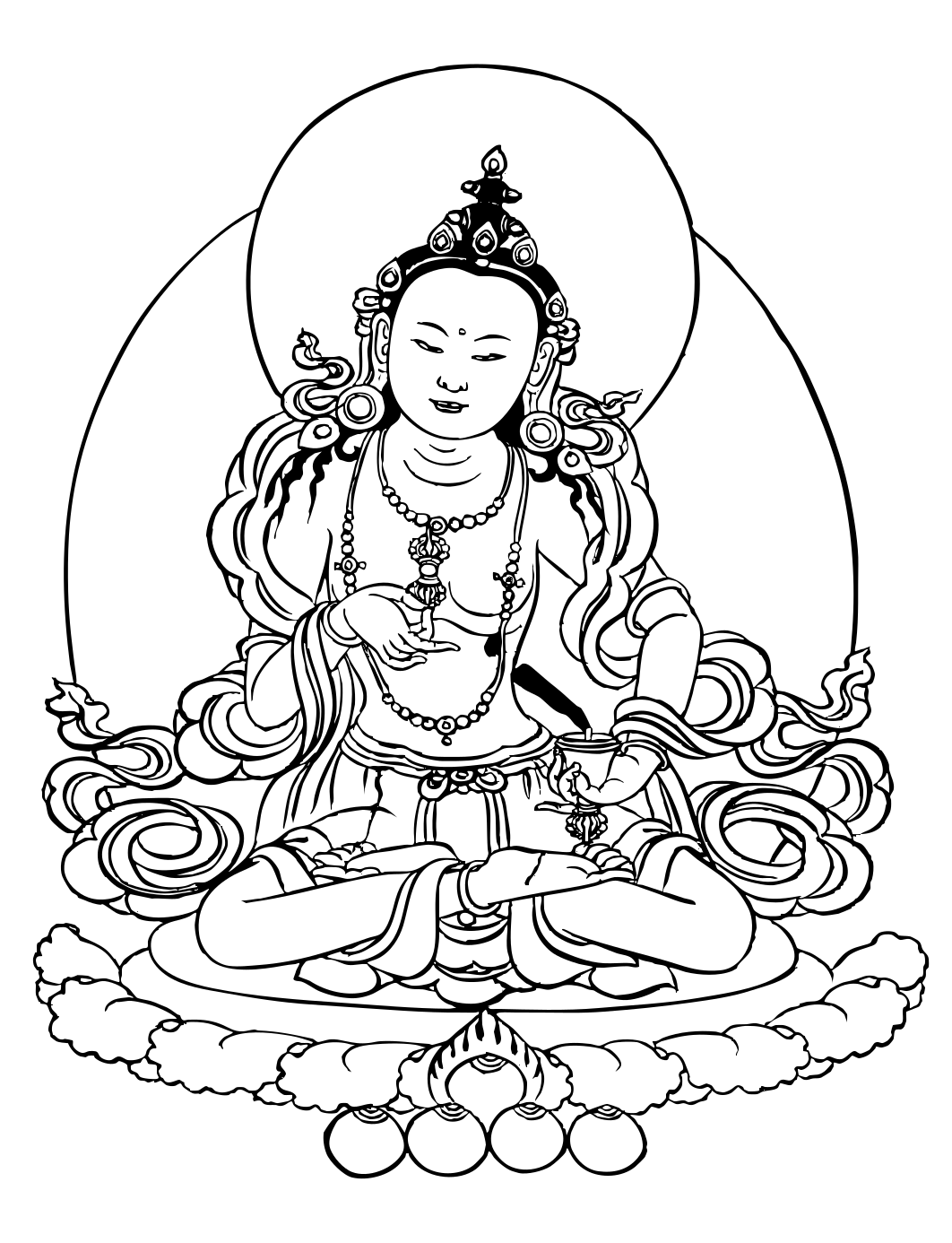
The Perfection of Wisdom in Twenty-Five Thousand Lines is among the most important scriptures underlying both the “vast” and the “profound” approaches to Buddhist thought and practice. Known as the “middle-length” version, being the second longest of the three long Perfection of Wisdom sūtras, it fills three volumes of the Kangyur. Like the two other long sūtras, it records the major teaching on the perfection of wisdom given by the Buddha Śākyamuni on Vulture Peak, detailing all aspects of the path to enlightenment while at the same time emphasizing how bodhisattvas must put them into practice without taking them—or any aspects of enlightenment itself—as having even the slightest true existence.
Translation by the Padmakara Translation Group. A complete draft by Gyurme Dorje was first edited by Charles Hastings, then revised and further edited by John Canti. The introduction was written by John Canti. We are grateful for the advice and help received from Gareth Sparham, Greg Seton, and Nathaniel Rich.
This translation is dedicated to the memory of our late colleague, long-time friend, and vajra brother Gyurme Dorje (1950–2020), who worked assiduously on this translation in his final years and into the very last months of his life. We would also like to express our gratitude to his wife, Xiaohong, for the extraordinary support she gave him on so many levels.
The translation was completed under the patronage and supervision of 84000: Translating the Words of the Buddha.
The generous sponsorship of Kris Yao and Xiang-Jen Yao, which helped make the work on this translation possible, is most gratefully acknowledged.
The Perfection of Wisdom in Twenty-Five Thousand Lines is one of the three so-called “long” sūtras on the Perfection of Wisdom, or Prajñāpāramitā. It fills three complete volumes of the Degé Kangyur, and of all the Prajñāpāramitā sūtras it is second in length only to the massive Perfection of Wisdom in One Hundred Thousand Lines (Toh 8), which fills twelve volumes. The third and shortest of the three “long” sūtras, the Perfection of Wisdom in Eighteen Thousand Lines (Toh 10), fills two and a half volumes.
All three sūtras have a similar structure, closely parallel content, and convey the same teaching: detailed presentations of everything that causes, conditions, and propagates the state of suffering, and of everything that either brings about, or is constituted by, the awakening from that state of suffering. Pervading these presentations is the constant message characteristic of the Prajñāpāramitā sūtras: that despite the importance of understanding all the phenomena of defilement and of putting into practice all the phenomena of the path leading to purification, none of the phenomena that are known, practiced, or attained must ever be taken as having any ultimately real existence if true awakening is to be attained.
The phenomena that are comprised by defilement and purification are grouped in the numerous sets or lists (mātṛkā or “matrices”) that have characterized Buddhist teachings from their earliest origins. These sets and subsets of phenomena (dharma) became, of course, a particular feature of the systematizing Abhidharma texts, but in parallel also came to constitute an important component of the Prajñāpāramitā sūtras. Their inclusion, which in the “long” sūtras is even more extensive than in the earlier Perfection of Wisdom in Eight Thousand Lines (Toh 12), may have served to confirm the continuity of the Prajñāpāramitā’s more profound and difficult perspective on Buddhist practice with earlier forms, as well as to highlight its distinctiveness. In each of the three long sutras, the discussions between the Buddha and the other interlocutors on these sets of dharmas follow one another in almost identical sequence, and the differences in length among the three are almost entirely due to the different degrees to which each set is unpacked into the individual items that it comprises.
While the exhaustive presentation of dharmas that these texts contain provides an important scriptural basis for the classic Buddhist understanding and categorization of phenomena in general, their intent goes much farther than the descriptive itemizing characteristic of the Abhidharma. Most obviously, in his dialectical treatment of each topic the Buddha explicitly undermines any tendencies on the part of his disciples, however subtle they may be, to take any dharma as real or truly existing, or even to adopt it as a point of reference. It is from this “profound” theme of the Prajñāpāramitā sūtras that the fullest forms of Buddhist philosophical understanding of emptiness developed, as exemplified by the great Madhyamaka treatises of Nāgārjuna and later scholars; it is also this theme that led to the practice traditions of Chan, Thiền, Sŏn, and Zen.
Rather less obviously, for it remains largely implicit (especially in the progressive order in which he sets them out), the Buddha’s instructions on how to overcome and abandon those tendencies form an integrated series of practices—the actual path that the bodhisattva must take toward complete awakening—and by extension a description of how a practitioner’s mind may be progressively brought to a direct realization of the ultimate. These “vast” instructions were explained to Asaṅga by Maitreya and are an underlying element of the great Yogācāra treatises as well as the key by which many later Indian commentaries explain the Prajñāpāramitā sūtras.
Buddhist tradition holds that the Prajñāpāramitā was taught by the Buddha on Gṛdhrakūṭa (“Vulture Peak”), the craggy hill near the city of Rājagṛha, capital of the Indian kingdom of Magadha. Some accounts say that this teaching took place over a period of some thirty years, while others say twelve years. Nevertheless, not only the three long sūtras but all five of the longer so-called “mother sūtras” are traditionally said to be accounts of the same teaching by the Buddha given on a single occasion. This assertion is made on the basis of two points: first that the Buddha’s interlocutors are the same, and second that a prophecy made by the Buddha included in all of them could only have been made once. Indeed, the multiplicity of versions of this single teaching is not even limited to the five long sūtras in the canon, for several even longer versions are said to have been recorded for the needs of nonhuman beings. While the longest of the versions preserved in the Kangyur, The Perfection of Wisdom in One Hundred Thousand Lines (Toh 8), is said to have been destined for the nāgas—from whose realm it was retrieved by Nāgārjuna—it is also said that there is a sūtra for the gods with ten million lines, and that the longest version of all, destined for the gandharvas, is a sūtra in one billion lines.
From a historical perspective, versions of Prajñāpāramitā sūtras in writing seem to have first appeared in the first centuries
Different hypotheses regarding the steps and order in which that evolution took place have been proposed, one being that The Perfection of Wisdom in Eight Thousand Lines (Aṣṭasāhasrikā) represents an early version that first led to further long “mother” versions by a process of expansion in the first three centuries
It is important to bear in mind that the naming of the different versions by the number of lines they contain is likely to have been a later development, applied as a means of classifying the profusion of circulating texts of different lengths. It was already in use by the time these texts were first translated into Tibetan in the late eighth and early ninth centuries, but it is not a feature of the earlier Chinese translations. The earliest evidence of this nomenclature appears to be in the Chinese literature, in the record of a lecture by the early sixth century translator Bodhiruci, and its widespread adoption in the centuries that followed may have served to limit further profusion and even reduce the variety of different texts by fixing their number. Nevertheless, its retrospective application to earlier texts may obscure rather than clarify their recensional affinities, and the comparison of parallel passages across recensions of all the sūtras remains a valid means of exploring qualitative textual differences regardless of the quantitative affiliation defined by the particular title.
This is particularly true of the longest versions of the sūtra, i.e., the sūtras in Ten Thousand Lines, Eighteen Thousand Lines, Twenty-Five Thousand Lines, and One Hundred Thousand Lines, which are better seen as a group, often termed “the Long Prajñāpāramitā Sūtras.” It includes texts that exist variably in Sanskrit, Chinese, and Tibetan, different recensional relationships between which can be distinguished independently of the “length” denominations into which they are categorized.
Coming to The Perfection of Wisdom in Twenty-Five Thousand Lines itself, we do not know—apart from placing it with reasonable probability within the process of the expansion of longer texts as mentioned above—when or where it first appeared as a distinct redaction of the Prajñāpāramitā sūtra, or even in what language. As is the case with many canonical works, the earliest historical mentions predate any surviving physical texts, and come from accounts of its first translation into Chinese.
Perhaps unsurprisingly, physical evidence that might corroborate the earliest of these historical records is unavailable, since the very oldest surviving manuscripts that are identifiable witnesses of The Perfection of Wisdom in Twenty-Five Thousand Lines (with the cautions mentioned above) are considerably later fragments in Sanskrit or Buddhist Hybrid Sanskrit from Khotan, Gilgit, and from unknown Central Asian locations, dating from the fifth or sixth century—by which time earlier recensions of the sūtra had already been well established for three or four centuries in China and in multiple translations.
There are separate accounts relating how two copies of such recensions, both representing a long Prajñāpāramitā sūtra of between eighteen and twenty thousand lines, were brought from Khotan to China to be translated into Chinese, both at around the same time in the second half of the third century
The story begins in 260
Mokṣala’s translation, despite the earlier start, ended up being the second Chinese translation to be completed, for in the meantime a Khotanese monk called Gītamitra had brought another Sanskrit manuscript from Khotan to China, this time to Chang’an, where he assisted the great translator Dharmarakṣa to produce the earliest Chinese translation (Taishō 222) in 286.
These accounts underline the importance of the Central Asian oasis states of the Tarim Basin in the spread of Buddhism to China in general, as well as in the early transmission of the long Prajñāpāramitā sūtras. It is noteworthy that all these scholar-monks responsible in their different ways for the transmission of these texts to China—Puṇyadhana, Gītamitra, and Mokṣala himself—were all Khotanese, and that Dharmarakṣa was himself a Central Asian born in Dunhuang, probably of Yuezhi ethnicity.
What remains of Dharmarakṣa’s translation today is incomplete and includes only the first twenty-seven chapters, while Mokṣala’s is more complete and contains ninety chapters. The considerable differences that can be discerned between the two texts (in addition to the incomplete nature of the former) are partly due to these two translators’ quite different styles, but also reflect what must have been substantial differences between their Indic source texts despite the close proximity in which they seem to have coexisted in Khotan.
In the early years of the fifth century yet another Central Asian, the great Kuchean translator Kumārajīva, produced his own complete translation (Taishō 223) comprising ninety chapters. This third Chinese translation became the best known and most studied, partly because of Kumārajīva’s readable style and literary renown, but also because it was accompanied by his parallel translation of selections from an encyclopedic commentarial work, known as the Dazhidu lun (*Mahāprajñāpāramitopadeśa, Taishō 1509) and attributed to Nāgārjuna. This translation of the commentary became an authoritative and detailed source of Mahāyāna doctrine for Chinese scholars, but its presumed Sanskrit original has left no mention at all in any Indic source. If its traces are to be found at all in India, as indeed they may be, they are mostly indirect.
Finally, in the mid-seventh century Xuanzang translated a massive compilation of Prajñāpāramitā texts he had brought from his travels in India, known as the Large Perfection of Wisdom Sūtra (Taishō 220), its content and structure probably based on a collection compiled in India rather than being of his own devising. The first section or “assembly” of the compilation represents a text similar to The Perfection of Wisdom in One Hundred Thousand Lines, although the original Sanskrit text that Xuanzang used was probably even longer. It is the second section, containing eighty-five chapters, that represents the fourth and last Chinese translation of The Perfection of Wisdom in Twenty-Five Thousand Lines. It is worth noting here that in Xuanzang’s Chinese translations, as in the Tibetan translations, the language and structure of the two longest sūtras, The Hundred Thousand Lines and The Twenty-Five Thousand Lines, are noticeably similar except for the degree of repetition and expansion of the lists of dharmas, whereas the third section, representing The Perfection of Wisdom in Eighteen Thousand Lines, has more differences in content and may reflect a more elaborated and possibly later text.
It is important to emphasize again here that the categorization of these early translations into sūtras denominated as having a certain length in terms of “lines” (śloka) had not yet become the more definitive naming system that evolved in later centuries. All these texts can most usefully be seen as versions of the “Large Perfection of Wisdom” (Mahāprajñāpāramitā) sūtra, as distinct from the mid-length Perfection of Wisdom in Eight Thousand Lines and the many short versions of the sūtra, each of which followed their own evolutionary path. The texts, even in different languages, of the “Large Perfection of Wisdom,” differentiated as they are by greater or lesser degrees of expansion of the lists of dharmas, show complex patterns of textual proximity that do not necessarily follow their numerical denominations.
The work that, despite this reserve, we can nevertheless call The Perfection of Wisdom in Twenty-Five Thousand Lines, particularly in the form of Kumārajīva’s translation and its accompanying commentary, has arguably been among the most important influences on Chinese Buddhism. Yet the ways in which the sūtra was interpreted and used in China led in strikingly different directions from those taken by Indian and Tibetan scholars. This is partly because the massively detailed Dazhidu lun commentary, so influential in China, had remained largely unknown in India (see above), and partly because of the comprehensive way in which Kumārajīva and his followers presented Mahāyāna thought and practice, integrating the Prajñāpāramitā with Nāgārjuna and Āryadeva’s Madhyamaka treatises as well as with other Mahāyāna sūtras in the textual corpus of the San lun zong or “Three Treatises” school, the influence of which later spread to Korea and Japan. But another major determinant in this respect is simply that the sūtra’s influence and spread in China was early, and effectively predated the influential new turns that—while Kumārajīva was still at work on his translations in Chang’an—the study of the sūtra was just beginning to take in India.
At an unknown date in the mid-fourth century, a brilliant young Gandhāran scholar in Puruṣapura (modern Peshawar in Pakistan) is said to have attained mastery of all the available Buddhist scriptures and treatises except—to his frustration—the Prajñāpāramitā sūtras, which he could not fully understand. He sought advice from his teachers, one of whom recommended that he should seek the divine help of the bodhisattva and future buddha Maitreya in retreat. He therefore set off to Central India and spent twelve years arduously but (in his own estimation) fruitlessly practicing in a cave until, at the point of giving up his quest, he had a vision of Maitreya in person and was taken by him to the Tuṣita heaven. There he received and wrote down a set of treatises known as the “Five Teachings of Maitreya” (byams chos sde lnga).
Such, in brief, is the legendary account transmitted in Tibetan Buddhist tradition about how Asaṅga (ca. 320–90) wrote down the five important treatises that Tibetan tradition attributes to Maitreya. All five treatises are said—in the legendary account, and by some commentators, too—to be Maitreya’s explanations of the Prajñāpāramitā, but one of them in particular, The Ornament of Clear Realization (Abhisamayālaṃkāra), bears an explicit relationship to it and seems to have had a powerful influence on the exegesis of the Prajñāpāramitā texts, both in the great Buddhist monastic universities of Nālandā, Vikramaśilā, and Odantapuri in India, and after their decline in Kashmir and Tibet where their scholastic traditions continued. Surprisingly, however, and despite Xuanzang’s familiarity with Asaṅga’s other works, it was not translated into Chinese and had no influence at all on Chinese scholarship.
The Ornament of Clear Realization is a short and somewhat cryptic text, not a commentary in the usual sense but rather a key to the implicit structure and essential points of the longer Prajñāpāramitā sūtras. It can be applied to any of the “six mother sūtras,” which indeed are collectively so called because they all follow that very structure and all include the full set of all eight “clear realizations” (abhisamaya, mngon par rtogs pa) that constitute the main divisions of the Ornament. Each of these eight divisions is subdivided into a hierarchy of further divisions, making seventy points in all. The seventy points follow the order of the topics discussed in the long versions of the sūtra and, at a low resolution, can be mapped more or less closely to them all—although at higher resolutions the hypothetical version of the text that is inferentially discernible from the Ornament’s details does not correspond exactly to any one of the extant witnesses, even those of The Perfection of Wisdom in Twenty-Five Thousand Lines to which it is most closely related and on which it is often said to be based.
The influence that The Ornament of Clear Realization exerted on the interpretation of the Prajñāpāramitā is evident from the range of Prajñāpāramitā treatises by Indian authors that have survived, either in Sanskrit or in Tibetan translations in the Tengyur. There are no fewer than twenty-one such treatises based on the Ornament: twelve that apply its enumeration of topics as commentaries to the different “mother” versions of the sūtra, and nine that are (in various senses) commentaries on the Ornament itself. The long commentary attributed in the Chinese tradition to Nāgārjuna, the Dazhidu lun (see above)—which would, of course have predated the appearance of The Ornament of Clear Realization by a century or two if the attribution is correct—seems to have left virtually no evident traces in the Indian literature, and Nāgārjuna’s Madhyamaka works, which can be viewed as general treatises on the doctrines of the Prajñāpāramitā, are not usually counted as part of the Prajñāpāramitā literature as such. Only Dignāga’s Piṇḍārthasaṅgraha (Toh 3809) and two other treatises, both incorporating the Sanskrit term bṛhaṭṭīkā in the titles by which they are most commonly known (Toh 3807 and 3808), comment on the long Prajñāpāramitā sūtras without specific reference to The Ornament of Clear Realization, although all three use terms and concepts from the other Maitreya-Asaṅga treatises and the Yogācāra system in general.
Toward the end of the flowering of Buddhist learning that took place in India between the sixth and twelfth centuries
The great cultural transfer of Buddhist literature, practice, and scholarship that began in the Tibetan imperial period of the late eighth and early ninth centuries, particularly during the reigns of Tri Songdetsen and Ralpachen, naturally included translating the Prajñāpāramitā texts available in India at the time. By the time the two surviving inventories of the early ninth century, the Denkarma and Phangthangma, had been compiled, all the Prajñāpāramitā sūtras had been translated, but only some of the treatises and commentaries.
The accounts of Tibetan historians concerning the early translation period focus principally on the various translators, translations, and manuscripts of The Perfection of Wisdom in One Hundred Thousand Lines, but most of the other sūtras, long and short, are listed in the two inventories, including The Perfection of Wisdom in Twenty-Five Thousand Lines.
Of the treatises, the two bṛhaṭṭīkā commentaries on the long sūtras (mentioned above) are listed in the inventories, as are a number of commentaries on the short sūtras. It is not entirely certain whether or not there was an early translation of The Ornament of Clear Realization itself, as the entry that appears to mention it may be read in different ways, but there were early translations of one, and possibly two, of Haribhadra’s most important commentaries on it, and of a commentary by one of his students, Buddhaśrījñāna. It is worth remembering that Haribhadra himself may have studied with Śāntarakṣita and is likely to have been still alive and active when these early translations were made.
It was nevertheless only in the later period of translation, under the successive influences of Rinchen Sangpo, Atiśa Dipaṃkaraśrījñāna, and particularly Ngok Lotsāwa Loden Sherab, that the full panoply of Prajñāpāramitā and Ornament of Clear Realization treatises appear to have been extensively studied. Ngok and his circle replaced or revised many of the older translations and supplemented them with translations of works by later Indian scholars, including Smṛtijñānakīrti, Dharmaśrī, Ratnākaraśānti, Abhayākaragupta, and Atiśa himself, which had not even been composed at the time of the early translation period.
In other words, while the prevailing state of Prajñāpāramitā study in India at the time was reflected in the early period Tibetan translations, its evolution had by no means come to an end and was continuing, contemporaneously with the implantation of Buddhism in Tibet. Indeed, that evolution continued within Tibet in subsequent centuries, following the rather abrupt decline of Buddhism in northeastern India and, some time later, in the northwest and Kashmir, too. Several major exegetical lineages and systems of Prajñāpāramitā study were founded in both eastern and central Tibet, particularly to begin with at Sangphu but also at Sakya, Tsurphu, Jonang, Mindröling, and the three great Gelukpa monasteries around Lhasa. Study of the Prajñāpāramitā scriptures in the light of The Ornament of Clear Realization, although often in parallel with study of the Madhyamaka, became a distinct, specialist topic pursued by innumerable great scholars down to the present day. Over the centuries almost two hundred and fifty ever more detailed commentaries and synthetic treatises have been composed in Tibetan by almost all the best-known scholastic authors.
In contrast to the great importance attached to interpretations based on The Ornament of Clear Realization, meanwhile, the commentaries not based on it—Dignāga’s and the two bṛhaṭṭīkā commentaries—were much less studied in Tibet.
In common with the other long versions of the sūtra, The Perfection of Wisdom in Twenty-Five Thousand Lines was translated in the early period of translation, as mentioned above. Although its colophon does not mention the translators who worked on it, the various Kangyur catalogs agree that it was translated “at the time of Yeshé Dé and others,” and the fact that it is mentioned in the two early imperial inventories is evidence that its translation was completed by around 813
The Tibetan version of the text found in the Kangyur—the version translated here—contains certain archaic spellings (used in an unusual, inconsistent pattern), certain archaic terms, and renders some bodhisattvas’ names in nonstandard ways; these features may indicate that it was not as extensively revised as were some other canonical texts in the early ninth-century revisions. Its language is strikingly similar to that of The Perfection of Wisdom in One Hundred Thousand Lines, both in these respects and in the exact correspondence of the very numerous passages common to both sūtras. Indeed, it is evident that the two texts—at least as they are found in the Degé Kangyur today—must have been translated in close relationship, whether in parallel or in sequence, and very likely that the same translators were responsible for both. In contrast, the Tibetan translation of the third of the long sūtras, The Perfection of Wisdom in Eighteen Thousand Lines, diverges noticeably from the other two in its language and use of certain terms and names, even though its content and structure are essentially the same and it is quite plausibly the work of the same translators. It is difficult to be sure whether or not those differences in the Tibetan reflect differences in the source from which The Perfection of Wisdom in Eighteen Thousand Lines was translated, but a parallel discrepancy can be seen in the Chinese of Xuanzang’s translation (see above i.19), which—to the extent that there is an equivalence of the three long sūtras in Tibetan with Xuanzang’s three “assemblies”—suggests that The Perfection of Wisdom in Eighteen Thousand Lines may have diverged in its textual evolution relative to the other two versions some time before it was translated into Chinese and Tibetan.
The version of The Perfection of Wisdom in Twenty-Five Thousand Lines as found in the Kangyur and translated here (Toh 9 in the Degé Kangyur) no doubt reflects one of several Sanskrit versions that were circulating in India at the time it was translated—i.e., in the early period—and may even include elements taken from more than one source. It is not, however, the only canonical version of the sūtra in Tibetan, for another was adopted by scholars in the later period and is now found in the Tengyur (Toh 3790).
That Tengyur version of the sūtra is known colloquially in Tibetan as the “eight-chapter version of the Twenty-Five Thousand” (nyi khri le’u brgyad ma), and the compilation of the Sanskrit text that was its source is attributed to Haribhadra. Although it is sometimes presented as a commentary written by Haribhadra (hence its inclusion in the Tengyur), it is better described as a slightly different version of the sūtra, with some relatively minor differences of order, modifications in certain places, and added structural divisions in the form of brief headings that follow the eight principal topics and their subheadings as set out in The Ornament of Clear Realization. Western scholars, following Conze, have often referred to it as the “recast” or “revised” version, but such a description is misleading in implying the primacy of some “unrevised” version entirely free from exegetical redaction. In the evolution of the many coexisting versions of the long sūtra, there has been no such clear distinction between scriptural transmission and exegetical development.
The Tengyur version is a Tibetan translation that, according to its colophon, was made from a Sanskrit manuscript in a Yambu (Kathmandu) monastery by the Newar paṇḍita Śāntibhadra and the Tibetan translator Naktso Lotsāwa Tsultrim Gyalwa (nag tsho lo tsA ba tshul khrims rgyal ba, 1011–64, closely associated with Atiśa). Nevertheless, the Tibetan translation appears to have been made using the early translation of the Kangyur version (i.e., Toh 9) as the basis upon which the relatively small number of changes necessary to align it with the Sanskrit manuscript in question were made. A large majority of passages are common to the two versions and nearly identical; to describe the Tengyur version as a different translation is therefore somewhat misleading. At the same time, the fact that the later translation was probably made using the earlier as its starting point does not necessarily imply the same chronological relationship between the two Sanskrit source texts. The existence of this alternative, Tengyur version again bears witness to the continuing evolution in the interpretation and study of the Prajñāpāramitā sūtras in India, and increasingly in parallel in Tibet itself, during the four or five centuries that mark the introduction of Buddhist literature to Tibet.
In the monastic colleges still active today that specialize in Prajñāpāramitā studies, it is the Tengyur (“eight-chapter”) version of The Perfection of Wisdom in Twenty-Five Thousand Lines to which reference is predominantly made, either directly or because it is the version effectively integrated in the commentaries. To the extent that the curricula of colleges today reflect those of their forebears back through the centuries, the Tengyur version may well have been the principal focus of detailed study since the time it was translated—which, although in the later translation period, still predated by several centuries the emergence of the Kangyur and Tengyur as the established canonical collections.
The present Kangyur version has nevertheless remained in place, and in particular represents the sūtra in terms of its being the sacred, scriptural “words of the Buddha” (buddhavacana), along with the other sūtras, for reading and recitation if not for detailed analysis and study. The existence of an alternative may even have contributed to the fact that this version seems to have preserved more features of its early translation than many other canonical texts.
To have in mind the versions of the sūtra that exist in Tibetan makes it easier to understand the relationship of the surviving Sanskrit texts to those versions.
In brief, the Sanskrit manuscripts we have of this specific sūtra—as denominated by its length, i.e., The Perfection of Wisdom in Twenty-Five Thousand Lines itself—are of a later date than the Tibetan translations, being copies of manuscripts preserved by the Newar Buddhist tradition in Nepal and not generally more than a few centuries old. Manuscripts of that recension are preserved in Cambridge, Tokyo, Paris, and Kolkata. A critical edition of the section corresponding to the first of the eight abhisamaya topics was published by Nalinaksha Dutt in 1934, and more recently a complete edition in several volumes by Takayasu Kimura has appeared (1986–2007), with concordances to the various manuscripts and the Tibetan and Chinese translations.
These manuscripts of the so-called “Nepalese recension,” and the editions made from them, correspond most closely to the Tengyur “eight-chapter” version of the sūtra, and like it are explicitly aligned to the order of topics in The Ornament of Clear Realization. However, since most passages of the Kangyur and Tengyur versions are either identical or very similar (as noted above), these complete Sanskrit manuscripts are still useful and informative references for reading the present Kangyur version.
The Sanskrit manuscripts of The Perfection of Wisdom in One Hundred Thousand Lines are also of Nepalese origin and are of relatively recent date. Nevertheless, from a recensional perspective they are closer to the present, Kangyur version of The Perfection of Wisdom in Twenty-Five Thousand Lines than the Sanskrit manuscripts of The Perfection of Wisdom in Twenty-Five Thousand Lines just mentioned, which correspond more to the eight-chapter Tengyur version. These Hundred Thousand Sanskrit manuscripts are thus an important reference for the study of this text. In the first decade of the twentieth century, Pratāpacandra Ghoṣa produced an edition of the first twelve chapters from three manuscripts kept in Kolkata and one in Cambridge. More recently, Kimura has been publishing an edition from manuscripts kept in Tokyo of further portions of the text, so far in four volumes, the last in 2014.
Several other incomplete or fragmentary Indic manuscripts are also important references, in part because they are older than the “Nepalese” recensions. The oldest known Prajñāpāramitā text of all, radiocarbon-dated to the first century
The earliest surviving manuscript of a “Larger” version is another birch-bark scroll, this one found along with a large number of other texts in Gilgit in 1931. It is in Sanskrit, is almost complete, and can be dated by details of its script to the sixth or seventh century
Somewhat later manuscripts include a set of ninety-one fragments inscribed on copper, identifiable as belonging to a version of The Perfection of Wisdom in Twenty-Five Thousand Lines, found in Sri Lanka in 1923 in the remains of a stūpa. These Indikuṭasāya Copper Plaques are written in a Sinhalese script of the eighth or ninth century. More substantial fragments, found more recently in Sri Lanka at Anuradhapura, are written on several large gold sheets in a ninth century script. These Sri Lankan fragments of The Perfection of Wisdom in Twenty-Five Thousand Lines contain passages in an order that conforms to The Ornament of Clear Realization but do not include the exegetical subdivision headings characteristic of the Tibetan translation in the Tengyur or the later “Nepalese” Sanskrit versions. In other words, they can be taken as representing an intermediate phase in a multiplicity of recensions ranging between these latter versions on the one hand, and on the other those earlier recensions—like the hypothetical Sanskrit text from which the present Kangyur version must have translated—that appear to have been the least influenced by the Ornament.
Finally, this discussion of the Sanskrit manuscripts related to the present sūtra would be incomplete without a mention of the last four chapters in this Kangyur version of the text, chapters 73 to 76, which, as mentioned below, are not present in any Indic version directly identifiable with this particular recension. Nevertheless, the Sanskrit of The Perfection of Wisdom in Eight Thousand Lines closely matches them in content, and Vaidya’s 1960 edition provides a convenient reference.
The sūtra, which fills three volumes in the Degé Kangyur, is divided into seventy-six chapters of quite unequal length. The chapter divisions correspond, to a greater or lesser extent, to those in the other long versions of the Prajñāpāramitā. Of the three longest sūtras, only The Perfection of Wisdom in Eighteen Thousand Lines provides chapter titles for all its eighty-seven chapters; in the present text, only seventeen of the seventy-six chapters have explicit titles. As mentioned below (i.60 and i.61), some of these chapter titles (which in the source texts are found in the chapter colophons at the end of each chapter rather than as initial titles) are probably intended to encompass a group of preceding chapters as well.
At the most basic level, the structure common to the three long sūtras can be divided into three parts:
The first chapter which, as in many sūtras, provides the setting or context (nidāna, gleng gzhi), and is common to all the long versions of the sūtra, with differences in length due to different degrees of expansion and some other minor differences in content;
The main subject matter of the Buddha’s dialogues with his disciples, covered in the bulk of the subsequent chapters, providing the parallel in content of all the sūtras; and
Several final chapters variably included (and not included at all in The Perfection of Wisdom in One Hundred Thousand Lines), which can be viewed as supplementary elements—this is where the three long versions differ most, apart from the extent of their repetitive expansion or contraction.
Thus, the first seventy-one chapters of the present text match in content all seventy-two chapters of The Perfection of Wisdom in One Hundred Thousand Lines, but in more condensed form. The Hundred Thousand ends at the equivalent of this point.
Many of the chapter breaks in the present text also correspond to those in The Perfection of Wisdom in Eighteen Thousand Lines with its yet more condensed subject matter, but since the shorter text has more breaks, the first seventy-one chapters in the present text correspond to the first eighty-two of the eighty-seven chapters of the Eighteen Thousand.
Coming now to the variably included final chapters, the seventy-second chapter of the present text is known as “The Maitreya Chapter” and is found only here in this text (both the Kangyur and Tengyur versions) and in the Eighteen Thousand. More will be said about it below.
The next chapter in the Eighteen Thousand (chapter 84) is the “Verse Summary of the Perfection of Wisdom,” which is also found in all Kangyurs as a separate text (Toh 13), but is not included in the present text or in any other of the long sūtras.
The final four chapters of the present text, 73 to 76, cover the story of Sadāprarudita and Dharmodgata, and also (at the end of chapter 76), the Buddha’s entrustment of the text to Ānanda. These four chapters are not included in the Nepalese Sanskrit manuscripts or the Tengyur version of the text, nor in the Hundred Thousand, but are included (as three final chapters rather than four) in both the Eighteen Thousand and the Eight Thousand. The content of the equivalent chapters in those two texts is almost identical to the content of these chapters here, although the Tibetan translation in this text is clearly a different one made by a different translator team. It nevertheless matches closely, as mentioned above, the surviving Sanskrit of that part of the Eight Thousand. More will be said about the content of these narrative chapters below.
As already mentioned, the sūtra opens with the setting of the context for the Buddha’s teaching of the Prajñāpāramitā. He is on Vulture Peak near Rājagṛha, surrounded by a gathering of arhat monks, nuns, laymen, laywomen, and countless bodhisattvas, of whom thirty-seven are named at this point. After a sequence of meditative stabilities and miraculous displays in which he emanates lights that allay the sufferings of beings in world systems throughout the trichiliocosm and make visible the buddhas teaching in the buddhafields in the ten directions, buddhas and bodhisattvas in each of those buddhafields become aware that a teaching is about to take place, and amid further miraculous displays the bodhisattvas arrive in this world with their offerings to attend the teachings.
The main subject matter, the teachings that the Buddha then gives, unfold as the rest of the text from the beginning of the second chapter. A very broad description of the sūtra’s principal theme, which is common to all the Prajñāpāramitā texts, has been sketched above in the opening paragraphs of this introduction.
At a first reading and without exegetical guidance, the sūtra’s very extensive presentation of its subject matter may seem somewhat disorganized and unstructured. There are nevertheless several much-studied ways of understanding how the teaching can be classified into different sections and topics. What follows is an extremely abbreviated outline of three such ways among those mentioned in the commentaries: the “three approaches” (or “gateways”); the “eleven discourses”; and The Ornament of Clear Realization’s eight principal topics or “clear realizations” and their seventy subtopics.
The three approaches (sgo gsum) are the brief, intermediate, and detailed teachings, destined respectively for those whose faculties allow them to understand terse, middling, or extensive explanations:
(1) The brief teaching comes at the start of chapter 2, and consists only of the Buddha’s statement:
“Śāradvatīputra, bodhisattva great beings who wish to attain consummate buddhahood with respect to all phenomena in all their aspects should persevere in the perfection of wisdom.” (2.2)
(2) The intermediate teaching follows immediately and continues through the discussions between Śāriputra, Subhūti, and the Buddha to the end of chapter 13. The Buddha responds to Śāriputra’s question about what the brief teaching means in terms of the four topics into which it can be subdivided: what a bodhisattva great being is, what it is to attain consummate buddhahood with respect to all phenomena in all their aspects, what persevering means, and what the perfection of wisdom is. Four practices are taught (armor-like, engagement, accumulation, and deliverance), and then, in some detail, eight aspects related to the “persevering.” The last of these eight is a discussion, starting with chapter 8, that arrives at an authoritative conclusion, including twenty-eight or twenty-nine questions, further dialogue between Subhūti and Śāriputra, and in chapters 11, 12, and 13 a long discussion of the Great Vehicle, its attributes, and its results. This entire intermediate teaching is sometimes referred to as “the chapter of Subhūti,” which is also the chapter title this text gives to the last chapter in this section, the thirteenth; that chapter title may be intended to cover the entire group of chapters 3 through 12, too. The intermediate teaching corresponds to the first chapter of The Perfection of Wisdom in Eight Thousand Lines, is centered on all-aspect omniscience, and by teaching nonconceptual perfection of wisdom focuses on ultimate truth.
(3) The detailed teaching is covered by most of the rest of the text, from chapter 14 to the end of chapter 71 (it does not include the Maitreya chapter or the final Sadāprarudita and Dharmodgata chapters). It contains a long series of points to be explained and is divided into two parts: (a) The first part begins with the questions put to Subhūti by Śakra, lord of the gods. The first ten of its chapters, 14 through 23, in which Śakra figures prominently, are probably intended to be covered by the title “Śakra” given in the chapter colophon of chapter 23, and among many important points they explain are how a bodhisattva’s knowledge encompasses that of śrāvakas and pratyekabuddhas, and the benefits, protections, and vast merit conferred by appreciating, honoring, and knowing the perfection of wisdom. Subsequent chapters cover a range of topics, from the dedication of merit, in chapter 24, up to how a bodhisattva’s progress to awakening becomes irreversible, in chapter 40. (b) The second part comprises the discussions prompted by Subhūti’s two hundred and seventy-seven questions, which start in chapter 41 and end in chapter 71. It is centered on knowledge of the paths, and in teaching both conceptual and nonconceptual perfection of wisdom it explains both relative and ultimate truths.
The eleven formulations (rnam grangs bcu gcig) are mentioned in several commentaries detailing the interlocutor concerned, but are not explicitly correlated with particular locations in the texts. Following the mentions in the two bṛhaṭṭīkā commentaries (Toh 3807 and 3808) and Sparham, we may speculatively identify some of them in the present text as follows:
(1) to Śāriputra, from the beginning of chapter 2 as far as 2.245;
(2) by Subhūti, the rest of chapter 2 to the end of chapter 13;
(3) to Śakra, chapter 14, but possibly including several subsequent chapters as well;
(4) to Subhūti, difficult to identify;
(5) to Maitreya, the first part of chapter 24;
(6) to Subhūti, perhaps the rest of chapter 24 from 24.46;
(7) to Śakra, perhaps chapter 25 to 25.17;
(8) to Subhūti, perhaps starting in chapter 25 at 25.18, but very likely chapters 41 to 71;
(9) to Maitreya, chapter 72;
(10) to Subhūti, again difficult to identify with any certainty; and
(11) the narrative of Sadāprarudita and Dharmodgata and entrustment of the sūtra to Ānanda, chapters 73 to 76.
It is possible that the list is not intended to follow a sequential order in all instances. In any case, further study on this approach to the sūtras would be desirable.
The eight topics and seventy points of The Ornament of Clear Realization cannot be mapped with complete precision to the content of this version of the sūtra, as explained above (i.24)—and indeed that is the raison d’être of the Tengyur version. Nevertheless, included in the following list of the eight principal topics and their subdivision into seventy points is an approximate matching of the eight topics themselves to the content of the chapters of this sūtra, based on how the equivalent passages of the Sanskrit text can be identified in the Tibetan of this version. The seventy points of the Ornament are more difficult to match with the present text, and indeed many of them are not even mentioned in the sutra; some, however, can be discerned—not always in the same order as in the Ornament.
(1) All-aspect omniscience (sarvākārajñatā, rnam pa thams cad mkhyen pa nyid) is covered in chapters 2 to 13. Its ten topics are (i) setting of the mind on enlightenment; (ii) the instructions concerning its application within the Great Vehicle; (iii) the four aspects of becoming established on the path of preparation, comprising warmth, peak, acceptance, and supremacy; (iv) the naturally present affinity with the spiritual family, which is the basis for attaining the Great Vehicle; (v) the referents through which the Great Vehicle is attained; (vi) the goals attained through the Great Vehicle; (vii) the armor-like practice; (viii) practice through engagement; (ix) practice through the provisions of merit and wisdom; and (x) practice of definitive deliverance.
(2) Knowledge of the path (mārgajñatā, lam gyi rnam pa shes pa nyid) is covered in chapters 14 to 27. Its eleven topics are (i) essential aspects for understanding the path; (ii) knowledge of the path which is that of the śrāvakas; (iii) knowledge of the path which is that of the pratyekabuddhas; (iv) the beneficial path of insight, which accords with the Great Vehicle; (v) the functions of the path of cultivation; (vi) the aspirational path of cultivation; (vii) the path of cultivation resulting in eulogy, exhortation, and praise; (viii) the path of cultivation resulting in dedication; (ix) the path of cultivation resulting in sympathetic rejoicing; (x) the path of cultivation resulting in attainment; and (xi) the path of meditation resulting in purity.
(3) Knowledge of all the dharmas (sarvajñatā, thams cad shes pa nyid) is covered in chapter 28. Its nine topics are (i) the basic understanding that wisdom leads to not remaining in cyclic existence; (ii) the basic understanding that compassion leads to not remaining in quiescence; (iii) the basic understanding that lack of skillful means leads to distance from the perfection of wisdom; (iv) the basic understanding that skillful means lead to proximity to it; (v) the basic understanding of the discordant factors associated with the fixation of śrāvakas and pratyekabuddhas; (vi) the remedial factors countering those fixations; (vii) training in the aforementioned basic understandings; (viii) training in the sameness of those basic understandings; and (ix) the path of insight which integrates these basic understandings.
(4) Clear realization of all aspects (sarvākārābhisambodha, rnam kun mngon rdzogs rtogs pa) is covered in chapters 29 to 44. Its eleven topics are (i) the aspects of the three kinds of knowledge (1–3 above); (ii) training in those aspects; (iii) the qualities acquired through those trainings; (iv) the defects to be eliminated during training; (v) the defining characteristics of training; (vii) the path of provisions in accord with liberation; (vii) the path of preparation in accord with the four degrees of penetration (1.iii above); (viii) the signs of irreversibility in bodhisattva trainees; (ix) training in the sameness of cyclic existence and quiescence; (x) the training associated with the pure realms; and (xi) training in skillful means for the sake of others.
(5) Culminating clear realization (mūrdhābhisamaya, rtse mor phyin pa’i mngon rtogs) is covered in chapters 45 through to the first few paragraphs of chapter 59. Its eight topics are (i) the culminating training of warmth on the path of preparation; (ii) the culminating training in the peak on the path of preparation; (iii) the culminating training in acceptance on the path of preparation; (iv) the culminating training in supremacy on the path of preparation; (v) the culminating training on the path of insight; (vi) the culminating training on the path of cultivation; (vii) the culminating uninterrupted training on the path of cultivation, comprising the adamantine meditative stability; and (viii) the mistaken notions that are to be eliminated.
(6) Serial clear realization (ānupūrvābhisamaya, mthar gyis pa’i mngon rtogs) is covered by most of chapter 59, from after the first few paragraphs, through to the first few paragraphs of chapter 60. Its thirteen topics are (i–vi) the serial trainings in the six perfections of generosity, ethical discipline, tolerance, perseverance, meditative concentration, and wisdom; (vii–xii) the serial training in the six recollections of the spiritual teacher, the Buddha, the Dharma, the Saṅgha, ethical discipline, and generosity; and (xiii) the serial training in the realization that phenomena are without essential nature.
(7) Instantaneous clear realization (ekakṣaṇābhisamaya, skad cig ma gcig gis mngon par rtogs pa) is covered in most of chapter 60, from after the first few paragraphs, through to the end of chapter 61. Its four topics are (i) instantaneous training in terms of maturation, (ii) instantaneous training in terms of nonmaturation, (iii) instantaneous training in terms of the lack of defining characteristics, and (iv) instantaneous training in terms of nonduality.
(8) The fruitional buddha body of reality (dharmakāyābhisamaya, ’bras bu chos sku) is covered in chapters 62 to 71. Its four topics are (i) the buddha body of essentiality, (ii) the buddha body of wisdom and reality, (iii) the buddha body of perfect resource, and (iv) the buddha body of emanation.
Most of the interest in the Perfection of Wisdom sūtras shown by commentators, whether traditional or modern, has understandably been focused on the doctrinal content rather than the narrative structure, which is sometimes even dismissed as contrived and largely irrelevant. But while the narrative content may not be these sūtras’ most essential feature, it has both purpose and meaning. An appreciation of how the teachings are said to unfold, and of who is saying what, why, and in answer to what question, adds a rich and rewarding layer of understanding for anyone reading these difficult texts closely. Who, then, are the protagonists in this work, and why are they the protagonists and not others?
The most obvious feature of all the longer Perfection of Wisdom sūtras in this regard is that much of the discussion occurs between the Buddha and his śrāvaka disciples, although the subject matter lies at the heart of the Mahāyāna, the path of bodhisattvas.
A number of Mahāyāna sūtras feature conversations between the Buddha, bodhisattvas, and śrāvaka disciples in which the śrāvaka disciples are depicted as rigid and limited in their views compared to the bodhisattvas. But in the Prajñāpāramitā sūtras this is not the case. Substantial statements about the perfection of wisdom are made not only by the Buddha in answer to the śrāvaka interlocutors’ questions, but also directly by the śrāvaka interlocutors themselves. Indeed very little is said by any bodhisattvas, despite their explicit presence at the teaching recounted in these sūtras. Even Mañjuśrī, who could be expected to have a leading role, is simply said to be present among the other bodhisattvas, but no more. Avalokiteśvara too, so central in the Heart Sūtra, is merely present in the audience. The sole exception is Maitreya, who takes part in the dialogue a few times and—most notably—is the Buddha’s main interlocutor for the important “Maitreya chapter” (chapter 72 here in the Twenty-Five Thousand), on which see below (i.111–i.113). In the final chapters, Dharmodgata and his disciple Sadāprarudita could perhaps be said to be bodhisattva protagonists (see below, i.114); but their status is different, as figures from the past in a narrative related by the Buddha.
Instead, much of the teaching on the Perfection of Wisdom is set out in the form of exchanges between the Buddha and his śrāvaka disciples. Seven or eight names of well-known disciples are variously mentioned in the sūtra collectively as small groups concerned in the discussions on particular topics, sometimes along with the bodhisattvas, but the only ones among them who speak as individuals are Śāriputra, Subhūti, Pūrṇa Maitrāyaṇīputra, and Ānanda.
Of these, it is to Śāriputra—without Śāriputra having asked any question—that the Buddha addresses the brief statement at the beginning of chapter 2 that starts off the entire teaching. In the canonical literature, Śāriputra (whose name takes the longer form Śāradvatīputra in the sūtra) is “foremost of those with great wisdom” of the disciples, the specialist in the distinction and analysis of dharmas characteristic of the Abhidharma, and it is therefore fitting, as the Dazhidu lun points out, that the teaching should initially be addressed to him. Śāriputra then asks for more detail, and the Buddha’s response forms the entirety of the rest of the long chapter, which is accordingly known as the “Śāriputra chapter” and forms a survey of what is meant by the bodhisattva’s practice of the perfection of wisdom that is relatively easy to understand—suggesting that it is the material particularly appropriate to Śāriputra’s perspective. Nevertheless, in subsequent chapters, Śāriputra continues to participate. He does so mainly by asking questions, many of them put to Subhūti rather than to the Buddha himself, and makes few statements of his own. Nevertheless, he is wise and experienced enough even to be able to correct a misunderstanding of Śakra’s at one point (25.6). Śāriputra is appreciative and respectful of the teaching, and wants to understand it in terms of his own framework. The other interlocutors treat Śāriputra’s perspective on it respectfully. Implicitly, however, as the sūtra proceeds it becomes clear that Śāriputra’s category-based understanding lacks the profundity of Subhūti’s.
Indeed, it is Subhūti who is by far the most prominent protagonist in these sūtras. At the beginning of chapter 3, the Buddha asks Subhūti to address the bodhisattvas and tell them how a bodhisattva will become emancipated in the perfection of wisdom. This important passage sets the scene for the rest of the intermediate teaching (on which see i.60 above), all of which (up to the end of chapter 13) is referred to as the “Subhūti chapter” since much of the teaching is either delivered by Subhūti himself, or given by the Buddha in response to Subhūti’s questions. This does not mean, however, that Subhūti’s participation as a protagonist is limited to that section of the sūtra. His conspicuous presence and his major statements continue throughout, and there are only a few (mostly short) chapters in the rest of the text in which Subhūti does not figure at all.
Subhūti is an intriguing figure. As an arhat, he is declared by the Buddha in the canonical literature to hold two distinctions of the “foremost among…” type: “foremost among those worthy of donations” and “foremost among those dwelling free of afflicted mental states.” In the Chinese canon he has another distinction, that of being “foremost among those dwelling in meditation on emptiness.” Despite these mentions of his distinctions Subhūti figures surprisingly rarely in the Pali canon. In the Mūlasarvāstivāda vinaya corpus he seems to be mentioned even less, but the one story about him, found in the Vinayakṣudrakavastu (Toh 6) as well as in the Pali paracanonical literature, is perhaps significant in explaining his interest in the most profound views; it has also traditionally been used to place the timing of the Prajñāpāramitā teachings in the main events of the Buddha’s life. In the Lokottaravāda Mahāvastu he does not appear at all. In the Mahāyāna sūtras, however, he figures much more frequently, and his appearances as a protagonist mostly show him in a respectful light that conforms to the personal characteristics alluded to in the Pali and Mūlasarvastivāda literature: those of someone interested above all in meditative practice and the profound view of impermanence, emptiness, nonself, and the ultimate that transcends conceptual notions. In the Lotus Sūtra he is one of the small group of śrāvakas whose future full awakening to buddhahood is prophesied by the Buddha. On the other hand, there are also a few Mahāyāna works, as there are for other śrāvaka disciples, in which he is demonstratively outclassed by bodhisattvas.
That Subhūti’s role in the Perfection of Wisdom sūtras is not presented as paradoxical—a śrāvaka arhat who teaches the perfection of wisdom to bodhisattvas—is perhaps surprising at first sight, but is an important key to understanding the long sūtras.
First of all, to practice the perfection of wisdom, as is made clear in the sūtra, is not itself the exclusive domain of the bodhisattva path. For example, Śāriputra himself confirms to Subhūti at the end of chapter 4 (4.24) that śrāvakas and pratyekabuddhas, as well as bodhisattvas, “should earnestly study, take up, uphold, recite, master, and focus their attention correctly on this very perfection of wisdom.” Moreover, as Subhūti starts his explanations to Śakra in chapter 14 (14.3) by exhorting the gods to become bodhisattvas, he also implies that although śrāvaka arhats are (from their own perspective) in their last life, there is nothing to prevent them from spending their remaining time practicing the perfection of wisdom.
Is it a different matter for a śrāvaka to teach the perfection of wisdom—especially to bodhisattvas? The important role of śrāvakas in the past teaching the six perfections to future bodhisattvas, and thus ensuring the emergence of future buddhas, is mentioned by Subhūti in chapter 14 (14.27). If there is nevertheless any basis for a śrāvaka teaching the perfection of wisdom to be seen as paradoxical, it is exposed and dispelled early on, at least from a formal perspective. No sooner has the Buddha asked Subhūti to teach than some of the arhats and bodhisattvas present wonder whether he will teach using his own understanding and inspired speech, or through the power of the Buddha (3.2); Subhūti replies immediately (3.3) that a śrāvaka like him can only teach anything through the power of the Buddha. A good deal of room for interpretation is nonetheless left in this passage—first in what is meant by “inspired speech” (pratibhāna, spobs pa), then also in the details of Subhūti’s disclaimer, but most of all in the way Subhūti begins to respond to what the Buddha has asked him to do (3.4). For instead of launching straight into a teaching of his own, he asks how he could possibly teach bodhisattvas a perfection of wisdom when neither bodhisattvas nor a perfection of wisdom can be identified other than their mere designations. This key prompt elicits a long teaching by the Buddha on just that topic that lasts for several chapters, punctuated by further questions from Subhūti and long statements by him addressed either to the Buddha, or to Sāriputra when the latter again asks for clarification. Indeed that central question continues to echo throughout the text.
On a few particular occasions we are reminded that Subhūti, or in other places Śāriputra, speaks by the power of the Buddha. But each of the two arhats remains firmly in character, and it is clear that—while both are technically on the same level—Subhūti is someone of a very different category and status compared to Śāriputra. He also has a quite different role. While both at times seek clarifications from the Buddha, Śāriputra does little more than elicit such clarifications, whether from the Buddha or from Subhūti—while Subhūti, on the other hand, makes long and extensive statements of his own. Indeed, at one point in chapter 13 (13.63) Śāriputra exclaims that Subhūti should have been declared “foremost among those who teach the Dharma,” which of course was not one of his official distinctions.
{Dt.4} Homage to all the buddhas and bodhisattvas!
Thus did I hear at one time. The Blessed One was staying on Vulture Peak near Rājagṛha, with a large monastic gathering comprising some five thousand monks. All of them were arhats who had attained the cessation of contaminants, free of afflicted mental states, fully controlled, their minds thoroughly liberated, their wisdom well liberated, thoroughbreds, mighty elephants, their tasks accomplished, their work completed, their burdens relinquished, their own objectives fulfilled, the fetters binding them to the rebirth process completely severed, their minds thoroughly liberated through perfect instruction, supreme in their perfection of all mental powers, with the exception of just one person— the venerable Ānanda, still a trainee who was one who had entered the stream. Also present were some five hundred nuns headed by Yaśodharā and Mahāprajāpatī, and a great many laymen and laywomen, all of whom had seen the Dharma.
There, too, were innumerable, inestimable bodhisattva great beings, all of whom had attained the dhāraṇīs and attained the meditative stabilities, acting in accord with emptiness, their perceptual range being one of signlessness, their aspirations free from deliberation, their attainments the acceptance of the sameness of all phenomena and the dhāraṇī of nonattachment. They possessed inspired eloquence that was unimpeded and had comprehended the inexhaustible teachings according to their exact knowledge. Using miraculous displays through their great extrasensory powers, their extrasensory powers never failing, and with engaging speech, without indolence but with perseverance, without regard for their bodies or their lives, their conduct unpretentious, without insincerity, and without thoughts of ulterior fame, profit, or respect, free from self-interest they taught the Dharma. They had realized and integrated the sublime acceptance of the profound dharmas. They had acquired great fearlessness, without discouragement, and they had gone completely beyond all the works of Māra. Having interrupted the continuity of karmic obscurations, they had overcome karma, the afflicted mental states, and hostile forces, and in the face of all challenges had remained undefeated. They were difficult for all śrāvakas and pratyekabuddhas to fathom. Through their realization they were skilled in analyzing and teaching the Dharma, and they had energetically applied themselves to their aspirations over countless eons. Smiling and communicative, their faces without frowns of anger, with their sweet, gentle words they were skilled in addressing others in melodic verse. As their inspired eloquence flowed uninterrupted, they possessed the fearlessness that overwhelmed endless assemblies. From the wisdom that they had taught for endless tens of millions of eons, they were skilled in emancipation. They had comprehended that all phenomena are like a magical display, a mirage, a reflection of the moon in water, a dream, an echo, an optical aberration, empty space, a castle in the sky, a phantom, or a reflection. {Dt.5} Without discouragement, they were skilled in comprehending the mental attitudes, subtle knowledge, conduct, and interests of all beings. Their attitude toward all beings was free of any animosity, and their tolerance was immense. They were skilled in the wisdom that brings the sameness of all phenomena to be understood, and because they were possessed of profound reality their depth was hard to estimate. They had fully attained power over their own minds, and they had entirely attained power over all phenomena. They were liberated from all past actions, afflicted mental states, and obscurations of view. They were skilled in teaching how to understand dependence, and had engaged in all the inexhaustible modes of dependent origination, were free from all views, latent impulses, and obsessions, and had abandoned all fetters. They were skilled in bringing about peace from all actions and afflicted mental states, skilled in the primordial wisdom that brings realization of the truth, constantly and uninterruptedly considering all phenomena to resemble an echo, fearless in their measureless teachings of the ways of the Dharma, and skilled in bringing forth comprehension of the true nature itself. Their progress was governed by their aspiration to establish infinite buddhafields. Constantly and uninterruptedly they brought into being the meditative stability of recollecting the buddhas who reside in countless world systems; they were skilled in attending buddhas wherever they appear and skilled in requesting innumerable buddhas to teach. They were skilled in bringing about peace from the afflicted mental states that are generated through the diverse false views of beings, and skilled in bringing forth realization of the wisdom that revels in the miraculous production of a hundred thousand meditative stabilities. Every one of them had qualities of which a full description would be incomplete even if infinite eons were spent on it.
Among them were the following: the bodhisattva great being Bhadrapāla, along with Ratnākara, Ratnagarbha, Ratnadatta, Sārthavāha, Naradatta, Guhagupta, Varuṇadeva, Indradatta, Bhadrabala, Uttaramati, Viśeṣamati, Vardhamānamati, Anantamati, Amoghadarśin, Anāvaraṇamati, Susaṃprasthita, Suvikrāntavikrāmin, Anantavīrya, Nityodyukta, Nityayukta, Anikṣiptadhura, Sūryagarbha, Candragarbha, Anupamamati, Avalokiteśvara, Mahāsthāmaprāpta, Mañjuśrīkumārabhūta, Mārabalapramardin, Vajramati, Ratnamudrāhasta, Nityotkṣiptahasta, Mahākaruṇācintin, Mahāvyūha, Vyūharāja, Merukūṭa, and the bodhisattva great being Maitreya, heading many hundred billion trillions of accompanying bodhisattvas.
At that time, the Blessed One himself arranged his seat, the lion throne, and sat upright with his legs crossed, directing his attention. Seated there, he was absorbed in the meditative stability called king of meditative stabilities, in which all meditative stabilities are gathered, comprehended, pursued, and subsumed.
The Blessed One, mindful and with full awareness, then arose from that meditative stability and observed this buddhafield with clairvoyance. {Dt.6} Seeing in this manner, he sent forth lights from his entire body. Sixty hundred billion trillion rays of light issued from each of the two wheels with a thousand spokes that were imprinted on the soles of his feet. Sixty hundred billion trillion rays of light also issued from the ten toes of his two feet. Sixty hundred billion trillion rays of light also issued respectively from his two ankles, his two shins, his two knees, his two thighs, his two hips, his navel, the two sides of his ribs, and from the śrīvatsa at his heart, which is one of the major marks of a great person. Sixty hundred billion trillion rays of light also issued respectively from each of his ten fingers, and similarly, sixty hundred billion trillion rays of light also issued respectively from his two arms, his two shoulders, his neck, his four incisors, his forty teeth, his two eyes, his two ears, his two nostrils, the hair ringlet between his eyebrows, his uṣṇīṣa, and his mouth. All those sets of sixty hundred billion trillion rays of light permeated this great trichiliocosm with a great brightness. The world systems of the eastern direction, numerous as the grains of sand of the river Gaṅgā, were permeated with a great brightness. The world systems of each of the other cardinal directions—south, west, and north—and those of the intermediate directions—northeast, southeast, southwest, and northwest—along with those of the nadir and the zenith, numerous as the grains of sand of the river Gaṅgā, were also permeated with a great brightness. All beings who beheld these rays of light and who were touched by that light became assured of reaching unsurpassed, complete enlightenment. {Dt.7}
Then again, the Blessed One caused light rays to be diffused from all his pores, and that light again permeated these world systems of the great trichiliocosm with a great brightness. The world systems of the eastern direction, numerous as the grains of sand of the river Gaṅgā, were permeated with a great brightness. The world systems of each of the other cardinal directions—south, west, and north—and those of the intermediate directions—northeast, southeast, southwest, and northwest—along with those of the nadir and the zenith, numerous as the grains of sand of the river Gaṅgā, were also permeated with a great brightness. All beings who beheld that light and who were touched by that light became assured of reaching unsurpassed, complete enlightenment.
Then again, with the natural light of the tathāgatas the Blessed One caused these world systems of the great trichiliocosm to be permeated with a great brightness. The world systems of the eastern direction, numerous as the grains of sand of the river Gaṅgā, were permeated with a great brightness. The world systems of each of the other cardinal directions—south, west, and north—and those of the intermediate directions—northeast, southeast, southwest, and northwest—along with those of the nadir and the zenith, numerous as the grains of sand of the river Gaṅgā, were also permeated with a great brightness. All beings who beheld that light and who were touched by that light became assured of reaching unsurpassed, complete enlightenment.
Then the Blessed One extended his tongue from his mouth. Covering this entire great trichiliocosm with his tongue, he smiled, and from his tongue emanated many hundred billion trillion variegated rays of light. On all those rays of light, in their entirety, manifold lotus flowers appeared, fashioned of diverse gemstones, of golden color, with a thousand petals, diverse, beautiful to behold, pleasant, exquisitely shaded, scented, soft, and blissful to the touch like kācalindika. On those lotus flowers were seated many forms of tathāgatas, and the Dharma teaching they taught was this very Dharma teaching concerning the six perfections. They departed for the world systems of the eastern direction, numerous as the grains of sand of the river Gaṅgā, and on arriving there, they taught this very Dharma teaching concerning the six perfections. {Dt.8} They departed for the world systems of each of the other cardinal directions—south, west, and north—and those of the intermediate directions—northeast, southeast, southwest, and northwest—along with those of the nadir and the zenith, numerous as the grains of sand of the river Gaṅgā, and on arriving there, they also taught this very Dharma teaching concerning the six perfections. All beings who heard those teachings became assured of reaching unsurpassed, complete enlightenment.
Then, while seated on the lion throne, the Blessed One became absorbed in the meditative stability of the buddhas called the lion’s play, and manifested his miraculous abilities. By manifesting those miraculous abilities, he caused these world systems of the great trichiliocosm to shake in six ways. That is to say, they shook, shuddered, and juddered; they rocked, reeled, and tottered; they quivered, careened, and convulsed; they trembled, throbbed, and quaked; they rumbled, roared, and thundered; and they faltered, lurched, and staggered. As their eastern sides reared up their western sides plunged down; as their western sides reared up their eastern sides plunged down; as their southern sides reared up their northern sides plunged down; as their northern sides reared up their southern sides plunged down; as their edges reared up their centers plunged down; and as their centers reared up their edges plunged down. Then, slowly and gradually, they all settled, whereupon all beings experienced spiritual and temporal well-being.
At that time, in a single fleeting instant, in this great trichiliocosm, the hells, the animal realms, the worlds of Yama, the states that lack freedom, the lower realms, the evil destinies, and as many places of unfortunate rebirth as there are, were all interrupted and emptied of the beings born in them. All of those beings were then reborn equal in fortune to human beings, or similarly they were reborn equal in fortune to the gods of the Caturmahārājakāyika, Trayastriṃśa, Yāma, Tuṣita, Nirmāṇarata, and Paranirmitavaśavartin realms. {Dt.9} Then those gods and those human beings, with joy, appreciation, and ease, recollected their former lives. Having recollected those lives they felt joy, appreciation, and ease, and departed for where there were blessed ones. On arriving there they paid homage at their feet. Placing their hands together, they bowed toward those tathāgatas, arhats, completely awakened buddhas.
In the world systems of the eastern direction, numerous as the grains of sand of the river Gaṅgā, and in the world systems of each of the other cardinal directions—south, west, and north—and those of the intermediate directions—northeast, southeast, southwest, and northwest—along with those of the nadir and the zenith, numerous as the grains of sand of the river Gaṅgā, the hells, the animal realms, and the worlds of Yama were again all interrupted, and the states that lack freedom vanished. All the beings in them were reborn equal in fortune to human beings and to the gods. Then those human beings and those gods, with joy, appreciation, and ease, recollected their former lives. Having recollected those lives they felt joy, appreciation, and ease, and each departed for the buddhafields where those respective tathāgatas, arhats, completely awakened buddhas resided. On arriving there they paid homage at their feet. Placing their hands together, they bowed toward those tathāgatas, arhats, completely awakened buddhas.
At that time, in this great trichiliocosm, all those who were blind, as many as there were, saw sights. Those who were deaf heard sounds. Those who were insane regained their wits. Those who were agitated attained a state of mind without agitation. Those without clothing obtained clothing. Those who were destitute obtained wealth. Those who were hungry obtained food. Those who were thirsty obtained drink. Those afflicted with ill health became free from disease. Those with physical disabilities and imperfect sense faculties were restored to full perfection of body and senses, and flourished. Those who were weary were refreshed. Those who had not forsaken nonvirtuous ways of acting and livelihood of body, speech, and mind forsook those nonvirtuous ways of acting and livelihood of body, speech, and mind. {Dt.10} All beings too became even-minded toward all other beings, considering one another as just like their father, mother, brother, sister, partner, ally, or friend. All beings too acquired the paths of the ten virtuous actions, and they maintained the practice of chastity and purity, without the stench of immorality and without the notion of nonvirtue. At that time all beings possessed every kind of happiness such that their happiness resembled, by comparison, the happiness experienced by monks absorbed in the third meditative concentration. At that time all beings possessed wisdom such that they knew as follows: “Excellent is generosity! Excellent is peace! Excellent is discipline! Excellent is restraint! Excellent is truth! Excellent is carefulness! Excellent is loving kindness! Excellent is compassion! Excellent is the practice of chastity! Excellent is nonviolence with respect to all living creatures!”
At that time the Blessed One, seated on the lion throne, resembled, as an analogy, the unobscured sun in the pure expanse of space, or the orb of the full moon. His light filled this great trichiliocosm, with its Mount Sumerus and all that surrounded them, its god realms, Indra realms, Vaśavartin realms, gods, asuras, Brahmā realms, and Pure Abodes, outshining them all. While he remained seated, he himself was adorned with light, of lustrous complexion, sparkling, gleaming, and shining in splendor and glory. And while the Blessed One remained seated, outshining this great trichiliocosm, adorned with light, of lustrous complexion, sparkling, gleaming, and shining in splendor and glory, he similarly outshone the world systems of the eastern direction, numerous as the grains of sand of the river Gaṅgā, being adorned with light, of lustrous complexion, sparkling, gleaming, and shining in splendor and glory. Similarly, he outshone the world systems of each of the other cardinal directions—south, west, and north—and those of the intermediate directions—northeast, southeast, southwest, and northwest—along with those of the nadir and the zenith, numerous as the grains of sand of the river Gaṅgā, being adorned with light, of lustrous complexion, sparkling, gleaming, and shining in splendor and glory. Just as Sumeru, king of mountains, continues to outshine all other dark mountains, beautiful, sparkling, gleaming, and shining; just as the orb of the moon continues to outshine all the constellations of stars, adorned, sparkling, gleaming, and shining; and just as the orb of the sun continues to outshine all other lights, adorned, sparkling, gleaming, and shining, so did the Blessed One, adorned with light, of lustrous complexion, sparkling, gleaming, and shining in splendor and glory, outshine the worlds of the ten directions, with their gods, Indra realms, Brahmā realms, and Pure Abodes.
Then the Blessed One again showed, in this great trichiliocosm, his own original body just as it is. All the gods, as many as there are, of the Pure Abodes, {Dt.11} the Ābhāsvara realms, the Brahmā realms, and the Paranirmitavaśavartin, Nirmāṇarata, Tuṣita, Yāma, Trayastriṃśa, and Caturmahārājakāyika realms, saw the tathāgata, arhat, completely awakened Buddha seated on the lion throne. They were delighted. They rejoiced. They were contented. Their extreme joy gave rise to such delight and contentment that they took many heavenly flowers, garlands, perfumes, unguents, powders, and heavenly pastes; heavenly blue lotuses, day lotuses, night lotuses, white lotuses, water lilies, and fragrant water lilies; and heavenly crocuses, mangosteen leaves, heavenly robes, ornaments, parasols, victory banners, and heavenly ribbons, and set out for the place where the Blessed One was seated. Going there, they sprinkled, scattered, and showered down upon the Blessed One those flowers, garlands, perfumes, unguents, powders, pastes, blue lotuses, day lotuses, night lotuses, white lotuses, water lilies, fragrant water lilies, crocuses, mangosteen leaves, heavenly robes, ornaments, parasols, victory banners, and heavenly ribbons.
All human beings who were disciplined and suitable recipients of the teachings, as many as there were in this great trichiliocosm, also brought all kinds of flowers, ones that grow in water and grow on the plains, and they set out for the place where the Blessed One was seated. Going there, they offered these to the Blessed One.
Through the blessings of the Blessed One all these flowers, garlands, perfumes, unguents, powders, and so forth, and the robes, ornaments, parasols, victory banners, and ribbons, immediately formed a towering mansion of flowers and the like, extending into the sky above the head of the Blessed One, and as large as the great trichiliocosm. From that towering mansion, heavenly flowers and many wreaths of silk were suspended, draped, and floated in the air. This whole great trichiliocosm was exquisitely adorned by the flowers and wreaths of silk, and it was exquisitely adorned, too, by the golden light of the Blessed One, sparkling, gleaming, and shining. In this great trichiliocosm the world systems of the eastern direction, as many as the grains of sand of the river Gaṅgā, were permeated and illuminated by that light of the Blessed One. The world systems of each of the other cardinal directions—south, west, and north—and those of the intermediate directions—northeast, southeast, southwest, and northwest—along with those of the nadir and the zenith, numerous as the grains of sand of the river Gaṅgā, were also permeated and illuminated by that light of the Blessed One. {Dt.12} There, the human beings of the Jambudvīpas beheld the body of the Tathāgata that one can never tire of beholding, thinking, “The Tathāgata is seated before us, teaching the Dharma.” And just as the human beings of the Jambudvīpas had that thought, in the same manner, the inhabitants of the Aparagodānīyas, Pūrvavidehas, and Uttarakurus, the gods of Caturmahārājakāyikas, and those of the other realms, up to and including the Akaniṣṭhas, and similarly all the human beings and all the gods of the chiliocosm, the dichiliocosm, and the great trichiliocosm, beheld the body of the Tathāgata that one can never tire of beholding, thinking, “The Tathāgata is seated before us, teaching the Dharma.”
Then again, while seated on that lion throne, the Blessed One sent forth lights that illuminated this great trichiliocosm. He illuminated all the world systems of the eastern direction, and each of the other cardinal directions—south, west, and north—and those of the intermediate directions—northeast, southeast, southwest, and northwest—along with those of the nadir and the zenith, numerous as the grains of sand of the river Gaṅgā. Through that light all beings, as many as there were in this great trichiliocosm, beheld the many tathāgatas, arhats, completely awakened buddhas of the world systems of the eastern direction, numerous as the grains of sand of the river Gaṅgā, along with their monastic communities of śrāvakas and their assemblies of bodhisattvas. And in these world systems of the eastern direction, numerous as the grains of sand of the river Gaṅgā, those assemblies of beings, as many as there were, also beheld in this great trichiliocosm the Blessed One, the tathāgata, arhat, completely awakened Buddha Śākyamuni, residing together with the community of monks and the assembly of bodhisattvas. Similarly, in the world systems of each of the other cardinal directions—south, west, and north—and those of the intermediate directions—northeast, southeast, southwest, and northwest—along with those of the nadir and the zenith, numerous as the grains of sand of the river Gaṅgā, those assemblies of beings, as many as there were, also beheld in this great trichiliocosm the Blessed One, the tathāgata, arhat, completely awakened Buddha Śākyamuni, residing together with the community of monks and the assembly of bodhisattvas.
Beyond all the world systems in the eastern direction, more numerous than the grains of sand of the river Gaṅgā, there is the world system called Ratnavatī. There resided and lived the tathāgata, arhat, completely awakened buddha called Ratnākara, teaching this very perfection of wisdom to bodhisattva great beings. At that time, in that world system there was a bodhisattva great being named Samantaraśmi who, on beholding that great light, the great trembling of the earth, and the body of a tathāgata that one can never tire of beholding, set out for the place where that blessed one, the tathāgata, arhat, completely awakened Buddha Ratnākara was residing. Going there, he asked that blessed one, the tathāgata Ratnākara, the following: “Blessed Lord, what are the causes {Dt.13} and what are the conditions for such a great light to emerge in the world, for a narrow stretch of land to tremble in this manner, and for the body of a tathāgata, such as this, to be present?”
That blessed one, the tathāgata Ratnākara, replied to the bodhisattva great being Samantaraśmi, “Noble son, west from here, beyond world systems numerous as the grains of sand of the river Gaṅgā, there is a world system called Patient Endurance. There a tathāgata, arhat, completely awakened buddha named Śākyamuni resides and is alive at present. He teaches the perfection of wisdom to bodhisattva great beings. Such is his power.”
Then the bodhisattva great being Samantaraśmi said to that blessed one, the tathāgata Ratnākara, “Blessed Lord, I too will go to that world system of Patient Endurance to behold the Blessed One, the tathāgata, arhat, completely awakened Buddha Śākyamuni, to pay homage and respect to him, and indeed to see all those bodhisattva great beings, most of whom are youthful ones, have acquired dhāraṇī and exact knowledge, and have mastered all the meditative stabilities and meditative absorptions.”
That blessed one, the tathāgata Ratnākara, then replied, “Go then, noble son, for I know the right time for this has arrived!”
The tathāgata Ratnākara gave the bodhisattva great being Samantaraśmi a thousand lotus flowers, made of diverse jewels, golden in color, each with a thousand petals, and instructed him, “Noble son! You should scatter these lotuses toward the Blessed One, the tathāgata, arhat, completely awakened Buddha Śākyamuni, saying, ‘Blessed Lord, these golden-colored lotuses with a thousand petals have been sent as an offering to you, Blessed Lord, by that blessed one, the tathāgata Ratnākara, who inquires if you, Blessed Lord, are free from sickness, free from all harms, in good health, strong, comfortable, and well?’ Noble son, you should conduct yourself with care in that buddhafield. If you ask why, it is because bodhisattva great beings who are born in that world system are hard to satisfy. Beware of harm there.” {Dt.14}
Then the bodhisattva great being Samantaraśmi received from that blessed one, the tathāgata, arhat, completely awakened Buddha Ratnākara those golden thousand-petaled lotuses. Accompanied by many hundred billion trillions of bodhisattvas in the form of householders, mendicants, young men, and young women, he vanished from that buddhafield. After serving, respecting, honoring, and worshiping all the blessed lord buddhas who resided and were alive in the eastern direction, as many as there were, with flowers, perfumes, incense, garlands, unguents, powders, robes, ornaments, parasols, victory banners, and ribbons, through the great miraculous ability of the bodhisattvas and through the great power of the bodhisattvas, he then set out for that place where the Blessed One, the tathāgata, arhat, completely awakened Buddha Śākyamuni resided. Arriving there, he bowed his head toward the feet of the Blessed One and took a place to one side. Having taken a place to one side, the bodhisattva great being Samantaraśmi then addressed the Blessed One as follows: “That blessed one, the tathāgata, arhat, completely awakened Buddha Ratnākara, has sent these golden-colored, thousand-petaled lotuses as an offering to you, Blessed Lord, inquiring if you, Blessed Lord, are free from sickness, free from all harms, in good health, strong, comfortable, and well?”
The Blessed One, the tathāgata Śākyamuni, took those lotuses and scattered them in the world systems of the eastern direction, numerous as the grains of sand of the river Gaṅgā, where the tathāgatas, arhats, completely awakened buddhas resided. The lotuses fully covered all those world systems, and upon those lotuses many bodies of the tathāgatas were seated, teaching this very doctrine, from the six perfections onward. All beings who heard that teaching of the Dharma became assured of reaching unsurpassed, complete enlightenment. Those bodhisattvas in the form of householders, mendicants, young men, and young women also served, venerated, honored, and worshiped the Blessed One, the tathāgata, arhat, completely awakened Buddha Śākyamuni, through the roots of their respective virtuous actions, and took places to one side. {Dt.15}
Beyond all the world systems in the southern direction, more numerous than the grains of sand of the river Gaṅgā, there is the world system called Sarvaśokāpagata. There resides and lives the tathāgata, arhat, completely awakened buddha called Aśokaśrī, teaching this very perfection of wisdom to bodhisattva great beings. At that time, in that world system there was a bodhisattva great being named Vigataśoka who, on beholding that great light, the great trembling of the earth, and the body of a tathāgata that one can never tire of beholding, set out for the place where that blessed one, the tathāgata, arhat, completely awakened Buddha Aśokaśrī was residing. Going there, he asked that blessed one, the tathāgata Aśokaśrī, the following: “Blessed Lord, what are the causes and what are the conditions for such a great light to emerge in the world, for a narrow stretch of land to tremble in this manner, and for the body of a tathāgata, such as this, to be present?”
That blessed one, the tathāgata Aśokaśrī, replied to the bodhisattva great being Vigataśoka, “Noble son, north from here, beyond world systems numerous as the grains of sand of the river Gaṅgā, there is a world system called Patient Endurance. There a tathāgata, arhat, completely awakened buddha named Śākyamuni resides and is alive at present. He teaches the perfection of wisdom to bodhisattva great beings. Such is his power.”
Then the bodhisattva great being Vigataśoka said to that blessed one, the tathāgata Aśokaśrī, “Blessed Lord, I too will go to that world system of Patient Endurance to behold the Blessed One, the tathāgata, arhat, completely awakened Buddha Śākyamuni, to pay homage and respect to him, and indeed to see all those bodhisattva great beings, most of whom are youthful ones, have acquired dhāraṇī and exact knowledge, and have mastered all the meditative stabilities and meditative absorptions.”
That blessed one, the tathāgata Aśokaśrī, then replied, “Go then, noble son, for I know the right time for this has arrived!”
The tathāgata Aśokaśrī gave the bodhisattva great being Vigataśoka a thousand lotus flowers, made of diverse jewels, golden in color, each with a thousand petals, and instructed him, “Noble son, you should scatter these lotuses toward the Blessed One, the tathāgata, arhat, completely awakened Buddha Śākyamuni, saying, ‘Blessed Lord, these golden-colored lotuses with a thousand petals have been sent as an offering to you, Blessed Lord, by that blessed one, the tathāgata Aśokaśrī, who inquires if you, Blessed Lord, are free from sickness, free from all harms, in good health, strong, comfortable, and well?’ Noble son, you should conduct yourself with care in that buddhafield. If you ask why, it is because bodhisattva great beings who are born in that world system are hard to satisfy. Beware of harm there.”
Then the bodhisattva great being Vigataśoka received from that blessed one, the tathāgata, arhat, completely awakened Buddha Aśokaśrī, those golden-colored, thousand-petaled lotuses. Accompanied by many hundred billion trillions of bodhisattvas in the form of householders, mendicants, young men, and young women, he vanished from that buddhafield. After serving, respecting, honoring, and worshiping all the blessed lord buddhas who resided and were alive in the southern direction, as many as there were, with flowers, perfumes, incense, garlands, unguents, powders, robes, ornaments, parasols, victory banners, and ribbons, through the great miraculous ability of the bodhisattvas and through the great power of the bodhisattvas, he then set out for that place where the Blessed One, the tathāgata, arhat, completely awakened Buddha Śākyamuni resided. Arriving there, he bowed his head toward the feet of the Blessed One and took a place to one side. Having taken a place to one side, the bodhisattva great being Vigataśoka then addressed the Blessed One as follows: “That blessed one, the tathāgata, arhat, completely awakened Buddha Aśokaśrī, has sent these golden-colored, thousand-petaled lotuses as an offering to you, Blessed Lord, inquiring if you, Blessed Lord, are free from sickness, free from all harms, in good health, strong, comfortable, and well?”
The Blessed One, the tathāgata Śākyamuni, took those lotuses and scattered them in the world systems of the southern direction, numerous as the grains of sand of the river Gaṅgā, where the tathāgatas, arhats, completely awakened buddhas resided. The lotuses fully covered all those world systems, and upon them many bodies of the tathāgatas were seated, teaching this very doctrine from the six perfections onward. All beings who heard that teaching of the Dharma became assured of reaching unsurpassed, complete enlightenment. Those bodhisattvas in the form of householders, mendicants, young men, and young women also served, venerated, honored, and worshiped the Blessed One, the tathāgata, arhat, completely awakened Buddha Śākyamuni, with the roots of their respective virtuous actions, and then took places to one side.
Beyond all the world systems in the western direction, more numerous than the grains of sand of the river Gaṅgā, there is the world system called Upaśāntā. There resides and lives the tathāgata, arhat, completely awakened buddha called Ratnārcis, teaching this very perfection of wisdom to bodhisattva great beings. At that time, in that world system there was a bodhisattva great being named Cāritramati who, on beholding that great light, the trembling of the earth, and the body of a tathāgata that one can never tire of beholding, set out for the place where that blessed one, the tathāgata, arhat, completely awakened Buddha Ratnārcis, was residing. Going there, he asked that blessed one, the tathāgata Ratnārcis, the following: “Blessed Lord, what are the causes and what are the conditions for such a great light to emerge in the world, for a narrow stretch of land to tremble in this manner, and for the body of a tathāgata, such as this, to be present?”
That blessed one, the tathāgata Ratnārcis, replied to the bodhisattva great being Cāritramati, “Noble son, east from here, beyond world systems numerous as the grains of sand of the river Gaṅgā, there is a world system called Patient Endurance. There a tathāgata, arhat, completely awakened buddha named Śākyamuni resides and is alive at present. He teaches the perfection of wisdom to bodhisattva great beings. Such is his power.”
Then the bodhisattva great being Cāritramati said to that blessed one, the tathāgata Ratnārcis, “Blessed Lord, I too will go to that world system of Patient Endurance to behold the Blessed One, the tathāgata, arhat, completely awakened Buddha Śākyamuni, to pay homage and respect to him, and indeed to see all those bodhisattva great beings, most of whom are youthful ones, have acquired dhāraṇī and exact knowledge, and have mastered all the meditative stabilities and meditative absorptions.”
That blessed one, the tathāgata Ratnārcis, then replied, “Go then, noble son, for I know the right time for this has arrived!”
The tathāgata Ratnārcis gave the bodhisattva great being Cāritramati a thousand lotus flowers, made of diverse jewels, golden in color, each with a thousand petals, and instructed him, “Noble son, you should scatter these lotuses toward the Blessed One, the tathāgata, arhat, completely awakened Buddha Śākyamuni, saying, ‘Blessed Lord, these golden-colored lotuses with a thousand petals have been sent as an offering to you, Blessed Lord, by that blessed one, the tathāgata Ratnārcis, who inquires if you, Blessed Lord, are free from sickness, free from all harms, in good health, strong, comfortable, and well?’ Noble son, you should conduct yourself with care in that buddhafield. If you ask why, it is because bodhisattva great beings who are born in that world system are hard to satisfy. Beware of harm there.”
Then the bodhisattva great being Cāritramati received from that blessed one, the tathāgata, arhat, completely awakened Buddha Ratnārcis, those golden-colored, thousand-petaled lotuses. Accompanied by many hundred billion trillions of bodhisattvas in the form of householders, mendicants, young men, and young women, he vanished from that buddhafield. After serving, respecting, honoring, and worshiping all the blessed lord buddhas who resided and were alive in the western direction, as many as there were, with flowers, perfumes, incense, garlands, unguents, powders, robes, ornaments, parasols, victory banners, and ribbons, through the great miraculous ability of the bodhisattvas and through the great power of the bodhisattvas, he then set out for that place where the Blessed One, the tathāgata, arhat, completely awakened Buddha Śākyamuni resided. Arriving there, he bowed his head toward the feet of the Blessed One and took a place to one side. Having taken a place to one side, the bodhisattva great being Cāritramati then addressed the Blessed One as follows: “That blessed one, the tathāgata, arhat, completely awakened Buddha Ratnārcis, has sent these golden-colored, thousand-petaled lotuses as an offering to you, Blessed Lord, inquiring if you, Blessed Lord, are free from sickness, free from all harms, in good health, strong, comfortable, and well?”
The Blessed One, the tathāgata Śākyamuni, took those lotuses and scattered them in the world systems of the western direction, numerous as the grains of sand of the river Gaṅgā, where the tathāgatas, arhats, completely awakened buddhas resided. The lotuses fully covered all those world systems, and upon them many bodies of the tathāgatas were seated, teaching this very doctrine, from the six perfections onward. All beings who heard that teaching of the Dharma became assured of reaching unsurpassed, complete enlightenment. Those bodhisattvas in the form of householders, mendicants, young men, and young women also served, venerated, honored, and worshiped the Blessed One, the tathāgata, arhat, completely awakened buddha Śākyamuni, with the roots of their respective virtuous actions, and then took places to one side.
Beyond all the world systems in the northern direction, more numerous than the grains of sand of the river Gaṅgā, there is the world system called Jayā. There resides and lives the tathāgata, arhat, completely awakened buddha called Jayendra, teaching this very perfection of wisdom to bodhisattva great beings. At that time, in that world system there was a bodhisattva great being named Jayadatta who, on beholding that great light, the great trembling of the earth, and the body of a tathāgata that one can never tire of beholding, set out for the place where that blessed one, the tathāgata, arhat, completely awakened Buddha Jayendra was residing. Going there, he asked that blessed one, the tathāgata Jayendra, the following: “Blessed Lord, what are the causes and what are the conditions for such a great light to emerge in the world, for a narrow stretch of land to tremble in this manner, and for the body of a tathāgata, such as this, to be present?”
That blessed one, the tathāgata Jayendra, replied to the bodhisattva great being Jayadatta, “Noble son, south from here, beyond world systems numerous as the grains of sand of the river Gaṅgā, there is a world system called Patient Endurance. There a tathāgata, arhat, completely awakened buddha named Śākyamuni resides and is alive at present. He teaches the perfection of wisdom to bodhisattva great beings. Such is his power.”
Then the bodhisattva great being Jayadatta said to that blessed one, the tathāgata Jayendra, “Blessed Lord, I too will go to that world system of Patient Endurance to behold the Blessed One, the tathāgata, arhat, completely awakened Buddha Śākyamuni, to pay homage and respect to him, and indeed to see all those bodhisattva great beings, most of whom are youthful ones, have acquired dhāraṇī and exact knowledge, and have mastered all the meditative stabilities and meditative absorptions.”
That blessed one, the tathāgata Jayendra, then replied, “Go then, noble son, for I know the right time for this has arrived!”
The tathāgata Jayendra gave the bodhisattva great being Jayadatta a thousand lotus flowers, made of diverse jewels, golden in color, each with a thousand petals, and instructed him, “Noble son, you should scatter these lotuses toward the Blessed One, the tathāgata, arhat, completely awakened Buddha Śākyamuni, saying, ‘Blessed Lord, these golden-colored lotuses with a thousand petals have been sent as an offering to you, Blessed Lord, by that blessed one, the tathāgata Jayendra, who inquires if you, Blessed Lord, are free from sickness, free from all harms, in good health, strong, comfortable, and well?’ Noble son, you should conduct yourself with care in that buddhafield. If you ask why, it is because bodhisattva great beings who are born in that world system are hard to satisfy. Beware of harm there.”
Then the bodhisattva great being Jayadatta received from that blessed one, the tathāgata, arhat, completely awakened Buddha Jayendra, those golden-colored, thousand-petaled lotuses. Accompanied by many hundred billion trillions of bodhisattvas in the form of householders, mendicants, young men, and young women, he vanished from that buddhafield. After serving, respecting, honoring, and worshiping all the blessed lord buddhas who resided and were alive in the northern direction, as many as there were, with flowers, perfumes, incense, garlands, unguents, powders, robes, ornaments, parasols, victory banners, and ribbons, through the great miraculous ability of the bodhisattvas and through the great power of the bodhisattvas, he then set out for that place where the Blessed One, the tathāgata, arhat, completely awakened Buddha Śākyamuni, resided. Arriving there, he bowed his head toward the feet of the Blessed One and took a place to one side. Having taken a place to one side, the bodhisattva great being Jayadatta then addressed the Blessed One as follows: “That blessed one, the tathāgata, arhat, completely awakened Buddha Jayendra, has sent these golden-colored, thousand-petaled lotuses as an offering to you, Blessed Lord, inquiring if you, Blessed Lord, are free from sickness, free from all harms, in good health, strong, comfortable, and well?”
The Blessed One, the tathāgata Śākyamuni, took those lotuses, and scattered them in the world systems of the northern direction, numerous as the grains of sand of the river Gaṅgā, where the tathāgatas, arhats, completely awakened buddhas resided. The lotuses fully covered all those world systems, and upon them many bodies of the tathāgatas were seated, teaching this very doctrine, from the six perfections onward. All beings who heard that teaching of the Dharma became assured of reaching unsurpassed, complete enlightenment. Those bodhisattvas in the form of householders, mendicants, young men, and young women also served, venerated, honored, and worshiped the Blessed One, the tathāgata, arhat, completely awakened Buddha Śākyamuni, with the roots of their respective virtuous actions, and then took places to one side. {Dt.16}
Beyond all the world systems in the northeastern intermediate direction, more numerous than the grains of sand of the river Gaṅgā, there is the world system called Samādhyalaṅkṛta. There resides and lives the tathāgata, arhat, completely awakened buddha called Samādhihastyuttaraśrī, teaching this very perfection of wisdom to bodhisattva great beings. At that time, in that world system there was a bodhisattva great being named Vijayavikrāmin who, on beholding that great light, the great trembling of the earth, and the body of a tathāgata that one can never tire of beholding, set out for the place where that blessed one, the tathāgata, arhat, completely awakened Buddha Samādhihastyuttaraśrī was residing. Going there, he asked that blessed one, the tathāgata Samādhihastyuttaraśrī, the following: “Blessed Lord, what are the causes and what are the conditions for such a great light to emerge in the world, for a narrow stretch of land to tremble in this manner, and for the body of a tathāgata, such as this, to be present?”
That blessed one, the tathāgata Samādhihastyuttaraśrī, replied to the bodhisattva great being Vijayavikrāmin, “Noble son, in the intermediate direction southwest from here, beyond world systems numerous as the grains of sand of the river Gaṅgā, there is a world system called Patient Endurance. There a tathāgata, arhat, completely awakened buddha named Śākyamuni resides and is alive at present. He teaches the perfection of wisdom to bodhisattva great beings. Such is his power.”
The bodhisattva great being Vijayavikrāmin said to that blessed one, the tathāgata Samādhihastyuttaraśrī, “Blessed Lord, I too will go to that world system of Patient Endurance to behold the Blessed One, the tathāgata, arhat, completely awakened Buddha Śākyamuni, to pay homage and respect to him, and indeed to see all those bodhisattva great beings, most of whom are youthful ones, have acquired dhāraṇī and exact knowledge, and have mastered all the meditative stabilities and meditative absorptions.”
That blessed one, the tathāgata Samādhihastyuttaraśrī, then replied, “Go then, noble son, for I know the right time for this has arrived!”
The tathāgata Samādhihastyuttaraśrī gave the bodhisattva great being Vijayavikrāmin a thousand lotus flowers, made of diverse jewels, golden in color, each with a thousand petals, and instructed him, “Noble son, you should scatter these lotuses toward the Blessed One, the tathāgata, arhat, completely awakened Buddha Śākyamuni, saying, ‘Blessed Lord, these golden-colored lotuses with a thousand petals have been sent as an offering to you, Blessed Lord, by that blessed one, the tathāgata Samādhihastyuttaraśrī, who inquires if you, Blessed Lord, are free from sickness, free from all harms, in good health, strong, comfortable, and well?’ Noble son, you should conduct yourself with care in that buddhafield. If you ask why, it is because bodhisattva great beings who are born in that world system are hard to satisfy. Beware of harm there.”
The bodhisattva great being Vijayavikrāmin received from that blessed one, the tathāgata, arhat, completely awakened buddha Samādhihastyuttaraśrī, those golden-colored, thousand-petaled lotuses. Accompanied by many hundred billion trillions of bodhisattvas in the form of householders, mendicants, young men, and young women, he vanished from that buddhafield. After serving, respecting, honoring, and worshiping all the blessed lord buddhas who resided and were alive in the northeastern intermediate direction, as many as there were, with flowers, perfumes, incense, garlands, unguents, powders, robes, ornaments, parasols, victory banners, and ribbons, through the great miraculous ability of the bodhisattvas and through the great power of the bodhisattvas, he then set out for that place where the Blessed One, the tathāgata, arhat, completely awakened Buddha Śākyamuni, resided. Arriving there, he bowed his head toward the feet of the Blessed One and took a place to one side. Having taken a place to one side, the bodhisattva great being Vijayavikrāmin then addressed the Blessed One as follows: “That blessed one, the tathāgata, arhat, completely awakened Buddha Samādhihastyuttaraśrī, has sent these golden-colored, thousand-petaled lotuses as an offering to you, Blessed Lord, inquiring if you, Blessed Lord, are free from sickness, free from all harms, in good health, strong, comfortable, and well?”
The Blessed One, the tathāgata Śākyamuni, took those lotuses and scattered them in the world systems of the northeastern intermediate direction, numerous as the grains of sand of the river Gaṅgā, where the tathāgatas, arhats, completely awakened buddhas resided. The lotuses fully covered all those world systems, and upon them many bodies of the tathāgatas were seated, teaching this very doctrine, from the six perfections onward. All beings who heard that teaching of the Dharma became assured of reaching unsurpassed, complete enlightenment. Those bodhisattvas in the form of householders, mendicants, young men, and young women also served, venerated, honored, and worshiped the Blessed One, the tathāgata, arhat, completely awakened Buddha Śākyamuni, with the roots of their respective virtuous actions, and then took places to one side.
Beyond all the world systems in the southeastern intermediate direction, more numerous than the grains of sand of the river Gaṅgā, there is the world system called Bodhimaṇḍalākārasurucirā. There resides and lives the tathāgata, arhat, completely awakened buddha called Padmottaraśrī, teaching this very perfection of wisdom to bodhisattva great beings. At that time, in that world system there was a bodhisattva great being named Padmahasta who, on beholding that great light, the great trembling of the earth, and the body of a tathāgata that one can never tire of beholding, set out for the place where that blessed one, the tathāgata, arhat, completely awakened Buddha Padmottaraśrī, was residing. Going there, he asked that blessed one, the tathāgata Padmottaraśrī, the following: “Blessed Lord, what are the causes and what are the conditions for such a great light to emerge in the world, for a narrow stretch of land to tremble in this manner, and for the body of a tathāgata, such as this, to be present?”
The Blessed One, the tathāgata Padmottaraśrī, replied to the bodhisattva great being Padmahasta, “Noble son, in the intermediate direction northwest from here, beyond world systems numerous as the grains of sand of the river Gaṅgā, there is a world system called Patient Endurance. There a tathāgata, arhat, completely awakened buddha named Śākyamuni resides and is alive at present. He teaches the perfection of wisdom to bodhisattva great beings. Such is his power.”
Then the bodhisattva great being Padmahasta said to that blessed one, the tathāgata Padmottaraśrī, “Blessed Lord, I too will go to that world system of Patient Endurance to behold the Blessed One, the tathāgata, arhat, completely awakened Buddha Śākyamuni, to pay homage and respect to him, and indeed to see all those bodhisattva great beings, most of whom are youthful ones, have acquired dhāraṇī and exact knowledge, and have mastered all the meditative stabilities and meditative absorptions.”
That blessed one, the tathāgata Padmottaraśrī, then replied, “Go then, noble son, for I know the right time for this has arrived!”
The tathāgata Padmottaraśrī gave the bodhisattva great being Padmahasta a thousand lotus flowers, made of diverse jewels, golden in color, each with a thousand petals, and instructed him, “Noble son, you should scatter these lotuses toward the Blessed One, the tathāgata, arhat, completely awakened Buddha Śākyamuni, saying, ‘Blessed Lord, these golden-colored lotuses with a thousand petals have been sent as an offering to you, Blessed Lord, by that blessed one, the tathāgata Padmottaraśrī, who inquires if you, Blessed Lord, are free from sickness, free from all harms, in good health, strong, comfortable, and well?’ Noble son, you should conduct yourself with care in that buddhafield. If you ask why, it is because bodhisattva great beings who are born in that world system are hard to satisfy. Beware of harm there.”
The bodhisattva great being Padmahasta received from that blessed one, the tathāgata, arhat, completely awakened Buddha Padmottaraśrī, those golden-colored, thousand-petaled lotuses. Accompanied by many hundred billion trillions of bodhisattvas in the form of householders, mendicants, young men, and young women, he vanished from that buddhafield. After serving, respecting, honoring, and worshiping all the blessed lord buddhas who resided and were alive in the southeastern intermediate direction, as many as there were, with flowers, perfumes, incense, garlands, unguents, powders, robes, ornaments, parasols, victory banners, and ribbons, through the great miraculous ability of the bodhisattvas and through the great power of the bodhisattvas, he then set out for that place where the Blessed One, the tathāgata, arhat, completely awakened Buddha Śākyamuni, resided. Arriving there, he bowed his head toward the feet of the Blessed One and took a place to one side. Having taken a place to one side, the bodhisattva great being Padmahasta then addressed the Blessed One as follows: “That blessed one, the tathāgata, arhat, completely awakened Buddha Padmottaraśrī, has sent these golden-colored, thousand-petaled lotuses as an offering to you, Blessed Lord, inquiring if you, Blessed Lord, are free from sickness, free from all harms, in good health, strong, comfortable, and well?”
The Blessed One, the tathāgata Śākyamuni, took those lotuses and scattered them in the world systems of the southeastern intermediate direction, numerous as the grains of sand of the river Gaṅgā, where the tathāgatas, arhats, completely awakened buddhas resided. The lotuses fully covered all those world systems, and upon them many bodies of the tathāgatas were seated, teaching this very doctrine, from the six perfections onward. All beings who heard that teaching of the Dharma became assured of reaching unsurpassed, complete enlightenment. Those bodhisattvas in the form of householders, mendicants, young men, and young women also served, venerated, honored, and worshiped the Blessed One, the tathāgata, arhat. completely awakened Buddha Śākyamuni, with the roots of their respective virtuous actions, and then took places to one side.
Beyond all the world systems in the southwestern intermediate direction, more numerous than the grains of sand of the river Gaṅgā, there is the world system called Vigatarajaḥsañcayā. There resides and lives the tathāgata, arhat, completely awakened buddha called Sūryamaṇḍalaprabhāsottamaśrī, teaching this very perfection of wisdom to bodhisattva great beings. At that time, in that world system there was a bodhisattva great being named Sūryaprabhāsa who, on beholding that great light, the great trembling of the earth, and the body of a tathāgata that one can never tire of beholding, set out for the place where that blessed one, the tathāgata, arhat, completely awakened Buddha Sūryamaṇḍalaprabhāsottamaśrī, was residing. Going there, he asked that blessed one, the tathāgata Sūryamaṇḍalaprabhāsottamaśrī, the following: “Blessed Lord, what are the causes and what are the conditions for such a great light to emerge in the world, for a narrow stretch of land to tremble in this manner, and for the body of a tathāgata, such as this, to be present?”
That blessed one, the tathāgata Sūryamaṇḍalaprabhāsottamaśrī, replied to the bodhisattva great being Sūryaprabhāsa, “Noble son, in the intermediate direction northeast from here, beyond world systems numerous as the grains of sand of the river Gaṅgā, there is a world system called Patient Endurance. There a tathāgata, arhat, completely awakened buddha named Śākyamuni resides and is alive at present. He teaches the perfection of wisdom to bodhisattva great beings. Such is his power.”
The bodhisattva great being Sūryaprabhāsa said to that blessed one, the tathāgata Sūryamaṇḍalaprabhāsottamaśrī, “Blessed Lord, I too will go to that world system of Patient Endurance to behold the Blessed One, the tathāgata, arhat, completely awakened Buddha Śākyamuni, to pay homage and respect to him, and indeed also to see all those bodhisattva great beings, most of whom are youthful ones, have acquired dhāraṇī and exact knowledge, and have mastered all the meditative stabilities and meditative absorptions.”
That blessed one, the tathāgata Sūryamaṇḍalaprabhāsottamaśrī, then replied, “Go then, noble son, for I know the right time for this has arrived!”
The tathāgata Sūryamaṇḍalaprabhāsottamaśrī gave the bodhisattva great being Sūryaprabhāsa a thousand lotus flowers made of diverse jewels, golden in color, each with a thousand petals, and instructed him, “Noble son, you should scatter these lotuses toward the Blessed One, the tathāgata, arhat, completely awakened Buddha Śākyamuni, saying, ‘Blessed Lord, these golden-colored lotuses with a thousand petals have been sent as an offering to you, Blessed Lord, by that blessed one, the tathāgata Sūryamaṇḍalaprabhāsottamaśrī, who inquires if you, Blessed Lord, are free from sickness, free from all harms, in good health, strong, comfortable, and well?’ Noble son, you should conduct yourself with care in that buddhafield. If you ask why, it is because bodhisattva great beings who are born in that world system are hard to satisfy. Beware of harm there.”
Then the bodhisattva great being Sūryaprabhāsa received from that blessed one, the tathāgata, arhat, completely awakened buddha Sūryamaṇḍalaprabhāsottamaśrī, those golden-colored, thousand-petaled lotuses. Accompanied by many hundred billion trillions of bodhisattvas in the form of householders, mendicants, young men, and young women, he vanished from that buddhafield. After serving, respecting, honoring, and worshiping all the blessed lord buddhas who resided and were alive in the southwestern intermediate direction, as many as there were, with flowers, perfumes, incense, garlands, unguents, powders, robes, ornaments, parasols, victory banners, and ribbons, through the great miraculous ability of the bodhisattvas and through the great power of the bodhisattvas, he then set out for that place where the Blessed One, the tathāgata, arhat, completely awakened Buddha Śākyamuni, resided. Arriving there, he bowed his head toward the feet of the Blessed One and took a place to one side. Having taken a place to one side, the bodhisattva great being Sūryaprabhāsa then addressed the Blessed One as follows: “That blessed one, the tathāgata, arhat, completely awakened Buddha Sūryamaṇḍalaprabhāsottamaśrī, has sent these golden-colored, thousand-petaled lotuses as an offering to you, Blessed Lord, inquiring if you, Blessed Lord, are free from sickness, free from all harms, in good health, strong, comfortable, and well?”
The Blessed One, the tathāgata Śākyamuni, took those lotuses and scattered them in the world systems of the southwestern intermediate direction, numerous as the grains of sand of the river Gaṅgā, where the tathāgatas, arhats, completely awakened buddhas resided. The lotuses fully covered all those world systems, and upon them many bodies of the tathāgatas were seated, teaching this very doctrine, from the six perfections onward. All beings who heard that teaching of the Dharma became assured of reaching unsurpassed, complete enlightenment. Those bodhisattvas in the form of householders, mendicants, young men, and young women also served, venerated, honored, and worshiped the Blessed One, the tathāgata, arhat, completely awakened Buddha Śākyamuni, with the roots of their respective virtuous actions, and then took places to one side.
Beyond all the world systems in the northwestern intermediate direction, more numerous than the grains of sand of the river Gaṅgā, there is the world system called Vaśībhūtā. There resides and lives the tathāgata, arhat, completely awakened buddha called Ekacchatra, teaching this very perfection of wisdom to bodhisattva great beings. At that time, in that world system there was a bodhisattva great being named Ratnottama who, on beholding that great light, the great trembling of the earth, and the body of a tathāgata that one can never tire of beholding, set out for the place where that blessed one, the tathāgata, arhat, completely awakened Buddha Ekacchatra, was residing. Going there, he asked that blessed one, the tathāgata Ekacchatra, the following: “Blessed Lord, what are the causes and what are the conditions for such a great light to emerge in the world, for a narrow stretch of land to tremble in this manner, and for the body of a tathāgata, such as this, to be present?”
That blessed one, the tathāgata Ekacchatra, replied to the bodhisattva great being Ratnottama, “Noble son, in the intermediate direction southeast from here, beyond world systems numerous as the grains of sand of the river Gaṅgā, there is a world system called Patient Endurance. There a tathāgata, arhat, completely awakened buddha named Śākyamuni resides and is alive at present. He teaches the perfection of wisdom to bodhisattva great beings. Such is his power.”
The bodhisattva great being Ratnottama said to that blessed one, the tathāgata Ekacchatra, “Blessed Lord, I too will go to that world system of Patient Endurance to behold the Blessed One, the tathāgata, arhat, completely awakened Buddha Śākyamuni, to pay homage and respect to him, and indeed to see all those bodhisattva great beings, most of whom are youthful ones, have acquired dhāraṇī and exact knowledge, and have mastered all the meditative stabilities and meditative absorptions.”
That blessed one, the tathāgata Ekacchatra, then replied, “Go then, noble son, for I know the right time for this has arrived!”
The tathāgata Ekacchatra gave the bodhisattva great being Ratnottama a thousand lotus flowers, made of diverse jewels, golden in color, each with a thousand petals, and instructed him, “Noble son, you should scatter these lotuses toward the Blessed One, the tathāgata, arhat, completely awakened Buddha Śākyamuni, saying, ‘Blessed Lord, these golden-colored lotuses with a thousand petals have been sent as an offering to you, Blessed Lord, by that blessed one, the tathāgata Ekacchatra, who inquires if you, Blessed Lord, are free from sickness, free from all harms, in good health, strong, comfortable, and well?’ Noble son, you should conduct yourself with care in that buddhafield. If you ask why, it is because bodhisattva great beings who are born in that world system are hard to satisfy. Beware of harm there.”
The bodhisattva great being Ratnottama received from that blessed one, the tathāgata, arhat, completely awakened buddha Ekacchatra, those golden-colored, thousand-petaled lotuses. Accompanied by many hundred billion trillions of bodhisattvas in the form of householders, mendicants, young men, and young women, he vanished from that buddhafield. After serving, respecting, honoring, and worshiping all the blessed lord buddhas who resided and were alive in the northwestern intermediate direction, as many as there were, with flowers, perfumes, incense, garlands, unguents, powders, robes, ornaments, parasols, victory banners, and ribbons, through the great miraculous ability of the bodhisattvas and through the great power of the bodhisattvas, he then set out for that place where the Blessed One, the tathāgata, arhat, completely awakened Buddha Śākyamuni, resided. Arriving there, he bowed his head toward the feet of the Blessed One and took a place to one side. Having taken a place to one side, the bodhisattva great being Ratnottama then addressed the Blessed One as follows: “That blessed one, the tathāgata, arhat, completely awakened buddha Ekacchatra, has sent these golden-colored, thousand-petaled lotuses as an offering to you, Blessed Lord, inquiring if you, Blessed Lord, are free from sickness, free from all harms, in good health, strong, comfortable, and well?” {Dt.17}
The Blessed One, the tathāgata Śākyamuni, took those lotuses and scattered them in the world systems of the northwestern intermediate direction, numerous as the grains of sand of the river Gaṅgā, where the tathāgatas, arhats, completely awakened buddhas resided. The lotuses fully covered all those world systems, and upon them many bodies of the tathāgatas were seated, teaching this very doctrine, from the six perfections onward. All beings who heard that teaching of the Dharma became assured of reaching unsurpassed, complete enlightenment. Those bodhisattvas in the form of householders, mendicants, young men, and young women also served, venerated, honored, and worshiped the Blessed One, the tathāgata, arhat, completely awakened Buddha Śākyamuni, with the roots of their respective virtuous actions, and then took places to one side.
Beyond all the world systems in the direction of the nadir, more numerous than the grains of sand of the river Gaṅgā, there is the world system called Padmā. There resides and lives the tathāgata, arhat, completely awakened buddha called Padmaśrī, teaching this very perfection of wisdom to bodhisattva great beings. At that time, in that world system there was a bodhisattva great being named Padmottara who, on beholding that great light, the great trembling of the earth, and the body of a tathāgata that one can never tire of beholding, set out for the place where that blessed one, the tathāgata, arhat, completely awakened Buddha Padmaśrī, was residing. Going there, he asked that blessed one, the tathāgata Padmaśrī, the following: “Blessed Lord, what are the causes and what are the conditions for such a great light to emerge in the world, for a narrow stretch of land to tremble in this manner, and for the body of a tathāgata, such as this, to be present?”
That blessed one, the tathāgata Padmaśrī, replied to the bodhisattva great being Padmottara, “Noble son, from here, in the direction of the zenith, beyond world systems numerous as the grains of sand of the river Gaṅgā, there is a world system called Patient Endurance. There a tathāgata, arhat, completely awakened buddha named Śākyamuni resides and is alive at present. He teaches the perfection of wisdom to bodhisattva great beings. Such is his power.”
The bodhisattva great being Padmottara said to that blessed one, the tathāgata Padmaśrī, “Blessed Lord! I too will go to that world system of Patient Endurance to behold the Blessed One, the tathāgata, arhat, completely awakened Buddha Śākyamuni, to pay homage and respect to him, and indeed to see all those bodhisattva great beings, most of whom are youthful ones, have acquired dhāraṇī and exact knowledge, and have mastered all the meditative stabilities and meditative absorptions.”
That blessed one, the tathāgata Padmaśrī, then replied, “Go then, noble son, for I know the right time for this has arrived!”
The tathāgata Padmaśrī gave the bodhisattva great being Padmottara a thousand lotus flowers, made of diverse jewels, golden in color, each with a thousand petals, and instructed him, “Noble son, you should scatter these lotuses toward the Blessed One, the tathāgata, arhat, completely awakened Buddha Śākyamuni, saying, ‘Blessed Lord, these golden-colored lotuses with a thousand petals have been sent as an offering to you, Blessed Lord, by that blessed one, the tathāgata Padmaśrī, who inquires if you, Blessed Lord, are free from sickness, free from all harms, in good health, strong, comfortable, and well?’ Noble son, you should conduct yourself with care in that buddhafield. If you ask why, it is because bodhisattva great beings who are born in that world system are hard to satisfy. Beware of harm there.”
Then the bodhisattva great being Padmottara received from that blessed one, the tathāgata, arhat, completely awakened Buddha Padmaśrī, those golden-colored, thousand-petaled lotuses. Accompanied by many hundred billion trillions of bodhisattvas in the form of householders, mendicants, young men, and young women, he vanished from that buddhafield. After serving, respecting, honoring, and worshiping all the blessed lord buddhas who resided and were alive in the direction of the nadir, as many as there were, with flowers, perfumes, incense, garlands, unguents, powders, robes, ornaments, parasols, victory banners, and ribbons, through the great miraculous ability of the bodhisattvas and through the great power of the bodhisattvas, he then set out for that place where the Blessed One, the tathāgata, arhat, completely awakened Buddha Śākyamuni, resided. Arriving there, he bowed his head toward the feet of the Blessed One and took a place to one side. Having taken a place to one side, the bodhisattva great being Padmottara then addressed the Blessed One as follows: “That blessed one, the tathāgata, arhat, completely awakened Buddha Padmaśrī, has sent these golden-colored, thousand-petaled lotuses as an offering to you, Blessed Lord, inquiring if you, Blessed Lord, are free from sickness, free from all harms, in good health, strong, comfortable, and well?”
The Blessed One, the tathāgata Śākyamuni, took those lotuses and scattered them in the world systems in the direction of the nadir, numerous as the grains of sand of the river Gaṅgā, where the tathāgatas, arhats, completely awakened buddhas resided. The lotuses fully covered all those world systems, and upon them many bodies of the tathāgatas were seated, teaching this very doctrine, from the six perfections themselves onward. All beings who heard that teaching of the Dharma became assured of reaching unsurpassed, complete enlightenment. Those bodhisattvas in the form of householders, mendicants, young men, and young women also served, venerated, honored, and worshiped the Blessed One, the tathāgata, arhat, completely awakened Buddha Śākyamuni, with the roots of their respective virtuous actions, and then took places to one side.
Beyond all the world systems in the direction of the zenith, more numerous than the grains of sand of the river Gaṅgā, there is the world system called Nandā. There resides and lives the tathāgata, arhat, completely awakened buddha called Nandaśrī, teaching this very perfection of wisdom to bodhisattva great beings. At that time, in that world system there was a bodhisattva great being named Nandadatta who, on beholding that great light, the great trembling of the earth, and the body of a tathāgata that one can never tire of beholding, set out for the place where that blessed one, the tathāgata, arhat, completely awakened Buddha Nandaśrī, was residing. Going there, he asked that blessed one, the tathāgata Nandaśrī, the following: “Blessed Lord, what are the causes and what are the conditions for such a great light to emerge in the world, for a narrow stretch of land to tremble in this manner, and for the body of a tathāgata, such as this, to be present?”
That blessed one, the tathāgata Nandaśrī, replied to the bodhisattva great being Nandadatta, “Noble son, from here, in the direction of the nadir, beyond world systems numerous as the grains of sand of the river Gaṅgā, there is a world system called Patient Endurance. There a tathāgata, arhat, completely awakened buddha named Śākyamuni resides and is alive at present. He teaches the perfection of wisdom to bodhisattva great beings. Such is his power.”
The bodhisattva great being Nandadatta said to that blessed one, the tathāgata Nandaśrī, “Blessed Lord, I too will go to that world system of Patient Endurance to behold the Blessed One, the tathāgata, arhat, completely awakened Buddha Śākyamuni, to pay homage and respect to him, and indeed to see all those bodhisattva great beings, most of whom are youthful ones, have acquired dhāraṇī and exact knowledge, and have mastered all the meditative stabilities and meditative absorptions.”
That blessed one, the tathāgata Nandaśrī, then replied, “Go then, noble son, for I know the right time for this has arrived!”
The tathāgata Nandaśrī gave to the bodhisattva great being Nandadatta a thousand lotus flowers, made of diverse jewels, golden in color, each with a thousand petals, and instructed him, “Noble son, you should scatter these lotuses toward the Blessed One, the tathāgata, arhat, completely awakened Buddha Śākyamuni, saying, ‘Blessed Lord, these golden-colored lotuses with a thousand petals have been sent as an offering to you, Blessed Lord, by that blessed one, the tathāgata Nandaśrī, who inquires if you, Blessed Lord, are free from sickness, free from all harms, in good health, strong, comfortable, and well?’ Noble son, you should conduct yourself with care in that buddhafield. If you ask why, it is because bodhisattva great beings who are born in that world system are hard to satisfy. Beware of harm there.”
Then the bodhisattva great being Nandadatta received from that blessed one, the tathāgata, arhat, completely awakened Buddha Nandaśrī, those golden-colored, thousand-petaled lotuses. Accompanied by many hundred billion trillions of bodhisattvas in the form of householders, mendicants, young men, and young women, he vanished from that buddhafield. After serving, respecting, honoring, and worshiping all the blessed lord buddhas who resided and were alive in the direction of the zenith, as many as there were, with flowers, perfumes, incense, garlands, unguents, powders, robes, ornaments, parasols, victory banners, and ribbons, through the great miraculous ability of the bodhisattvas and through the great power of the bodhisattvas, he then set out for that place where the Blessed One, the tathāgata, arhat, completely awakened Buddha Śākyamuni, resided. Arriving there, he bowed his head toward the feet of the Blessed One and took a place to one side. Having taken a place to one side, the bodhisattva great being Nandadatta then addressed the Blessed One as follows: “That blessed one, the tathāgata, arhat, completely awakened Buddha Nandaśrī, has sent these golden-colored, thousand-petaled lotuses as an offering to you, Blessed Lord, inquiring if you, Blessed Lord, are free from sickness, free from all harms, in good health, strong, comfortable, and well?”
The Blessed One, the tathāgata Śākyamuni, took those lotuses and scattered them in the world systems in the direction of the zenith, numerous as the grains of sand of the river Gaṅgā, where the tathāgatas, arhats, completely awakened buddhas resided. The lotuses fully covered all those world systems, and upon them many bodies of the tathāgatas were seated, teaching this very doctrine, from the six perfections onward. All beings who heard that teaching of the Dharma became assured of reaching unsurpassed, complete enlightenment. Those bodhisattvas in the form of householders, mendicants, young men, and young women also served, venerated, honored, and worshiped the Blessed One, the tathāgata, arhat, completely awakened Buddha Śākyamuni, with the roots of their respective virtuous actions, and then took places to one side.
At that time, in a single fleeting instant, this great trichiliocosm was completely transformed into the nature of gemstones, replete with scattered flowers and completely bedecked with wreaths and bundles of silk. Various kinds of incense wafted from various containers, and it was completely adorned with wish-granting trees, the tips of their branches ornate and fully ripe with fruits, and with all kinds of flowering trees, fruit trees, trees of fragrance, trees of garlands, trees of powders, and trees of incense, just like the world system of Padmavatī, the buddhafield of that blessed one, the tathāgata, arhat, completely awakened Buddha Samantakusuma, where the crown prince Mañjuśrī resides alongside the god Susthitamati and other bodhisattva great beings of mighty splendor.
This completes the first chapter, “The Context,” from “The Perfection of Wisdom in Twenty-Five Thousand Lines.”
At that time, when the Blessed One thus understood that the entire world had assembled—a great multitude with its gods, māras, Brahmā divinities, all kinds of beings including ascetics and brahmins, gods, humans, and asuras, as well as numerous bodhisattva great beings most of whom were crown princes— he said to the venerable Śāradvatīputra: {Dt.18}
“Śāradvatīputra, bodhisattva great beings who wish to attain consummate buddhahood with respect to all phenomena in all their aspects should persevere in the perfection of wisdom.”
The venerable Śāradvatīputra then asked the Blessed One, “Blessed Lord, how should bodhisattva great beings who wish to attain consummate buddhahood with respect to all phenomena in all their aspects persevere in the perfection of wisdom?”
The Blessed One replied to Śāradvatīputra, “Śāradvatīputra, in this regard, bodhisattva great beings should stay in the perfection of wisdom without there being any place to stay. That is, they should perfect the perfection of generosity without there being any giving up, since no gift, giver, or recipient is apprehended. They should perfect the perfection of ethical discipline, since there are no downfalls or nondownfalls to be committed. They should perfect the perfection of tolerance, since there is no disturbance. They should perfect the perfection of perseverance, since there is no weakening of physical or mental effort. They should perfect the perfection of meditative concentration, since there is no experience to relish. They should perfect the perfection of wisdom, since no phenomena are apprehended.
“Śāradvatīputra, bodhisattva great beings, abiding in the perfection of wisdom, should perfect the four applications of mindfulness since mindfulness is not apprehended. They should perfect the four correct exertions, the four supports for miraculous ability, the five faculties, the five powers, the seven branches of enlightenment, and the noble eightfold path. They should perfect the meditative stability of emptiness, the meditative stability of signlessness, and the meditative stability of wishlessness. They should cultivate the four meditative concentrations, the four immeasurable attitudes, the four formless absorptions, the eight aspects of liberation, the nine serial steps of meditative absorption, the five extrasensory powers, the contemplation of a bloated corpse, the contemplation of a worm-infested corpse, the contemplation of a putrefied corpse, the contemplation of a bloody corpse, {Dt.20} the contemplation of a blue-black corpse, the contemplation of a devoured corpse, the contemplation of a dismembered corpse, the contemplation of a skeleton, the contemplation of an immolated corpse, and the contemplation of the unpleasantness of food. They should cultivate the recollection of the Buddha, the recollection of the Dharma, the recollection of the Saṅgha, the recollection of ethical discipline, the recollection of giving away, the recollection of the god realms, the recollection of breathing, the recollection of disillusionment, the recollection of death, and the recollection of the body; the perception of impermanence, the perception of suffering, the perception of nonself, the perception of unattractiveness, the perception of death, the perception of disinterest with respect to all mundane phenomena, and the perception that all mundane phenomena are unreliable; and the knowledge of suffering, the knowledge of the origin of suffering, the knowledge of the cessation of suffering, the knowledge of the path, the knowledge of the extinction of contaminants, the knowledge that contaminants will not arise again, the knowledge of phenomena, the knowledge of phenomena that is subsequently realized, the knowledge of the relative, the knowledge that is masterful, and the knowledge that is semantic. They should perfect the meditative stability endowed with ideation and scrutiny, the meditative stability free from ideation and endowed merely with scrutiny, the meditative stability devoid of both ideation and scrutiny, the faculties that will enable knowledge of all that is unknown, the faculties that acquire the knowledge of all phenomena, the faculties endowed with the knowledge of all phenomena, the sense fields of mastery, the sense fields of complete suffusion, the four attractive qualities of a bodhisattva, the four determinations, the ten levels, the ten modes of conduct, the ten aspects of tolerance, the twenty higher aspirations, omniscient wisdom, stillness, the knowing of higher insight, the three knowledges, the four kinds of exact knowledge, the four fearlessnesses, {Dt.21} the five undiminished extrasensory powers, the six perfections, the seven aspects of spiritual wealth, the eight notions of saintly beings, the nine states of beings, the ten powers of the tathāgatas, the eighteen distinct qualities of the buddhas, great loving kindness, great compassion, great empathetic joy, and great equanimity.
“Bodhisattva great beings who wish to attain consummate buddhahood, all-aspect omniscience in all its finest aspects, and who wish to attain the knowledge of the path, the knowledge of all the dharmas, and knowledge of the aspects of all beings’ minds, their conduct, and their knowledge, should persevere in the perfection of wisdom. Bodhisattva great beings who wish to abandon all the afflicted mental states and their connecting propensities should persevere in the perfection of wisdom.
“So it is, Śāradvatīputra, that bodhisattva great beings should persevere in the perfection of wisdom.
The Perfection of Wisdom in Twenty-Five Thousand Lines is among the most important scriptures underlying both the “vast” and the “profound” approaches to Buddhist thought and practice. Known as the “middle-length” version, being the second longest of the three long Perfection of Wisdom sūtras, it fills three volumes of the Kangyur. Like the two other long sūtras, it records the major teaching on the perfection of wisdom given by the Buddha Śākyamuni on Vulture Peak, detailing all aspects of the path to enlightenment while at the same time emphasizing how bodhisattvas must put them into practice without taking them—or any aspects of enlightenment itself—as having even the slightest true existence.
Translation by the Padmakara Translation Group. A complete draft by Gyurme Dorje was first edited by Charles Hastings, then revised and further edited by John Canti. The introduction was written by John Canti. We are grateful for the advice and help received from Gareth Sparham, Greg Seton, and Nathaniel Rich.
This translation is dedicated to the memory of our late colleague, long-time friend, and vajra brother Gyurme Dorje (1950–2020), who worked assiduously on this translation in his final years and into the very last months of his life. We would also like to express our gratitude to his wife, Xiaohong, for the extraordinary support she gave him on so many levels.
The translation was completed under the patronage and supervision of 84000: Translating the Words of the Buddha.
The generous sponsorship of Kris Yao and Xiang-Jen Yao, which helped make the work on this translation possible, is most gratefully acknowledged.
The Perfection of Wisdom in Twenty-Five Thousand Lines is one of the three so-called “long” sūtras on the Perfection of Wisdom, or Prajñāpāramitā. It fills three complete volumes of the Degé Kangyur, and of all the Prajñāpāramitā sūtras it is second in length only to the massive Perfection of Wisdom in One Hundred Thousand Lines (Toh 8), which fills twelve volumes. The third and shortest of the three “long” sūtras, the Perfection of Wisdom in Eighteen Thousand Lines (Toh 10), fills two and a half volumes.
All three sūtras have a similar structure, closely parallel content, and convey the same teaching: detailed presentations of everything that causes, conditions, and propagates the state of suffering, and of everything that either brings about, or is constituted by, the awakening from that state of suffering. Pervading these presentations is the constant message characteristic of the Prajñāpāramitā sūtras: that despite the importance of understanding all the phenomena of defilement and of putting into practice all the phenomena of the path leading to purification, none of the phenomena that are known, practiced, or attained must ever be taken as having any ultimately real existence if true awakening is to be attained.
The phenomena that are comprised by defilement and purification are grouped in the numerous sets or lists (mātṛkā or “matrices”) that have characterized Buddhist teachings from their earliest origins. These sets and subsets of phenomena (dharma) became, of course, a particular feature of the systematizing Abhidharma texts, but in parallel also came to constitute an important component of the Prajñāpāramitā sūtras. Their inclusion, which in the “long” sūtras is even more extensive than in the earlier Perfection of Wisdom in Eight Thousand Lines (Toh 12), may have served to confirm the continuity of the Prajñāpāramitā’s more profound and difficult perspective on Buddhist practice with earlier forms, as well as to highlight its distinctiveness. In each of the three long sutras, the discussions between the Buddha and the other interlocutors on these sets of dharmas follow one another in almost identical sequence, and the differences in length among the three are almost entirely due to the different degrees to which each set is unpacked into the individual items that it comprises.
While the exhaustive presentation of dharmas that these texts contain provides an important scriptural basis for the classic Buddhist understanding and categorization of phenomena in general, their intent goes much farther than the descriptive itemizing characteristic of the Abhidharma. Most obviously, in his dialectical treatment of each topic the Buddha explicitly undermines any tendencies on the part of his disciples, however subtle they may be, to take any dharma as real or truly existing, or even to adopt it as a point of reference. It is from this “profound” theme of the Prajñāpāramitā sūtras that the fullest forms of Buddhist philosophical understanding of emptiness developed, as exemplified by the great Madhyamaka treatises of Nāgārjuna and later scholars; it is also this theme that led to the practice traditions of Chan, Thiền, Sŏn, and Zen.
Rather less obviously, for it remains largely implicit (especially in the progressive order in which he sets them out), the Buddha’s instructions on how to overcome and abandon those tendencies form an integrated series of practices—the actual path that the bodhisattva must take toward complete awakening—and by extension a description of how a practitioner’s mind may be progressively brought to a direct realization of the ultimate. These “vast” instructions were explained to Asaṅga by Maitreya and are an underlying element of the great Yogācāra treatises as well as the key by which many later Indian commentaries explain the Prajñāpāramitā sūtras.
Buddhist tradition holds that the Prajñāpāramitā was taught by the Buddha on Gṛdhrakūṭa (“Vulture Peak”), the craggy hill near the city of Rājagṛha, capital of the Indian kingdom of Magadha. Some accounts say that this teaching took place over a period of some thirty years, while others say twelve years. Nevertheless, not only the three long sūtras but all five of the longer so-called “mother sūtras” are traditionally said to be accounts of the same teaching by the Buddha given on a single occasion. This assertion is made on the basis of two points: first that the Buddha’s interlocutors are the same, and second that a prophecy made by the Buddha included in all of them could only have been made once. Indeed, the multiplicity of versions of this single teaching is not even limited to the five long sūtras in the canon, for several even longer versions are said to have been recorded for the needs of nonhuman beings. While the longest of the versions preserved in the Kangyur, The Perfection of Wisdom in One Hundred Thousand Lines (Toh 8), is said to have been destined for the nāgas—from whose realm it was retrieved by Nāgārjuna—it is also said that there is a sūtra for the gods with ten million lines, and that the longest version of all, destined for the gandharvas, is a sūtra in one billion lines.
From a historical perspective, versions of Prajñāpāramitā sūtras in writing seem to have first appeared in the first centuries
Different hypotheses regarding the steps and order in which that evolution took place have been proposed, one being that The Perfection of Wisdom in Eight Thousand Lines (Aṣṭasāhasrikā) represents an early version that first led to further long “mother” versions by a process of expansion in the first three centuries
It is important to bear in mind that the naming of the different versions by the number of lines they contain is likely to have been a later development, applied as a means of classifying the profusion of circulating texts of different lengths. It was already in use by the time these texts were first translated into Tibetan in the late eighth and early ninth centuries, but it is not a feature of the earlier Chinese translations. The earliest evidence of this nomenclature appears to be in the Chinese literature, in the record of a lecture by the early sixth century translator Bodhiruci, and its widespread adoption in the centuries that followed may have served to limit further profusion and even reduce the variety of different texts by fixing their number. Nevertheless, its retrospective application to earlier texts may obscure rather than clarify their recensional affinities, and the comparison of parallel passages across recensions of all the sūtras remains a valid means of exploring qualitative textual differences regardless of the quantitative affiliation defined by the particular title.
This is particularly true of the longest versions of the sūtra, i.e., the sūtras in Ten Thousand Lines, Eighteen Thousand Lines, Twenty-Five Thousand Lines, and One Hundred Thousand Lines, which are better seen as a group, often termed “the Long Prajñāpāramitā Sūtras.” It includes texts that exist variably in Sanskrit, Chinese, and Tibetan, different recensional relationships between which can be distinguished independently of the “length” denominations into which they are categorized.
Coming to The Perfection of Wisdom in Twenty-Five Thousand Lines itself, we do not know—apart from placing it with reasonable probability within the process of the expansion of longer texts as mentioned above—when or where it first appeared as a distinct redaction of the Prajñāpāramitā sūtra, or even in what language. As is the case with many canonical works, the earliest historical mentions predate any surviving physical texts, and come from accounts of its first translation into Chinese.
Perhaps unsurprisingly, physical evidence that might corroborate the earliest of these historical records is unavailable, since the very oldest surviving manuscripts that are identifiable witnesses of The Perfection of Wisdom in Twenty-Five Thousand Lines (with the cautions mentioned above) are considerably later fragments in Sanskrit or Buddhist Hybrid Sanskrit from Khotan, Gilgit, and from unknown Central Asian locations, dating from the fifth or sixth century—by which time earlier recensions of the sūtra had already been well established for three or four centuries in China and in multiple translations.
There are separate accounts relating how two copies of such recensions, both representing a long Prajñāpāramitā sūtra of between eighteen and twenty thousand lines, were brought from Khotan to China to be translated into Chinese, both at around the same time in the second half of the third century
The story begins in 260
Mokṣala’s translation, despite the earlier start, ended up being the second Chinese translation to be completed, for in the meantime a Khotanese monk called Gītamitra had brought another Sanskrit manuscript from Khotan to China, this time to Chang’an, where he assisted the great translator Dharmarakṣa to produce the earliest Chinese translation (Taishō 222) in 286.
These accounts underline the importance of the Central Asian oasis states of the Tarim Basin in the spread of Buddhism to China in general, as well as in the early transmission of the long Prajñāpāramitā sūtras. It is noteworthy that all these scholar-monks responsible in their different ways for the transmission of these texts to China—Puṇyadhana, Gītamitra, and Mokṣala himself—were all Khotanese, and that Dharmarakṣa was himself a Central Asian born in Dunhuang, probably of Yuezhi ethnicity.
What remains of Dharmarakṣa’s translation today is incomplete and includes only the first twenty-seven chapters, while Mokṣala’s is more complete and contains ninety chapters. The considerable differences that can be discerned between the two texts (in addition to the incomplete nature of the former) are partly due to these two translators’ quite different styles, but also reflect what must have been substantial differences between their Indic source texts despite the close proximity in which they seem to have coexisted in Khotan.
In the early years of the fifth century yet another Central Asian, the great Kuchean translator Kumārajīva, produced his own complete translation (Taishō 223) comprising ninety chapters. This third Chinese translation became the best known and most studied, partly because of Kumārajīva’s readable style and literary renown, but also because it was accompanied by his parallel translation of selections from an encyclopedic commentarial work, known as the Dazhidu lun (*Mahāprajñāpāramitopadeśa, Taishō 1509) and attributed to Nāgārjuna. This translation of the commentary became an authoritative and detailed source of Mahāyāna doctrine for Chinese scholars, but its presumed Sanskrit original has left no mention at all in any Indic source. If its traces are to be found at all in India, as indeed they may be, they are mostly indirect.
Finally, in the mid-seventh century Xuanzang translated a massive compilation of Prajñāpāramitā texts he had brought from his travels in India, known as the Large Perfection of Wisdom Sūtra (Taishō 220), its content and structure probably based on a collection compiled in India rather than being of his own devising. The first section or “assembly” of the compilation represents a text similar to The Perfection of Wisdom in One Hundred Thousand Lines, although the original Sanskrit text that Xuanzang used was probably even longer. It is the second section, containing eighty-five chapters, that represents the fourth and last Chinese translation of The Perfection of Wisdom in Twenty-Five Thousand Lines. It is worth noting here that in Xuanzang’s Chinese translations, as in the Tibetan translations, the language and structure of the two longest sūtras, The Hundred Thousand Lines and The Twenty-Five Thousand Lines, are noticeably similar except for the degree of repetition and expansion of the lists of dharmas, whereas the third section, representing The Perfection of Wisdom in Eighteen Thousand Lines, has more differences in content and may reflect a more elaborated and possibly later text.
It is important to emphasize again here that the categorization of these early translations into sūtras denominated as having a certain length in terms of “lines” (śloka) had not yet become the more definitive naming system that evolved in later centuries. All these texts can most usefully be seen as versions of the “Large Perfection of Wisdom” (Mahāprajñāpāramitā) sūtra, as distinct from the mid-length Perfection of Wisdom in Eight Thousand Lines and the many short versions of the sūtra, each of which followed their own evolutionary path. The texts, even in different languages, of the “Large Perfection of Wisdom,” differentiated as they are by greater or lesser degrees of expansion of the lists of dharmas, show complex patterns of textual proximity that do not necessarily follow their numerical denominations.
The work that, despite this reserve, we can nevertheless call The Perfection of Wisdom in Twenty-Five Thousand Lines, particularly in the form of Kumārajīva’s translation and its accompanying commentary, has arguably been among the most important influences on Chinese Buddhism. Yet the ways in which the sūtra was interpreted and used in China led in strikingly different directions from those taken by Indian and Tibetan scholars. This is partly because the massively detailed Dazhidu lun commentary, so influential in China, had remained largely unknown in India (see above), and partly because of the comprehensive way in which Kumārajīva and his followers presented Mahāyāna thought and practice, integrating the Prajñāpāramitā with Nāgārjuna and Āryadeva’s Madhyamaka treatises as well as with other Mahāyāna sūtras in the textual corpus of the San lun zong or “Three Treatises” school, the influence of which later spread to Korea and Japan. But another major determinant in this respect is simply that the sūtra’s influence and spread in China was early, and effectively predated the influential new turns that—while Kumārajīva was still at work on his translations in Chang’an—the study of the sūtra was just beginning to take in India.
At an unknown date in the mid-fourth century, a brilliant young Gandhāran scholar in Puruṣapura (modern Peshawar in Pakistan) is said to have attained mastery of all the available Buddhist scriptures and treatises except—to his frustration—the Prajñāpāramitā sūtras, which he could not fully understand. He sought advice from his teachers, one of whom recommended that he should seek the divine help of the bodhisattva and future buddha Maitreya in retreat. He therefore set off to Central India and spent twelve years arduously but (in his own estimation) fruitlessly practicing in a cave until, at the point of giving up his quest, he had a vision of Maitreya in person and was taken by him to the Tuṣita heaven. There he received and wrote down a set of treatises known as the “Five Teachings of Maitreya” (byams chos sde lnga).
Such, in brief, is the legendary account transmitted in Tibetan Buddhist tradition about how Asaṅga (ca. 320–90) wrote down the five important treatises that Tibetan tradition attributes to Maitreya. All five treatises are said—in the legendary account, and by some commentators, too—to be Maitreya’s explanations of the Prajñāpāramitā, but one of them in particular, The Ornament of Clear Realization (Abhisamayālaṃkāra), bears an explicit relationship to it and seems to have had a powerful influence on the exegesis of the Prajñāpāramitā texts, both in the great Buddhist monastic universities of Nālandā, Vikramaśilā, and Odantapuri in India, and after their decline in Kashmir and Tibet where their scholastic traditions continued. Surprisingly, however, and despite Xuanzang’s familiarity with Asaṅga’s other works, it was not translated into Chinese and had no influence at all on Chinese scholarship.
The Ornament of Clear Realization is a short and somewhat cryptic text, not a commentary in the usual sense but rather a key to the implicit structure and essential points of the longer Prajñāpāramitā sūtras. It can be applied to any of the “six mother sūtras,” which indeed are collectively so called because they all follow that very structure and all include the full set of all eight “clear realizations” (abhisamaya, mngon par rtogs pa) that constitute the main divisions of the Ornament. Each of these eight divisions is subdivided into a hierarchy of further divisions, making seventy points in all. The seventy points follow the order of the topics discussed in the long versions of the sūtra and, at a low resolution, can be mapped more or less closely to them all—although at higher resolutions the hypothetical version of the text that is inferentially discernible from the Ornament’s details does not correspond exactly to any one of the extant witnesses, even those of The Perfection of Wisdom in Twenty-Five Thousand Lines to which it is most closely related and on which it is often said to be based.
The influence that The Ornament of Clear Realization exerted on the interpretation of the Prajñāpāramitā is evident from the range of Prajñāpāramitā treatises by Indian authors that have survived, either in Sanskrit or in Tibetan translations in the Tengyur. There are no fewer than twenty-one such treatises based on the Ornament: twelve that apply its enumeration of topics as commentaries to the different “mother” versions of the sūtra, and nine that are (in various senses) commentaries on the Ornament itself. The long commentary attributed in the Chinese tradition to Nāgārjuna, the Dazhidu lun (see above)—which would, of course have predated the appearance of The Ornament of Clear Realization by a century or two if the attribution is correct—seems to have left virtually no evident traces in the Indian literature, and Nāgārjuna’s Madhyamaka works, which can be viewed as general treatises on the doctrines of the Prajñāpāramitā, are not usually counted as part of the Prajñāpāramitā literature as such. Only Dignāga’s Piṇḍārthasaṅgraha (Toh 3809) and two other treatises, both incorporating the Sanskrit term bṛhaṭṭīkā in the titles by which they are most commonly known (Toh 3807 and 3808), comment on the long Prajñāpāramitā sūtras without specific reference to The Ornament of Clear Realization, although all three use terms and concepts from the other Maitreya-Asaṅga treatises and the Yogācāra system in general.
Toward the end of the flowering of Buddhist learning that took place in India between the sixth and twelfth centuries
The great cultural transfer of Buddhist literature, practice, and scholarship that began in the Tibetan imperial period of the late eighth and early ninth centuries, particularly during the reigns of Tri Songdetsen and Ralpachen, naturally included translating the Prajñāpāramitā texts available in India at the time. By the time the two surviving inventories of the early ninth century, the Denkarma and Phangthangma, had been compiled, all the Prajñāpāramitā sūtras had been translated, but only some of the treatises and commentaries.
The accounts of Tibetan historians concerning the early translation period focus principally on the various translators, translations, and manuscripts of The Perfection of Wisdom in One Hundred Thousand Lines, but most of the other sūtras, long and short, are listed in the two inventories, including The Perfection of Wisdom in Twenty-Five Thousand Lines.
Of the treatises, the two bṛhaṭṭīkā commentaries on the long sūtras (mentioned above) are listed in the inventories, as are a number of commentaries on the short sūtras. It is not entirely certain whether or not there was an early translation of The Ornament of Clear Realization itself, as the entry that appears to mention it may be read in different ways, but there were early translations of one, and possibly two, of Haribhadra’s most important commentaries on it, and of a commentary by one of his students, Buddhaśrījñāna. It is worth remembering that Haribhadra himself may have studied with Śāntarakṣita and is likely to have been still alive and active when these early translations were made.
It was nevertheless only in the later period of translation, under the successive influences of Rinchen Sangpo, Atiśa Dipaṃkaraśrījñāna, and particularly Ngok Lotsāwa Loden Sherab, that the full panoply of Prajñāpāramitā and Ornament of Clear Realization treatises appear to have been extensively studied. Ngok and his circle replaced or revised many of the older translations and supplemented them with translations of works by later Indian scholars, including Smṛtijñānakīrti, Dharmaśrī, Ratnākaraśānti, Abhayākaragupta, and Atiśa himself, which had not even been composed at the time of the early translation period.
In other words, while the prevailing state of Prajñāpāramitā study in India at the time was reflected in the early period Tibetan translations, its evolution had by no means come to an end and was continuing, contemporaneously with the implantation of Buddhism in Tibet. Indeed, that evolution continued within Tibet in subsequent centuries, following the rather abrupt decline of Buddhism in northeastern India and, some time later, in the northwest and Kashmir, too. Several major exegetical lineages and systems of Prajñāpāramitā study were founded in both eastern and central Tibet, particularly to begin with at Sangphu but also at Sakya, Tsurphu, Jonang, Mindröling, and the three great Gelukpa monasteries around Lhasa. Study of the Prajñāpāramitā scriptures in the light of The Ornament of Clear Realization, although often in parallel with study of the Madhyamaka, became a distinct, specialist topic pursued by innumerable great scholars down to the present day. Over the centuries almost two hundred and fifty ever more detailed commentaries and synthetic treatises have been composed in Tibetan by almost all the best-known scholastic authors.
In contrast to the great importance attached to interpretations based on The Ornament of Clear Realization, meanwhile, the commentaries not based on it—Dignāga’s and the two bṛhaṭṭīkā commentaries—were much less studied in Tibet.
In common with the other long versions of the sūtra, The Perfection of Wisdom in Twenty-Five Thousand Lines was translated in the early period of translation, as mentioned above. Although its colophon does not mention the translators who worked on it, the various Kangyur catalogs agree that it was translated “at the time of Yeshé Dé and others,” and the fact that it is mentioned in the two early imperial inventories is evidence that its translation was completed by around 813
The Tibetan version of the text found in the Kangyur—the version translated here—contains certain archaic spellings (used in an unusual, inconsistent pattern), certain archaic terms, and renders some bodhisattvas’ names in nonstandard ways; these features may indicate that it was not as extensively revised as were some other canonical texts in the early ninth-century revisions. Its language is strikingly similar to that of The Perfection of Wisdom in One Hundred Thousand Lines, both in these respects and in the exact correspondence of the very numerous passages common to both sūtras. Indeed, it is evident that the two texts—at least as they are found in the Degé Kangyur today—must have been translated in close relationship, whether in parallel or in sequence, and very likely that the same translators were responsible for both. In contrast, the Tibetan translation of the third of the long sūtras, The Perfection of Wisdom in Eighteen Thousand Lines, diverges noticeably from the other two in its language and use of certain terms and names, even though its content and structure are essentially the same and it is quite plausibly the work of the same translators. It is difficult to be sure whether or not those differences in the Tibetan reflect differences in the source from which The Perfection of Wisdom in Eighteen Thousand Lines was translated, but a parallel discrepancy can be seen in the Chinese of Xuanzang’s translation (see above i.19), which—to the extent that there is an equivalence of the three long sūtras in Tibetan with Xuanzang’s three “assemblies”—suggests that The Perfection of Wisdom in Eighteen Thousand Lines may have diverged in its textual evolution relative to the other two versions some time before it was translated into Chinese and Tibetan.
The version of The Perfection of Wisdom in Twenty-Five Thousand Lines as found in the Kangyur and translated here (Toh 9 in the Degé Kangyur) no doubt reflects one of several Sanskrit versions that were circulating in India at the time it was translated—i.e., in the early period—and may even include elements taken from more than one source. It is not, however, the only canonical version of the sūtra in Tibetan, for another was adopted by scholars in the later period and is now found in the Tengyur (Toh 3790).
That Tengyur version of the sūtra is known colloquially in Tibetan as the “eight-chapter version of the Twenty-Five Thousand” (nyi khri le’u brgyad ma), and the compilation of the Sanskrit text that was its source is attributed to Haribhadra. Although it is sometimes presented as a commentary written by Haribhadra (hence its inclusion in the Tengyur), it is better described as a slightly different version of the sūtra, with some relatively minor differences of order, modifications in certain places, and added structural divisions in the form of brief headings that follow the eight principal topics and their subheadings as set out in The Ornament of Clear Realization. Western scholars, following Conze, have often referred to it as the “recast” or “revised” version, but such a description is misleading in implying the primacy of some “unrevised” version entirely free from exegetical redaction. In the evolution of the many coexisting versions of the long sūtra, there has been no such clear distinction between scriptural transmission and exegetical development.
The Tengyur version is a Tibetan translation that, according to its colophon, was made from a Sanskrit manuscript in a Yambu (Kathmandu) monastery by the Newar paṇḍita Śāntibhadra and the Tibetan translator Naktso Lotsāwa Tsultrim Gyalwa (nag tsho lo tsA ba tshul khrims rgyal ba, 1011–64, closely associated with Atiśa). Nevertheless, the Tibetan translation appears to have been made using the early translation of the Kangyur version (i.e., Toh 9) as the basis upon which the relatively small number of changes necessary to align it with the Sanskrit manuscript in question were made. A large majority of passages are common to the two versions and nearly identical; to describe the Tengyur version as a different translation is therefore somewhat misleading. At the same time, the fact that the later translation was probably made using the earlier as its starting point does not necessarily imply the same chronological relationship between the two Sanskrit source texts. The existence of this alternative, Tengyur version again bears witness to the continuing evolution in the interpretation and study of the Prajñāpāramitā sūtras in India, and increasingly in parallel in Tibet itself, during the four or five centuries that mark the introduction of Buddhist literature to Tibet.
In the monastic colleges still active today that specialize in Prajñāpāramitā studies, it is the Tengyur (“eight-chapter”) version of The Perfection of Wisdom in Twenty-Five Thousand Lines to which reference is predominantly made, either directly or because it is the version effectively integrated in the commentaries. To the extent that the curricula of colleges today reflect those of their forebears back through the centuries, the Tengyur version may well have been the principal focus of detailed study since the time it was translated—which, although in the later translation period, still predated by several centuries the emergence of the Kangyur and Tengyur as the established canonical collections.
The present Kangyur version has nevertheless remained in place, and in particular represents the sūtra in terms of its being the sacred, scriptural “words of the Buddha” (buddhavacana), along with the other sūtras, for reading and recitation if not for detailed analysis and study. The existence of an alternative may even have contributed to the fact that this version seems to have preserved more features of its early translation than many other canonical texts.
To have in mind the versions of the sūtra that exist in Tibetan makes it easier to understand the relationship of the surviving Sanskrit texts to those versions.
In brief, the Sanskrit manuscripts we have of this specific sūtra—as denominated by its length, i.e., The Perfection of Wisdom in Twenty-Five Thousand Lines itself—are of a later date than the Tibetan translations, being copies of manuscripts preserved by the Newar Buddhist tradition in Nepal and not generally more than a few centuries old. Manuscripts of that recension are preserved in Cambridge, Tokyo, Paris, and Kolkata. A critical edition of the section corresponding to the first of the eight abhisamaya topics was published by Nalinaksha Dutt in 1934, and more recently a complete edition in several volumes by Takayasu Kimura has appeared (1986–2007), with concordances to the various manuscripts and the Tibetan and Chinese translations.
These manuscripts of the so-called “Nepalese recension,” and the editions made from them, correspond most closely to the Tengyur “eight-chapter” version of the sūtra, and like it are explicitly aligned to the order of topics in The Ornament of Clear Realization. However, since most passages of the Kangyur and Tengyur versions are either identical or very similar (as noted above), these complete Sanskrit manuscripts are still useful and informative references for reading the present Kangyur version.
The Sanskrit manuscripts of The Perfection of Wisdom in One Hundred Thousand Lines are also of Nepalese origin and are of relatively recent date. Nevertheless, from a recensional perspective they are closer to the present, Kangyur version of The Perfection of Wisdom in Twenty-Five Thousand Lines than the Sanskrit manuscripts of The Perfection of Wisdom in Twenty-Five Thousand Lines just mentioned, which correspond more to the eight-chapter Tengyur version. These Hundred Thousand Sanskrit manuscripts are thus an important reference for the study of this text. In the first decade of the twentieth century, Pratāpacandra Ghoṣa produced an edition of the first twelve chapters from three manuscripts kept in Kolkata and one in Cambridge. More recently, Kimura has been publishing an edition from manuscripts kept in Tokyo of further portions of the text, so far in four volumes, the last in 2014.
Several other incomplete or fragmentary Indic manuscripts are also important references, in part because they are older than the “Nepalese” recensions. The oldest known Prajñāpāramitā text of all, radiocarbon-dated to the first century
The earliest surviving manuscript of a “Larger” version is another birch-bark scroll, this one found along with a large number of other texts in Gilgit in 1931. It is in Sanskrit, is almost complete, and can be dated by details of its script to the sixth or seventh century
Somewhat later manuscripts include a set of ninety-one fragments inscribed on copper, identifiable as belonging to a version of The Perfection of Wisdom in Twenty-Five Thousand Lines, found in Sri Lanka in 1923 in the remains of a stūpa. These Indikuṭasāya Copper Plaques are written in a Sinhalese script of the eighth or ninth century. More substantial fragments, found more recently in Sri Lanka at Anuradhapura, are written on several large gold sheets in a ninth century script. These Sri Lankan fragments of The Perfection of Wisdom in Twenty-Five Thousand Lines contain passages in an order that conforms to The Ornament of Clear Realization but do not include the exegetical subdivision headings characteristic of the Tibetan translation in the Tengyur or the later “Nepalese” Sanskrit versions. In other words, they can be taken as representing an intermediate phase in a multiplicity of recensions ranging between these latter versions on the one hand, and on the other those earlier recensions—like the hypothetical Sanskrit text from which the present Kangyur version must have translated—that appear to have been the least influenced by the Ornament.
Finally, this discussion of the Sanskrit manuscripts related to the present sūtra would be incomplete without a mention of the last four chapters in this Kangyur version of the text, chapters 73 to 76, which, as mentioned below, are not present in any Indic version directly identifiable with this particular recension. Nevertheless, the Sanskrit of The Perfection of Wisdom in Eight Thousand Lines closely matches them in content, and Vaidya’s 1960 edition provides a convenient reference.
The sūtra, which fills three volumes in the Degé Kangyur, is divided into seventy-six chapters of quite unequal length. The chapter divisions correspond, to a greater or lesser extent, to those in the other long versions of the Prajñāpāramitā. Of the three longest sūtras, only The Perfection of Wisdom in Eighteen Thousand Lines provides chapter titles for all its eighty-seven chapters; in the present text, only seventeen of the seventy-six chapters have explicit titles. As mentioned below (i.60 and i.61), some of these chapter titles (which in the source texts are found in the chapter colophons at the end of each chapter rather than as initial titles) are probably intended to encompass a group of preceding chapters as well.
At the most basic level, the structure common to the three long sūtras can be divided into three parts:
The first chapter which, as in many sūtras, provides the setting or context (nidāna, gleng gzhi), and is common to all the long versions of the sūtra, with differences in length due to different degrees of expansion and some other minor differences in content;
The main subject matter of the Buddha’s dialogues with his disciples, covered in the bulk of the subsequent chapters, providing the parallel in content of all the sūtras; and
Several final chapters variably included (and not included at all in The Perfection of Wisdom in One Hundred Thousand Lines), which can be viewed as supplementary elements—this is where the three long versions differ most, apart from the extent of their repetitive expansion or contraction.
Thus, the first seventy-one chapters of the present text match in content all seventy-two chapters of The Perfection of Wisdom in One Hundred Thousand Lines, but in more condensed form. The Hundred Thousand ends at the equivalent of this point.
Many of the chapter breaks in the present text also correspond to those in The Perfection of Wisdom in Eighteen Thousand Lines with its yet more condensed subject matter, but since the shorter text has more breaks, the first seventy-one chapters in the present text correspond to the first eighty-two of the eighty-seven chapters of the Eighteen Thousand.
Coming now to the variably included final chapters, the seventy-second chapter of the present text is known as “The Maitreya Chapter” and is found only here in this text (both the Kangyur and Tengyur versions) and in the Eighteen Thousand. More will be said about it below.
The next chapter in the Eighteen Thousand (chapter 84) is the “Verse Summary of the Perfection of Wisdom,” which is also found in all Kangyurs as a separate text (Toh 13), but is not included in the present text or in any other of the long sūtras.
The final four chapters of the present text, 73 to 76, cover the story of Sadāprarudita and Dharmodgata, and also (at the end of chapter 76), the Buddha’s entrustment of the text to Ānanda. These four chapters are not included in the Nepalese Sanskrit manuscripts or the Tengyur version of the text, nor in the Hundred Thousand, but are included (as three final chapters rather than four) in both the Eighteen Thousand and the Eight Thousand. The content of the equivalent chapters in those two texts is almost identical to the content of these chapters here, although the Tibetan translation in this text is clearly a different one made by a different translator team. It nevertheless matches closely, as mentioned above, the surviving Sanskrit of that part of the Eight Thousand. More will be said about the content of these narrative chapters below.
As already mentioned, the sūtra opens with the setting of the context for the Buddha’s teaching of the Prajñāpāramitā. He is on Vulture Peak near Rājagṛha, surrounded by a gathering of arhat monks, nuns, laymen, laywomen, and countless bodhisattvas, of whom thirty-seven are named at this point. After a sequence of meditative stabilities and miraculous displays in which he emanates lights that allay the sufferings of beings in world systems throughout the trichiliocosm and make visible the buddhas teaching in the buddhafields in the ten directions, buddhas and bodhisattvas in each of those buddhafields become aware that a teaching is about to take place, and amid further miraculous displays the bodhisattvas arrive in this world with their offerings to attend the teachings.
The main subject matter, the teachings that the Buddha then gives, unfold as the rest of the text from the beginning of the second chapter. A very broad description of the sūtra’s principal theme, which is common to all the Prajñāpāramitā texts, has been sketched above in the opening paragraphs of this introduction.
At a first reading and without exegetical guidance, the sūtra’s very extensive presentation of its subject matter may seem somewhat disorganized and unstructured. There are nevertheless several much-studied ways of understanding how the teaching can be classified into different sections and topics. What follows is an extremely abbreviated outline of three such ways among those mentioned in the commentaries: the “three approaches” (or “gateways”); the “eleven discourses”; and The Ornament of Clear Realization’s eight principal topics or “clear realizations” and their seventy subtopics.
The three approaches (sgo gsum) are the brief, intermediate, and detailed teachings, destined respectively for those whose faculties allow them to understand terse, middling, or extensive explanations:
(1) The brief teaching comes at the start of chapter 2, and consists only of the Buddha’s statement:
“Śāradvatīputra, bodhisattva great beings who wish to attain consummate buddhahood with respect to all phenomena in all their aspects should persevere in the perfection of wisdom.” (2.2)
(2) The intermediate teaching follows immediately and continues through the discussions between Śāriputra, Subhūti, and the Buddha to the end of chapter 13. The Buddha responds to Śāriputra’s question about what the brief teaching means in terms of the four topics into which it can be subdivided: what a bodhisattva great being is, what it is to attain consummate buddhahood with respect to all phenomena in all their aspects, what persevering means, and what the perfection of wisdom is. Four practices are taught (armor-like, engagement, accumulation, and deliverance), and then, in some detail, eight aspects related to the “persevering.” The last of these eight is a discussion, starting with chapter 8, that arrives at an authoritative conclusion, including twenty-eight or twenty-nine questions, further dialogue between Subhūti and Śāriputra, and in chapters 11, 12, and 13 a long discussion of the Great Vehicle, its attributes, and its results. This entire intermediate teaching is sometimes referred to as “the chapter of Subhūti,” which is also the chapter title this text gives to the last chapter in this section, the thirteenth; that chapter title may be intended to cover the entire group of chapters 3 through 12, too. The intermediate teaching corresponds to the first chapter of The Perfection of Wisdom in Eight Thousand Lines, is centered on all-aspect omniscience, and by teaching nonconceptual perfection of wisdom focuses on ultimate truth.
(3) The detailed teaching is covered by most of the rest of the text, from chapter 14 to the end of chapter 71 (it does not include the Maitreya chapter or the final Sadāprarudita and Dharmodgata chapters). It contains a long series of points to be explained and is divided into two parts: (a) The first part begins with the questions put to Subhūti by Śakra, lord of the gods. The first ten of its chapters, 14 through 23, in which Śakra figures prominently, are probably intended to be covered by the title “Śakra” given in the chapter colophon of chapter 23, and among many important points they explain are how a bodhisattva’s knowledge encompasses that of śrāvakas and pratyekabuddhas, and the benefits, protections, and vast merit conferred by appreciating, honoring, and knowing the perfection of wisdom. Subsequent chapters cover a range of topics, from the dedication of merit, in chapter 24, up to how a bodhisattva’s progress to awakening becomes irreversible, in chapter 40. (b) The second part comprises the discussions prompted by Subhūti’s two hundred and seventy-seven questions, which start in chapter 41 and end in chapter 71. It is centered on knowledge of the paths, and in teaching both conceptual and nonconceptual perfection of wisdom it explains both relative and ultimate truths.
The eleven formulations (rnam grangs bcu gcig) are mentioned in several commentaries detailing the interlocutor concerned, but are not explicitly correlated with particular locations in the texts. Following the mentions in the two bṛhaṭṭīkā commentaries (Toh 3807 and 3808) and Sparham, we may speculatively identify some of them in the present text as follows:
(1) to Śāriputra, from the beginning of chapter 2 as far as 2.245;
(2) by Subhūti, the rest of chapter 2 to the end of chapter 13;
(3) to Śakra, chapter 14, but possibly including several subsequent chapters as well;
(4) to Subhūti, difficult to identify;
(5) to Maitreya, the first part of chapter 24;
(6) to Subhūti, perhaps the rest of chapter 24 from 24.46;
(7) to Śakra, perhaps chapter 25 to 25.17;
(8) to Subhūti, perhaps starting in chapter 25 at 25.18, but very likely chapters 41 to 71;
(9) to Maitreya, chapter 72;
(10) to Subhūti, again difficult to identify with any certainty; and
(11) the narrative of Sadāprarudita and Dharmodgata and entrustment of the sūtra to Ānanda, chapters 73 to 76.
It is possible that the list is not intended to follow a sequential order in all instances. In any case, further study on this approach to the sūtras would be desirable.
The eight topics and seventy points of The Ornament of Clear Realization cannot be mapped with complete precision to the content of this version of the sūtra, as explained above (i.24)—and indeed that is the raison d’être of the Tengyur version. Nevertheless, included in the following list of the eight principal topics and their subdivision into seventy points is an approximate matching of the eight topics themselves to the content of the chapters of this sūtra, based on how the equivalent passages of the Sanskrit text can be identified in the Tibetan of this version. The seventy points of the Ornament are more difficult to match with the present text, and indeed many of them are not even mentioned in the sutra; some, however, can be discerned—not always in the same order as in the Ornament.
(1) All-aspect omniscience (sarvākārajñatā, rnam pa thams cad mkhyen pa nyid) is covered in chapters 2 to 13. Its ten topics are (i) setting of the mind on enlightenment; (ii) the instructions concerning its application within the Great Vehicle; (iii) the four aspects of becoming established on the path of preparation, comprising warmth, peak, acceptance, and supremacy; (iv) the naturally present affinity with the spiritual family, which is the basis for attaining the Great Vehicle; (v) the referents through which the Great Vehicle is attained; (vi) the goals attained through the Great Vehicle; (vii) the armor-like practice; (viii) practice through engagement; (ix) practice through the provisions of merit and wisdom; and (x) practice of definitive deliverance.
(2) Knowledge of the path (mārgajñatā, lam gyi rnam pa shes pa nyid) is covered in chapters 14 to 27. Its eleven topics are (i) essential aspects for understanding the path; (ii) knowledge of the path which is that of the śrāvakas; (iii) knowledge of the path which is that of the pratyekabuddhas; (iv) the beneficial path of insight, which accords with the Great Vehicle; (v) the functions of the path of cultivation; (vi) the aspirational path of cultivation; (vii) the path of cultivation resulting in eulogy, exhortation, and praise; (viii) the path of cultivation resulting in dedication; (ix) the path of cultivation resulting in sympathetic rejoicing; (x) the path of cultivation resulting in attainment; and (xi) the path of meditation resulting in purity.
(3) Knowledge of all the dharmas (sarvajñatā, thams cad shes pa nyid) is covered in chapter 28. Its nine topics are (i) the basic understanding that wisdom leads to not remaining in cyclic existence; (ii) the basic understanding that compassion leads to not remaining in quiescence; (iii) the basic understanding that lack of skillful means leads to distance from the perfection of wisdom; (iv) the basic understanding that skillful means lead to proximity to it; (v) the basic understanding of the discordant factors associated with the fixation of śrāvakas and pratyekabuddhas; (vi) the remedial factors countering those fixations; (vii) training in the aforementioned basic understandings; (viii) training in the sameness of those basic understandings; and (ix) the path of insight which integrates these basic understandings.
(4) Clear realization of all aspects (sarvākārābhisambodha, rnam kun mngon rdzogs rtogs pa) is covered in chapters 29 to 44. Its eleven topics are (i) the aspects of the three kinds of knowledge (1–3 above); (ii) training in those aspects; (iii) the qualities acquired through those trainings; (iv) the defects to be eliminated during training; (v) the defining characteristics of training; (vii) the path of provisions in accord with liberation; (vii) the path of preparation in accord with the four degrees of penetration (1.iii above); (viii) the signs of irreversibility in bodhisattva trainees; (ix) training in the sameness of cyclic existence and quiescence; (x) the training associated with the pure realms; and (xi) training in skillful means for the sake of others.
(5) Culminating clear realization (mūrdhābhisamaya, rtse mor phyin pa’i mngon rtogs) is covered in chapters 45 through to the first few paragraphs of chapter 59. Its eight topics are (i) the culminating training of warmth on the path of preparation; (ii) the culminating training in the peak on the path of preparation; (iii) the culminating training in acceptance on the path of preparation; (iv) the culminating training in supremacy on the path of preparation; (v) the culminating training on the path of insight; (vi) the culminating training on the path of cultivation; (vii) the culminating uninterrupted training on the path of cultivation, comprising the adamantine meditative stability; and (viii) the mistaken notions that are to be eliminated.
(6) Serial clear realization (ānupūrvābhisamaya, mthar gyis pa’i mngon rtogs) is covered by most of chapter 59, from after the first few paragraphs, through to the first few paragraphs of chapter 60. Its thirteen topics are (i–vi) the serial trainings in the six perfections of generosity, ethical discipline, tolerance, perseverance, meditative concentration, and wisdom; (vii–xii) the serial training in the six recollections of the spiritual teacher, the Buddha, the Dharma, the Saṅgha, ethical discipline, and generosity; and (xiii) the serial training in the realization that phenomena are without essential nature.
(7) Instantaneous clear realization (ekakṣaṇābhisamaya, skad cig ma gcig gis mngon par rtogs pa) is covered in most of chapter 60, from after the first few paragraphs, through to the end of chapter 61. Its four topics are (i) instantaneous training in terms of maturation, (ii) instantaneous training in terms of nonmaturation, (iii) instantaneous training in terms of the lack of defining characteristics, and (iv) instantaneous training in terms of nonduality.
(8) The fruitional buddha body of reality (dharmakāyābhisamaya, ’bras bu chos sku) is covered in chapters 62 to 71. Its four topics are (i) the buddha body of essentiality, (ii) the buddha body of wisdom and reality, (iii) the buddha body of perfect resource, and (iv) the buddha body of emanation.
Most of the interest in the Perfection of Wisdom sūtras shown by commentators, whether traditional or modern, has understandably been focused on the doctrinal content rather than the narrative structure, which is sometimes even dismissed as contrived and largely irrelevant. But while the narrative content may not be these sūtras’ most essential feature, it has both purpose and meaning. An appreciation of how the teachings are said to unfold, and of who is saying what, why, and in answer to what question, adds a rich and rewarding layer of understanding for anyone reading these difficult texts closely. Who, then, are the protagonists in this work, and why are they the protagonists and not others?
The most obvious feature of all the longer Perfection of Wisdom sūtras in this regard is that much of the discussion occurs between the Buddha and his śrāvaka disciples, although the subject matter lies at the heart of the Mahāyāna, the path of bodhisattvas.
A number of Mahāyāna sūtras feature conversations between the Buddha, bodhisattvas, and śrāvaka disciples in which the śrāvaka disciples are depicted as rigid and limited in their views compared to the bodhisattvas. But in the Prajñāpāramitā sūtras this is not the case. Substantial statements about the perfection of wisdom are made not only by the Buddha in answer to the śrāvaka interlocutors’ questions, but also directly by the śrāvaka interlocutors themselves. Indeed very little is said by any bodhisattvas, despite their explicit presence at the teaching recounted in these sūtras. Even Mañjuśrī, who could be expected to have a leading role, is simply said to be present among the other bodhisattvas, but no more. Avalokiteśvara too, so central in the Heart Sūtra, is merely present in the audience. The sole exception is Maitreya, who takes part in the dialogue a few times and—most notably—is the Buddha’s main interlocutor for the important “Maitreya chapter” (chapter 72 here in the Twenty-Five Thousand), on which see below (i.111–i.113). In the final chapters, Dharmodgata and his disciple Sadāprarudita could perhaps be said to be bodhisattva protagonists (see below, i.114); but their status is different, as figures from the past in a narrative related by the Buddha.
Instead, much of the teaching on the Perfection of Wisdom is set out in the form of exchanges between the Buddha and his śrāvaka disciples. Seven or eight names of well-known disciples are variously mentioned in the sūtra collectively as small groups concerned in the discussions on particular topics, sometimes along with the bodhisattvas, but the only ones among them who speak as individuals are Śāriputra, Subhūti, Pūrṇa Maitrāyaṇīputra, and Ānanda.
Of these, it is to Śāriputra—without Śāriputra having asked any question—that the Buddha addresses the brief statement at the beginning of chapter 2 that starts off the entire teaching. In the canonical literature, Śāriputra (whose name takes the longer form Śāradvatīputra in the sūtra) is “foremost of those with great wisdom” of the disciples, the specialist in the distinction and analysis of dharmas characteristic of the Abhidharma, and it is therefore fitting, as the Dazhidu lun points out, that the teaching should initially be addressed to him. Śāriputra then asks for more detail, and the Buddha’s response forms the entirety of the rest of the long chapter, which is accordingly known as the “Śāriputra chapter” and forms a survey of what is meant by the bodhisattva’s practice of the perfection of wisdom that is relatively easy to understand—suggesting that it is the material particularly appropriate to Śāriputra’s perspective. Nevertheless, in subsequent chapters, Śāriputra continues to participate. He does so mainly by asking questions, many of them put to Subhūti rather than to the Buddha himself, and makes few statements of his own. Nevertheless, he is wise and experienced enough even to be able to correct a misunderstanding of Śakra’s at one point (25.6). Śāriputra is appreciative and respectful of the teaching, and wants to understand it in terms of his own framework. The other interlocutors treat Śāriputra’s perspective on it respectfully. Implicitly, however, as the sūtra proceeds it becomes clear that Śāriputra’s category-based understanding lacks the profundity of Subhūti’s.
Indeed, it is Subhūti who is by far the most prominent protagonist in these sūtras. At the beginning of chapter 3, the Buddha asks Subhūti to address the bodhisattvas and tell them how a bodhisattva will become emancipated in the perfection of wisdom. This important passage sets the scene for the rest of the intermediate teaching (on which see i.60 above), all of which (up to the end of chapter 13) is referred to as the “Subhūti chapter” since much of the teaching is either delivered by Subhūti himself, or given by the Buddha in response to Subhūti’s questions. This does not mean, however, that Subhūti’s participation as a protagonist is limited to that section of the sūtra. His conspicuous presence and his major statements continue throughout, and there are only a few (mostly short) chapters in the rest of the text in which Subhūti does not figure at all.
Subhūti is an intriguing figure. As an arhat, he is declared by the Buddha in the canonical literature to hold two distinctions of the “foremost among…” type: “foremost among those worthy of donations” and “foremost among those dwelling free of afflicted mental states.” In the Chinese canon he has another distinction, that of being “foremost among those dwelling in meditation on emptiness.” Despite these mentions of his distinctions Subhūti figures surprisingly rarely in the Pali canon. In the Mūlasarvāstivāda vinaya corpus he seems to be mentioned even less, but the one story about him, found in the Vinayakṣudrakavastu (Toh 6) as well as in the Pali paracanonical literature, is perhaps significant in explaining his interest in the most profound views; it has also traditionally been used to place the timing of the Prajñāpāramitā teachings in the main events of the Buddha’s life. In the Lokottaravāda Mahāvastu he does not appear at all. In the Mahāyāna sūtras, however, he figures much more frequently, and his appearances as a protagonist mostly show him in a respectful light that conforms to the personal characteristics alluded to in the Pali and Mūlasarvastivāda literature: those of someone interested above all in meditative practice and the profound view of impermanence, emptiness, nonself, and the ultimate that transcends conceptual notions. In the Lotus Sūtra he is one of the small group of śrāvakas whose future full awakening to buddhahood is prophesied by the Buddha. On the other hand, there are also a few Mahāyāna works, as there are for other śrāvaka disciples, in which he is demonstratively outclassed by bodhisattvas.
That Subhūti’s role in the Perfection of Wisdom sūtras is not presented as paradoxical—a śrāvaka arhat who teaches the perfection of wisdom to bodhisattvas—is perhaps surprising at first sight, but is an important key to understanding the long sūtras.
First of all, to practice the perfection of wisdom, as is made clear in the sūtra, is not itself the exclusive domain of the bodhisattva path. For example, Śāriputra himself confirms to Subhūti at the end of chapter 4 (4.24) that śrāvakas and pratyekabuddhas, as well as bodhisattvas, “should earnestly study, take up, uphold, recite, master, and focus their attention correctly on this very perfection of wisdom.” Moreover, as Subhūti starts his explanations to Śakra in chapter 14 (14.3) by exhorting the gods to become bodhisattvas, he also implies that although śrāvaka arhats are (from their own perspective) in their last life, there is nothing to prevent them from spending their remaining time practicing the perfection of wisdom.
Is it a different matter for a śrāvaka to teach the perfection of wisdom—especially to bodhisattvas? The important role of śrāvakas in the past teaching the six perfections to future bodhisattvas, and thus ensuring the emergence of future buddhas, is mentioned by Subhūti in chapter 14 (14.27). If there is nevertheless any basis for a śrāvaka teaching the perfection of wisdom to be seen as paradoxical, it is exposed and dispelled early on, at least from a formal perspective. No sooner has the Buddha asked Subhūti to teach than some of the arhats and bodhisattvas present wonder whether he will teach using his own understanding and inspired speech, or through the power of the Buddha (3.2); Subhūti replies immediately (3.3) that a śrāvaka like him can only teach anything through the power of the Buddha. A good deal of room for interpretation is nonetheless left in this passage—first in what is meant by “inspired speech” (pratibhāna, spobs pa), then also in the details of Subhūti’s disclaimer, but most of all in the way Subhūti begins to respond to what the Buddha has asked him to do (3.4). For instead of launching straight into a teaching of his own, he asks how he could possibly teach bodhisattvas a perfection of wisdom when neither bodhisattvas nor a perfection of wisdom can be identified other than their mere designations. This key prompt elicits a long teaching by the Buddha on just that topic that lasts for several chapters, punctuated by further questions from Subhūti and long statements by him addressed either to the Buddha, or to Sāriputra when the latter again asks for clarification. Indeed that central question continues to echo throughout the text.
On a few particular occasions we are reminded that Subhūti, or in other places Śāriputra, speaks by the power of the Buddha. But each of the two arhats remains firmly in character, and it is clear that—while both are technically on the same level—Subhūti is someone of a very different category and status compared to Śāriputra. He also has a quite different role. While both at times seek clarifications from the Buddha, Śāriputra does little more than elicit such clarifications, whether from the Buddha or from Subhūti—while Subhūti, on the other hand, makes long and extensive statements of his own. Indeed, at one point in chapter 13 (13.63) Śāriputra exclaims that Subhūti should have been declared “foremost among those who teach the Dharma,” which of course was not one of his official distinctions.
{Dt.4} Homage to all the buddhas and bodhisattvas!
Thus did I hear at one time. The Blessed One was staying on Vulture Peak near Rājagṛha, with a large monastic gathering comprising some five thousand monks. All of them were arhats who had attained the cessation of contaminants, free of afflicted mental states, fully controlled, their minds thoroughly liberated, their wisdom well liberated, thoroughbreds, mighty elephants, their tasks accomplished, their work completed, their burdens relinquished, their own objectives fulfilled, the fetters binding them to the rebirth process completely severed, their minds thoroughly liberated through perfect instruction, supreme in their perfection of all mental powers, with the exception of just one person— the venerable Ānanda, still a trainee who was one who had entered the stream. Also present were some five hundred nuns headed by Yaśodharā and Mahāprajāpatī, and a great many laymen and laywomen, all of whom had seen the Dharma.
There, too, were innumerable, inestimable bodhisattva great beings, all of whom had attained the dhāraṇīs and attained the meditative stabilities, acting in accord with emptiness, their perceptual range being one of signlessness, their aspirations free from deliberation, their attainments the acceptance of the sameness of all phenomena and the dhāraṇī of nonattachment. They possessed inspired eloquence that was unimpeded and had comprehended the inexhaustible teachings according to their exact knowledge. Using miraculous displays through their great extrasensory powers, their extrasensory powers never failing, and with engaging speech, without indolence but with perseverance, without regard for their bodies or their lives, their conduct unpretentious, without insincerity, and without thoughts of ulterior fame, profit, or respect, free from self-interest they taught the Dharma. They had realized and integrated the sublime acceptance of the profound dharmas. They had acquired great fearlessness, without discouragement, and they had gone completely beyond all the works of Māra. Having interrupted the continuity of karmic obscurations, they had overcome karma, the afflicted mental states, and hostile forces, and in the face of all challenges had remained undefeated. They were difficult for all śrāvakas and pratyekabuddhas to fathom. Through their realization they were skilled in analyzing and teaching the Dharma, and they had energetically applied themselves to their aspirations over countless eons. Smiling and communicative, their faces without frowns of anger, with their sweet, gentle words they were skilled in addressing others in melodic verse. As their inspired eloquence flowed uninterrupted, they possessed the fearlessness that overwhelmed endless assemblies. From the wisdom that they had taught for endless tens of millions of eons, they were skilled in emancipation. They had comprehended that all phenomena are like a magical display, a mirage, a reflection of the moon in water, a dream, an echo, an optical aberration, empty space, a castle in the sky, a phantom, or a reflection. {Dt.5} Without discouragement, they were skilled in comprehending the mental attitudes, subtle knowledge, conduct, and interests of all beings. Their attitude toward all beings was free of any animosity, and their tolerance was immense. They were skilled in the wisdom that brings the sameness of all phenomena to be understood, and because they were possessed of profound reality their depth was hard to estimate. They had fully attained power over their own minds, and they had entirely attained power over all phenomena. They were liberated from all past actions, afflicted mental states, and obscurations of view. They were skilled in teaching how to understand dependence, and had engaged in all the inexhaustible modes of dependent origination, were free from all views, latent impulses, and obsessions, and had abandoned all fetters. They were skilled in bringing about peace from all actions and afflicted mental states, skilled in the primordial wisdom that brings realization of the truth, constantly and uninterruptedly considering all phenomena to resemble an echo, fearless in their measureless teachings of the ways of the Dharma, and skilled in bringing forth comprehension of the true nature itself. Their progress was governed by their aspiration to establish infinite buddhafields. Constantly and uninterruptedly they brought into being the meditative stability of recollecting the buddhas who reside in countless world systems; they were skilled in attending buddhas wherever they appear and skilled in requesting innumerable buddhas to teach. They were skilled in bringing about peace from the afflicted mental states that are generated through the diverse false views of beings, and skilled in bringing forth realization of the wisdom that revels in the miraculous production of a hundred thousand meditative stabilities. Every one of them had qualities of which a full description would be incomplete even if infinite eons were spent on it.
Among them were the following: the bodhisattva great being Bhadrapāla, along with Ratnākara, Ratnagarbha, Ratnadatta, Sārthavāha, Naradatta, Guhagupta, Varuṇadeva, Indradatta, Bhadrabala, Uttaramati, Viśeṣamati, Vardhamānamati, Anantamati, Amoghadarśin, Anāvaraṇamati, Susaṃprasthita, Suvikrāntavikrāmin, Anantavīrya, Nityodyukta, Nityayukta, Anikṣiptadhura, Sūryagarbha, Candragarbha, Anupamamati, Avalokiteśvara, Mahāsthāmaprāpta, Mañjuśrīkumārabhūta, Mārabalapramardin, Vajramati, Ratnamudrāhasta, Nityotkṣiptahasta, Mahākaruṇācintin, Mahāvyūha, Vyūharāja, Merukūṭa, and the bodhisattva great being Maitreya, heading many hundred billion trillions of accompanying bodhisattvas.
At that time, the Blessed One himself arranged his seat, the lion throne, and sat upright with his legs crossed, directing his attention. Seated there, he was absorbed in the meditative stability called king of meditative stabilities, in which all meditative stabilities are gathered, comprehended, pursued, and subsumed.
The Blessed One, mindful and with full awareness, then arose from that meditative stability and observed this buddhafield with clairvoyance. {Dt.6} Seeing in this manner, he sent forth lights from his entire body. Sixty hundred billion trillion rays of light issued from each of the two wheels with a thousand spokes that were imprinted on the soles of his feet. Sixty hundred billion trillion rays of light also issued from the ten toes of his two feet. Sixty hundred billion trillion rays of light also issued respectively from his two ankles, his two shins, his two knees, his two thighs, his two hips, his navel, the two sides of his ribs, and from the śrīvatsa at his heart, which is one of the major marks of a great person. Sixty hundred billion trillion rays of light also issued respectively from each of his ten fingers, and similarly, sixty hundred billion trillion rays of light also issued respectively from his two arms, his two shoulders, his neck, his four incisors, his forty teeth, his two eyes, his two ears, his two nostrils, the hair ringlet between his eyebrows, his uṣṇīṣa, and his mouth. All those sets of sixty hundred billion trillion rays of light permeated this great trichiliocosm with a great brightness. The world systems of the eastern direction, numerous as the grains of sand of the river Gaṅgā, were permeated with a great brightness. The world systems of each of the other cardinal directions—south, west, and north—and those of the intermediate directions—northeast, southeast, southwest, and northwest—along with those of the nadir and the zenith, numerous as the grains of sand of the river Gaṅgā, were also permeated with a great brightness. All beings who beheld these rays of light and who were touched by that light became assured of reaching unsurpassed, complete enlightenment. {Dt.7}
Then again, the Blessed One caused light rays to be diffused from all his pores, and that light again permeated these world systems of the great trichiliocosm with a great brightness. The world systems of the eastern direction, numerous as the grains of sand of the river Gaṅgā, were permeated with a great brightness. The world systems of each of the other cardinal directions—south, west, and north—and those of the intermediate directions—northeast, southeast, southwest, and northwest—along with those of the nadir and the zenith, numerous as the grains of sand of the river Gaṅgā, were also permeated with a great brightness. All beings who beheld that light and who were touched by that light became assured of reaching unsurpassed, complete enlightenment.
Then again, with the natural light of the tathāgatas the Blessed One caused these world systems of the great trichiliocosm to be permeated with a great brightness. The world systems of the eastern direction, numerous as the grains of sand of the river Gaṅgā, were permeated with a great brightness. The world systems of each of the other cardinal directions—south, west, and north—and those of the intermediate directions—northeast, southeast, southwest, and northwest—along with those of the nadir and the zenith, numerous as the grains of sand of the river Gaṅgā, were also permeated with a great brightness. All beings who beheld that light and who were touched by that light became assured of reaching unsurpassed, complete enlightenment.
Then the Blessed One extended his tongue from his mouth. Covering this entire great trichiliocosm with his tongue, he smiled, and from his tongue emanated many hundred billion trillion variegated rays of light. On all those rays of light, in their entirety, manifold lotus flowers appeared, fashioned of diverse gemstones, of golden color, with a thousand petals, diverse, beautiful to behold, pleasant, exquisitely shaded, scented, soft, and blissful to the touch like kācalindika. On those lotus flowers were seated many forms of tathāgatas, and the Dharma teaching they taught was this very Dharma teaching concerning the six perfections. They departed for the world systems of the eastern direction, numerous as the grains of sand of the river Gaṅgā, and on arriving there, they taught this very Dharma teaching concerning the six perfections. {Dt.8} They departed for the world systems of each of the other cardinal directions—south, west, and north—and those of the intermediate directions—northeast, southeast, southwest, and northwest—along with those of the nadir and the zenith, numerous as the grains of sand of the river Gaṅgā, and on arriving there, they also taught this very Dharma teaching concerning the six perfections. All beings who heard those teachings became assured of reaching unsurpassed, complete enlightenment.
Then, while seated on the lion throne, the Blessed One became absorbed in the meditative stability of the buddhas called the lion’s play, and manifested his miraculous abilities. By manifesting those miraculous abilities, he caused these world systems of the great trichiliocosm to shake in six ways. That is to say, they shook, shuddered, and juddered; they rocked, reeled, and tottered; they quivered, careened, and convulsed; they trembled, throbbed, and quaked; they rumbled, roared, and thundered; and they faltered, lurched, and staggered. As their eastern sides reared up their western sides plunged down; as their western sides reared up their eastern sides plunged down; as their southern sides reared up their northern sides plunged down; as their northern sides reared up their southern sides plunged down; as their edges reared up their centers plunged down; and as their centers reared up their edges plunged down. Then, slowly and gradually, they all settled, whereupon all beings experienced spiritual and temporal well-being.
At that time, in a single fleeting instant, in this great trichiliocosm, the hells, the animal realms, the worlds of Yama, the states that lack freedom, the lower realms, the evil destinies, and as many places of unfortunate rebirth as there are, were all interrupted and emptied of the beings born in them. All of those beings were then reborn equal in fortune to human beings, or similarly they were reborn equal in fortune to the gods of the Caturmahārājakāyika, Trayastriṃśa, Yāma, Tuṣita, Nirmāṇarata, and Paranirmitavaśavartin realms. {Dt.9} Then those gods and those human beings, with joy, appreciation, and ease, recollected their former lives. Having recollected those lives they felt joy, appreciation, and ease, and departed for where there were blessed ones. On arriving there they paid homage at their feet. Placing their hands together, they bowed toward those tathāgatas, arhats, completely awakened buddhas.
In the world systems of the eastern direction, numerous as the grains of sand of the river Gaṅgā, and in the world systems of each of the other cardinal directions—south, west, and north—and those of the intermediate directions—northeast, southeast, southwest, and northwest—along with those of the nadir and the zenith, numerous as the grains of sand of the river Gaṅgā, the hells, the animal realms, and the worlds of Yama were again all interrupted, and the states that lack freedom vanished. All the beings in them were reborn equal in fortune to human beings and to the gods. Then those human beings and those gods, with joy, appreciation, and ease, recollected their former lives. Having recollected those lives they felt joy, appreciation, and ease, and each departed for the buddhafields where those respective tathāgatas, arhats, completely awakened buddhas resided. On arriving there they paid homage at their feet. Placing their hands together, they bowed toward those tathāgatas, arhats, completely awakened buddhas.
At that time, in this great trichiliocosm, all those who were blind, as many as there were, saw sights. Those who were deaf heard sounds. Those who were insane regained their wits. Those who were agitated attained a state of mind without agitation. Those without clothing obtained clothing. Those who were destitute obtained wealth. Those who were hungry obtained food. Those who were thirsty obtained drink. Those afflicted with ill health became free from disease. Those with physical disabilities and imperfect sense faculties were restored to full perfection of body and senses, and flourished. Those who were weary were refreshed. Those who had not forsaken nonvirtuous ways of acting and livelihood of body, speech, and mind forsook those nonvirtuous ways of acting and livelihood of body, speech, and mind. {Dt.10} All beings too became even-minded toward all other beings, considering one another as just like their father, mother, brother, sister, partner, ally, or friend. All beings too acquired the paths of the ten virtuous actions, and they maintained the practice of chastity and purity, without the stench of immorality and without the notion of nonvirtue. At that time all beings possessed every kind of happiness such that their happiness resembled, by comparison, the happiness experienced by monks absorbed in the third meditative concentration. At that time all beings possessed wisdom such that they knew as follows: “Excellent is generosity! Excellent is peace! Excellent is discipline! Excellent is restraint! Excellent is truth! Excellent is carefulness! Excellent is loving kindness! Excellent is compassion! Excellent is the practice of chastity! Excellent is nonviolence with respect to all living creatures!”
At that time the Blessed One, seated on the lion throne, resembled, as an analogy, the unobscured sun in the pure expanse of space, or the orb of the full moon. His light filled this great trichiliocosm, with its Mount Sumerus and all that surrounded them, its god realms, Indra realms, Vaśavartin realms, gods, asuras, Brahmā realms, and Pure Abodes, outshining them all. While he remained seated, he himself was adorned with light, of lustrous complexion, sparkling, gleaming, and shining in splendor and glory. And while the Blessed One remained seated, outshining this great trichiliocosm, adorned with light, of lustrous complexion, sparkling, gleaming, and shining in splendor and glory, he similarly outshone the world systems of the eastern direction, numerous as the grains of sand of the river Gaṅgā, being adorned with light, of lustrous complexion, sparkling, gleaming, and shining in splendor and glory. Similarly, he outshone the world systems of each of the other cardinal directions—south, west, and north—and those of the intermediate directions—northeast, southeast, southwest, and northwest—along with those of the nadir and the zenith, numerous as the grains of sand of the river Gaṅgā, being adorned with light, of lustrous complexion, sparkling, gleaming, and shining in splendor and glory. Just as Sumeru, king of mountains, continues to outshine all other dark mountains, beautiful, sparkling, gleaming, and shining; just as the orb of the moon continues to outshine all the constellations of stars, adorned, sparkling, gleaming, and shining; and just as the orb of the sun continues to outshine all other lights, adorned, sparkling, gleaming, and shining, so did the Blessed One, adorned with light, of lustrous complexion, sparkling, gleaming, and shining in splendor and glory, outshine the worlds of the ten directions, with their gods, Indra realms, Brahmā realms, and Pure Abodes.
Then the Blessed One again showed, in this great trichiliocosm, his own original body just as it is. All the gods, as many as there are, of the Pure Abodes, {Dt.11} the Ābhāsvara realms, the Brahmā realms, and the Paranirmitavaśavartin, Nirmāṇarata, Tuṣita, Yāma, Trayastriṃśa, and Caturmahārājakāyika realms, saw the tathāgata, arhat, completely awakened Buddha seated on the lion throne. They were delighted. They rejoiced. They were contented. Their extreme joy gave rise to such delight and contentment that they took many heavenly flowers, garlands, perfumes, unguents, powders, and heavenly pastes; heavenly blue lotuses, day lotuses, night lotuses, white lotuses, water lilies, and fragrant water lilies; and heavenly crocuses, mangosteen leaves, heavenly robes, ornaments, parasols, victory banners, and heavenly ribbons, and set out for the place where the Blessed One was seated. Going there, they sprinkled, scattered, and showered down upon the Blessed One those flowers, garlands, perfumes, unguents, powders, pastes, blue lotuses, day lotuses, night lotuses, white lotuses, water lilies, fragrant water lilies, crocuses, mangosteen leaves, heavenly robes, ornaments, parasols, victory banners, and heavenly ribbons.
All human beings who were disciplined and suitable recipients of the teachings, as many as there were in this great trichiliocosm, also brought all kinds of flowers, ones that grow in water and grow on the plains, and they set out for the place where the Blessed One was seated. Going there, they offered these to the Blessed One.
Through the blessings of the Blessed One all these flowers, garlands, perfumes, unguents, powders, and so forth, and the robes, ornaments, parasols, victory banners, and ribbons, immediately formed a towering mansion of flowers and the like, extending into the sky above the head of the Blessed One, and as large as the great trichiliocosm. From that towering mansion, heavenly flowers and many wreaths of silk were suspended, draped, and floated in the air. This whole great trichiliocosm was exquisitely adorned by the flowers and wreaths of silk, and it was exquisitely adorned, too, by the golden light of the Blessed One, sparkling, gleaming, and shining. In this great trichiliocosm the world systems of the eastern direction, as many as the grains of sand of the river Gaṅgā, were permeated and illuminated by that light of the Blessed One. The world systems of each of the other cardinal directions—south, west, and north—and those of the intermediate directions—northeast, southeast, southwest, and northwest—along with those of the nadir and the zenith, numerous as the grains of sand of the river Gaṅgā, were also permeated and illuminated by that light of the Blessed One. {Dt.12} There, the human beings of the Jambudvīpas beheld the body of the Tathāgata that one can never tire of beholding, thinking, “The Tathāgata is seated before us, teaching the Dharma.” And just as the human beings of the Jambudvīpas had that thought, in the same manner, the inhabitants of the Aparagodānīyas, Pūrvavidehas, and Uttarakurus, the gods of Caturmahārājakāyikas, and those of the other realms, up to and including the Akaniṣṭhas, and similarly all the human beings and all the gods of the chiliocosm, the dichiliocosm, and the great trichiliocosm, beheld the body of the Tathāgata that one can never tire of beholding, thinking, “The Tathāgata is seated before us, teaching the Dharma.”
Then again, while seated on that lion throne, the Blessed One sent forth lights that illuminated this great trichiliocosm. He illuminated all the world systems of the eastern direction, and each of the other cardinal directions—south, west, and north—and those of the intermediate directions—northeast, southeast, southwest, and northwest—along with those of the nadir and the zenith, numerous as the grains of sand of the river Gaṅgā. Through that light all beings, as many as there were in this great trichiliocosm, beheld the many tathāgatas, arhats, completely awakened buddhas of the world systems of the eastern direction, numerous as the grains of sand of the river Gaṅgā, along with their monastic communities of śrāvakas and their assemblies of bodhisattvas. And in these world systems of the eastern direction, numerous as the grains of sand of the river Gaṅgā, those assemblies of beings, as many as there were, also beheld in this great trichiliocosm the Blessed One, the tathāgata, arhat, completely awakened Buddha Śākyamuni, residing together with the community of monks and the assembly of bodhisattvas. Similarly, in the world systems of each of the other cardinal directions—south, west, and north—and those of the intermediate directions—northeast, southeast, southwest, and northwest—along with those of the nadir and the zenith, numerous as the grains of sand of the river Gaṅgā, those assemblies of beings, as many as there were, also beheld in this great trichiliocosm the Blessed One, the tathāgata, arhat, completely awakened Buddha Śākyamuni, residing together with the community of monks and the assembly of bodhisattvas.
Beyond all the world systems in the eastern direction, more numerous than the grains of sand of the river Gaṅgā, there is the world system called Ratnavatī. There resided and lived the tathāgata, arhat, completely awakened buddha called Ratnākara, teaching this very perfection of wisdom to bodhisattva great beings. At that time, in that world system there was a bodhisattva great being named Samantaraśmi who, on beholding that great light, the great trembling of the earth, and the body of a tathāgata that one can never tire of beholding, set out for the place where that blessed one, the tathāgata, arhat, completely awakened Buddha Ratnākara was residing. Going there, he asked that blessed one, the tathāgata Ratnākara, the following: “Blessed Lord, what are the causes {Dt.13} and what are the conditions for such a great light to emerge in the world, for a narrow stretch of land to tremble in this manner, and for the body of a tathāgata, such as this, to be present?”
That blessed one, the tathāgata Ratnākara, replied to the bodhisattva great being Samantaraśmi, “Noble son, west from here, beyond world systems numerous as the grains of sand of the river Gaṅgā, there is a world system called Patient Endurance. There a tathāgata, arhat, completely awakened buddha named Śākyamuni resides and is alive at present. He teaches the perfection of wisdom to bodhisattva great beings. Such is his power.”
Then the bodhisattva great being Samantaraśmi said to that blessed one, the tathāgata Ratnākara, “Blessed Lord, I too will go to that world system of Patient Endurance to behold the Blessed One, the tathāgata, arhat, completely awakened Buddha Śākyamuni, to pay homage and respect to him, and indeed to see all those bodhisattva great beings, most of whom are youthful ones, have acquired dhāraṇī and exact knowledge, and have mastered all the meditative stabilities and meditative absorptions.”
That blessed one, the tathāgata Ratnākara, then replied, “Go then, noble son, for I know the right time for this has arrived!”
The tathāgata Ratnākara gave the bodhisattva great being Samantaraśmi a thousand lotus flowers, made of diverse jewels, golden in color, each with a thousand petals, and instructed him, “Noble son! You should scatter these lotuses toward the Blessed One, the tathāgata, arhat, completely awakened Buddha Śākyamuni, saying, ‘Blessed Lord, these golden-colored lotuses with a thousand petals have been sent as an offering to you, Blessed Lord, by that blessed one, the tathāgata Ratnākara, who inquires if you, Blessed Lord, are free from sickness, free from all harms, in good health, strong, comfortable, and well?’ Noble son, you should conduct yourself with care in that buddhafield. If you ask why, it is because bodhisattva great beings who are born in that world system are hard to satisfy. Beware of harm there.” {Dt.14}
Then the bodhisattva great being Samantaraśmi received from that blessed one, the tathāgata, arhat, completely awakened Buddha Ratnākara those golden thousand-petaled lotuses. Accompanied by many hundred billion trillions of bodhisattvas in the form of householders, mendicants, young men, and young women, he vanished from that buddhafield. After serving, respecting, honoring, and worshiping all the blessed lord buddhas who resided and were alive in the eastern direction, as many as there were, with flowers, perfumes, incense, garlands, unguents, powders, robes, ornaments, parasols, victory banners, and ribbons, through the great miraculous ability of the bodhisattvas and through the great power of the bodhisattvas, he then set out for that place where the Blessed One, the tathāgata, arhat, completely awakened Buddha Śākyamuni resided. Arriving there, he bowed his head toward the feet of the Blessed One and took a place to one side. Having taken a place to one side, the bodhisattva great being Samantaraśmi then addressed the Blessed One as follows: “That blessed one, the tathāgata, arhat, completely awakened Buddha Ratnākara, has sent these golden-colored, thousand-petaled lotuses as an offering to you, Blessed Lord, inquiring if you, Blessed Lord, are free from sickness, free from all harms, in good health, strong, comfortable, and well?”
The Blessed One, the tathāgata Śākyamuni, took those lotuses and scattered them in the world systems of the eastern direction, numerous as the grains of sand of the river Gaṅgā, where the tathāgatas, arhats, completely awakened buddhas resided. The lotuses fully covered all those world systems, and upon those lotuses many bodies of the tathāgatas were seated, teaching this very doctrine, from the six perfections onward. All beings who heard that teaching of the Dharma became assured of reaching unsurpassed, complete enlightenment. Those bodhisattvas in the form of householders, mendicants, young men, and young women also served, venerated, honored, and worshiped the Blessed One, the tathāgata, arhat, completely awakened Buddha Śākyamuni, through the roots of their respective virtuous actions, and took places to one side. {Dt.15}
Beyond all the world systems in the southern direction, more numerous than the grains of sand of the river Gaṅgā, there is the world system called Sarvaśokāpagata. There resides and lives the tathāgata, arhat, completely awakened buddha called Aśokaśrī, teaching this very perfection of wisdom to bodhisattva great beings. At that time, in that world system there was a bodhisattva great being named Vigataśoka who, on beholding that great light, the great trembling of the earth, and the body of a tathāgata that one can never tire of beholding, set out for the place where that blessed one, the tathāgata, arhat, completely awakened Buddha Aśokaśrī was residing. Going there, he asked that blessed one, the tathāgata Aśokaśrī, the following: “Blessed Lord, what are the causes and what are the conditions for such a great light to emerge in the world, for a narrow stretch of land to tremble in this manner, and for the body of a tathāgata, such as this, to be present?”
That blessed one, the tathāgata Aśokaśrī, replied to the bodhisattva great being Vigataśoka, “Noble son, north from here, beyond world systems numerous as the grains of sand of the river Gaṅgā, there is a world system called Patient Endurance. There a tathāgata, arhat, completely awakened buddha named Śākyamuni resides and is alive at present. He teaches the perfection of wisdom to bodhisattva great beings. Such is his power.”
Then the bodhisattva great being Vigataśoka said to that blessed one, the tathāgata Aśokaśrī, “Blessed Lord, I too will go to that world system of Patient Endurance to behold the Blessed One, the tathāgata, arhat, completely awakened Buddha Śākyamuni, to pay homage and respect to him, and indeed to see all those bodhisattva great beings, most of whom are youthful ones, have acquired dhāraṇī and exact knowledge, and have mastered all the meditative stabilities and meditative absorptions.”
That blessed one, the tathāgata Aśokaśrī, then replied, “Go then, noble son, for I know the right time for this has arrived!”
The tathāgata Aśokaśrī gave the bodhisattva great being Vigataśoka a thousand lotus flowers, made of diverse jewels, golden in color, each with a thousand petals, and instructed him, “Noble son, you should scatter these lotuses toward the Blessed One, the tathāgata, arhat, completely awakened Buddha Śākyamuni, saying, ‘Blessed Lord, these golden-colored lotuses with a thousand petals have been sent as an offering to you, Blessed Lord, by that blessed one, the tathāgata Aśokaśrī, who inquires if you, Blessed Lord, are free from sickness, free from all harms, in good health, strong, comfortable, and well?’ Noble son, you should conduct yourself with care in that buddhafield. If you ask why, it is because bodhisattva great beings who are born in that world system are hard to satisfy. Beware of harm there.”
Then the bodhisattva great being Vigataśoka received from that blessed one, the tathāgata, arhat, completely awakened Buddha Aśokaśrī, those golden-colored, thousand-petaled lotuses. Accompanied by many hundred billion trillions of bodhisattvas in the form of householders, mendicants, young men, and young women, he vanished from that buddhafield. After serving, respecting, honoring, and worshiping all the blessed lord buddhas who resided and were alive in the southern direction, as many as there were, with flowers, perfumes, incense, garlands, unguents, powders, robes, ornaments, parasols, victory banners, and ribbons, through the great miraculous ability of the bodhisattvas and through the great power of the bodhisattvas, he then set out for that place where the Blessed One, the tathāgata, arhat, completely awakened Buddha Śākyamuni resided. Arriving there, he bowed his head toward the feet of the Blessed One and took a place to one side. Having taken a place to one side, the bodhisattva great being Vigataśoka then addressed the Blessed One as follows: “That blessed one, the tathāgata, arhat, completely awakened Buddha Aśokaśrī, has sent these golden-colored, thousand-petaled lotuses as an offering to you, Blessed Lord, inquiring if you, Blessed Lord, are free from sickness, free from all harms, in good health, strong, comfortable, and well?”
The Blessed One, the tathāgata Śākyamuni, took those lotuses and scattered them in the world systems of the southern direction, numerous as the grains of sand of the river Gaṅgā, where the tathāgatas, arhats, completely awakened buddhas resided. The lotuses fully covered all those world systems, and upon them many bodies of the tathāgatas were seated, teaching this very doctrine from the six perfections onward. All beings who heard that teaching of the Dharma became assured of reaching unsurpassed, complete enlightenment. Those bodhisattvas in the form of householders, mendicants, young men, and young women also served, venerated, honored, and worshiped the Blessed One, the tathāgata, arhat, completely awakened Buddha Śākyamuni, with the roots of their respective virtuous actions, and then took places to one side.
Beyond all the world systems in the western direction, more numerous than the grains of sand of the river Gaṅgā, there is the world system called Upaśāntā. There resides and lives the tathāgata, arhat, completely awakened buddha called Ratnārcis, teaching this very perfection of wisdom to bodhisattva great beings. At that time, in that world system there was a bodhisattva great being named Cāritramati who, on beholding that great light, the trembling of the earth, and the body of a tathāgata that one can never tire of beholding, set out for the place where that blessed one, the tathāgata, arhat, completely awakened Buddha Ratnārcis, was residing. Going there, he asked that blessed one, the tathāgata Ratnārcis, the following: “Blessed Lord, what are the causes and what are the conditions for such a great light to emerge in the world, for a narrow stretch of land to tremble in this manner, and for the body of a tathāgata, such as this, to be present?”
That blessed one, the tathāgata Ratnārcis, replied to the bodhisattva great being Cāritramati, “Noble son, east from here, beyond world systems numerous as the grains of sand of the river Gaṅgā, there is a world system called Patient Endurance. There a tathāgata, arhat, completely awakened buddha named Śākyamuni resides and is alive at present. He teaches the perfection of wisdom to bodhisattva great beings. Such is his power.”
Then the bodhisattva great being Cāritramati said to that blessed one, the tathāgata Ratnārcis, “Blessed Lord, I too will go to that world system of Patient Endurance to behold the Blessed One, the tathāgata, arhat, completely awakened Buddha Śākyamuni, to pay homage and respect to him, and indeed to see all those bodhisattva great beings, most of whom are youthful ones, have acquired dhāraṇī and exact knowledge, and have mastered all the meditative stabilities and meditative absorptions.”
That blessed one, the tathāgata Ratnārcis, then replied, “Go then, noble son, for I know the right time for this has arrived!”
The tathāgata Ratnārcis gave the bodhisattva great being Cāritramati a thousand lotus flowers, made of diverse jewels, golden in color, each with a thousand petals, and instructed him, “Noble son, you should scatter these lotuses toward the Blessed One, the tathāgata, arhat, completely awakened Buddha Śākyamuni, saying, ‘Blessed Lord, these golden-colored lotuses with a thousand petals have been sent as an offering to you, Blessed Lord, by that blessed one, the tathāgata Ratnārcis, who inquires if you, Blessed Lord, are free from sickness, free from all harms, in good health, strong, comfortable, and well?’ Noble son, you should conduct yourself with care in that buddhafield. If you ask why, it is because bodhisattva great beings who are born in that world system are hard to satisfy. Beware of harm there.”
Then the bodhisattva great being Cāritramati received from that blessed one, the tathāgata, arhat, completely awakened Buddha Ratnārcis, those golden-colored, thousand-petaled lotuses. Accompanied by many hundred billion trillions of bodhisattvas in the form of householders, mendicants, young men, and young women, he vanished from that buddhafield. After serving, respecting, honoring, and worshiping all the blessed lord buddhas who resided and were alive in the western direction, as many as there were, with flowers, perfumes, incense, garlands, unguents, powders, robes, ornaments, parasols, victory banners, and ribbons, through the great miraculous ability of the bodhisattvas and through the great power of the bodhisattvas, he then set out for that place where the Blessed One, the tathāgata, arhat, completely awakened Buddha Śākyamuni resided. Arriving there, he bowed his head toward the feet of the Blessed One and took a place to one side. Having taken a place to one side, the bodhisattva great being Cāritramati then addressed the Blessed One as follows: “That blessed one, the tathāgata, arhat, completely awakened Buddha Ratnārcis, has sent these golden-colored, thousand-petaled lotuses as an offering to you, Blessed Lord, inquiring if you, Blessed Lord, are free from sickness, free from all harms, in good health, strong, comfortable, and well?”
The Blessed One, the tathāgata Śākyamuni, took those lotuses and scattered them in the world systems of the western direction, numerous as the grains of sand of the river Gaṅgā, where the tathāgatas, arhats, completely awakened buddhas resided. The lotuses fully covered all those world systems, and upon them many bodies of the tathāgatas were seated, teaching this very doctrine, from the six perfections onward. All beings who heard that teaching of the Dharma became assured of reaching unsurpassed, complete enlightenment. Those bodhisattvas in the form of householders, mendicants, young men, and young women also served, venerated, honored, and worshiped the Blessed One, the tathāgata, arhat, completely awakened buddha Śākyamuni, with the roots of their respective virtuous actions, and then took places to one side.
Beyond all the world systems in the northern direction, more numerous than the grains of sand of the river Gaṅgā, there is the world system called Jayā. There resides and lives the tathāgata, arhat, completely awakened buddha called Jayendra, teaching this very perfection of wisdom to bodhisattva great beings. At that time, in that world system there was a bodhisattva great being named Jayadatta who, on beholding that great light, the great trembling of the earth, and the body of a tathāgata that one can never tire of beholding, set out for the place where that blessed one, the tathāgata, arhat, completely awakened Buddha Jayendra was residing. Going there, he asked that blessed one, the tathāgata Jayendra, the following: “Blessed Lord, what are the causes and what are the conditions for such a great light to emerge in the world, for a narrow stretch of land to tremble in this manner, and for the body of a tathāgata, such as this, to be present?”
That blessed one, the tathāgata Jayendra, replied to the bodhisattva great being Jayadatta, “Noble son, south from here, beyond world systems numerous as the grains of sand of the river Gaṅgā, there is a world system called Patient Endurance. There a tathāgata, arhat, completely awakened buddha named Śākyamuni resides and is alive at present. He teaches the perfection of wisdom to bodhisattva great beings. Such is his power.”
Then the bodhisattva great being Jayadatta said to that blessed one, the tathāgata Jayendra, “Blessed Lord, I too will go to that world system of Patient Endurance to behold the Blessed One, the tathāgata, arhat, completely awakened Buddha Śākyamuni, to pay homage and respect to him, and indeed to see all those bodhisattva great beings, most of whom are youthful ones, have acquired dhāraṇī and exact knowledge, and have mastered all the meditative stabilities and meditative absorptions.”
That blessed one, the tathāgata Jayendra, then replied, “Go then, noble son, for I know the right time for this has arrived!”
The tathāgata Jayendra gave the bodhisattva great being Jayadatta a thousand lotus flowers, made of diverse jewels, golden in color, each with a thousand petals, and instructed him, “Noble son, you should scatter these lotuses toward the Blessed One, the tathāgata, arhat, completely awakened Buddha Śākyamuni, saying, ‘Blessed Lord, these golden-colored lotuses with a thousand petals have been sent as an offering to you, Blessed Lord, by that blessed one, the tathāgata Jayendra, who inquires if you, Blessed Lord, are free from sickness, free from all harms, in good health, strong, comfortable, and well?’ Noble son, you should conduct yourself with care in that buddhafield. If you ask why, it is because bodhisattva great beings who are born in that world system are hard to satisfy. Beware of harm there.”
Then the bodhisattva great being Jayadatta received from that blessed one, the tathāgata, arhat, completely awakened Buddha Jayendra, those golden-colored, thousand-petaled lotuses. Accompanied by many hundred billion trillions of bodhisattvas in the form of householders, mendicants, young men, and young women, he vanished from that buddhafield. After serving, respecting, honoring, and worshiping all the blessed lord buddhas who resided and were alive in the northern direction, as many as there were, with flowers, perfumes, incense, garlands, unguents, powders, robes, ornaments, parasols, victory banners, and ribbons, through the great miraculous ability of the bodhisattvas and through the great power of the bodhisattvas, he then set out for that place where the Blessed One, the tathāgata, arhat, completely awakened Buddha Śākyamuni, resided. Arriving there, he bowed his head toward the feet of the Blessed One and took a place to one side. Having taken a place to one side, the bodhisattva great being Jayadatta then addressed the Blessed One as follows: “That blessed one, the tathāgata, arhat, completely awakened Buddha Jayendra, has sent these golden-colored, thousand-petaled lotuses as an offering to you, Blessed Lord, inquiring if you, Blessed Lord, are free from sickness, free from all harms, in good health, strong, comfortable, and well?”
The Blessed One, the tathāgata Śākyamuni, took those lotuses, and scattered them in the world systems of the northern direction, numerous as the grains of sand of the river Gaṅgā, where the tathāgatas, arhats, completely awakened buddhas resided. The lotuses fully covered all those world systems, and upon them many bodies of the tathāgatas were seated, teaching this very doctrine, from the six perfections onward. All beings who heard that teaching of the Dharma became assured of reaching unsurpassed, complete enlightenment. Those bodhisattvas in the form of householders, mendicants, young men, and young women also served, venerated, honored, and worshiped the Blessed One, the tathāgata, arhat, completely awakened Buddha Śākyamuni, with the roots of their respective virtuous actions, and then took places to one side. {Dt.16}
Beyond all the world systems in the northeastern intermediate direction, more numerous than the grains of sand of the river Gaṅgā, there is the world system called Samādhyalaṅkṛta. There resides and lives the tathāgata, arhat, completely awakened buddha called Samādhihastyuttaraśrī, teaching this very perfection of wisdom to bodhisattva great beings. At that time, in that world system there was a bodhisattva great being named Vijayavikrāmin who, on beholding that great light, the great trembling of the earth, and the body of a tathāgata that one can never tire of beholding, set out for the place where that blessed one, the tathāgata, arhat, completely awakened Buddha Samādhihastyuttaraśrī was residing. Going there, he asked that blessed one, the tathāgata Samādhihastyuttaraśrī, the following: “Blessed Lord, what are the causes and what are the conditions for such a great light to emerge in the world, for a narrow stretch of land to tremble in this manner, and for the body of a tathāgata, such as this, to be present?”
That blessed one, the tathāgata Samādhihastyuttaraśrī, replied to the bodhisattva great being Vijayavikrāmin, “Noble son, in the intermediate direction southwest from here, beyond world systems numerous as the grains of sand of the river Gaṅgā, there is a world system called Patient Endurance. There a tathāgata, arhat, completely awakened buddha named Śākyamuni resides and is alive at present. He teaches the perfection of wisdom to bodhisattva great beings. Such is his power.”
The bodhisattva great being Vijayavikrāmin said to that blessed one, the tathāgata Samādhihastyuttaraśrī, “Blessed Lord, I too will go to that world system of Patient Endurance to behold the Blessed One, the tathāgata, arhat, completely awakened Buddha Śākyamuni, to pay homage and respect to him, and indeed to see all those bodhisattva great beings, most of whom are youthful ones, have acquired dhāraṇī and exact knowledge, and have mastered all the meditative stabilities and meditative absorptions.”
That blessed one, the tathāgata Samādhihastyuttaraśrī, then replied, “Go then, noble son, for I know the right time for this has arrived!”
The tathāgata Samādhihastyuttaraśrī gave the bodhisattva great being Vijayavikrāmin a thousand lotus flowers, made of diverse jewels, golden in color, each with a thousand petals, and instructed him, “Noble son, you should scatter these lotuses toward the Blessed One, the tathāgata, arhat, completely awakened Buddha Śākyamuni, saying, ‘Blessed Lord, these golden-colored lotuses with a thousand petals have been sent as an offering to you, Blessed Lord, by that blessed one, the tathāgata Samādhihastyuttaraśrī, who inquires if you, Blessed Lord, are free from sickness, free from all harms, in good health, strong, comfortable, and well?’ Noble son, you should conduct yourself with care in that buddhafield. If you ask why, it is because bodhisattva great beings who are born in that world system are hard to satisfy. Beware of harm there.”
The bodhisattva great being Vijayavikrāmin received from that blessed one, the tathāgata, arhat, completely awakened buddha Samādhihastyuttaraśrī, those golden-colored, thousand-petaled lotuses. Accompanied by many hundred billion trillions of bodhisattvas in the form of householders, mendicants, young men, and young women, he vanished from that buddhafield. After serving, respecting, honoring, and worshiping all the blessed lord buddhas who resided and were alive in the northeastern intermediate direction, as many as there were, with flowers, perfumes, incense, garlands, unguents, powders, robes, ornaments, parasols, victory banners, and ribbons, through the great miraculous ability of the bodhisattvas and through the great power of the bodhisattvas, he then set out for that place where the Blessed One, the tathāgata, arhat, completely awakened Buddha Śākyamuni, resided. Arriving there, he bowed his head toward the feet of the Blessed One and took a place to one side. Having taken a place to one side, the bodhisattva great being Vijayavikrāmin then addressed the Blessed One as follows: “That blessed one, the tathāgata, arhat, completely awakened Buddha Samādhihastyuttaraśrī, has sent these golden-colored, thousand-petaled lotuses as an offering to you, Blessed Lord, inquiring if you, Blessed Lord, are free from sickness, free from all harms, in good health, strong, comfortable, and well?”
The Blessed One, the tathāgata Śākyamuni, took those lotuses and scattered them in the world systems of the northeastern intermediate direction, numerous as the grains of sand of the river Gaṅgā, where the tathāgatas, arhats, completely awakened buddhas resided. The lotuses fully covered all those world systems, and upon them many bodies of the tathāgatas were seated, teaching this very doctrine, from the six perfections onward. All beings who heard that teaching of the Dharma became assured of reaching unsurpassed, complete enlightenment. Those bodhisattvas in the form of householders, mendicants, young men, and young women also served, venerated, honored, and worshiped the Blessed One, the tathāgata, arhat, completely awakened Buddha Śākyamuni, with the roots of their respective virtuous actions, and then took places to one side.
Beyond all the world systems in the southeastern intermediate direction, more numerous than the grains of sand of the river Gaṅgā, there is the world system called Bodhimaṇḍalākārasurucirā. There resides and lives the tathāgata, arhat, completely awakened buddha called Padmottaraśrī, teaching this very perfection of wisdom to bodhisattva great beings. At that time, in that world system there was a bodhisattva great being named Padmahasta who, on beholding that great light, the great trembling of the earth, and the body of a tathāgata that one can never tire of beholding, set out for the place where that blessed one, the tathāgata, arhat, completely awakened Buddha Padmottaraśrī, was residing. Going there, he asked that blessed one, the tathāgata Padmottaraśrī, the following: “Blessed Lord, what are the causes and what are the conditions for such a great light to emerge in the world, for a narrow stretch of land to tremble in this manner, and for the body of a tathāgata, such as this, to be present?”
The Blessed One, the tathāgata Padmottaraśrī, replied to the bodhisattva great being Padmahasta, “Noble son, in the intermediate direction northwest from here, beyond world systems numerous as the grains of sand of the river Gaṅgā, there is a world system called Patient Endurance. There a tathāgata, arhat, completely awakened buddha named Śākyamuni resides and is alive at present. He teaches the perfection of wisdom to bodhisattva great beings. Such is his power.”
Then the bodhisattva great being Padmahasta said to that blessed one, the tathāgata Padmottaraśrī, “Blessed Lord, I too will go to that world system of Patient Endurance to behold the Blessed One, the tathāgata, arhat, completely awakened Buddha Śākyamuni, to pay homage and respect to him, and indeed to see all those bodhisattva great beings, most of whom are youthful ones, have acquired dhāraṇī and exact knowledge, and have mastered all the meditative stabilities and meditative absorptions.”
That blessed one, the tathāgata Padmottaraśrī, then replied, “Go then, noble son, for I know the right time for this has arrived!”
The tathāgata Padmottaraśrī gave the bodhisattva great being Padmahasta a thousand lotus flowers, made of diverse jewels, golden in color, each with a thousand petals, and instructed him, “Noble son, you should scatter these lotuses toward the Blessed One, the tathāgata, arhat, completely awakened Buddha Śākyamuni, saying, ‘Blessed Lord, these golden-colored lotuses with a thousand petals have been sent as an offering to you, Blessed Lord, by that blessed one, the tathāgata Padmottaraśrī, who inquires if you, Blessed Lord, are free from sickness, free from all harms, in good health, strong, comfortable, and well?’ Noble son, you should conduct yourself with care in that buddhafield. If you ask why, it is because bodhisattva great beings who are born in that world system are hard to satisfy. Beware of harm there.”
The bodhisattva great being Padmahasta received from that blessed one, the tathāgata, arhat, completely awakened Buddha Padmottaraśrī, those golden-colored, thousand-petaled lotuses. Accompanied by many hundred billion trillions of bodhisattvas in the form of householders, mendicants, young men, and young women, he vanished from that buddhafield. After serving, respecting, honoring, and worshiping all the blessed lord buddhas who resided and were alive in the southeastern intermediate direction, as many as there were, with flowers, perfumes, incense, garlands, unguents, powders, robes, ornaments, parasols, victory banners, and ribbons, through the great miraculous ability of the bodhisattvas and through the great power of the bodhisattvas, he then set out for that place where the Blessed One, the tathāgata, arhat, completely awakened Buddha Śākyamuni, resided. Arriving there, he bowed his head toward the feet of the Blessed One and took a place to one side. Having taken a place to one side, the bodhisattva great being Padmahasta then addressed the Blessed One as follows: “That blessed one, the tathāgata, arhat, completely awakened Buddha Padmottaraśrī, has sent these golden-colored, thousand-petaled lotuses as an offering to you, Blessed Lord, inquiring if you, Blessed Lord, are free from sickness, free from all harms, in good health, strong, comfortable, and well?”
The Blessed One, the tathāgata Śākyamuni, took those lotuses and scattered them in the world systems of the southeastern intermediate direction, numerous as the grains of sand of the river Gaṅgā, where the tathāgatas, arhats, completely awakened buddhas resided. The lotuses fully covered all those world systems, and upon them many bodies of the tathāgatas were seated, teaching this very doctrine, from the six perfections onward. All beings who heard that teaching of the Dharma became assured of reaching unsurpassed, complete enlightenment. Those bodhisattvas in the form of householders, mendicants, young men, and young women also served, venerated, honored, and worshiped the Blessed One, the tathāgata, arhat. completely awakened Buddha Śākyamuni, with the roots of their respective virtuous actions, and then took places to one side.
Beyond all the world systems in the southwestern intermediate direction, more numerous than the grains of sand of the river Gaṅgā, there is the world system called Vigatarajaḥsañcayā. There resides and lives the tathāgata, arhat, completely awakened buddha called Sūryamaṇḍalaprabhāsottamaśrī, teaching this very perfection of wisdom to bodhisattva great beings. At that time, in that world system there was a bodhisattva great being named Sūryaprabhāsa who, on beholding that great light, the great trembling of the earth, and the body of a tathāgata that one can never tire of beholding, set out for the place where that blessed one, the tathāgata, arhat, completely awakened Buddha Sūryamaṇḍalaprabhāsottamaśrī, was residing. Going there, he asked that blessed one, the tathāgata Sūryamaṇḍalaprabhāsottamaśrī, the following: “Blessed Lord, what are the causes and what are the conditions for such a great light to emerge in the world, for a narrow stretch of land to tremble in this manner, and for the body of a tathāgata, such as this, to be present?”
That blessed one, the tathāgata Sūryamaṇḍalaprabhāsottamaśrī, replied to the bodhisattva great being Sūryaprabhāsa, “Noble son, in the intermediate direction northeast from here, beyond world systems numerous as the grains of sand of the river Gaṅgā, there is a world system called Patient Endurance. There a tathāgata, arhat, completely awakened buddha named Śākyamuni resides and is alive at present. He teaches the perfection of wisdom to bodhisattva great beings. Such is his power.”
The bodhisattva great being Sūryaprabhāsa said to that blessed one, the tathāgata Sūryamaṇḍalaprabhāsottamaśrī, “Blessed Lord, I too will go to that world system of Patient Endurance to behold the Blessed One, the tathāgata, arhat, completely awakened Buddha Śākyamuni, to pay homage and respect to him, and indeed also to see all those bodhisattva great beings, most of whom are youthful ones, have acquired dhāraṇī and exact knowledge, and have mastered all the meditative stabilities and meditative absorptions.”
That blessed one, the tathāgata Sūryamaṇḍalaprabhāsottamaśrī, then replied, “Go then, noble son, for I know the right time for this has arrived!”
The tathāgata Sūryamaṇḍalaprabhāsottamaśrī gave the bodhisattva great being Sūryaprabhāsa a thousand lotus flowers made of diverse jewels, golden in color, each with a thousand petals, and instructed him, “Noble son, you should scatter these lotuses toward the Blessed One, the tathāgata, arhat, completely awakened Buddha Śākyamuni, saying, ‘Blessed Lord, these golden-colored lotuses with a thousand petals have been sent as an offering to you, Blessed Lord, by that blessed one, the tathāgata Sūryamaṇḍalaprabhāsottamaśrī, who inquires if you, Blessed Lord, are free from sickness, free from all harms, in good health, strong, comfortable, and well?’ Noble son, you should conduct yourself with care in that buddhafield. If you ask why, it is because bodhisattva great beings who are born in that world system are hard to satisfy. Beware of harm there.”
Then the bodhisattva great being Sūryaprabhāsa received from that blessed one, the tathāgata, arhat, completely awakened buddha Sūryamaṇḍalaprabhāsottamaśrī, those golden-colored, thousand-petaled lotuses. Accompanied by many hundred billion trillions of bodhisattvas in the form of householders, mendicants, young men, and young women, he vanished from that buddhafield. After serving, respecting, honoring, and worshiping all the blessed lord buddhas who resided and were alive in the southwestern intermediate direction, as many as there were, with flowers, perfumes, incense, garlands, unguents, powders, robes, ornaments, parasols, victory banners, and ribbons, through the great miraculous ability of the bodhisattvas and through the great power of the bodhisattvas, he then set out for that place where the Blessed One, the tathāgata, arhat, completely awakened Buddha Śākyamuni, resided. Arriving there, he bowed his head toward the feet of the Blessed One and took a place to one side. Having taken a place to one side, the bodhisattva great being Sūryaprabhāsa then addressed the Blessed One as follows: “That blessed one, the tathāgata, arhat, completely awakened Buddha Sūryamaṇḍalaprabhāsottamaśrī, has sent these golden-colored, thousand-petaled lotuses as an offering to you, Blessed Lord, inquiring if you, Blessed Lord, are free from sickness, free from all harms, in good health, strong, comfortable, and well?”
The Blessed One, the tathāgata Śākyamuni, took those lotuses and scattered them in the world systems of the southwestern intermediate direction, numerous as the grains of sand of the river Gaṅgā, where the tathāgatas, arhats, completely awakened buddhas resided. The lotuses fully covered all those world systems, and upon them many bodies of the tathāgatas were seated, teaching this very doctrine, from the six perfections onward. All beings who heard that teaching of the Dharma became assured of reaching unsurpassed, complete enlightenment. Those bodhisattvas in the form of householders, mendicants, young men, and young women also served, venerated, honored, and worshiped the Blessed One, the tathāgata, arhat, completely awakened Buddha Śākyamuni, with the roots of their respective virtuous actions, and then took places to one side.
Beyond all the world systems in the northwestern intermediate direction, more numerous than the grains of sand of the river Gaṅgā, there is the world system called Vaśībhūtā. There resides and lives the tathāgata, arhat, completely awakened buddha called Ekacchatra, teaching this very perfection of wisdom to bodhisattva great beings. At that time, in that world system there was a bodhisattva great being named Ratnottama who, on beholding that great light, the great trembling of the earth, and the body of a tathāgata that one can never tire of beholding, set out for the place where that blessed one, the tathāgata, arhat, completely awakened Buddha Ekacchatra, was residing. Going there, he asked that blessed one, the tathāgata Ekacchatra, the following: “Blessed Lord, what are the causes and what are the conditions for such a great light to emerge in the world, for a narrow stretch of land to tremble in this manner, and for the body of a tathāgata, such as this, to be present?”
That blessed one, the tathāgata Ekacchatra, replied to the bodhisattva great being Ratnottama, “Noble son, in the intermediate direction southeast from here, beyond world systems numerous as the grains of sand of the river Gaṅgā, there is a world system called Patient Endurance. There a tathāgata, arhat, completely awakened buddha named Śākyamuni resides and is alive at present. He teaches the perfection of wisdom to bodhisattva great beings. Such is his power.”
The bodhisattva great being Ratnottama said to that blessed one, the tathāgata Ekacchatra, “Blessed Lord, I too will go to that world system of Patient Endurance to behold the Blessed One, the tathāgata, arhat, completely awakened Buddha Śākyamuni, to pay homage and respect to him, and indeed to see all those bodhisattva great beings, most of whom are youthful ones, have acquired dhāraṇī and exact knowledge, and have mastered all the meditative stabilities and meditative absorptions.”
That blessed one, the tathāgata Ekacchatra, then replied, “Go then, noble son, for I know the right time for this has arrived!”
The tathāgata Ekacchatra gave the bodhisattva great being Ratnottama a thousand lotus flowers, made of diverse jewels, golden in color, each with a thousand petals, and instructed him, “Noble son, you should scatter these lotuses toward the Blessed One, the tathāgata, arhat, completely awakened Buddha Śākyamuni, saying, ‘Blessed Lord, these golden-colored lotuses with a thousand petals have been sent as an offering to you, Blessed Lord, by that blessed one, the tathāgata Ekacchatra, who inquires if you, Blessed Lord, are free from sickness, free from all harms, in good health, strong, comfortable, and well?’ Noble son, you should conduct yourself with care in that buddhafield. If you ask why, it is because bodhisattva great beings who are born in that world system are hard to satisfy. Beware of harm there.”
The bodhisattva great being Ratnottama received from that blessed one, the tathāgata, arhat, completely awakened buddha Ekacchatra, those golden-colored, thousand-petaled lotuses. Accompanied by many hundred billion trillions of bodhisattvas in the form of householders, mendicants, young men, and young women, he vanished from that buddhafield. After serving, respecting, honoring, and worshiping all the blessed lord buddhas who resided and were alive in the northwestern intermediate direction, as many as there were, with flowers, perfumes, incense, garlands, unguents, powders, robes, ornaments, parasols, victory banners, and ribbons, through the great miraculous ability of the bodhisattvas and through the great power of the bodhisattvas, he then set out for that place where the Blessed One, the tathāgata, arhat, completely awakened Buddha Śākyamuni, resided. Arriving there, he bowed his head toward the feet of the Blessed One and took a place to one side. Having taken a place to one side, the bodhisattva great being Ratnottama then addressed the Blessed One as follows: “That blessed one, the tathāgata, arhat, completely awakened buddha Ekacchatra, has sent these golden-colored, thousand-petaled lotuses as an offering to you, Blessed Lord, inquiring if you, Blessed Lord, are free from sickness, free from all harms, in good health, strong, comfortable, and well?” {Dt.17}
The Blessed One, the tathāgata Śākyamuni, took those lotuses and scattered them in the world systems of the northwestern intermediate direction, numerous as the grains of sand of the river Gaṅgā, where the tathāgatas, arhats, completely awakened buddhas resided. The lotuses fully covered all those world systems, and upon them many bodies of the tathāgatas were seated, teaching this very doctrine, from the six perfections onward. All beings who heard that teaching of the Dharma became assured of reaching unsurpassed, complete enlightenment. Those bodhisattvas in the form of householders, mendicants, young men, and young women also served, venerated, honored, and worshiped the Blessed One, the tathāgata, arhat, completely awakened Buddha Śākyamuni, with the roots of their respective virtuous actions, and then took places to one side.
Beyond all the world systems in the direction of the nadir, more numerous than the grains of sand of the river Gaṅgā, there is the world system called Padmā. There resides and lives the tathāgata, arhat, completely awakened buddha called Padmaśrī, teaching this very perfection of wisdom to bodhisattva great beings. At that time, in that world system there was a bodhisattva great being named Padmottara who, on beholding that great light, the great trembling of the earth, and the body of a tathāgata that one can never tire of beholding, set out for the place where that blessed one, the tathāgata, arhat, completely awakened Buddha Padmaśrī, was residing. Going there, he asked that blessed one, the tathāgata Padmaśrī, the following: “Blessed Lord, what are the causes and what are the conditions for such a great light to emerge in the world, for a narrow stretch of land to tremble in this manner, and for the body of a tathāgata, such as this, to be present?”
That blessed one, the tathāgata Padmaśrī, replied to the bodhisattva great being Padmottara, “Noble son, from here, in the direction of the zenith, beyond world systems numerous as the grains of sand of the river Gaṅgā, there is a world system called Patient Endurance. There a tathāgata, arhat, completely awakened buddha named Śākyamuni resides and is alive at present. He teaches the perfection of wisdom to bodhisattva great beings. Such is his power.”
The bodhisattva great being Padmottara said to that blessed one, the tathāgata Padmaśrī, “Blessed Lord! I too will go to that world system of Patient Endurance to behold the Blessed One, the tathāgata, arhat, completely awakened Buddha Śākyamuni, to pay homage and respect to him, and indeed to see all those bodhisattva great beings, most of whom are youthful ones, have acquired dhāraṇī and exact knowledge, and have mastered all the meditative stabilities and meditative absorptions.”
That blessed one, the tathāgata Padmaśrī, then replied, “Go then, noble son, for I know the right time for this has arrived!”
The tathāgata Padmaśrī gave the bodhisattva great being Padmottara a thousand lotus flowers, made of diverse jewels, golden in color, each with a thousand petals, and instructed him, “Noble son, you should scatter these lotuses toward the Blessed One, the tathāgata, arhat, completely awakened Buddha Śākyamuni, saying, ‘Blessed Lord, these golden-colored lotuses with a thousand petals have been sent as an offering to you, Blessed Lord, by that blessed one, the tathāgata Padmaśrī, who inquires if you, Blessed Lord, are free from sickness, free from all harms, in good health, strong, comfortable, and well?’ Noble son, you should conduct yourself with care in that buddhafield. If you ask why, it is because bodhisattva great beings who are born in that world system are hard to satisfy. Beware of harm there.”
Then the bodhisattva great being Padmottara received from that blessed one, the tathāgata, arhat, completely awakened Buddha Padmaśrī, those golden-colored, thousand-petaled lotuses. Accompanied by many hundred billion trillions of bodhisattvas in the form of householders, mendicants, young men, and young women, he vanished from that buddhafield. After serving, respecting, honoring, and worshiping all the blessed lord buddhas who resided and were alive in the direction of the nadir, as many as there were, with flowers, perfumes, incense, garlands, unguents, powders, robes, ornaments, parasols, victory banners, and ribbons, through the great miraculous ability of the bodhisattvas and through the great power of the bodhisattvas, he then set out for that place where the Blessed One, the tathāgata, arhat, completely awakened Buddha Śākyamuni, resided. Arriving there, he bowed his head toward the feet of the Blessed One and took a place to one side. Having taken a place to one side, the bodhisattva great being Padmottara then addressed the Blessed One as follows: “That blessed one, the tathāgata, arhat, completely awakened Buddha Padmaśrī, has sent these golden-colored, thousand-petaled lotuses as an offering to you, Blessed Lord, inquiring if you, Blessed Lord, are free from sickness, free from all harms, in good health, strong, comfortable, and well?”
The Blessed One, the tathāgata Śākyamuni, took those lotuses and scattered them in the world systems in the direction of the nadir, numerous as the grains of sand of the river Gaṅgā, where the tathāgatas, arhats, completely awakened buddhas resided. The lotuses fully covered all those world systems, and upon them many bodies of the tathāgatas were seated, teaching this very doctrine, from the six perfections themselves onward. All beings who heard that teaching of the Dharma became assured of reaching unsurpassed, complete enlightenment. Those bodhisattvas in the form of householders, mendicants, young men, and young women also served, venerated, honored, and worshiped the Blessed One, the tathāgata, arhat, completely awakened Buddha Śākyamuni, with the roots of their respective virtuous actions, and then took places to one side.
Beyond all the world systems in the direction of the zenith, more numerous than the grains of sand of the river Gaṅgā, there is the world system called Nandā. There resides and lives the tathāgata, arhat, completely awakened buddha called Nandaśrī, teaching this very perfection of wisdom to bodhisattva great beings. At that time, in that world system there was a bodhisattva great being named Nandadatta who, on beholding that great light, the great trembling of the earth, and the body of a tathāgata that one can never tire of beholding, set out for the place where that blessed one, the tathāgata, arhat, completely awakened Buddha Nandaśrī, was residing. Going there, he asked that blessed one, the tathāgata Nandaśrī, the following: “Blessed Lord, what are the causes and what are the conditions for such a great light to emerge in the world, for a narrow stretch of land to tremble in this manner, and for the body of a tathāgata, such as this, to be present?”
That blessed one, the tathāgata Nandaśrī, replied to the bodhisattva great being Nandadatta, “Noble son, from here, in the direction of the nadir, beyond world systems numerous as the grains of sand of the river Gaṅgā, there is a world system called Patient Endurance. There a tathāgata, arhat, completely awakened buddha named Śākyamuni resides and is alive at present. He teaches the perfection of wisdom to bodhisattva great beings. Such is his power.”
The bodhisattva great being Nandadatta said to that blessed one, the tathāgata Nandaśrī, “Blessed Lord, I too will go to that world system of Patient Endurance to behold the Blessed One, the tathāgata, arhat, completely awakened Buddha Śākyamuni, to pay homage and respect to him, and indeed to see all those bodhisattva great beings, most of whom are youthful ones, have acquired dhāraṇī and exact knowledge, and have mastered all the meditative stabilities and meditative absorptions.”
That blessed one, the tathāgata Nandaśrī, then replied, “Go then, noble son, for I know the right time for this has arrived!”
The tathāgata Nandaśrī gave to the bodhisattva great being Nandadatta a thousand lotus flowers, made of diverse jewels, golden in color, each with a thousand petals, and instructed him, “Noble son, you should scatter these lotuses toward the Blessed One, the tathāgata, arhat, completely awakened Buddha Śākyamuni, saying, ‘Blessed Lord, these golden-colored lotuses with a thousand petals have been sent as an offering to you, Blessed Lord, by that blessed one, the tathāgata Nandaśrī, who inquires if you, Blessed Lord, are free from sickness, free from all harms, in good health, strong, comfortable, and well?’ Noble son, you should conduct yourself with care in that buddhafield. If you ask why, it is because bodhisattva great beings who are born in that world system are hard to satisfy. Beware of harm there.”
Then the bodhisattva great being Nandadatta received from that blessed one, the tathāgata, arhat, completely awakened Buddha Nandaśrī, those golden-colored, thousand-petaled lotuses. Accompanied by many hundred billion trillions of bodhisattvas in the form of householders, mendicants, young men, and young women, he vanished from that buddhafield. After serving, respecting, honoring, and worshiping all the blessed lord buddhas who resided and were alive in the direction of the zenith, as many as there were, with flowers, perfumes, incense, garlands, unguents, powders, robes, ornaments, parasols, victory banners, and ribbons, through the great miraculous ability of the bodhisattvas and through the great power of the bodhisattvas, he then set out for that place where the Blessed One, the tathāgata, arhat, completely awakened Buddha Śākyamuni, resided. Arriving there, he bowed his head toward the feet of the Blessed One and took a place to one side. Having taken a place to one side, the bodhisattva great being Nandadatta then addressed the Blessed One as follows: “That blessed one, the tathāgata, arhat, completely awakened Buddha Nandaśrī, has sent these golden-colored, thousand-petaled lotuses as an offering to you, Blessed Lord, inquiring if you, Blessed Lord, are free from sickness, free from all harms, in good health, strong, comfortable, and well?”
The Blessed One, the tathāgata Śākyamuni, took those lotuses and scattered them in the world systems in the direction of the zenith, numerous as the grains of sand of the river Gaṅgā, where the tathāgatas, arhats, completely awakened buddhas resided. The lotuses fully covered all those world systems, and upon them many bodies of the tathāgatas were seated, teaching this very doctrine, from the six perfections onward. All beings who heard that teaching of the Dharma became assured of reaching unsurpassed, complete enlightenment. Those bodhisattvas in the form of householders, mendicants, young men, and young women also served, venerated, honored, and worshiped the Blessed One, the tathāgata, arhat, completely awakened Buddha Śākyamuni, with the roots of their respective virtuous actions, and then took places to one side.
At that time, in a single fleeting instant, this great trichiliocosm was completely transformed into the nature of gemstones, replete with scattered flowers and completely bedecked with wreaths and bundles of silk. Various kinds of incense wafted from various containers, and it was completely adorned with wish-granting trees, the tips of their branches ornate and fully ripe with fruits, and with all kinds of flowering trees, fruit trees, trees of fragrance, trees of garlands, trees of powders, and trees of incense, just like the world system of Padmavatī, the buddhafield of that blessed one, the tathāgata, arhat, completely awakened Buddha Samantakusuma, where the crown prince Mañjuśrī resides alongside the god Susthitamati and other bodhisattva great beings of mighty splendor.
This completes the first chapter, “The Context,” from “The Perfection of Wisdom in Twenty-Five Thousand Lines.”
At that time, when the Blessed One thus understood that the entire world had assembled—a great multitude with its gods, māras, Brahmā divinities, all kinds of beings including ascetics and brahmins, gods, humans, and asuras, as well as numerous bodhisattva great beings most of whom were crown princes— he said to the venerable Śāradvatīputra: {Dt.18}
“Śāradvatīputra, bodhisattva great beings who wish to attain consummate buddhahood with respect to all phenomena in all their aspects should persevere in the perfection of wisdom.”
The venerable Śāradvatīputra then asked the Blessed One, “Blessed Lord, how should bodhisattva great beings who wish to attain consummate buddhahood with respect to all phenomena in all their aspects persevere in the perfection of wisdom?”
The Blessed One replied to Śāradvatīputra, “Śāradvatīputra, in this regard, bodhisattva great beings should stay in the perfection of wisdom without there being any place to stay. That is, they should perfect the perfection of generosity without there being any giving up, since no gift, giver, or recipient is apprehended. They should perfect the perfection of ethical discipline, since there are no downfalls or nondownfalls to be committed. They should perfect the perfection of tolerance, since there is no disturbance. They should perfect the perfection of perseverance, since there is no weakening of physical or mental effort. They should perfect the perfection of meditative concentration, since there is no experience to relish. They should perfect the perfection of wisdom, since no phenomena are apprehended.
“Śāradvatīputra, bodhisattva great beings, abiding in the perfection of wisdom, should perfect the four applications of mindfulness since mindfulness is not apprehended. They should perfect the four correct exertions, the four supports for miraculous ability, the five faculties, the five powers, the seven branches of enlightenment, and the noble eightfold path. They should perfect the meditative stability of emptiness, the meditative stability of signlessness, and the meditative stability of wishlessness. They should cultivate the four meditative concentrations, the four immeasurable attitudes, the four formless absorptions, the eight aspects of liberation, the nine serial steps of meditative absorption, the five extrasensory powers, the contemplation of a bloated corpse, the contemplation of a worm-infested corpse, the contemplation of a putrefied corpse, the contemplation of a bloody corpse, {Dt.20} the contemplation of a blue-black corpse, the contemplation of a devoured corpse, the contemplation of a dismembered corpse, the contemplation of a skeleton, the contemplation of an immolated corpse, and the contemplation of the unpleasantness of food. They should cultivate the recollection of the Buddha, the recollection of the Dharma, the recollection of the Saṅgha, the recollection of ethical discipline, the recollection of giving away, the recollection of the god realms, the recollection of breathing, the recollection of disillusionment, the recollection of death, and the recollection of the body; the perception of impermanence, the perception of suffering, the perception of nonself, the perception of unattractiveness, the perception of death, the perception of disinterest with respect to all mundane phenomena, and the perception that all mundane phenomena are unreliable; and the knowledge of suffering, the knowledge of the origin of suffering, the knowledge of the cessation of suffering, the knowledge of the path, the knowledge of the extinction of contaminants, the knowledge that contaminants will not arise again, the knowledge of phenomena, the knowledge of phenomena that is subsequently realized, the knowledge of the relative, the knowledge that is masterful, and the knowledge that is semantic. They should perfect the meditative stability endowed with ideation and scrutiny, the meditative stability free from ideation and endowed merely with scrutiny, the meditative stability devoid of both ideation and scrutiny, the faculties that will enable knowledge of all that is unknown, the faculties that acquire the knowledge of all phenomena, the faculties endowed with the knowledge of all phenomena, the sense fields of mastery, the sense fields of complete suffusion, the four attractive qualities of a bodhisattva, the four determinations, the ten levels, the ten modes of conduct, the ten aspects of tolerance, the twenty higher aspirations, omniscient wisdom, stillness, the knowing of higher insight, the three knowledges, the four kinds of exact knowledge, the four fearlessnesses, {Dt.21} the five undiminished extrasensory powers, the six perfections, the seven aspects of spiritual wealth, the eight notions of saintly beings, the nine states of beings, the ten powers of the tathāgatas, the eighteen distinct qualities of the buddhas, great loving kindness, great compassion, great empathetic joy, and great equanimity.
“Bodhisattva great beings who wish to attain consummate buddhahood, all-aspect omniscience in all its finest aspects, and who wish to attain the knowledge of the path, the knowledge of all the dharmas, and knowledge of the aspects of all beings’ minds, their conduct, and their knowledge, should persevere in the perfection of wisdom. Bodhisattva great beings who wish to abandon all the afflicted mental states and their connecting propensities should persevere in the perfection of wisdom.
“So it is, Śāradvatīputra, that bodhisattva great beings should persevere in the perfection of wisdom.
In Tibetan, as well as its official title as on our title page, it is also known by the shortened name Sherchin Nyitri Ngatong (sher phyin nyi khri lnga stong); or by the moniker Nyitri (nyi khri), which is sometimes misunderstood to mean “in twenty thousand lines,” but is instead simply an even more truncated version of the title. Another moniker sometimes used to indicate the source of a citation from it in Tibetan commentarial works is Yum Barma (yum bar ma), “the middle length ‘mother’ [sūtra],” and a similar moniker Yum Dringpo (yum ’bring po), with the same meaning, is found in the Degé dkar chag. It should be noted, too, that the customary honorific “Noble” (’phags pa, corresponding to Skt. ārya) is not appended to the title, nor to the colophon or chapter colophons, in any Kangyurs; nor is the text called a “sūtra” or “Mahāyāna sūtra.”
See Gareth Sparham, trans., The Perfection of Wisdom in One Hundred Thousand Lines (Toh 8), 2024.
See Gareth Sparham, trans., The Perfection of Wisdom in Eighteen Thousand Lines (Toh 10), 2022.
These numbers of volumes vary across different Kangyurs according to the density of the folios.
See Butön chos ’byung F.73.b, where Butön attributes as his sources Trophu Lotsāwa Jampa Pal (khro phu lo tsA ba byams pa dpal), Chim Jampé Yang (mchims ’jam pa’i dbyangs), Chak Lotsāwa Drachom (chag lo tsA ba dgra bcom), and “some others.”
That is, among the six “mother” Prajñāpāramitā sūtras (so called because they include all eight implicit topics of the Abhisamayālaṅkara, see below), the five long sūtras (in one hundred thousand, twenty-five thousand, eighteen thousand, ten thousand, and eight thousand lines, Toh 8–12). The sixth “mother” is the Verse Summary (Ratnaguṇa-saṅcayagāthā, Toh 13), which is said to have been taught subsequently in the Magadha dialect.
Some accounts place the occasion relatively late in the Buddha’s life, perhaps in his mid or late fifties, on the grounds that Subhūti, the leading arhat protagonist, according to some biographies, attained the state of arhat just after the Buddha had returned to the human world after his stay in the Trāyastriṃsa god realm to teach his mother; Subhūti, reflecting on impermanence, had decided to remain meditating in retreat instead of joining the crowd receiving the Buddha and was acknowledged by the Buddha as having been the first to have come to meet him. See n.74.
See Butön chos ’byung F.73.b–74.a. The prophecy in question is the one for Gaṅgadevī, related in chapter 44 of the present text, chapter 43 of The Perfection of Wisdom in One Hundred Thousand Lines (Toh 8), chapter 53 of The Perfection of Wisdom in Eighteen Thousand Lines (Toh 10), and chapter 19 of The Perfection of Wisdom in Eight Thousand Lines (Toh 12). It is not, however, found in The Perfection of Wisdom in Ten Thousand Lines (Toh 11).
Since the longer texts are prose works, “line” (śloka) in this context is simply a unit of measure of thirty-two syllables, rather than implying a verse couplet as in some other contexts.
According to Zacchetti (2015), p. 176, the mentions come in a list of Prajñāpāramitā scriptures at the beginning of the Jin’gang xian lun (金剛仙論, Taishō 1512).
This point was emphasized by Zacchetti (2005), pp. 42–50, and is further discussed in Zacchetti (2015), pp. 185–87.
In BHS, written in Early Turkestan Brāhmī type b script: (1) the Petrovsky fragments kept in St. Petersburg, and (2) the Crosby fragment 254/255 found in Khotan, kept in the Library of Congress. In Sanskrit: (3) the Gilgit manuscript no. 24, in Gilgit/Bāmiyān type 1 rounded Gupta script. See Bongard-Levin and Hori (1996).
Both were probably in Sanskrit, and it is known that one of the source texts (the one translated by Mokṣala, see below) was written in one of the Brāhmī-derived scripts that were by then becoming more widespread. In earlier centuries texts circulating in Khotan were often in Gāndhārī, written in Kharoṣṭhī script. See Salomon (2014), pp. 7–8.
放光般若經 (Fang guang bore jing, Taishō 221); the surviving text is probably the revised redaction made in Cangyuan in 304
大智度論 (Dazhidu lun, Taishō 1509). Kumārajīva did not claim to have translated the complete text, but only the first fifty-two chapters in full and then selections from the rest.
Zacchetti’s masterful, posthumously published study of the Dazhidu lun (Zacchetti 2021) explores the possible interactions of a limited set of elements of the commentary’s content with the expansion of the Long Sūtras in their Indic versions, while also pointing to the tendency of Mahāyāna texts to evolve by incorporating explanations from the oral commentarial tradition that accompanies their transmission.
The “Three Treatises” are Kumārajīva’s renderings of Nāgārjuna’s Mūlamadhyamakakārikā, a Madhyamaka text called the Bai lun (*Śataśāstra) attributed to Āryadeva, and a work on emptiness called the Shi’ermen lun (*Dvādaśamukhaśāstra) attributed to Nāgārjuna. However, the Dazhidu lun is often considered the fourth text of the corpus.
The five texts are the Abhisamayālaṃkāra (Toh 3786), the Mahāyānasūtrālaṃkāra (Toh 4020), the Madhyāntavibhāga (Toh 4021), the Dharmadharmatāvibhāga (Toh 4023), and the Ratnagotravibhāgottaratantraśāstra (Toh 4024). Asaṅga’s numerous works also include important texts of which Maitreya’s direct authorship is not claimed, such as the Abhidharmasamuccaya, the Yogācārabhūmiśāstra corpus, the Mahāyānasaṃgraha, and several sūtra commentaries. Authorship statements of the “Five Teachings of Maitreya” refer to Maitreya using the ubiquitous epithet nātha (Tib. mgon po), “Lord” or “Protector,” and some modern scholars have assumed that there must have been a human teacher called Maitreyanātha from whom Asaṅga received them, simply on the basis that nonhuman teachers do not exist. While no such assumption has any basis in the traditional accounts, it is true that the traditional accounts themselves are of uncertain, if ancient, provenance. They do not seem to have been written down in any Indic language, nor in Tibetan before the eleventh or twelfth century. If it is presumed that they accompanied the texts of the corpus in oral form as they were transmitted to Tibet (at different periods), it remains uncertain which particular texts they accompanied. Nonetheless there are mentions in Vasubandhu’s works of the double authorship of at least one of the texts, and in other Sanskrit works of the five texts as a whole. Chinese tradition, with mentions dating as early as the sixth century, agrees that Asaṅga received certain texts from Maitreya, but includes among them the Yogācārabhūmiśāstra corpus, excludes the Ratnagotravibhāga (which it attributes to a Sāramati), and omits both the Dharmadharmatāvibhāga and the Abhisamayālaṃkāra, neither of which were known in China.
Thirteen if a lost commentary said (from some interpretations of a statement by Haribhadra) to have been written by Asaṅga, and possibly called the Tattvaviniścaya, is included (see Kongtrul book 3, Ngawang Zangpo 2010, p. 257; Tāranātha’s History in Chimpa et al 1980, p. 161; and Brunnhölzl 2010, vol. 1, p. 695 n103); fourteen if the Tengyur version of The Perfection of Wisdom in Twenty-Five Thousand Lines (Toh 3790) is included. Although the latter is sometimes described as a commentary and attributed to Haribhadra, it is really a version of the sūtra, slightly edited and with some passages reordered, with inserted mentions of the Ornament’s structural outline. See i.35–i.39 below.
Nevertheless, of the “four great cahariot traditions of interpretation” (shing rta chen po’i srol bzhi) into which it divides Prajñāpāramitā commentarial works, the catalog (dkar chag) of the Degé Tengyur (F.432.b) classifies Nāgārjuna’s works on reasoning (rigs pa’i tshogs) as the second, even if at that point instead of listing them it simply contains a reference to the Madhyamaka section. See also n.43.
One of the two texts mentioned, The Long Explanation of the Noble Perfection of Wisdom in One Hundred Thousand, Twenty-Five Thousand, and Eighteen Thousand Lines (Toh 3808), also known as the “longer” Bṛhaṭṭīkā, just the Bṛhaṭṭīkā, Paddhati, gzhung ’grel, or yum gsum gnod ’joms, is attributed variously to Vasubandhu and to Daṃṣṭrāsena; as its full title makes clear it comments on all three of the long sūtras. The other, The Long Explanation of the Noble Perfection of Wisdom in One Hundred Thousand Lines (Toh 3807), also known as the “shorter” Bṛhaṭṭīkā, the ’bum kyi gnod ’joms or gnod ’joms chung ba, is attributed mostly to Daṃṣṭrāsena, and even the Tibetan king Tri Songdetsen; it comments on The Perfection of Wisdom in One Hundred Thousand Lines alone. For a recently published English translation of the first, see Sparham (2022b), and for details of both see Sparham’s introduction, i.1 and Brunnhölzl (2010), vol. 1, pp. 42 and 692–94 n99. Other Prajñāpāramitā treatises composed without reference to the topics of The Ornament of Clear Realization may include, somewhat doubtfully, a lost commentary thought by some to have been written by Asaṅga himself (see Obermiller 1999 p. 10 and n7).
See, for example, Kongtrul book 3, pp. 258–59, and the account in Tendar Lharampa’s Heart Sūtra commentary translated in Lopez (1988), p. 145.
One reading of the ambiguous entries in the Denkarma that Herrmann-Pfandt numbers 516A would suggest an early translation of Haribhadra’s Āloka (or rgyan snang, Toh 3791), a commentary that applies The Ornament of Clear Realization to The Perfection of Wisdom in Eight Thousand Lines, while entry 517 is his Vṛtti or Vivṛti (don gsal, Toh 3793).
Ngok Lotsāwa Loden Sherab (rngog lo tsA ba blo ldan shes rab, 1059–1110), one of the principal founding figures of the Tibetan scholastic tradition, who spent seventeen years in Kashmir and in Nepal.
Sangphu Neuthok (gsang phu ne’u thog) was an important study center of the early Kadampa tradition, founded in 1073 by Ngok Lekpai Sherab (rngog legs pa’i shes rab), uncle of Ngok Loden Sherab.
Tibetan authors speak of four great “chariot” traditions (shing rta chen po’i srol bzhi), as in the Tengyur dkar chag F.431.a, of commentary on the Prajñāpāramitā. The first is that of The Ornament of Clear Realization, the third that of the two bṛhaṭṭīka commentaries, and the fourth that of Dignāga’s Yogācāra-based explanations. The second of the four, however, is essentially the entirety of Nāgārjuna’s reasoning on emptiness that forms the Madhyamaka tradition. Thus although Prajñāpāramitā studies as such were and are, in Tibet, focused almost entirely on the The Ornament of Clear Realization, the influence of the Prajñāpāramitā in the form of the much more widely studied Madhyamaka system has been very far reaching. See also i.25 above, and n.33.
The two Hemis Kangyurs are alone in adding that the translators were “Zhang Yeshé Dé and others, in the time of me khri srid sde btsan” (Hemis I) and “… time of mes khri srong (?lnga) btsan” (Hemis II). These possibly corrupted spellings, although they do not correspond to the usual names of the Tibetan kings of the period, may perhaps refer to the king Tridé Songtsen (khri sde srong btsan), also known as Senalek (sad na legs), who reigned 800–815
Unequivocal confirmation of the Tibetan translators responsible for surviving versions of The Perfection of Wisdom in One Hundred Thousand Lines is incomplete. The recorded details of its early translations are nevertheless quite complex. The versions in the Degé and most other Kangyurs (which differ among each other in several respects) lack a translators’ colophon, but those in the Narthang and Lhasa Kangurs have colophons that name Jinamitra, Surendrabodhi, Yeshé Dé, “and others” as responsible. The Degé catalog (dkar chag) affirms that the sūtra was translated in the early period as well as mentioning the additions made later by Ngok Lotsāwa. Traditional histories mention more than one early translation, by Lang Khampa Gocha (rlangs khams pa go cha); by Wé Mañjuśrī (dbas ma.ny+ju shrI) and Nyang Indrawaro (nyang indra wa ro); a version with all repetitions in full made by Vairotsana (pa gor vai ro tsa na); and a revised version made during the reign of Ralpachen by Surendrabodhi, Kawa Paltsek (ka ba dpal brtseg), and Chokro Lu’i Gyaltsen (cok ro klu’i rgyal mtshan). See Kongtrul book 3 in Ngawang Zangpo (2010), pp. 258–59. See also The Perfection of Wisdom in One Hundred Thousand Lines, i.22 for a more complete discussion.
See Sparham trans., The Perfection of Wisdom in Eighteen Thousand Lines (Toh 10). A colophon attributing the translation to Jinamitra, Surendrabodhi, Yeshé Dé, and others appears in the Stok Palace, Ulaanbaatar, and Phukdrak Kangyurs but not in the Degé or other Kangyurs, while a similar colophon in the Hemis and Gangteng Kangyurs lists Prajñāvarman in the place of Surendrabodhi.
Conze mentions the possibility that the lineage of such a Sanskrit manuscript may extend back to the fifth century when, according to Tāranātha’s History, Ārya Vimuktisena found discrepancies between the sūtra and The Ornament of Clear Realization, but had his doubts resolved when, following the instructions of Maitreya in a dream, he met the upāsaka Śāntivarman in Vārāṇasī and obtained from him a version of The Perfection of Wisdom in Twenty-Five Thousand Lines that Śāntivarman had brought from South India and that corresponded with the order of the Ornament. See Conze (1978), p. 37, and Tāranātha’s History in Chimpa et al, p. 189.
Conze (1975), pp. 37–38, provides a brief summary of the principal differences between the texts. Lethcoe (1976) compares part of the “revised” Sanskrit text and the Ornament itself with the “unrevised” Chinese translations, but without reference to either Tibetan version. Zacchetti (2015) notes that a comparative study is also to be found in Watanabe (1994), but we have not yet been able to consult that article.
The Degé catalog entry for The Perfection of Wisdom in One Hundred Thousand Lines states that Ngok Lotsāwa made some revisions to the early translation of that text (i.e., in the late eleventh century) based on a Sanskrit manuscript kept in a temple in Phamting (Pharping) in Nepal. The revisions he made are not all listed but include the names of three meditative stabilities (samādhi) that he added to the list in chapter 8. Two of those meditative stabilities are listed in the present text of The Perfection of Wisdom in Twenty-Five Thousand Lines, so it may possibly be that this text, too, bears traces of some later revisions. On the other hand, the lists of meditative stabilities are anyway not identical between the two texts, whether in number or content, so no solid conclusion can be reached on this basis.
Zacchetti (2021), pp. 23–26, places the Nepalese Sanskrit manuscripts of the Hundred Thousand and the Tibetan text of the present, Kangyur version of the Twenty-Five Thousand in the same broad recensional grouping as the Bajaur manuscript (see also n.56). He does not mention the Tibetan text of the Hundred Thousand but, given its close correspondence noted above to that of the Twenty-Five Thousand, it may presumably be placed in the same grouping.
See von Hinüber (2014) and Zacchetti (2015), p. 187. Critical editions of parts of the manuscript have been published by Conze (1962) and (1974), Zacchetti (2005), and Choong (2006).
See Zacchetti (2005), pp. 19–22. Furthermore, Zacchetti (2021), pp. 23–26, places the Tibetan text of the present, Kangyur version of the Twenty-Five Thousand in the same broad recensional grouping as the Bajaur manuscript and hypothesizes that this may possibly be atributed to cultural exchanges between Tibet and the Gilgit valley facilitated by the documented Tibetan presence there in the eighth century.
See von Hinüber (1983); Zacchetti (2005), pp. 43–44 and n178; and Zacchetti (2015), pp. 188–89.
The sole exception being that chapter 56 corresponds to two chapters, 56 and 57, in the longer text.
The colophon of the present Degé Kangyur version (while not clear on this point) suggests that these chapters may perhaps have been absent, too, from some early manuscripts. It does nevertheless state that they were included in the “original” (phyi mo), presumably referring to the Sanskrit from which the earliest translation was made. The Degé catalog (F.117.a.5–6) for the Hundred Thousand mentions that when Nāgārjuna brought the text from the nāga realm, the Maitreya chapter and these other final chapters were missing from the text because the nāgas had withheld them from him, but that there was a tradition for some versions of the text (though not in the Degé) of adding them, as a supplement from the Twenty-Five Thousand and the Eight Thousand.
The three approaches provide much of the framework for the commentary on the three long sūtras, The Long Explanation of the Noble Perfection of Wisdom in One Hundred Thousand, Twenty-Five Thousand, and Eighteen Thousand Lines (Toh 3808). A very brief summary is given here but for more details see Sparham (2022b), i.46. The term “three approaches” is also applied in other commentaries, e.g. Haribhadra’s Abhisamayālaṃkārāloka (Toh 3791), to the sūtras being of three different lengths; see Brunnhölzl (2010), vol. 1 p. 35.
It should be noted that only the three long sūtras start with the Buddha’s statement to Śāriputra and the subsequent teaching to him (and in the Ten Thousand, Toh 11, the same material prompted by an initial question from Śāriputra). In contrast, in the Eight Thousand, Toh 12, the Buddha’s request to Subhūti is the initial passage and the briefer equivalent of the Śāriputra chapter only comes afterward.
The distinction is found in Pali in the Aṅguttaranikāya (AN 1.89) and in Sanskrit and Tibetan in several Mahāyāna sūtras including the Śūraṃgamasamādhisūtra (Toh 132, Degé Kangyur vol. 55, mdo sde, da, F.305.b). Detailed accounts of how Sāriputra became a disciple of the Buddha are to be found in The Chapter on Going Forth (Toh 1-1) and The Ratnaketu Dhāranī (Toh 138). Interestingly, The Chapter on Going Forth (1.401) adds a “foremost” distinction that we have not identified elsewhere, that of being foremost among those with great pratibhāna (“confidence” or “inspired speech”).
The second of these distinctions is mentioned in the present sūtra (4.23, 6.30). Both distinctions are found in Pali in the Aṅguttaranikāya (AN 1.201–2) and in Sanskrit and Tibetan in several Mahāyāna sūtras including the Śūraṃgamasamādhisūtra (Toh 132, Degé Kangyur vol. 55, mdo sde, da, F.305.b). The first of the two is dakṣineyānām agryaḥ in Sanskrit, and the second usually araṇavihāriṇām agryaḥ, rendered in Tibetan (Mvy 6366) as nyon mongs pa med par gnas pa rnams kyi mchog, “foremost among those dwelling free of afflicted mental states,” but also sometimes araṇyavihāriṇām agryaḥ, interpreted as “dwelling in seclusion.”
The Majjhimanikāya (MN 139) mentions his dwelling in nonconflict at the end of an explanation of that topic. He and his nephew Saddha are mentioned in the Aṅguttaranikāya (AN 11.14); and his meditation is commended by the Buddha in the Udāna (Ud 6.7). The Theragāthā (1.1) contains a verse on him that is said to refer to his practicing in retreat in Rājagṛha, and the prose legend associated with it in Dhammapāla’s commentary, the Paramatthadīpani (see Rhys Davids 1913, pp. 1–6), states that he was the younger brother of the benefactor Anāthapiṇḍada, that he was inspired to go forth during the dedication of the Jetavana presented to the Buddha by his brother, and that he attained the state of arhat through the practice of loving kindness. The legend also includes the story of how King Bimbisara promised him a hermitage but then forgot to build it, causing a drought since the gods did not want to let him suffer in the open as he meditated.
The story is in the Vinayakṣudrakavastu (Toh 6, Degé Kangyur vol. 11, ’dul ba, da, F.92.a), and relates the story of Subhūti remaining in meditative seclusion in Rājagṛha instead of coming to greet the Buddha in Sāṃkāśya on his descent from Trāyastrimśa. The narrative is reproduced in the Dazhidu lun 137a (see Lamotte 2001, pp. 208, et seq.) and is also mentioned in Lamotte 1962, p. 155 n27; it appears in abridged form in Tāranātha’s biography of the Buddha compiled from Vinaya sources. On MSV works in Chinese, see previous note n.72.
For examples, see The Ratnaketu Dhāraṇī (Toh 138, 3.66); The Dharma Council (Dharmasaṅgīti, Toh 238, 1.399); The Acceptance That Tames Beings with the Sky-Colored Method of Perfect Conduct (Toh 263, 7.37); and especially chapter 4 of Unraveling the Intent (Toh 106), in which Subhūti discusses with the Buddha the ultimate single nature common to all dharmas. But see also n.79.
As in The Prophecy Concerning Strīvivarta (Toh 190), most of which comprises a discussion between the bodhisattva Strīvivarta and Subhūti, drawing on the latter’s two characterizations as a worthy recipient of offerings and a specialist in the profound; and in Subhūti’s reasons for not wishing to call on Vimalakīrti in chapter 3 of The Teaching of Vimalakīrti (Toh 176), drawing on his role as a recipient of offerings.
The stories in Pali commentaries (and alluded to in some Kangyur texts, too) that outline Subhūti’s other distinction, of being “foremost among those worthy of receiving offerings,” relate that when on his alms round he would stop outside each house and meditate deeply and at length on loving kindness for the householder before receiving any donation of food. This other detail, according to which—even in a quite different area than his unceasing pursuit of emptiness and the ultimate view—it is again apparent that he is uncompromisingly ready to take the Buddha’s teachings to their utmost limits, nicely rounds out what we can glean of his personal character.
The unique feature of The Perfection of Wisdom in Ten Thousand Lines (Toh 11) is that the lists of dharmas are all gathered into the first two chapters, as well as appearing again scattered throughout the sūtra; see Padmakara Translation Group (2018). In all other versions of the long sūtras, they have to be sought individually.
See Dharmachakra Translation Committee, trans., The Heart of the Perfection of Wisdom, the Blessed Mother (Toh 21), 2022.
Lhasa Kangyur, vol. 34. This appears to be a prestige volume on which the compilers and sponsors spared no expense, as the xylograph has line drawings of buddhas, bodhisattvas, and lineage masters on every single folio. For details of the text by Tsongkhapa (folios 523.b–555.b) see bibliography. A number of other noncanonical texts, including a Bhaiṣajyaguru sādhana, follow in the same volume.
See, for example, The Sūtra on Reliance Upon a Spiritual Friend (Toh 300); or The Jewel Cloud (Toh 231), 1.385 and 1.449.
In this text, we have opted to translate the epithet bhagavat (bcom ldan ’das) as “the Blessed One” when it stands alone in narrative contexts, and as “Lord” when found in dialogue, as in the vocative expressions “Blessed Lord” (bhadantabhagavan, [btsun pa] bcom ldan ’das) and “Lord Buddha” (bhagavanbuddha, sangs rgyas bcom ldan ’das).
bka’ yang dag pas, here and in the Hundred Thousand, is one Tibetan rendering in the canonical texts of Skt. samyagājñā, the other being the more widespread yang dag pa’i shes pas (“by perfect understanding”), as in the equivalent phrase in the Eighteen Thousand, 1.2 and as recommended in Mahāvyutpatti 1087. See also The Jewel Cloud (Toh 231), 1.2 and n.21.
Full explanations of the introductory passage can be found in The Long Explanation (Toh 3808), 1.3. An interpretation of the corresponding introductory paragraph in The Perfection of Wisdom in Eight Thousand Lines (Aṣṭasāhasrikāprajñāpāramitā) can also be found in Haribhadra’s Mirror Commentary on the Ornament of Clear Realization (Abhisamayālaṃkārālokā). See Sparham 2006: I, pp. 171–81.
The Tengyur version of the sūtra, instead of grangs med pa, here reads koṭīniyutaśatasahasra (bye ba khrag khrig brgya stong), “one hundred billion trillion.”
The various dhāraṇīs are enumerated below at 9.44 and in Dutt 1934: pp. 212–13; also Conze 1975: pp. 160–62. Of the meditative stabilities, there are three enumerations in the present text, respectively comprising 32 (4.5), 119 ( 6.20) and 119 (8.247) meditative stabilities. On the implications and importance of dhāraṇī for the oral transmission of Buddhist teachings, see Davidson (2009): 97–147. The dhāraṇī gateways and gateways of meditative stability are also discussed in Lamotte’s Treatise, vol. IV, pp. 1522–42.
kṣāntisamatāpratilabdha (Dutt 1934, p. 4); the Tengyur version of the sūtra, instead of chos thams cad la mnyam pa nyid kyi bzod pa rab tu thob pa, reads this as chos thams cad la mnyam pa nyid kyis bzod pa rab tu thob pa, which could be interpreted as “acceptance due to the sameness of all phenomena.”
“The dhāraṇī of nonattachment” is not present in the equivalent passage of the Hundred Thousand.
This phrase is absent from the Tengyur version of the sūtra. Of the six extrasensory powers enumerated below at 2.234, the first five are meant here (as specified in the Ten Thousand) since these are the ones attainable by bodhisattvas, pratyekabuddhas, śrāvakas, and even by non-Buddhists, whereas the sixth is indicative of the termination of all rebirth in cyclic existence and can therefore be attained only by consummate buddhas.
Engaging speech (śravaṇīyapada, mnyan par ’os pa’i tshig). The Ten Thousand, F.1.b, reads gzung ba’i tshig (grahaṇapada), which implies either “captivating speech” or “comprehensible speech,” in contrast to gzung ba med pa’i tshig (agrahaṇapada) or “incomprehensible speech.” See Negi 1993–2005: p. 5505.
The twentieth of twenty-four aspects of the perfection of wisdom taught by Dharmodgata, and the twenty-second of the meditative stabilities realized by Sadāprarudita, in chapter 75. The Sanskrit term vibhāvana has a complex range of meanings and the English rendering here is a tentative attempt to reconcile the Sanskrit and Tibetan. See also breaking down of the cultivation.
Thirty-ninth of the eighty minor marks.
The 116th meditative stability in chapter 6 and 117th in chapter 8.
The forty-fourth of the fifty-one meditative stabilities manifested to Sadāprarudita in chapter 73.
The twelfth of the fifty-one meditative stabilities manifested to Sadāprarudita in chapter 73.
Thirty-fifth of the eighty minor marks.
Fifth of the sixteen god realms of form that correspond to the four meditative concentrations, meaning “Radiance.”
Eighth of the sixteen god realms of form that correspond to the four meditative concentrations, meaning “Inner Radiance.” See also n.110.
Name of a series of many buddhas.
The buddhafield of Akṣobhya.
A meditative stability.
The 116th meditative stability in both chapter 6 and chapter 8.
A synonym for emptiness, and the realm of phenomena (dharmadhātu).
The 79th meditative stability in chapters 6 and 8.
The thirty-sixth of the fifty-one meditative stabilities manifested to Sadāprarudita in chapter 73.
The 104th meditative stability in chapters 6 and 8.
The 99th meditative stability in chapters 6 and 8.
The fourth of twenty-four aspects of the perfection of wisdom taught by Dharmodgata, and realized as meditative stabilities by Sadāprarudita, in chapter 75.
The Sanskrit literally means “attainment,” and is used to refer specifically to meditative attainment and to particular meditative states. The Tibetan translators interpreted it as sama-āpatti, which suggests the idea of “equal” or “level”; however, they also parsed it as sam-āpatti, in which case it would have the sense of “concentration” or “absorption,” much like samādhi, but with the added sense of “attainment.”
Also rendered here as “meditative absorption.”
The Sanskrit literally means “attainment,” and is used to refer specifically to meditative attainment and to particular meditative states. The Tibetan translators interpreted it as sama-āpatti, which suggests the idea of “equal” or “level”; however, they also parsed it as sam-āpatti, in which case it would have the sense of “concentration” or “absorption,” much like samādhi, but with the added sense of “attainment.”
Also rendered here as “absorption.”
The bodhisattvas’ realization that all phenomena are unproduced and empty. It sustains them on the difficult path of benefiting all beings so that they do not succumb to the goal of personal liberation. Different sources link this realization to the first or eighth bodhisattva level (bhūmi).
Also translated here as “favored.”
The 78th meditative stability in chapters 6 and 8.
The acquisition of vows through direct insight into the nature of reality rather than through formal ceremony.
Eleventh of the twelve links of dependent origination.
Also translated in this text as “actualize.”
Also translated in this text as “come into being.”
Sixth of the eight attributes of the second level.
The thirteenth of the fifty-one meditative stabilities manifested to Sadāprarudita in chapter 73.
The eleventh of the fifty-one meditative stabilities manifested to Sadāprarudita in chapter 73.
See “afflicted mental state.”
The essentially pure nature of mind is obscured and afflicted by various psychological defilements, which destroy the mind’s peace and composure and lead to unwholesome deeds of body, speech, and mind, acting as causes for continued existence in saṃsāra. Included among them are the primary afflictions of desire (rāga), anger (dveṣa), and ignorance (moha). It is said that there are eighty-four thousand of these negative mental qualities, for which the eighty-four thousand categories of the Buddha’s teachings serve as the antidote.
Kleśa is also commonly translated as “negative emotions,” “disturbing emotions,” and so on. The Pāli kilesa, Middle Indic kileśa, and Buddhist Hybrid Sanskrit kleśa all primarily mean “stain” or “defilement.” The translation “affliction” is a secondary development that derives from the more general (non-Buddhist) classical understanding of √kliś (“to harm,“ “to afflict”). Both meanings are noted by Buddhist commentators.
See “five aggregates.”
First of the five undefiled aggregates.
Fourth of the five undefiled aggregates.
Second of the five undefiled aggregates.
Fifth of the five undefiled aggregates.
Third of the five undefiled aggregates.
Twelfth of the twelve links of dependent origination.
Fourth of the five obscurations.
Fifth of the pure abodes, meaning “Highest.”
Name of a buddha and of a series of future buddhas.
shes rab kyi pha rol tu phyin pa stong phrag nyi shu lnga pa (Pañcaviṃśatisāhasrikāprajñāpāramitā) [The Perfection of Wisdom in Twenty-Five Thousand Lines]. Toh 9, Degé Kangyur vols. 26–28 (shes phyin, nyi khri, ka–a), folios ka.1.b–ga.381.a.
shes rab kyi pha rol tu phyin pa stong phrag nyi shu lnga pa (Pañcaviṃśatisāhasrikāprajñāpāramitā) [The Perfection of Wisdom in Twenty-Five Thousand Lines, Toh 9]. bka’ ’gyur (dpe bsdur ma) [Comparative Edition of the Kangyur], krung go’i bod rig pa zhib ’jug ste gnas kyi bka’ bstan dpe sdur khang (The Tibetan Tripitaka Collation Bureau of the China Tibetology Research Center). 108 volumes. Beijing: krung go’i bod rig pa dpe skrun khang (China Tibetology Publishing House), 2006–2009, vols. 26–28.
Pañcaviṃśatisāhasrikā prajñāpāramitā [The Perfection of Wisdom in Twenty-Five Thousand Lines]. Sanskrit text based on the edition by Takayasu Kimura. Tokyo: Sankibo Busshorin 2007–9 (1–1, 1–2), 1986 (2–3), 1990 (4), 1992 (5), 2006 (6–8). Available as e-text on Göttingen Register of Electronic Texts in Indian Languages (GRETIL). Page references: {Ki.}
Pañcaviṃśatisāhasrikā prajñāpāramitā [The Perfection of Wisdom in Twenty-Five Thousand Lines]. Dutt, Nalinaksha. Calcutta Oriental Series 28. London: Luzac, 1934. Reprint edition, Sri Satguru Publications, 1986. Available as e-text on Göttingen Register of Electronic Texts in Indian Languages (GRETIL). Page references: {Dt.nn}
Aṣṭasāhasrikā prajñāpāramitā [The Perfection of Wisdom in Eight Thousand Lines]. Sanskrit text based on the edition by P. L. Vaidya, in Buddhist Sanskrit Texts, vol. 4. Darbhanga: The Mithila Institute, 1960. Available as e-text on Göttingen Register of Electronic Texts in Indian Languages (GRETIL). Page references (for chapters 73–75): {Va.nn}
shes rab kyi pha rol tu phyin pa stong phrag nyi shu lnga pa (Pañcaviṃśatisāhasrikāprajñāpāramitā) [The Perfection of Wisdom in Twenty-Five Thousand Lines, the “eight-chapter” (le’u brgyad ma) Tengyur version]. Toh 3790, Degé Tengyur vols. 82–84 (shes phyin, ga–ca), folios ga.1.b–ca.342.a.
shes rab kyi pha rol tu phyin pa stong phrag brgya pa (Śatasāhasrikāprajñāpāramitā) [The Perfection of Wisdom in One Hundred Thousand Lines]. Toh 8, Degé Kangyur vols. 14–25 (shes phyin, ’bum, ka–a).
Pañcaviṃśatisāhasrikā prajñāpāramitā [The Perfection of Wisdom in Twenty-Five Thousand Lines]. Sanskrit text of the Anurādhapura fragment, based on the edition by Oskar von Hinüber, “Sieben Goldblätter einer Pañcaviṃśatisāhasrikā Prajñāpāramitā aus Anurādhapura,” in Nachrichten der Akademie der Wissenschaften in Göttingen, Phil.-Hist.Kl. 1983, pp. 189–207. Available as e-text on Göttingen Register of Electronic Texts in Indian Languages (GRETIL).
Śatasāhasrikā prajñāpāramitā [The Perfection of Wisdom in One Hundred Thousand Lines]. Sanskrit texts based on Ghoṣa, Pratāpacandra, Çatasāhasrikā prajñāpāramitā: A Theological and Philosophical Discourse of Buddha With His Disciples in A Hundred Thousand Stanzas. Calcutta: Asiatic Society of Bengal, 1902–14 (chapters 1–12); and on Kimura, Takayasu, Śatasāhasrikā prajñāpāramitā, II/1–4, 4 vols. Tokyo: Sankibo Busshorin, 2009–14. Available as e-texts, Part I and Part II, on Göttingen Register of Electronic Texts in Indian Languages (GRETIL).
The Larger Prajñāpāramitā. Sanskrit edition (mostly according to the Gilgit manuscript GBM 175–675, fols. 1–27) from Zacchetti, Stefano (2005). In Praise of the Light: A Critical Synoptic Edition with an Annotated Translation of Chapters 1-3 of Dharmarakṣa’s Guang zan jing, Being the Earliest Chinese Translation of the Larger Prajñāpāramitā. Bibliotheca Philologica et Philosophica Buddhica, Vol. 8. The International Research Institute for Advanced Buddhology. Tokyo: Soka University, 2005. Available as e-text on Göttingen Register of Electronic Texts in Indian Languages (GRETIL).
The Larger Prajñāpāramitā. Sanskrit edition (Gilgit manuscript fols. 202.a.5-205.a.12, GBM 571.5–577.12) from Yoke Meei Choong, Zum Problem der Leerheit (śūnyatā) in der Prajñāpāramitā, Frankfurt: Europäische Hochschulschriften, Reihe 27, Bd. 97, 2006, pp. 109–33. Available as e-text on Göttingen Register of Electronic Texts in Indian Languages (GRETIL).
Daṃṣṭrasena. shes rab kyi pha rol tu phyin pa ’bum pa rgya cher ’grel pa (Śatasāhasrikāprajñāpāramitābṛhaṭṭīkā) [“An Extensive Commentary on The Perfection of Wisdom in One Hundred Thousand Lines”], Toh 3807, Degé Tengyur vols. 91–92. Also in Tengyur Pedurma (TPD) (bstan ’gyur [dpe bsdur ma]), [Comparative Edition of the Tengyur], krung go’i bod rig pa zhib ’jug ste gnas kyi bka’ bstan dpe sdur khang (The Tibetan Tripitaka Collation Bureau of the China Tibetology Research Center). 120 volumes. Beijing: krung go’i bod rig pa dpe skrun khang (China Tibetology Publishing House), 1994–2008, vol. 54 (TPD 54) pp. 627–1439 and vol. 55 pp. 2–550.
Denkarma (ldan dkar ma; pho brang stod thang ldan dkar gyi chos ’gyur ro cog gi dkar chag). Toh 4364, Degé Tengyur vol. 206 (sna tshogs, jo), folios 294.b–310.a.
Phangthangma (dkar chag ’phang thang ma). Beijing: mi rigs dpe skrun khang, 2003.
Butön (bu ston rin chen grub). bde bar gshegs pa’i bstan pa’i gsal byed chos kyi ’byung gnas gsung rab rin po che’i mdzod. In gsung ’bum/_rin chen grub/ zhol par ma/ ldi lir bskyar par brgyab pa/ [The Collected Works of Bu-ston: Edited by Lokesh Chandra from the Collections of Raghu Vira], vol. 24, pp. 633–1056. New Delhi: International Academy of Indian Culture, 1965–71.
Jamgön Kongtrül (’jam mgon kong sprul). shes bya kun khyab mdzod [“The Treasury of Knowledge”]. Root verses contained in three-volume publication. Beijing: Mi rigs dpe skrun khang, 1982; Boudhnath: Padma Karpo Translation Committee edition, 2000 (photographic reproduction of the original four-volume Palpung xylograph, 1844). Translated, along with the auto-commentary, by the Kalu Rinpoche Translation Group in The Treasury of Knowledge series (TOK). Ithaca, NY: Snow Lion Publications, 1995 to 2012. Mentioned here are Ngawang Zangpo 2010 (Books 2, 3, and 4) and Dorje 2012 (Book 6, Parts 1–2).
Nordrang Orgyan (nor brang o rgyan). chos rnam kun btus. 3 vols. Beijing: Krung go’i bod rig pa dpe skrun khang, 2008.
Tsongkhapa (tsong kha pa blo bzang grags pa). byang chub sems dpa’ sems dpa’ chen po rtagtu ngu’i rtogs pa brjod pa’i snyan dngags dpag bsam gyi ljong pa [“An Avadāna of the Bodhisattva-Mahāsattva Sadāprarudita”], in Lhasa (zhol) Kangyur vol. 34, folios 523.b–555.b (pp. 1046–1110). The same text is also to be found in Tsongkhapa’s Collected Works: gsung ’bum tsong kha pa (bkras lhun par rnying ldi lir bskyar par brgyab pa), vol. 3, Ngawang Gelek Demo, 1975, pp. 242–96.
Zhang Yisun et al. bod rgya tshig mdzod chen mo. 3 vols. Subsequently reprinted in 2 vols. and 1 vol. Beijing: Mi rigs dpe skrun khang, 1985. Translated in Nyima and Dorje 2001 (vol. 1).
Bhattacharya, B. [Illustrations of the Indikutasaya Copper Plaques], in Bulletin of the Baroda State Museum and Picture Gallery, I 1. Baroda: 1943-4.
Bodhi, Bhikkhu, trans. The Sūtra on the All-Embracing Net of Views. Kandy: Buddhist Publication Society, 1978.
Bongard-Levin, G.M., and Shin’ichirō Hori. “A Fragment of the Larger Prajñāpāramitā from Central Asia.” Journal of the International Association of Buddhist Studies 19, no. 1 (1996): 19-60.
Boucher, Daniel. “Dharmarakṣa and the Transmission of Buddhism to China.” Asia Major (Academia Sinica) no. 1/2, (2006): 13–37. http://www.jstor.org/stable/41649912.
Burchardi, Anne, trans. The Teaching on the Great Compassion of the Tathāgata (Tathāgatamahākaruṇānirdeśa, Toh 147). 84000: Translating the Words of the Buddha, 2020.
Brunnhölzl, Karl. Gone Beyond: The Prajñāpāramitā Sūtras, The Ornament of Clear Realization, and its Commentaries in the Tibetan Kagyü Tradition. 2 vols. Ithaca: Snow Lion, 2010 and 2011.
Chimpa, Lama and Alaka Chattopadhyaya, trans. Tāranātha’s History of Buddhism in India. Atlantic Highlands: Humanities Press, 1980.
Choong, Yoke Meei. Zum Problem der Leerheit (śūnyatā) in der Prajñāpāramitā. Frankfurt: Europäische Hochschulschriften, Reihe 27, Bd. 97, 2006, pp. 109–33.
Conze, Edward (1962). The Gilgit Manuscript of the Aṣṭādaśasāhasrikā-prajñāpāramitā: Chapters 50 to 55 corresponding to the 5th Abhisamaya. SOR 26. Rome: ISMEO, 1962.
Conze, Edward, trans. (1973). The Perfection of Wisdom in Eight Thousand Lines and Its Verse Summary. Bolinas, CA: Four Seasons Foundation, 1973.
Conze, Edward (1974). The Gilgit Manuscript of the Aṣṭādaśasāhasrikā-prajñāpāramitā: Chapters 70 to 82 corresponding to the 6th, 7th, and 8th Abhisamayas. SOR 46. Rome: ISMEO, 1974.
Conze, Edward (1975). The Large Sūtra on Perfect Wisdom: With the Divisions of the Abhisamayālaṅkāra. Berkeley: University of California Press, 1975.
Conze, Edward (1978). The Prajñāpāramitā Literature (Second edition). Tokyo: The Reiyukai, 1978.
Davidson, Ronald. “Studies in Dhāraṇī Literature I: Revisiting the Meaning of the Term Dhāraṇī.” Journal of Indian Philosophy 37, no. 2 (April 2009): 97–147.
Dayal, Har. The Bodhisattva Doctrine in Buddhist Sanskrit Literature. London: Routledge & Kegan Paul, 1932. Reprinted Delhi: Motilal Banarsidass, 1970.
Dharmachakra Translation Committee, trans. (2013). The Play in Full (Lalitavistara, Toh 95). 84000: Translating the Words of the Buddha, 2013.
Dharmachakra Translation Committee, trans. (2019a). The Jewel Cloud (Ratnamegha, Toh 231). 84000: Translating the Words of the Buddha, 2019.
Dharmachakra Translation Committee, trans. (2019b). The Precious Discourse on the Blessed One’s Extensive Wisdom That Leads to Infinite Certainty (Niṣṭhāgatabhagavajjñānavaipulyasūtraratnānanta, Toh 99). 84000: Translating the Words of the Buddha, 2019.
Dharmachakra Translation Committee, trans. (2022). The Heart of the Perfection of Wisdom, the Blessed Mother (Bhagavatīprajñāpāramitāhṛdaya, Toh 21). 84000: Translating the Words of the Buddha, 2022.
Dorje, Gyurme, trans., (1987). “The Guhyagarbhatantra and its XIVth Century Tibetan Commentary Phyogs bcu mun sel.” 3 vols. PhD diss. University of London, School of Oriental and African Studies, 1987.
Dorje, Gyurme, trans. (2012). Indo-Tibetan Classical Learning and Buddhist Phenomenology. Book 6, Parts 1–2 of Jamgön Kongtrul, The Treasury of Knowledge. Boston: Snow Lion, 2012.
Dudjom Rinpoche. The Nyingma School of Tibetan Buddhism: Its Fundamentals and History. 2 vols. Translated by Gyurme Dorje with Matthew Kapstein. Boston: Wisdom Publications, 1991.
Dutt, Nalinaksha. Pañcaviṃśati-sāhasrikā Prajñā-pāramitā. Calcutta Oriental Series 28. London: Luzac, 1934. Reprinted Delhi: Sri Satguru Publications, 1986.
Edgerton, Franklin. Buddhist Hybrid Sanskrit Grammar and Dictionary. 2 vols. New Haven: Yale University Press, 1953.
Falk, Harry. “The ‘Split’ Collection of Kharoṣṭhī texts.” ARIRIAB 14 (2011): 13–23.
Falk, Harry, and Seishi Karashima (2012). “A first‐century Prajñāpāramitā manuscript from Gandhāra – parivarta 1 (Texts from the Split Collection 1).” ARIRIAB 15 (2012): 19–61.
Falk, Harry, and Seishi Karashima (2013). “A first‐century Prajñāpāramitā manuscript from Gandhāra – parivarta 5 (Texts from the Split Collection 2).” ARIRIAB 16 (2013): 97–169.
Ghoṣa, Pratāpacandra, ed. Çatasāhasrikā prajñāpāramitā: A Theological and Philosophical Discourse of Buddha With His Disciples in A Hundred Thousand Stanzas. Calcutta: Asiatic Society of Bengal, 1902–14. Available as e-text on Göttingen Register of Electronic Texts in Indian Languages (GRETIL).
Herrmann-Pfandt, Adelheid. Die Lhan Kar Ma: Ein früher Katalog der ins Tibetische übersetzten buddhistischen Texte, Kritische Neuausgabe mit Einleitung und Materialien. Vienna: Verlag der Österreichischen Akademie der Wissenschaften, 2008.
Hikata, Ryusho. Suvikrāntavikrāmi-paripṛcchā-Prajñāpāramitā-sūtra: Edited with an Introductory Essay. Fukuoka, 1958.
Hinüber, O. von. (1983) “Sieben Goldblätter einer Pañca-viṃśatisāhasrikā Prajñāpāramitā aus Anurādhapura.” NAWG 7 (1983): 189–207.
Hinüber, O. von. (2014). “The Gilgit Manuscripts: An Ancient Library in Modern Research.” In From Birch Bark to Digital Data: Recent Advances in Buddhist Manuscript Research, edited by P. Harrison & J. Hartmann, 79–135. Vienna: 2014.
Kimura, Takayasu, ed. Pañcaviṃśatisāhasrikā Prajñā-pāramitā, I–VIII, 6 vols. Tokyo: Sankibo Busshorin, 2007–9 (1-1, 1-2), 1986 (2-3), 1990 (4), 1992 (5), 2006 (6-8). Available as e-text on Göttingen Register of Electronic Texts in Indian Languages (GRETIL).
Kloetzli, Randy. Buddhist Cosmology. Delhi: Motilal Banarsidass, 1983.
Konow, Sten. The First Two Chapters of the Daśasāhasrikā Prajñāpāramitā: Restoration of the Sanskrit Text, Analysis and Index. Oslo: I Kommisjon Hos Jacob Dybwad, 1941.
Lamotte, Etienne (1998). Śūraṃgamasamādhisūtra: The Concentration of Heroic Progress, An Early Mahāyāna Buddhist Scripture. English translation by Sara Boin-Webb. London: Curzon Press.
Lamotte, Etienne (2001). The Treatise on the Great Virtue of Wisdom of Nāgārjuna (Mahāprajñāpāramitāśāstra). English translation by Gelongma Karma Migme Chodron. Unpublished electronic text, 2001.
Lethcoe, Nancy R., “Some Notes on the Relationship between the Abhisamayālaṅkāra, the Revised Pañcaviṃśatisāhasrikā and the Chinese Translations of the Unrevised Pañcaviṃśatisāhasrikā.” JAOS 96/4 (1976): 499–511.
Lopez, Donald S. The Heart Sūtra Explained: Indian and Tibetan Commentaries. Albany: SUNY, 1988.
Martini, Giuliana (a.k.a. Dhammadinnā). “Bodhisattva Texts, Ideologies and Rituals in Khotan in the Fifth and Sixth Centuries.” In Buddhism Among the Iranian Peoples of Central Asia, vol. 1 of Multilingualism and History of Knowledge, edited by Matteo de Chiara, Matteo, Mauro Maggi, and Giuliana Martini. Vienna: Verlag der Österreichen Akademie der Wissenschaften, 2013.
Ñāṇamoli, Bhikkhu, trans. The Path of Purification by Buddhaghosa. Kandy: Buddhist Publication Society, 1979.
Negi, J.S., ed. Tibetan Sanskrit Dictionary (bod skad dang legs sbyar gyi tshig mdzod chen mo). 16 vols. Sarnath: Central Institute of Higher Tibetan Studies, 1993–2005.
Ngawang Zangpo, trans. Jamgön Kongtrul, The Treasury of Knowledge (Books Two, Three, and Four): Buddhism’s Journey to Tibet. Ithaca, NY: Snow Lion Publications, 2010.
Nyima, Tudeng and Gyurme Dorje, trans. An Encyclopaedic Tibetan-English Dictionary. Vol. 1. Beijing and London: Nationalities Publishing House and SOAS, 2001.
Obermiller, E. Prajñapāramitā in Tibetan Buddhism. Delhi: Book Faith India (reprint), 1999.
Padmakara Translation Group, trans. The Transcendent Perfection of Wisdom in Ten Thousand Lines (Daśasāhasrikāprajñāpāramitā, Toh 11). 84000: Translating the Words of the Buddha, 2018.
Pagel, Ulrich “The Dhāraṇīs of Mahāvyutpatti # 748: Origins and Formation,” in Buddhist Studies Review 24 no. 2 (2007), 151–91.
Patrul Rinpoche. Kunzang Lama’i Shelung: The Words of My Perfect Teacher. Translated by the Padmakara Translation Group. Revised second edition, 1998. London: International Sacred Literature Trust and Sage Altamira, 1994–98.
Paranavitana, S. “Indikaṭusāya Copper Plaques.” EZ 3 (1933): 199–212.
Rhys Davids, Caroline A.F. Psalms of the Early Buddhists: II Psalms of the Brethren. London: Pali Text Society, 1913. See Internet Archive.
Sakya Pandita Translation Group, trans. The Sūtra on Reliance upon a Virtuous Spiritual Friend (Kalyāṇamitrasevanasūtra, Toh 300). 84000: Translating the Words of the Buddha, 2011.
Salomon, Richard (2014). “Gāndhārī Manuscripts in the British Library, Schøyen and Other Collections.” In From Birch Bark to Digital Data: Recent Advances In Buddhist Manuscript Research, Edited by Paul Harrison and Jens-Uwe Hartmann. Vienna: Österreichischen Akademie der Wissenschaften.
Salomon, Richard (2018). The Buddhist Literature of Ancient Gandhāra: An Introduction with Selected Translations. Somerville, MA: Wisdom Publications.
Skilling, Peter, Prapod Assavavirulhakarn, Saerji: “Schøyen MS 2381/241 + 2382/uf18/2d + 2381/186: A (possible) Sanskrit parallel to the Pali Uruvela-sutta.” In Buddhist Manuscripts in the Schoyen Collection, Vol. IV, edited by Jens Braarvig and Jens-Uwe Hartmann. Oslo: Hermes Academic Publishing, 2013.
Sparham, Gareth, trans. (2006–2012). Abhisamayālaṃkāra with vṛtti and ālokā / vṛtti by Ārya Vimuktisena; ālokā by Haribhadra. 4 vols. Fremont, CA: Jain Publishing.
Sparham, Gareth, trans. (2022a). The Perfection of Wisdom in Eighteen Thousand Lines (Aṣṭādaśasāhasrikāprajñāpāramitā, Toh 10). 84000: Translating the Words of the Buddha.
Sparham, Gareth, trans. (2022b). The Long Explanation of the Noble Perfection of Wisdom in One Hundred Thousand, Twenty-Five Thousand, and Eighteen Thousand Lines (*Āryaśatasāhasrikāpañcaviṃśatisāhasrikāṣṭādaśasāhasrikāprajñāpāramitābṛhaṭṭīkā, Toh 3808). 84000: Translating the Words of the Buddha, 2022.
Sparham, Gareth, trans. (2024). The Perfection of Wisdom in One Hundred Thousand Lines (Śatasāhasrikāprajñāpāramitā, Toh 8). 84000: Translating the Words of the Buddha, 2024.
Stein, Lisa, and Ngawang Zangpo, trans. Butön’s History of Buddhism: In India and its Spread to Tibet, A Treasury of Priceless Scripture. Boston: Snow Lion, 2013.
Suzuki Kenta & Nagashima Jundo. “The Dunhuang Manuscript of the Larger Prajñāpāramitā.” In Buddhist Manuscripts from Central Asia: The British Library Sanskrit Fragments, vol. III/2, edited by S. Karashima, J. Nagashima & K. Wille: 593–821. Tokyo, 2015.
Vaidya, P.L. “Aṣṭasāhasrikā prajñāpāramitā.” In Buddhist Sanskrit Texts, vol. 4. Darbhanga: Mithila Institute, 1960. Available as e-text on Göttingen Register of Electronic Texts in Indian Languages (GRETIL).
Watanabe Shōgo, “A Comparative Study of the Pañcaviṃśatisāhasrikā Prajñāpāramitā.” JAOS 114/3 (1994): 386–96.
Zacchetti, Stefano (2005). In Praise of the Light: A Critical Synoptic Edition with an Annotated Translation of Chapters 1-3 of Dharmarakṣa’s Guang zan jing, Being the Earliest Chinese Translation of the Larger Prajñāpāramitā. Bibliotheca Philologica et Philosophica Buddhica, Vol. 8. The International Research Institute for Advanced Buddhology. Tokyo: Soka University.
Zacchetti, Stefano (2015). “Prajñāpāramitā Sūtras.” In Brill’s Encyclopedia of Buddhism, vol. 1, edited by Jonathan Silk. Leiden: Brill.
Zacchetti, Stefano (2021). The Da zhidu lun 大智度論 (*Mahāprajñāpāramitopadeśa) and the History of the Larger Prajñāpāramitā: Patterns of Textual Variation in Mahāyāna Sūtra Literature. Numata Center for Buddhist Studies: Hamburg Buddhist Studies 14, edited by Michael Radich and Jonathan Silk. Bochum / Freiburg: Projekt Verlag, 2021.
Zürcher, Erik. The Buddhist Conquest of China: The Spread and Adaptation of Buddhism in Medieval China, 3rd ed. [1st ed. 1959] with a foreword by S. F. Teiser. Leiden: Brill (Sinica Leidensia 11), 2007.