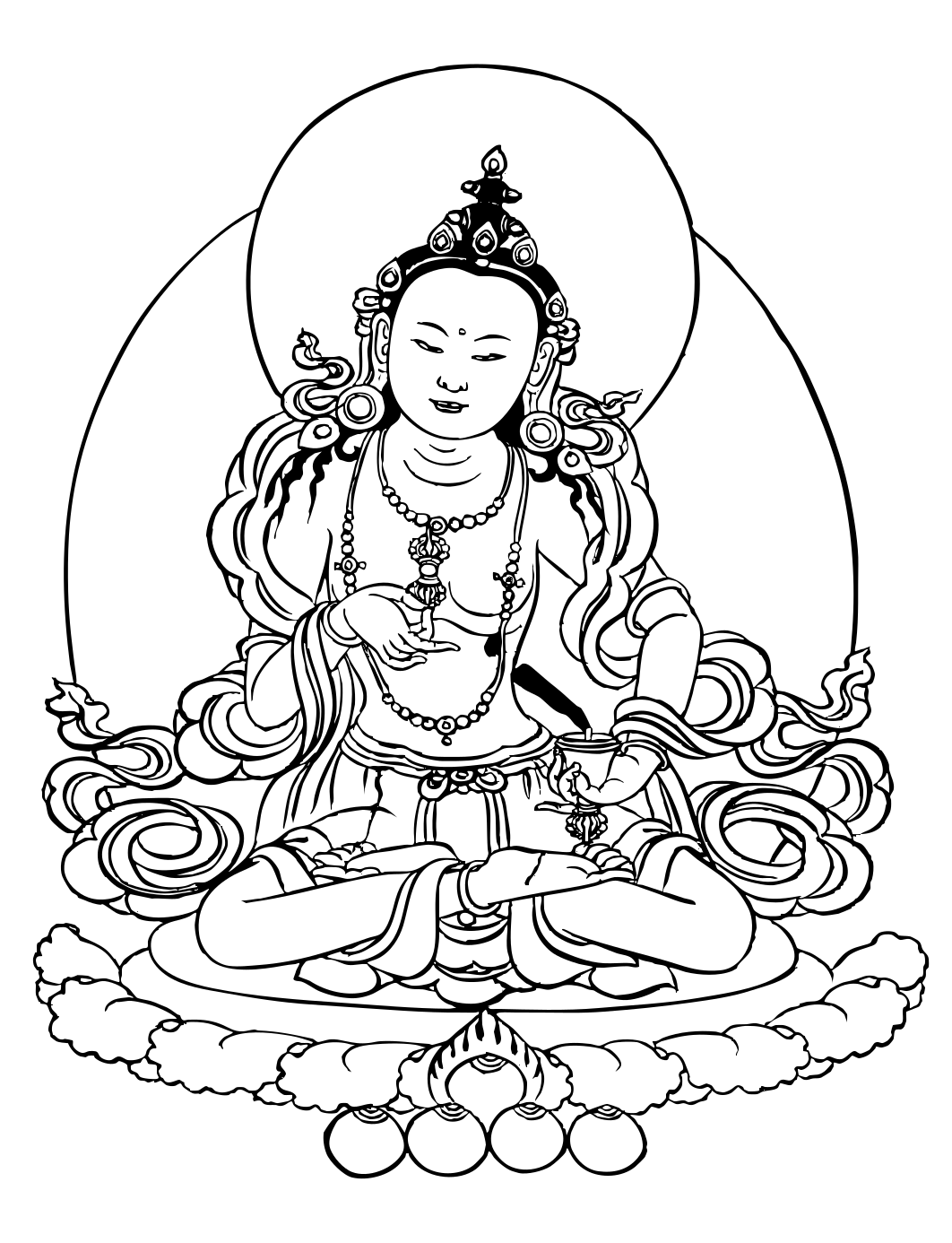
General Sūtra Section
The Good Eon
Toh 94
Imprint
Summary
Acknowledgements

Notes
Glossary
Bibliography
Abbreviations
༄༅།  །བསྐལ་པ་བཟང་པོ།
The Good Eon
Bhadra­kalpika
vajrasattva
s.

Summary

s.1

While resting in a park outside the city of Vaiśālī, the Buddha is approached by the bodhisattva Prāmodyarāja, who requests meditation instruction. The Buddha proceeds to give a teaching on a meditative absorption called elucidating the way of all phenomena and subsequently delivers an elaborate discourse on the six perfections. Prāmodyarāja then learns that all the future buddhas of the Good Eon are now present in the Blessed One’s audience of bodhisattvas. Responding to Prāmodyarāja’s request to reveal the names under which these present bodhisattvas will be known as buddhas in the future, the Buddha first lists these names, and then goes on to describe the circumstances surrounding their birth, awakening, and teaching in the world. In the sūtra’s final section, we learn how each of these great bodhisattvas who are on the path to buddhahood first developed the mind of awakening.

ac.

Acknowledgements

ac.1

Translated by the Dharmachakra Translation Committee under the guidance of Chokyi Nyima Rinpoche. Thomas Doctor produced the translation and Andreas Doctor, Anya Zilman, and Nika Jovic compared the draft translation with the original Tibetan and edited the text. The introduction was written by Thomas Doctor and the 84000 editorial team.

The translation was completed under the patronage and supervision of 84000: Translating the Words of the Buddha.

ac.2

The generous sponsorship of Dzongsar Jamyang Khyentse Rinpoche, Zhou Tian Yu, Chen Yi Qin, Zhou Xun, Zhao Xuan, Chen Kun, and Zhuo Yue, which helped make the work on this translation possible, is most gratefully acknowledged.

i.

Introduction

i.1

The Good Eon recounts the names and circumstances pertaining to all the one thousand and four buddhas who will appear in our world during this current eon, which is commonly known among Mahāyāna Buddhists as the Good Eon. Listed as the first scripture in the General Sūtra section of most Kangyur collections, it is among the longest of the Mahāyāna sūtras translated into Tibetan. Besides occupying this place of honor in the Kangyur, The Good Eon was often copied or printed separately in Tibet, where it has long functioned as a special ceremonial scripture that is read aloud by lamas on special occasions to foster well-being and good fortune, and that is often kept on the family altar in Tibetan homes for this purpose.

i.2

The sūtra unfolds in a park outside the city of Vaiśālī. The Buddha is resting there on his way to Vaiśālī from the city of Śrāvasti, where his monastic community has recently completed the annual rainy season retreat. Within the vast retinue that surrounds the Buddha is the bodhisattva Prāmodyarāja, who after a period of fasting and meditation approaches the Buddha. With the benefit of beings in mind, the bodhisattva requests instruction based on a certain meditative absorption that will allow one to accomplish omniscience. The Buddha proceeds to deliver a teaching on an absorption called elucidating the way of all phenomena, explaining how in the distant past, because a monarch (a previous life of the Buddha Akṣobhya) enabled a teacher (a previous life of the Buddha Amitāyus) to expound that absorption, he and his thousand sons were subsequently able to serve three billion buddhas over eighty eons. As a result, the thousand sons became destined to be the thousand buddhas of the Good Eon. Upon hearing this teaching, innumerable beings are deeply moved and attain profound states of liberation and awakening. At the end of his teaching, the Buddha himself enters this meditative absorption, as does Prāmodyarāja.

i.3

After seven days have elapsed, the citizens of Vaiśālī grow concerned and seek a way to rouse the Blessed One from his absorption for the benefit of gods and humans. Prāmodyarāja fulfils their wishes as he reemerges from meditation and requests the Buddha to explain the nature of the six perfections. The Buddha happily complies and delivers a remarkable and detailed long prose discourse (2.29–2.370) that elaborates one hundred and twenty-one different variations of the six perfections.

i.4

Responding to further questions from Prāmodyarāja, the Buddha reveals that in fact all the future buddhas of the current Good Eon are already present in the audience of bodhisattvas surrounding him, having mastered the absorption that he taught before. Overjoyed by this auspicious news, Prāmodyarāja further requests that the Buddha, out of love for the world, explain the names and circumstances under which these bodhisattvas will awaken as buddhas. The rest of the text comprises the Buddha’s reply, in the form of three enumerations, each of which includes the names of all the buddhas of the Good Eon.

i.5

In the first enumeration (2.A.6–2.A.99) the Buddha pronounces just the names of all the tathāgatas of the Good Eon, in a verse passage of ninety-three stanzas to which we have added the heading “the names” (although there are no headings in the source text). This list of names is followed by a few stanzas on the benefits of hearing and knowing them.

i.6

In the second enumeration (2.B.2–2.B.2514), again at Prāmodyarāja’s request, the Buddha then delivers a very extensive account in mixed prose and verse‍—comprising the main bulk of the text‍—that details, for each of the tathāgatas he had named, their respective birthplaces, family lines, physical radiance, family members, and chief disciples; the extent of their monastic community; their lifespans and the general lifespan of humans at the time; the duration of their teachings; and the character of their relics. This second list we have designated “the lives.”

i.7

In the third enumeration (2.C.4–2.C.997), again at Prāmodyarāja’s request, the Buddha proceeds to explain the circumstances under which each of these buddhas of the Good Eon was first inspired to develop the mind of awakening. Each buddha is covered in one stanza, in which we are told about their previous lives and occupations as they encountered buddhas of the past, and how they were moved to develop the compassionate resolve to attain awakening for the benefit of all. We have given this third list of 994 stanzas the heading “the engendering of the mind of awakening.”

i.8

The importance of giving rise to the mind set on awakening is underlined in a set of verses that follow, and the Buddha then tells another, different story of the previous lives of these thousand buddhas of the Good Eon when they were all the sons of a king who was another previous life of the Buddha Amitāyus. He then adds a further story, that of a universal emperor (a previous life of the Buddha Dīpaṅkara) and his sons, ministers, and queens, the consequence of whose devotion and determination will mature in three separate eons in the distant future. One eon will see ten thousand buddhas appearing (the sons), another eighty thousand (the ministers), and the third eighty-four thousand (the queens). The sūtra thus ends with a powerful account of the wondrous merit that ensues from contact with this teaching on the meditative absorption known as elucidating the way of all phenomena.

The Multiplicity of Buddhas and the Buddhas of the Good Eon

i.9

The theme for which The Good Eon is best known is its principal one, the detailed naming and descriptions of the thousand and four buddhas of the present Good Eon.

i.10

The appearance of successive buddhas over time is a theme common to all Buddhist traditions. From a historical viewpoint, artifacts referencing past buddhas can be dated as early as the emperor Aśoka’s time (third century ʙᴄᴇ), and references to the well-known set of seven successive buddhas are frequent from at least the first century ʙᴄᴇ onward. Mentions of multiple buddhas in both time and place are, of course, very widespread in the Mahāyāna sūtras.

i.11

The notion that buddhas have arisen and will arise one after another over time is the logical corollary of the idea that buddhas arise not as individuals in isolation but because they have, in previous lifetimes, been inspired and taught by previous buddhas. In this fundamental process through which the presence and teaching of buddhas inspire ordinary beings to themselves become further buddhas, the successive stages are seen as being spread over very long periods spanning many eons. The stages are defined in various different ways, but in essence the process begins with a period in which an individual accumulates merit independently, without necessarily involving the influence of a buddha. This is then followed by the first vow to attain awakening in the presence of a buddha, and at some subsequent point the prophecy of awakening made by another, later buddha. Next comes a long period of maturation during which the six (or more) perfections are practiced and the successive bodhisattva levels are traversed under the guidance of still more buddhas. During this period the bodhisattva will eventually reach a stage of irreversible progress after which awakening is inevitable. The process culminates in the bodhisattva being anointed by the preceding buddha as the next to come, taking birth in the Heaven of Joy, and being reborn in the final human lifetime in which awakening as a tathāgata will occur.

i.12

Each buddha during his dispensation will, in turn, inspire numerous disciples to make the aspirational vow to become awakened, will teach and guide others already on their path to that end, will prophesy the future awakening of many, and will anoint an immediate successor. The number of formal prophecies of awakenings made by the Buddha Śākyamuni alone throughout the canonical sūtras would account for a very large number of future buddhas. Most of these, however, are destined for awakening in a future eon rather than in the present one. The buddhas of the present fortunate eon, detailed in this text, are all understood to have been granted their prophecies in eons of the distant past, even if the text makes no mention of the prophecies themselves.

i.13

In the literature of different Buddhist traditions there are a number of sūtras and text passages that focus on detailing the lives of numerical sets of past buddhas, usually following a framework of standard features similar to that used in the second enumeration in this text, as described above (i.6). The archetype among the sūtras common to both the Pali Canon and the Chinese (and Sanskrit) āgamas is the Mahāpadāna or Mahāvadāna, which gives details of the widely known series of seven successive buddhas. The later Pali Buddhavaṃsa includes twenty-five buddhas, from Dīpaṅkara to Śākyamuni. Two sūtras, both called Bahubuddhaka (“The Many Buddhas”), are incorporated in the Mahāvastu of the Lokottaravāda branch of the Mahāsaṅghika school and mention a vast number of buddhas, many in sequences numbering millions of the same name. A similar passage on the same theme, probably related to these Mahāsaṅghika sūtras, is included in the introductory section of the sixth-century Chinese translation of the Abhiniṣkramaṇa­sūtra, the Foben xingji jing. Another fragmentary Bahubuddhaka text detailing fifteen buddhas from Dīpaṅkara to Maitreya has been identified among the Gāndhāran scrolls written in Kharoṣṭhī script, found in recent decades and dated to the first century ʙᴄᴇ.

i.14

A comparable “many buddhas” survey of buddhas met by the Buddha Śākyamuni in his past lives is found in the literature of the Mūlasarvāstivādin vinaya, with corresponding versions in Sarvāstivādin and Saṃmitīya texts. It summarizes the succession of buddhas he met in each of the three “incalculably long eons” preceding the present one‍—seventy-five thousand, seventy-six thousand, and seventy-seven thousand respectively‍—and describes the offerings, other acts of veneration, and aspirations he made, with a final section (in some versions) naming some seventy among those buddhas. This passage is found embedded in the Chinese, Tibetan, and fragmentary Sanskrit versions of the Bhaiṣajyavastu, which, in the Tibetan Vinaya section, is chapter 6 of the Vinayavastu (Toh 1).

i.15

The scriptural accounts mentioned so far refer essentially to buddhas of the past, even if many of them also introduce Maitreya as the buddha who will succede Śākyamuni in the future. A much more extended future is outlined in a number of texts that contain the notion that our present eon is particularly “good” or fortunate in that a thousand (or in some texts five hundred) buddhas will appear in it, many of these texts not being of distinctly Mahāyāna allegiance. The Good Eon, with its enumerations of only four past buddhas but one thousand still to come, is therefore by no means unique, even if the detail in which it sets out these buddhas’ names and other characteristics is unparalleled. Another feature of The Good Eon, origin stories (in fact two different origin stories) of the thousand buddhas as a group of practitioners whose collective inspiration to attain awakening arose on a specific, collectively experienced occasion, are also not confined to this text alone. The next most detailed account of the thousand buddhas’ origin story comes in the Karuṇa­puṇḍarīka (The White Lotus of Compassion, Toh 112), of which the third and fourth chapters contain a long narrative about a king called Araṇemin (a previous lifetime of Amitāyus), his priest Samudrareṇu, and the priest’s son, the Buddha Ratnagarbha, whose followers more generally are destined to become most of the best-known buddhas and bodhisattvas of the Mahāyāna. Among them, a thousand young brahmin disciples are prophesied to become the thousand buddhas of the Good Eon, and of these seven are named.

i.16

Similarly, a long narrative jātaka passage in the Tathāgatācintya­guhya­nirdeśa (The Teaching on the Unfathomable Secrets of the Tathāgatas, Toh 47) describes how the thousand sons of a king called Dhṛtarāṣṭra (a previous incarnation of the Buddha Dīpaṅkara) are prophesied to become the thousand buddhas of the Good Eon; some twenty of those buddhas are named, but only the first six match the names in The Good Eon.

i.17

In the Vimala­kīrti­nirdeśa (The Teaching of Vimalakīrti, Toh 176), too, the Buddha recounts a jātaka story about the thousand sons of a king called Ratnacchattra (a previous lifetime of the Buddha Ratnārcis) who, under the Buddha Bhaiṣajyarāja, are prophesied to become the thousand buddhas.

i.18

That the names and other details related to the thousand buddhas do not all correlate perfectly across texts is no great surprise. Even the three lists of buddhas within this single text do not match with full precision. That does not mean, however, that the prolific detail of this text and others like it should be dismissed as unimportant. Indeed, as this sūtra itself makes clear, just to recite, hear, and honor these names forges deep connections and aspirations, generates immeasurable merit, and brings inconceivable blessings. Moreover, the plethora of detail presented in this scripture also serves to underline the importance of aspiration, to reinforce the idea that countless buddhas can evolve from sentient beings, to illustrate the essential notion of lineage, and perhaps to delineate the past connections linking this set of successive buddhas destined to appear consecutively in a defined period of time in this particular universe. As a consequence of the merit and blessings associated with this powerful and intriguing theme of the thousand buddhas, it has found rich expression over the centuries not only in a wide range of literature but also in ritual, in temple mural and thangka paintings, and in sets of sculpted images.

The Good Eon as a “samādhi sūtra”

i.19

A central theme of the sūtra‍—but one that can easily be overlooked, eclipsed as it is by the detailed accounts of the thousand buddhas themselves‍—is the meditative absorption that, the Buddha explains, has been the practice through which the buddhas Amitāyus and Akṣobhya attained buddhahood (1.87 and 2.3 respectively), and the practice through which the thousand princes destined to become the thousand buddhas first began to progress on the path (2.3–2.4).

i.20

The meditative absorption (samādhi) in question, which he names as elucidating the way of all phenomena, is not so much the kind of concentrated state of mind that is often designated by the term samādhi, but more a wide-ranging ensemble of attitudes, behaviors, and practices. In all their diversity, what these elements have in common is that they are all based on the defining quality of bodhisattvas, the mind set on awakening for the sake of all beings.

i.21

The sūtra contains a long list of almost five hundred different facets of this meditative absorption (1.19–1.34). This first list is followed (after a short verse description) by another list of ninety-seven qualities that are acquired by bodhisattvas who attain the absorption (1.49–1.53), culminating in the Buddha’s equating the absorption with its ultimate result, omniscience itself.

i.22

Lists very similar to these are seen in several other important Mahāyāna sūtras belonging to the genre sometimes described collectively as the “samādhi sūtras.” Their Tibetan translations in many Kangyurs are mostly grouped together on the basis that their titles all contain the term samādhi (Tib. ting nge ’dzin), but among texts with such titles a particular subset is formed by those containing long lists, like this one, of features attributed to a named samādhi, clearly referring to a diverse set of practices and attitudes that are not states of meditation, concentration, or visionary experience of the kind more usually designated by the term samādhi. Texts in this group include The King of Samādhis (Samādhi­rāja, Toh 127), The Samādhi of Valiant Progress (Śūraṅgama­samādhi, Toh 132), The Samādhi in which the Buddhas of the Present All Stand Before One (Pratyutpanna­buddha­saṃmukhāvasthita­samādhi, Toh 133), and The Absorption that Encapsulates All Merit (Sarva­puṇya­samuccaya­samādhi, Toh 134), all of which appear to have been referred to as “samādhis” by Asaṅga as early as the fourth century CE in his Mahā­yāna­saṃgraha. To these texts can be added The Absorption of the Miraculous Ascertainment of Peace (Pra­śānta­viniścaya­prāti­hārya­samādhi, Toh 129).

i.23

The Good Eon, perhaps because it is placed elsewhere in the Kangyur and because its samādhi is not seen as its principal topic, is not widely recognized as belonging to this group of texts. Nevertheless, the samādhi list it contains bears striking similarity to the lists in the other sūtras mentioned, all of which (with the possible exception of The Absorption that Encapsulates All Merit) are quite similar to each other and contain sequences of nearly identical phrasing. Further research would be required to determine the details of the relationships between the list in this text and those in the other samādhi sūtras.

i.24

The samādhi list in The Good Eon is matched particularly closely by a samādhi list in a little-explored sūtra that exists only in Chinese, 觀察諸法行經 (Guancha zhufaxing jing), which as Taishō 649 is placed at the end of a series of other samādhi sūtras in volume 15. It was translated in the late sixth century ᴄᴇ by Jñānagupta. Its title is also the name of the samādhi described in the text, which matches the name of the samādhi in The Good Eon. As a sūtra in its own right, it starts with a different introductory passage and is set on Vulture Peak in Rājagṛha, but then focuses on the Buddha’s dialog with the bodhisattva Prāmodyarāja concerning the samādhi and its description. It appears therefore to represent an independent sūtra centered on the same samādhi passage as is found here in The Good Eon, but without the content concerning the thousand buddhas.

Sources and Translation

i.25

No complete version of The Good Eon is extant in any Indic language, and until recently the only known references to this scripture in Indian Buddhist literature were two brief citations included in two famed anthologies, the Śikṣāsamuccaya (Toh 3940) and the Sūtrasamuccaya (Toh 3934). However, the recent discoveries of two manuscript fragments (one Gāndhāri and one Sanskrit) testify to a somewhat wider circulation of the text in India than was previously assumed. Though no complete Indic version of The Good Eon survives, we can trace its textual history back to at least 300 ᴄᴇ when it was first translated into Chinese (Taishō 425). The translator, the monk Dharmarakṣa, was one of the most important translators of Mahāyāna Buddhist texts in China, responsible for the translation of around one hundred and fifty texts, including the first Chinese version of the Lotus Sūtra. In addition to this Chinese translation, two newly identified fragments of another Chinese translation of The Good Eon now support the theory that an additional Chinese translation was produced by the famed translator Kumārajīva (344–411) but, sadly, was subsequently lost.

i.26

According to the colophon to the Tibetan translation, the sūtra was translated into Tibetan by the Indian scholar Vidyākara­siṃha and the Tibetan translator Palgyi Yang. It was subsequently revised and finalized by the famous Tibetan editor Paltsek. This suggests that the Tibetan translation was produced in the late eighth or early ninth century ᴄᴇ. This dating is also confirmed by the text’s inclusion in the Denkarma catalog of the early ninth century.

i.27

This English translation was prepared based on the Tibetan translation in the Degé Kangyur in consultation with the Comparative Edition (Tib. dpe bsdur ma) and the Stok Palace Kangyur.

i.28

Our translation benefited immensely from the previous research published on this sūtra. We are especially indebted to the highly informative article series published by Peter Skilling on The Good Eon (2010, 2011, 2012) and the joint publications by Skilling and Saerji on this sūtra (2014, 2016, 2017, 2018, 2019). Skilling and Saerji did meticulous research on the names of the many buddhas that appear in the text, and we have, in many cases, adopted their renderings of these epithets. These scholars also translated the important section of the text that describes how these buddhas first developed the mind of awakening. Skilling and Saerji further published a careful study of the many references to the past lives of the Buddha that appear in the section on the perfections. We have referenced this research in the notes to our translation so that interested readers can easily consult it for further details. Finally, we also benefited from a complete translation of the Tibetan text that was published by Dharma Publishing several decades ago (The Fortunate Aeon, 1986). Considering the complexity and obscurity of many passages in this text, it is our hope that The Good Eon may continue to receive the sustained attention of scholars in the future. It is also our hope that this translation may be of benefit to those who wish to engage further with this beautiful sūtra.

The Translation

The Noble Great Vehicle Sūtra

The Good Eon

1.

Chapter 1

1.1

[B1] Homage to all buddhas and bodhisattvas.

1.2

Thus did I hear at one time. The Blessed One was residing at Śrāvasti, where he had observed the summer retreat. After the three months of summer had passed, he prepared his Dharma robes. Once he had prepared his Dharma robes, he put on the robes, took up his alms bowl, and, together with one hundred thousand monks and eight hundred million bodhisattvas, proceeded toward the city of Vaiśālī. On the way, the Blessed One entered a large forest, where he later arose from meditative seclusion.

1.3

The bodhisattva Prāmodyarāja, who had also entered meditative seclusion, now likewise reemerged from this state. He and the whole assembly of monks, nuns, male lay practitioners, female lay practitioners, gods, nāgas, yakṣas, gandharvas, asuras, garuḍas, kinnaras, and mahorāgas were now seated on their mats. All of the assembled bodhisattvas had attained illumination, dhāraṇī, and absorption. They were endowed with the five superknowledges, their words were engaging, and they were free from pretense, had no worldly ambitions, and were free from attachment. They taught the Dharma without any regard for material things. They had perfected acceptance of the profound Dharma, had accomplished fearlessness, and were beyond the actions of the māras. They had shed karmic obscurations, achieved the state free from any doubt about the nature of the Dharma, and accumulated aspirations throughout countless eons. They had smiles on their faces, spoke straightforwardly, and never frowned. They communicated in melodious voices, their minds were indomitable, and the flow of their eloquence was unbroken. They had achieved acceptance of equality. They were able to outshine infinite gatherings without any fear. They were adept at elaborating on a single word throughout ten million eons.

1.4

They were confident that all phenomena are just like illusions, a mirage, the moon in water, dreams, and echoes. Their minds were endowed with infinite fearlessness, and they were confident in knowing the most subtle movements in the minds of sentient beings, as well as every aspect of their conduct. They possessed vast virtue and their minds were unimpeded. They were free from exaggerating pride and endowed with patience. Their virtues were genuinely comprehensive. Their aspirations encompassed infinite arrays of buddha realms. They constantly manifested the absorption of recollecting the buddhas of countless world systems. They were skilled in supplicating boundless buddhas. They were skilled in quelling differing views, as well as latent tendencies and the fetters of emotional defilements. They were skilled in accomplishing hundreds of thousands of displays through absorption. They included the bodhisattva Maitreya, as well as the youthful Mañjuśrī, Avalokiteśvara, Sound of Thunder, Mind of Blooming Flowers of a Hundred Thousand Virtues, Possessor of the Mind of Infinite Practice and the Speech That Is Adorned with Flashes of Lightning, Possessor of the Mind of Complete Detachment, King of Renown, Perceiver of the Agreeable and the Disagreeable, King of the Splendid Light of Deep Accumulations of Gold, Seeing and Moving Across a Hundred Yojanas, Heaps of Eloquence, Mass of Wisdom, Amoghadarśin, Bhadrapāla, the Eight Holy Beings, Gandhahastin, Jewel Treasury, Heaps of Insight, Array of Offerings, King of the Melodious Lion’s Roar, Adorned with Arrays of Wisdom, Moving with the Gait of a Lion, Fearless in Limitless Mastery of Eloquence, the bodhisattva Prāmodyarāja, and others.

1.5

From the world systems of the great trichiliocosm came the Four Great Kings, Śakra, Brahmā, Īśvara, Mahābrahmā, nāga leaders, yakṣa leaders, asura leaders, garuḍa leaders, kinnara leaders, mahorāga leaders, and gandharva leaders, arriving in the presence of the Blessed One, scattering flowers before him, and then taking their places in the gathering.

1.6

At that time, the bodhisattva Prāmodyarāja observed seven days of fasting during which he would either stand or sit upright, practicing with unrelenting diligence, free from drowsiness and without sleep. It was then that the bodhisattva Prāmodyarāja spoke to the Blessed One: “Which quality must bodhisattvas perfect in order for them to know the thoughts and conduct of all sentient beings, to apply the words that have the intent of all the buddhas, to avoid teaching based on incorrect teachings, to follow knowledge grounded in truth as literally expressed, and to become free of any obscuration with respect to all the buddhas of the present? Through which quality may they be able to accompany and perceive the buddhas, achieve certainty through the Dharma, follow the ways of the world without becoming stained by the world, abide in meditative attainments without taking birth in the corresponding realms, practice the Dharma of nirvāṇa without transcending suffering, and practice the Dharma of hearers and solitary buddhas in which the aspirations of buddhahood are not perfected, without achieving deliverance through those vehicles? Through which quality may their minds be unclouded in recollecting the buddhas, may they engage with the different dispositions and also be in accord with them all, not become overpowered by any question or eloquence, apprehend all the infinite displays of the buddha realms, attain all forms of insight, bring sentient beings to maturation without adhering to the notion of ‘sentient being,’ teach the Dharma yet not fixate on any objective references, explain nirvāṇa yet not objectify this peacefulness in any way, act for the sake of awakening without fixation, and give up existence, as well as no existence, but aspire to what is vast? Blessed One, I do not ask in this way without any knowledge. Nevertheless, please explain.”

1.7

Then the bodhisattva Prāmodyarāja spoke these verses:

  • “A large assembly of gods, humans, yakṣas, and gandharvas
  • Have gathered here in accordance with their infinite aspirations.
  • What is the practice of the bodhisattvas?
  • You are the protector of the worlds, the Illuminator,
1.8
  • “Moon of Speech‍—as I beseech you,
  • Please give the teaching in step-by-step fashion.
  • When common people hear of the qualities of supreme awakening,
  • They become inspired and endeavor for awakening.
1.9
  • “With faith in the supreme qualities of awakening,
  • I ask you who have perfected all good qualities.
  • Master of infinite renown, do you know my mind?
  • Other than the Victorious One, who could be my witness?
1.10
  • “Gods and humans are thirsting for the qualities of the victorious ones.
  • Please explain, delineating the practices of the ten powers.
  • You possess the supreme qualities and have the qualities of awakening.
  • You who know the great ways of renown and beauty, please explain!
1.11
  • “How do the brilliant light rays of wisdom
  • Conquer the forces of darkness and their armies?
  • How is the trichiliocosm quickly shaken?
  • Well-Gone One, please explain about such activities of awakening.
1.12
  • “How does the flower of the buddha marks blossom?
  • How does one come to possess an infinite voice?
  • How does the absorption that resembles Sumeru arise?
  • Please explain such practices of the mind of awakening.
1.13
  • “Incomparable and unrivaled, you are without guile or pretense,
  • Selfless, worthy, and free from contamination of the three stains.
  • You are the supreme mendicant praised by throngs of the learned‍—
  • I ask you about the practices of supreme people.
1.14
  • “Your understanding is stable and mindful, and you have the flower of speech.
  • Unconfused, you master excellent conduct and are the best of orators.
  • Good person free from stains, supreme leader and benefactor,
  • Please teach me how to become victorious.
1.15
  • “When I have heard these matters from you,
  • I shall pursue the true practices of awakening throughout day and night.
  • Without anything else occupying my mind,
  • I shall joyfully devote myself fully to these practices.
1.16
  • “How does one possess absorption and dhāraṇī?
  • How does one possess wisdom, insight, and eloquence?
  • How is one able to behold buddhas in infinite directions,
  • And to ask questions regarding what is right and what is not?
1.17
  • “How is unequaled wisdom realized?
  • How are the hundreds of avenues of virtue accomplished?
  • And how does the teaching become free from error?
  • This I ask of you, who practices the ten powers.
1.18
  • “I ask not out of attachment to the pleasures of existence,
  • Or because I am swayed by objects.
  • I cherish the elixir of the victorious ones.
  • So please, quickly, teach me about the practice of the ten powers!”
1.19

The Blessed One then spoke to the bodhisattva Prāmodyarāja: “Excellent, Prāmodyarāja, excellent! I possess the absorption called elucidating the way of all phenomena. When bodhisattvas possess that absorption, they attain those qualities. Furthermore, they perfect one hundred and twenty-one perfections. They attain eighty-four thousand absorptions and eighty-four thousand dhāraṇīs. They realize expert ways of engaging in the conduct of all sentient beings, and they quickly awaken to unexcelled, complete, and perfect buddhahood.

1.20

“Prāmodyarāja, what is the absorption called elucidating the way of all phenomena? It is doing exactly what one says. It is saying exactly what one has done. It is purifying the body, purifying the speech, and purifying the mind. It is the wish to benefit. It is being endowed with love, not relinquishing compassion, not pursuing pleasures, pursuing the Dharma, ensuring that faith is not wasted, and practicing in accordance with one’s pledges. It is being expert regarding language. It is liberating sentient beings, practicing well-considered deeds, not having bodily cravings, and having an unwavering mind. It is easing those in pain, ennobling the happy, restraining the careless, improving the diligent, dispelling regrets regarding the Dharma, not harboring preconceptions regarding sentient beings, not harboring preconceptions regarding entities, cutting through grasping, and demolishing attributes. It is immutable equipoise, the constant pursuit of wisdom, giving up mundane conversation, seeking supramundane conversation, impeccable mindfulness, and freedom from discussing phenomena. It is correct engagement in actions, accomplishment in conduct, knowledge of the world, and firm conviction in karma. It is giving up lack of faith, being highly motivated, setting one’s mind on buddhas, teaching flourishing, rejoicing in merits, supplicating the buddhas, paying homage to those worthy of offerings, and expressing praise.

1.21

“It is being free from pride, being insatiable regarding roots of virtue, being constantly diligent, not giving up on one’s pursuits but ensuring their completion, being magnanimous in the world with respect to deeds performed according to causes and conditions, and not forsaking the requisites. It is not postulating a single metaphysical ground and not clinging to the idea that ‘this alone is true.’ It is never calling the desire realm ‘home,’ not clinging to the form realm, not being of the nature of the formless realm, and having firm conviction about how results manifest in accordance with their conditioning. It is sharing one’s own means and being impartial, never tricking any being, not being deceptive regarding the buddhas, not disparaging bodhisattvas, and not speaking badly about the teachings.

1.22

“It is harboring no anger toward the rational or irrational, not relying on the wealth of other groups, never failing to fulfill wishes, giving up pride, giving up anger, and conquering ignorance. It is not enjoying wealth, being content with bare necessities, abandoning worldly pursuits, not being displeased with not getting wealth, not becoming conceited at getting wealth, sharing whatever one obtains, and not hoarding. It is accepting negative words from others, guarding one’s words, being clear minded, encouraging those who are rational, not following those who are irrational, and practicing sustained inquiry. It is not giving up meditative seclusion, not leaving the wilderness, always practicing the ascetic virtues, being inspired by emptiness, not being satisfied with things, not fixating on the aggregates, subduing the elements, not reifying the sense sources, not revering objects, giving up error, attaining mental stability, abiding in the abodes of the noble ones, having a mind free from craving and yearning, attaining the level of being worthy of offerings, and completely purifying karmic conditioning.

1.23

“It is generosity whereby you do not take on karmic ripening, it is discipline whereby you have no arrogance, it is patience whereby you have no divisive thoughts, it is diligence in which your efforts are not squandered, it is concentration whereby you do not take rebirth, and it is insight whereby you do not squander life. It is equality as the perfection of progressing in the spiritual levels. It is not being conceited about one’s own qualities and not denigrating the good qualities of others. It is not remaining in saṃsāra, not objectifying nirvāṇa, mastering liberation, not being attached to nirvāṇa, and resting in certainty. It is having a smile on one’s face, not having an angry frown, and speaking with sincerity. It is praising novices, midlevel practitioners, and seniors due to their proper understanding. It is being free from animosity, pacifying disputes, praising peace, endeavoring in the accumulations, and having equal concern for those who are one’s friends and those who are not one’s friends.

1.24

“It is pursuing dhāraṇī. It is respectfully serving all beings as if they were one’s mother, respectfully serving all wise ones as if they were one’s father, respectfully serving all masters as if they were one’s own preceptor, venerating the bodhisattvas as if they were buddhas, worshiping the thus-gone ones, aspiring to virtue, and untiringly venerating the Three Jewels. It is joyfully persevering without being involved in worldly affairs, not having concern for the body, not being attached to one’s own life, maintaining a pure livelihood, not giving up the practice of making alms rounds, abandoning places where people gather, not praising householders, and not conducting business among those who have gone forth. It is having no hypocrisy, not engaging in flattery, speaking pleasantly, adhering to the practices of awakening, being naturally undaunted, and engaging in what is appropriate. It is offering continuous praise for the Buddha, always being attentive to the Dharma, and always following the Saṅgha. It is constantly worshiping those endowed with knowledge, always relying on those who are erudite, always guarding those in meditation, always exhorting those endowed with reason, always relying on the teachings of the buddhas, always cultivating the Dharma teachings, always trusting in merit, always being generous to sentient beings, always caring for those who have faith, and bringing relief to those who suffer.

1.25

“It is having pure conduct, knowing shame and modesty, having a manner that demonstrates shame and fear, giving up unwholesome conduct, attending to proper conduct, and being inclined toward renunciation. It is seeking out the abodes of the noble ones, cultivating the applications of mindfulness, relying on the correct abandonments, taking hold of the faculties, accomplishing the powers, having special insight into the factors of awakening, and being unerring on the path. It is possessing vast calm abiding, rousing special insight, being free from forgetfulness, and having genuine joy in the Dharma. It is going beyond objective references, not fearing the lack of support, and not confusing the absence of objective references with carelessness. It is abiding by the conduct of the bodhisattvas, engaging in the infinite conduct of the buddhas, having scorn for unwholesome conduct, being saddened by past karmic formations, purifying one’s own karma, and taking charge of what has not yet been tamed.

1.26

“It is never disparaging the teachings, not harboring doubts, acting in timely ways, giving up what is not timely, having skill in going and returning, knowing limits, being content regarding material things, having vast superknowledge, mastering absorption, having diverse modes of conduct, and having vast courage. It is the teachings of the thus-gone ones, being fully receptive through nonapprehension, satisfying the diligent, cultivation by the children of the buddhas, the wealth of the bodhisattvas, the abiding of the buddhas, and the practice of the learned, the domain of intelligent progress, and the domain of the teachers of the Dharma. It is inspiration for the highly motivated, the disposition to behold the protectors of the three worlds, a treasury for those in pursuit of wealth, and a field of those endowed with ripening. It is true happiness for the tormented, a park for those who have achieved dhāraṇī, a pool for those who have attained absorption, a mother for those endowed with virtuous qualities, a support for those inspired by speech, the cause of the major marks of the buddhas, the discernment of the minor marks, and the refuge of the buddha realms. It is the full attainment of dhāraṇī, mastery of attainment, and perfectly reasonable speech.

1.27

“It is transcendence of the realm of the māras, the realm of heroes, conquering the emotional defilements, demolishing unvirtuous actions, the adornment of those with aspirations, and invulnerability to the māras. It is the inexhaustible teachings, what is hard to fathom for non-Buddhist sectarians, what is dissimilar to the world, what transcends the Dharma of the hearers, and what is not the deliverance of the solitary buddhas. It is attaining omniscience, entering the existences of sentient beings, and inspiration for the ultimate state of reality. It is delighting those wishing for food, and satisfying those thirsting for drink. It is the essence of those who attain nirvāṇa, the chariot of those who attain nirvāṇa, the boat for sailing to the other shore, the boat for those wishing to cross, the lamp for the compassionate, the shooting star for the teachers of Dharma, the abode of those wishing for freedom from deception, wealth for those wishing to give, knowledge for those wishing for liberation, ennoblement for those in pursuit of amusements, an ocean for those wishing to learn, Mount Sumeru for those who accomplish absorption, a sense faculty for those who desire eyes, a display for those wishing to see, delight for those endowed with mind, the abode of nonregression, and the intention of those who have attained acceptance that phenomena are unborn.

1.28

“It is the cultivation of beginners, the banner of people with understanding, the awakening of those who revere calm abiding, and the Nārāyaṇa of those who teach the absence of self. It is the path of omniscience, the equality of birth for those with wisdom and liberation, what is praised by the gods, what is extolled by the nāgas, what is worshiped by humans, what inspires wonder in those in training, what is revered by those beyond training, what is applauded by the bodhisattvas, and what is cultivated by the lords of Dharma. It is the city of those who guard their faculties, the way of skillful ones, the attainment of the diligent, the dispelling of doubts, cutting through doubts, dispelling the defilements, and the dhāraṇīs of the bodhisattvas. It is a doctor for the sick, a remedy for error, and a reliever of pain. It is the contemplation for those wishing to persevere, fearlessness for those wishing to proclaim, vast and genuine knowledge for those wishing to speak, miraculous abilities for those wishing to perform miracles, a journey for those wishing to hear, eyes for those wishing to see, the path to nirvāṇa, relinquishing the lower realms, transcending the realms of desire, form, and formlessness, and accomplishing the realms of the buddhas.

1.29

“It is embracing the vajra-like absorption, the lion throne for those in their final existence, the roots of virtue for those who pursue nondegeneracy, giving joy to the sad, uplifting the downtrodden, fortifying the diligent, and accomplishing the dispositions of conduct. It is contemplation for the idle, the declaration of the equality of the three vehicles, abandoning all grasping, perfecting omniscience, thoroughly attaining the infinite gateways of those who teach the ultimate, ensuring that the qualities of the teaching of emptiness are not wasted, and perfecting the strength of the gateways of aspiration. It is communication for those who are inspired toward the absence of marks, the equality of the three times for those who are inspired toward seeing and equanimity, skill in universal outreach, and teaching awakening. It is not being vulnerable to denigration by others.

1.30

“It is the Dharma teachers’ pursuit of freedom from delusion, following Dharma teachers who are free of materialistic concerns, and listening to the Dharma without distraction. It is the unblemished retinue, the absence of obstacles for giving the Dharma, causing amazement in those who ask questions with conviction, dispelling regret, continuous engagement, not abandoning the accumulation of wisdom, the liberation of those who grasp, the taming of those who are offensive, and shedding the defilements. It is practicing without supports, being mindful of those wishing for mindfulness, uplifting the bodhisattvas, teaching the fourfold retinue, and the sweetest among delicious tastes. It is a declaration for those wishing for miraculous abilities, an open door for those wishing to turn back from existence, the liberation in nirvāṇa, a blissful body, a blissful mind, the joy of the wise, the nonabdication of firm commitments, and the undeterred attainment of the qualities of the thus-gone ones.

1.31

“It is the abode of the roots of virtue, the destruction of nonvirtue, training for those with misguided intelligence, the abode of those adhering to reason, the nondeceptive guide, the attainment of the light of the buddhas, the light of the mass of wisdom, and displaying the realms of the buddhas. It is the posing of millions of questions, thinking of virtuous qualities, a focal point for the weary, not forsaking those of poor intelligence, and delighting the knowledgeable. It is the cause of action for those wishing to teach, the protector of those who teach the Dharma, knowledge of all causes, and skill in means regarding all phenomena. It is accomplishing the means for contemplation, seeing in accord with reality, conveying meaning to oneself, truly satisfying others, cutting through the mesh, and dispelling ignorance. It is understanding the aggregates, understanding consciousness, comprehending name and form, seeing the six sense sources, understanding contact, knowing sensation, quelling craving, giving up grasping, halting becoming, uprooting birth, and transcending old age and death. It is the purification of suffering, rejoicing in happiness, dispelling suffering and unhappiness, attaining the accomplishments, satisfying the discerning, flawless light, and proclamations in accord with the Dharma. It is the power of beings who have gained fame, the cleansing of those who are stained, and overcoming the view that takes the aggregates to be a person.

1.32

“It is retaining what is heard and retaining the teachings of the Dharma. It is unmistaken awakening, unceasing engagement with virtuous factors, vast accumulations of virtue, the basis for attaining wisdom, the Dharma way of the diligent, expanding the saṅgha of noble beings, eliminating the criticism of others, approving of those who teach the Dharma, and the conduct of bodhisattvas. It is the moon for those wishing to play, the sun for those who pursue livelihood, the treatise for those wishing to train, the king of those who are respected, the guide of the learned, the seed of virtuous factors, the nectar of the ripened fruit, the basis for recollecting births, the attainment of birth, contempt for childish teachings, the authentic qualities of the teachings of the thus-gone ones, and the infinite ripening of those who teach and uphold the Dharma. It is a foundation of omniscience, attainment of the higher realms in teaching, abandoning all fears in posing questions, never turning back when crossing over, and a foundation for expressing realization. It is letting the entire world ponder the Dharma, the words of all the buddhas of the past, the treasure of the wisdom of all the buddhas of the present, and the perfection of the realization of all the buddhas of the future.

1.33

“It is quickly attaining unshakable true wisdom, the seal that emerges from the Buddha’s hand, and the insatiability of those who wish to ask about the Buddhadharma. It is the quelling of aggressive cognitions, the attainment of skillful means, cultivating the earth element, engaging with the water element, balancing the fire element, stabilizing the wind element, and attaining liberation in the space element. It is revealing the element of consciousness, dissatisfaction with conditioned factors, bringing an end to latent tendencies, dispelling anger, letting go in equanimity, skill regarding one’s own support, skill regarding the support of others, and words for those wishing to speak. It is freedom from clinging to accomplishments, relinquishing the idea of ‘I,’ relinquishing the idea of ‘mine,’ the basis for reversing inclinations, a cautious mind, attending to the mind like a guard dog, entering the vast, and comprehending the subtle.

1.34

“It is shade for the weary, traversing the river, being indomitable when under attack, the staff of good people, veneration for spiritual teachers, giving up dullness and sleep, going beyond agitation, giving up doubt, dispelling the wish for pleasure, and giving up laziness. It is not observing a self, not propounding the existence of a sentient being, not fixating on a life force, being free from forgetfulness regarding the Dharma, speaking flawless words, speaking with reason, properly contemplating the process of formation, the essence of mastery, the essence of being undeterred, inspiration toward generosity and wisdom, entering the retinue without timidity, not disparaging others, not proclaiming one’s own qualities, and constant commitment for the sake of awakening. It is diligent engagement, not staying for long in any location, giving up grasping, engaging in auspicious activities, not being of the body, an undaunted mind, expertise regarding the supports, cultivating recollection, being unswerving and free from pride, pursuing liberation, the resolution of doubt, taking birth in the pure abodes, the mind of equal love, the compassionate embrace, the joyous experience of appreciating oneself, dispelling attachment and anger within impartiality, accepting others through discipline, entering the attainment of absorption, and entering the liberation of all factors through insight. It is understanding the use of syllables, skill in etymology, mastering expressions, engaging with language, pursuit of the essence of expertise, and expressing the gift of Dharma without vested desires. It is having no zeal for single-minded certainty, not growing tired of a single approach, neither accepting nor rejecting what concerns awakening, not squandering any dharma, teaching correctly, and not deceiving any sentient being. It is the perfection of stable aspiration, continuous engagement throughout day and night, the conduct of the bodhisattvas, entering the realms of sentient beings, and accomplishing omniscience. Prāmodyarāja, this is the absorption that is known as elucidating the way of all phenomena.”

1.35

At that time, the Blessed One spoke these verses:

  • “The path of the noble ones that purifies conduct,
  • The way of harmony that refines the mind,
  • And the way of the branches of awakening, the essence of eloquence‍—
  • This absorption is the treasure of the well-gone ones.
1.36
  • “Stainless subduer of the māras that alone eliminates anger,
  • Insight that severs the craving for existence,
  • Perfectly granting the qualities of fame and renown,
  • Final deliverance from the three realms,
1.37
  • “It is the ground of wisdom and is also the path of virtue.
  • It is the family of the noble ones, the destroyer of māras,
  • The liberator from existence, praised by the well-gone ones‍—
  • This absorption is the wealth of the well-gone ones.
1.38
  • “The gate to ten million ways of entering perfect equality,
  • The source of understanding, satisfaction, and severance,
  • Destroyer of suffering and harbinger of happiness‍—
  • This absorption is the conduct of the well-gone ones.
1.39
  • “Making us recollect and understand the flower of the branches of awakening;
  • Amassing virtue, the excellent foundation, with a sense of modesty;
  • Delighting the well-gone ones with garlands of the branches of awakening‍—
  • This is the supreme absorption that is taught.
1.40
  • “Garland of the branches of awakening, liberation;
  • Conqueror of birth, culminating in the buddhafields;
  • Granter of moonlight, illuminator, beyond the three realms‍—
  • This supreme Dharma is praised by the moon.
1.41
  • “Giving up distractions, pretenses, and the worldly aims,
  • Adhering to a forest retreat,
  • And purifying the three modes of engagement‍—
  • Thus, one shall attain this absorption.
1.42
  • “Having relinquished the causes of attachments to others, deception, and profiteering,
  • You do not proclaim your own qualities.
  • May you don the three Dharma robes and live as a mendicant.
  • Thereby you will not engage in hoarding wealth.
1.43
  • “Maintain the cheerful character of the noble ones,
  • And if you wish to quickly attain absorption,
  • Be wise and always ask questions.
  • Once you have asked, you should also adhere to realization.
1.44
  • “Remaining far from gatherings and enjoying calm abiding,
  • Being a caring friend to all beings,
  • And always giving up fame, the basis for hypocrisy,
  • You should pursue this peaceful absorption.
1.45
  • “Dress in modesty and savor the food of solitude.
  • Resting in concentration within your home in solitude,
  • If you take constant joy in the realization of selflessness,
  • You will not wish for the pleasures of other experts.
1.46
  • “If you wish to quickly attain this absorption,
  • Be patient when others speak with anger,
  • Do not develop pride, let go of the sense of ‘I,’
  • And have firm faith in the ripening of karma.
1.47
  • “Without adhering to the paths and situations of the lower realms,
  • And without adhering to places devoid of noble beings,
  • Give rise to the power of diligence throughout day and night.
  • Thus, you must obtain this absorption‍—there is no other way.
1.48
  • “Free from the unattractive paths of the two extremes,
  • This true way is a path of equality.
  • Whoever sees this uncreated and unborn Dharma
  • Will delight the buddhas with their accomplishment.
1.49

“Prāmodyarāja, such is the absorption known as elucidating the way of all phenomena. Bodhisattvas who attain it comprehend all phenomena without error. They realize that all phenomena are unsupported. They realize all phenomena to be unborn. They realize all phenomena of the buddhas to be uncreated. They realize all phenomena to be hollow. They realize all phenomena to be fake. They realize all phenomena to be devoid of any essence. They become indomitable. They go beyond the five realms of wandering beings. They defeat the māras. They bring joy to all sentient beings. They receive the veneration of all the learned. They behold the whole nature of reality. They shine brightly like the moon. They know the movements in the minds of all sentient beings. They inspire everyone with pure intention. They know the whole trichiliocosm. They attain the level of devoted conduct.

1.50

“They delve into selflessness. They comprehend the elements that are to be left behind. They attain the spiritual level that transcends the arrogating pride of all sentient beings. They transcend obscuration. They comprehend the nature of name and form. They reflect on the teaching of the buddhas in terms of creative etymologies. They attain the thirty-two marks. They are unaffected by acquisition and lack of acquisition. They are unpolluted within the world. They are a support for all sentient beings. They open the door to nirvāṇa. They are donors. They reveal deathlessness. They comprehend nirvāṇa. They dispel the torments of sentient beings. They cut through the doubts of sentient beings. They are not adulterated by the six faculties. They attain the dhāraṇī of engaging in the sixteen syllables. What are the sixteen syllables they attain the dhāraṇī of engaging in? They are a, ra, pa, ca, na, da, sa, ka, tha, pa, ba, kṣa, cha, pa, ṭha, and ḍha. By means of the dhāraṇī of engaging in these sixteen, they attain the spiritual level of accomplishment in infinite ways.

1.51

“They comprehend the voidness of all phenomena. They gain certainty. They develop knowledge of the intentions of all sentient beings. In this way, all emotional defilements cease to exist. They understand the true nature of everything grasped by immature beings. They make headway. They satisfy all sentient beings. They offer worship by means of excellent speech. They provide the offering of deathlessness. They know all the deeds of the buddhas. They attain full knowledge. They cut through doubts in themselves and others. They are always eager to dispel the regrets of sentient beings. They obtain the melodious voice of the kalaviṅka bird. They gain attainment through equality. They bring forth the lion’s roar. They are sincere. They practice the perfection of patience and perfect great compassion. They go beyond the sphere of the māras. They perfect the melodious voice.

1.52

“They achieve acceptance by having given up pride. They possess profound concentration. They teach the Dharma that conquers the world. They achieve depth. They attain great strength and power with respect to all phenomena. They are full of knowledge, for they know in terms of all phenomena. They are mindful of the conduct of all sentient beings. Over countless eons they comprehend all things just as they are. They know all attacks. They attain the relinquishment of all thoughts of weariness. They quickly attain awakening. They are praised by the gods. They attend to all phenomena by means of knowledge. They are skilled in the achievement of meaningful objectives. All phenomena appear as they truly are to them. They partake of elixir as their food.

1.53

“They cut through all doubts. They discard all connections created by habitual tendencies. They are enveloped by great compassion. They recollect the true intent. They cultivate recollections of past lives. They swiftly comprehend the activities associated with the qualities of nirvāṇa. They attain the level of being worshiped by great gatherings. They destroy all pride. They accomplish the level of power. They engage with the manifold. They know accomplishment. They know all ripening. They expand the realms of the buddhas. They conquer the māra of the aggregates. They quickly comprehend the teaching of realization. Thereby, they quickly destroy the māras. They quickly subdue the attacks of others. They see buddhas in innumerable realms of the world. They also listen to their Dharma. They do not forget the sacred Dharma. They accomplish the perfection of reveling in absorption according to will. Thus, as the bodhisattvas who attain this absorption are careful, they should be declared omniscient. Why is that? Because, depending entirely on their wishes, they may within just one single life, or within two lives, or three lives, or four, or after eons, awaken to perfect buddhahood. And why is that? Because this absorption is omniscience.”

1.54

Then the Blessed One spoke these verses:

  • “Those who uphold this way of practicing the ten powers
  • Are free from delusion, unshakable, and unparalleled.
  • They attain the nectar of immortality and strive,
  • With matchless glory, in the realms of gods and humans.
1.55
  • “Those who uphold these ways of praise through the ten powers
  • Bring joy in overcoming the dirt and sod of the defilements,
  • And delight gods and humans with clear words.
  • Worthy of the qualities of the victors, they dispel the darkness of existence.
1.56
  • “Those who engage in this practice to attain the ten powers
  • Destroy the lower realms and are expert about the lower realms.
  • They dispel the unwholesome orientations of gods and humans and bring them joy.
  • They are wise path masters who discern the conduct of others.
1.57
  • “Engaging in this practice, they relinquish the vast realms of existence
  • And inspire the mistaken who have strayed there.
  • While they act in accordance with the wishes of gods and humans,
  • Such beings of power bring them vision, like unshrouded moons.
1.58
  • “This practice is unequaled and gives constant joy to gods and humans.
  • The wise who are displeased with the realms of existence,
  • Yet not confused by objects,
  • Reveal to their retinues hundreds of ways of proclaiming the teachings.
1.59
  • “Those who obtain the nectar from the city of the victors’ qualities,
  • Such benefactors who adopt it and reveal it,
  • Attain the thirty-two marks of beauty
  • And bring joy to gods and humans.
1.60
  • “This practice dispels the barbarian hordes.
  • It subdues myriad beings and reveals magnificent qualities.
  • With swift skill regarding the māras, objects, and existences,
  • You are a supreme mendicant, praised by gods and humans for your qualities.
1.61
  • “If you wish to attain the supreme wealth of immortality,
  • Then engage in this practice and you will soon be victorious.
  • With the sweet fragrance of the renowned, supreme qualities,
  • You will free gods and humans from fear and peacefully liberate their cities.
1.62
  • “Those who practice in this way find joy in immortality.
  • Applying themselves correctly, they praise the well-gone ones of the ten directions.
  • They deliver discourses and delight gods and humans.
  • They beautifully explain the way of benefiting, taming, and achieving equipoise.
1.63
  • “Helping the gods and asuras who live on earth reach nirvāṇa,
  • And destroying the armies of the māras,
  • They have come to worship the victors and are skilled in states of existence.
  • With mindfulness they abandon existence and have qualities of expert understanding.
1.64
  • “When you apprehend the supreme peace of this absorption,
  • Your faculties will be serene, you will embrace supreme wisdom,
  • And you will practice the conduct of a rhinoceros and be free from grasping a self.
  • This is the ever-blazing comet of the Dharma.
1.65
  • “Those who teach this ocean of wisdom
  • Realize the momentary nature of things.
  • In the three realms they are like lofty parasols,
  • Receiving the praises of the kings of the gods.
1.66
  • “Those who exert themselves in this peace that is hard to find
  • Dispel the painful emotional defilements.
  • In the worlds of the well-gone ones they explain cessation,
  • Interrupting the defilements and taming the three realms.
1.67
  • “Those who attain this supreme absorption
  • Are mindful of the conduct of others but also attend to their own deeds.
  • They develop abundant knowledge of the well-gone ones’ wisdom,
  • And adhere to it in all its aspects.
1.68
  • “Those who accomplish this belong to the family of the buddhas,
  • Perfecting many millions of attainments.
  • They always alleviate painful interactions
  • And are teachers of immortality.
1.69
  • “Exalted due to their beauty, delightful words, and renowned qualities,
  • They are in all regards adorned with the beauty of excellent qualities.
  • As they enter their assemblies
  • They shine like the full moon in the final month of autumn.
1.70
  • “Those who adhere to this meditative absorption
  • Will, even within saṃsāra, have a retinue, enjoyments,
  • Family line, fame, and the recognition of the well-gone ones.
  • Their eloquent acumen will be as vast as the sea.
1.71
  • “Those who practice this wondrous discourse
  • Will soon realize and teach
  • The selfless nature of all things,
  • Quickly becoming the doctor for the trichiliocosm.
1.72
  • “Finding attainment beyond death, they pass beyond
  • All of humanity and all the realms of sentient beings in the trichiliocosm,
  • As numerous the sand grains in the river Gaṅgā,
  • And so they attain the gateways of wisdom.
1.73
  • “Whoever engages in this practice with superior intent
  • Becomes immune to poison, weapons, and fire,
  • And will not fear being arrested and punished by the king.
  • They know no fear of kings or rākṣasas.
1.74
  • “As they retain the four words,
  • They leave the household and do not waste the wealth of immortality.
  • They are not affected by fire, famine, or evil influence.
  • They do not become blind, deaf, or confused.
1.75
  • “Those who practice this peaceful absorption
  • Will receive the treasure of dhāraṇī.
  • Whoever practices this receives at that point
  • The attention of six hundred and twenty million well-gone ones.
1.76
  • “If you wish to quickly reach awakening,
  • And if you wish for the supreme field of qualities,
  • Practice the way of this supreme discourse,
  • And omniscience will be in the palm of your hand.
1.77
  • “Therefore, any sentient being who listens to this
  • And delights in virtue for the sake of awakening
  • Will attain the treasure of the ten powers
  • By applying themselves to this for four days.
1.78
  • “Those who enter this supreme absorption
  • Will receive the constant attention
  • Of eight hundred million of the supreme among the two-legged,
  • As well as six hundred billion other victorious ones.
1.79
  • “Those who listen to this teaching, obtain it well,
  • And become inspired by listening
  • Will give up uncertainty and achieve awakening;
  • They will no longer have doubts or meet with saṃsāra.
1.80
  • “Those who listen to and correctly practice this discourse
  • With diligence and appreciation for its qualities,
  • Who write this discourse down and bear it,
  • Are certain to find omniscience in the palms of their hands.
1.81
  • “With superknowledge I see that one hundred eons ago
  • There appeared a victorious one known as Crest Ornament of Eloquence.
  • He taught this supreme absorption
  • And the prince, Moon of Glory, listened.
1.82
  • “The prince abandoned his kingdom and soon went forth,
  • Listening keenly throughout day and night.
  • In his final session, he passed away
  • And then took miraculous birth in a different realm.
1.83
  • “There he worshiped the incomparable one for more days
  • Than there are grains of sand in the Gaṅgā.
  • And for the sake of realizing awakening
  • He immersed himself in listening to this absorption for an eon.
1.84
  • “As prophesied by the victorious Dīpaṅkara,
  • He became the victor known as Jewel Crown Ornament.
  • Hence, since the effects of hearing this are great,
  • Do not be lazy once you have heard it.
1.85
  • “With beautiful melodies, bring gods and humans
  • To clear understanding and veneration.
  • Remember my explanation of this precious treasure.
  • Retain this jewel of the ten powers.
1.86

“Prāmodyarāja, in the past‍—innumerable, uncountable eons before‍—there appeared a thus-gone one, a worthy one, a complete and perfect buddha known as Proclaimer of the Melodious Thundering Roar of the Ornamental Beauty of Eloquence. Among the propagators of his Dharma teachings was a teacher known as Crest of the Banner of the Qualities of Infinite Eloquence. When he taught this absorption, a prince known as Teaching the Dharma to Many as the Pure Ripening of Merit offered a precious and priceless garment, and at the same time aroused the attitude of thinking ‘May all sentient beings achieve this absorption!’

1.87

“By the roots of virtue ensuing from this, he delighted thus-gone ones more numerous than the grains of sand found in eighty Gaṅgā Rivers. From all those blessed ones he received this absorption, and Dharma teachings that had not been taught before appeared. He then recollected his continuous miraculous births. This prince, Teaching the Dharma to Many as the Pure Ripening of Merit, attained perfect awakening and, in the buddha realm known as Aparimita­guṇa­vyūha, became known as the buddha Amitāyus. The monk and Dharma teacher called Crest of the Banner of the Qualities of Infinite Eloquence became the thus-gone one known as Great Eye.

1.88

“When the prince had heard this absorption, he relinquished the karmic obscurations created during seven million eons. In all his lives he never parted‍—even for just as long as it takes to snap one’s fingers‍—from the dhāraṇī accomplished through the differentiating sections and infinite gateways.

1.89

“There was also a thus-gone one known as Bright Countenance Like the Stainless Moon of the Essence of Glorious Splendor who taught and explained this absorption. When the son of a merchant, Vast Beauty and Fine Shape, listened to this teaching with his mind, he went forth from the household, abandoning seventy wives, a treasury that covered a league, and one thousand eight hundred gardens. He never again set his foot on ground covered with fabric. For ten thousand years after he had gone forth, he never wore footwear except in the latrine, but kept diligently on the move, free from drowsiness and sleep. When ten thousand years had passed, he obtained the dhāraṇī known as embodiment of the teachings, statements, and voices of all the buddhas, and he accomplished the absorption known as comprehending the use of all language. Receiving the veneration of six hundred thousand gods, he kept endeavoring. Now that he has accomplished virtue by body and mind, he resides in a world to the south that is adorned with all excellent qualities. There he has now truly awakened as a buddha and he is known as the thus-gone Reasoning Mind.” [B2]

1.90

At that time the Blessed One spoke these verses:

  • “I recollect eons more numerous, by comparison,
  • Than the sands in the river Gaṅgā.
  • There once was a protector of the world
  • Who was known by the name of Melodious Eloquence.
1.91
  • “A monk who was a skilled holder
  • Of that buddha’s teachings
  • Explained this absorption,
  • And a prince listened.
1.92
  • “He offered his garments to the monk,
  • And made a dedication.
  • Thus, he beheld the protectors, the buddhas,
  • And achieved awakening as Amitāyus.
1.93
  • “The ripening of the karma
  • Committed in the past
  • Is all brought to exhaustion
  • Upon hearing this mass of wisdom.
1.94
  • “Also, when the buddha Stainless Moon
  • Taught this meditative absorption,
  • A merchant son listened,
  • Abandoned his household, and went forth.
1.95
  • “Relinquishing sleep and pleasures,
  • He refrained from wearing shoes,
  • And cultivated this absorption
  • For ten thousand years.
1.96
  • “Just by hearing this,
  • He immediately attained supreme awakening,
  • Never looking back at the household, wealth, or pleasures,
  • And having no fondness for enjoyments.
1.97
  • “He beheld infinite buddhas
  • And received teachings from them all.
  • Entering all the ways of the teachings,
  • He quickly realized them all.
༄༅།  །བསྐལ་པ་བཟང་པོ།
The Good Eon
Bhadra­kalpika
vajrasattva
s.

Summary

s.1

While resting in a park outside the city of Vaiśālī, the Buddha is approached by the bodhisattva Prāmodyarāja, who requests meditation instruction. The Buddha proceeds to give a teaching on a meditative absorption called elucidating the way of all phenomena and subsequently delivers an elaborate discourse on the six perfections. Prāmodyarāja then learns that all the future buddhas of the Good Eon are now present in the Blessed One’s audience of bodhisattvas. Responding to Prāmodyarāja’s request to reveal the names under which these present bodhisattvas will be known as buddhas in the future, the Buddha first lists these names, and then goes on to describe the circumstances surrounding their birth, awakening, and teaching in the world. In the sūtra’s final section, we learn how each of these great bodhisattvas who are on the path to buddhahood first developed the mind of awakening.

ac.

Acknowledgements

ac.1

Translated by the Dharmachakra Translation Committee under the guidance of Chokyi Nyima Rinpoche. Thomas Doctor produced the translation and Andreas Doctor, Anya Zilman, and Nika Jovic compared the draft translation with the original Tibetan and edited the text. The introduction was written by Thomas Doctor and the 84000 editorial team.

The translation was completed under the patronage and supervision of 84000: Translating the Words of the Buddha.

ac.2

The generous sponsorship of Dzongsar Jamyang Khyentse Rinpoche, Zhou Tian Yu, Chen Yi Qin, Zhou Xun, Zhao Xuan, Chen Kun, and Zhuo Yue, which helped make the work on this translation possible, is most gratefully acknowledged.

i.

Introduction

i.1

The Good Eon recounts the names and circumstances pertaining to all the one thousand and four buddhas who will appear in our world during this current eon, which is commonly known among Mahāyāna Buddhists as the Good Eon. Listed as the first scripture in the General Sūtra section of most Kangyur collections, it is among the longest of the Mahāyāna sūtras translated into Tibetan. Besides occupying this place of honor in the Kangyur, The Good Eon was often copied or printed separately in Tibet, where it has long functioned as a special ceremonial scripture that is read aloud by lamas on special occasions to foster well-being and good fortune, and that is often kept on the family altar in Tibetan homes for this purpose.

i.2

The sūtra unfolds in a park outside the city of Vaiśālī. The Buddha is resting there on his way to Vaiśālī from the city of Śrāvasti, where his monastic community has recently completed the annual rainy season retreat. Within the vast retinue that surrounds the Buddha is the bodhisattva Prāmodyarāja, who after a period of fasting and meditation approaches the Buddha. With the benefit of beings in mind, the bodhisattva requests instruction based on a certain meditative absorption that will allow one to accomplish omniscience. The Buddha proceeds to deliver a teaching on an absorption called elucidating the way of all phenomena, explaining how in the distant past, because a monarch (a previous life of the Buddha Akṣobhya) enabled a teacher (a previous life of the Buddha Amitāyus) to expound that absorption, he and his thousand sons were subsequently able to serve three billion buddhas over eighty eons. As a result, the thousand sons became destined to be the thousand buddhas of the Good Eon. Upon hearing this teaching, innumerable beings are deeply moved and attain profound states of liberation and awakening. At the end of his teaching, the Buddha himself enters this meditative absorption, as does Prāmodyarāja.

i.3

After seven days have elapsed, the citizens of Vaiśālī grow concerned and seek a way to rouse the Blessed One from his absorption for the benefit of gods and humans. Prāmodyarāja fulfils their wishes as he reemerges from meditation and requests the Buddha to explain the nature of the six perfections. The Buddha happily complies and delivers a remarkable and detailed long prose discourse (2.29–2.370) that elaborates one hundred and twenty-one different variations of the six perfections.

i.4

Responding to further questions from Prāmodyarāja, the Buddha reveals that in fact all the future buddhas of the current Good Eon are already present in the audience of bodhisattvas surrounding him, having mastered the absorption that he taught before. Overjoyed by this auspicious news, Prāmodyarāja further requests that the Buddha, out of love for the world, explain the names and circumstances under which these bodhisattvas will awaken as buddhas. The rest of the text comprises the Buddha’s reply, in the form of three enumerations, each of which includes the names of all the buddhas of the Good Eon.

i.5

In the first enumeration (2.A.6–2.A.99) the Buddha pronounces just the names of all the tathāgatas of the Good Eon, in a verse passage of ninety-three stanzas to which we have added the heading “the names” (although there are no headings in the source text). This list of names is followed by a few stanzas on the benefits of hearing and knowing them.

i.6

In the second enumeration (2.B.2–2.B.2514), again at Prāmodyarāja’s request, the Buddha then delivers a very extensive account in mixed prose and verse‍—comprising the main bulk of the text‍—that details, for each of the tathāgatas he had named, their respective birthplaces, family lines, physical radiance, family members, and chief disciples; the extent of their monastic community; their lifespans and the general lifespan of humans at the time; the duration of their teachings; and the character of their relics. This second list we have designated “the lives.”

i.7

In the third enumeration (2.C.4–2.C.997), again at Prāmodyarāja’s request, the Buddha proceeds to explain the circumstances under which each of these buddhas of the Good Eon was first inspired to develop the mind of awakening. Each buddha is covered in one stanza, in which we are told about their previous lives and occupations as they encountered buddhas of the past, and how they were moved to develop the compassionate resolve to attain awakening for the benefit of all. We have given this third list of 994 stanzas the heading “the engendering of the mind of awakening.”

i.8

The importance of giving rise to the mind set on awakening is underlined in a set of verses that follow, and the Buddha then tells another, different story of the previous lives of these thousand buddhas of the Good Eon when they were all the sons of a king who was another previous life of the Buddha Amitāyus. He then adds a further story, that of a universal emperor (a previous life of the Buddha Dīpaṅkara) and his sons, ministers, and queens, the consequence of whose devotion and determination will mature in three separate eons in the distant future. One eon will see ten thousand buddhas appearing (the sons), another eighty thousand (the ministers), and the third eighty-four thousand (the queens). The sūtra thus ends with a powerful account of the wondrous merit that ensues from contact with this teaching on the meditative absorption known as elucidating the way of all phenomena.

The Multiplicity of Buddhas and the Buddhas of the Good Eon

i.9

The theme for which The Good Eon is best known is its principal one, the detailed naming and descriptions of the thousand and four buddhas of the present Good Eon.

i.10

The appearance of successive buddhas over time is a theme common to all Buddhist traditions. From a historical viewpoint, artifacts referencing past buddhas can be dated as early as the emperor Aśoka’s time (third century ʙᴄᴇ), and references to the well-known set of seven successive buddhas are frequent from at least the first century ʙᴄᴇ onward. Mentions of multiple buddhas in both time and place are, of course, very widespread in the Mahāyāna sūtras.

i.11

The notion that buddhas have arisen and will arise one after another over time is the logical corollary of the idea that buddhas arise not as individuals in isolation but because they have, in previous lifetimes, been inspired and taught by previous buddhas. In this fundamental process through which the presence and teaching of buddhas inspire ordinary beings to themselves become further buddhas, the successive stages are seen as being spread over very long periods spanning many eons. The stages are defined in various different ways, but in essence the process begins with a period in which an individual accumulates merit independently, without necessarily involving the influence of a buddha. This is then followed by the first vow to attain awakening in the presence of a buddha, and at some subsequent point the prophecy of awakening made by another, later buddha. Next comes a long period of maturation during which the six (or more) perfections are practiced and the successive bodhisattva levels are traversed under the guidance of still more buddhas. During this period the bodhisattva will eventually reach a stage of irreversible progress after which awakening is inevitable. The process culminates in the bodhisattva being anointed by the preceding buddha as the next to come, taking birth in the Heaven of Joy, and being reborn in the final human lifetime in which awakening as a tathāgata will occur.

i.12

Each buddha during his dispensation will, in turn, inspire numerous disciples to make the aspirational vow to become awakened, will teach and guide others already on their path to that end, will prophesy the future awakening of many, and will anoint an immediate successor. The number of formal prophecies of awakenings made by the Buddha Śākyamuni alone throughout the canonical sūtras would account for a very large number of future buddhas. Most of these, however, are destined for awakening in a future eon rather than in the present one. The buddhas of the present fortunate eon, detailed in this text, are all understood to have been granted their prophecies in eons of the distant past, even if the text makes no mention of the prophecies themselves.

i.13

In the literature of different Buddhist traditions there are a number of sūtras and text passages that focus on detailing the lives of numerical sets of past buddhas, usually following a framework of standard features similar to that used in the second enumeration in this text, as described above (i.6). The archetype among the sūtras common to both the Pali Canon and the Chinese (and Sanskrit) āgamas is the Mahāpadāna or Mahāvadāna, which gives details of the widely known series of seven successive buddhas. The later Pali Buddhavaṃsa includes twenty-five buddhas, from Dīpaṅkara to Śākyamuni. Two sūtras, both called Bahubuddhaka (“The Many Buddhas”), are incorporated in the Mahāvastu of the Lokottaravāda branch of the Mahāsaṅghika school and mention a vast number of buddhas, many in sequences numbering millions of the same name. A similar passage on the same theme, probably related to these Mahāsaṅghika sūtras, is included in the introductory section of the sixth-century Chinese translation of the Abhiniṣkramaṇa­sūtra, the Foben xingji jing. Another fragmentary Bahubuddhaka text detailing fifteen buddhas from Dīpaṅkara to Maitreya has been identified among the Gāndhāran scrolls written in Kharoṣṭhī script, found in recent decades and dated to the first century ʙᴄᴇ.

i.14

A comparable “many buddhas” survey of buddhas met by the Buddha Śākyamuni in his past lives is found in the literature of the Mūlasarvāstivādin vinaya, with corresponding versions in Sarvāstivādin and Saṃmitīya texts. It summarizes the succession of buddhas he met in each of the three “incalculably long eons” preceding the present one‍—seventy-five thousand, seventy-six thousand, and seventy-seven thousand respectively‍—and describes the offerings, other acts of veneration, and aspirations he made, with a final section (in some versions) naming some seventy among those buddhas. This passage is found embedded in the Chinese, Tibetan, and fragmentary Sanskrit versions of the Bhaiṣajyavastu, which, in the Tibetan Vinaya section, is chapter 6 of the Vinayavastu (Toh 1).

i.15

The scriptural accounts mentioned so far refer essentially to buddhas of the past, even if many of them also introduce Maitreya as the buddha who will succede Śākyamuni in the future. A much more extended future is outlined in a number of texts that contain the notion that our present eon is particularly “good” or fortunate in that a thousand (or in some texts five hundred) buddhas will appear in it, many of these texts not being of distinctly Mahāyāna allegiance. The Good Eon, with its enumerations of only four past buddhas but one thousand still to come, is therefore by no means unique, even if the detail in which it sets out these buddhas’ names and other characteristics is unparalleled. Another feature of The Good Eon, origin stories (in fact two different origin stories) of the thousand buddhas as a group of practitioners whose collective inspiration to attain awakening arose on a specific, collectively experienced occasion, are also not confined to this text alone. The next most detailed account of the thousand buddhas’ origin story comes in the Karuṇa­puṇḍarīka (The White Lotus of Compassion, Toh 112), of which the third and fourth chapters contain a long narrative about a king called Araṇemin (a previous lifetime of Amitāyus), his priest Samudrareṇu, and the priest’s son, the Buddha Ratnagarbha, whose followers more generally are destined to become most of the best-known buddhas and bodhisattvas of the Mahāyāna. Among them, a thousand young brahmin disciples are prophesied to become the thousand buddhas of the Good Eon, and of these seven are named.

i.16

Similarly, a long narrative jātaka passage in the Tathāgatācintya­guhya­nirdeśa (The Teaching on the Unfathomable Secrets of the Tathāgatas, Toh 47) describes how the thousand sons of a king called Dhṛtarāṣṭra (a previous incarnation of the Buddha Dīpaṅkara) are prophesied to become the thousand buddhas of the Good Eon; some twenty of those buddhas are named, but only the first six match the names in The Good Eon.

i.17

In the Vimala­kīrti­nirdeśa (The Teaching of Vimalakīrti, Toh 176), too, the Buddha recounts a jātaka story about the thousand sons of a king called Ratnacchattra (a previous lifetime of the Buddha Ratnārcis) who, under the Buddha Bhaiṣajyarāja, are prophesied to become the thousand buddhas.

i.18

That the names and other details related to the thousand buddhas do not all correlate perfectly across texts is no great surprise. Even the three lists of buddhas within this single text do not match with full precision. That does not mean, however, that the prolific detail of this text and others like it should be dismissed as unimportant. Indeed, as this sūtra itself makes clear, just to recite, hear, and honor these names forges deep connections and aspirations, generates immeasurable merit, and brings inconceivable blessings. Moreover, the plethora of detail presented in this scripture also serves to underline the importance of aspiration, to reinforce the idea that countless buddhas can evolve from sentient beings, to illustrate the essential notion of lineage, and perhaps to delineate the past connections linking this set of successive buddhas destined to appear consecutively in a defined period of time in this particular universe. As a consequence of the merit and blessings associated with this powerful and intriguing theme of the thousand buddhas, it has found rich expression over the centuries not only in a wide range of literature but also in ritual, in temple mural and thangka paintings, and in sets of sculpted images.

The Good Eon as a “samādhi sūtra”

i.19

A central theme of the sūtra‍—but one that can easily be overlooked, eclipsed as it is by the detailed accounts of the thousand buddhas themselves‍—is the meditative absorption that, the Buddha explains, has been the practice through which the buddhas Amitāyus and Akṣobhya attained buddhahood (1.87 and 2.3 respectively), and the practice through which the thousand princes destined to become the thousand buddhas first began to progress on the path (2.3–2.4).

i.20

The meditative absorption (samādhi) in question, which he names as elucidating the way of all phenomena, is not so much the kind of concentrated state of mind that is often designated by the term samādhi, but more a wide-ranging ensemble of attitudes, behaviors, and practices. In all their diversity, what these elements have in common is that they are all based on the defining quality of bodhisattvas, the mind set on awakening for the sake of all beings.

i.21

The sūtra contains a long list of almost five hundred different facets of this meditative absorption (1.19–1.34). This first list is followed (after a short verse description) by another list of ninety-seven qualities that are acquired by bodhisattvas who attain the absorption (1.49–1.53), culminating in the Buddha’s equating the absorption with its ultimate result, omniscience itself.

i.22

Lists very similar to these are seen in several other important Mahāyāna sūtras belonging to the genre sometimes described collectively as the “samādhi sūtras.” Their Tibetan translations in many Kangyurs are mostly grouped together on the basis that their titles all contain the term samādhi (Tib. ting nge ’dzin), but among texts with such titles a particular subset is formed by those containing long lists, like this one, of features attributed to a named samādhi, clearly referring to a diverse set of practices and attitudes that are not states of meditation, concentration, or visionary experience of the kind more usually designated by the term samādhi. Texts in this group include The King of Samādhis (Samādhi­rāja, Toh 127), The Samādhi of Valiant Progress (Śūraṅgama­samādhi, Toh 132), The Samādhi in which the Buddhas of the Present All Stand Before One (Pratyutpanna­buddha­saṃmukhāvasthita­samādhi, Toh 133), and The Absorption that Encapsulates All Merit (Sarva­puṇya­samuccaya­samādhi, Toh 134), all of which appear to have been referred to as “samādhis” by Asaṅga as early as the fourth century CE in his Mahā­yāna­saṃgraha. To these texts can be added The Absorption of the Miraculous Ascertainment of Peace (Pra­śānta­viniścaya­prāti­hārya­samādhi, Toh 129).

i.23

The Good Eon, perhaps because it is placed elsewhere in the Kangyur and because its samādhi is not seen as its principal topic, is not widely recognized as belonging to this group of texts. Nevertheless, the samādhi list it contains bears striking similarity to the lists in the other sūtras mentioned, all of which (with the possible exception of The Absorption that Encapsulates All Merit) are quite similar to each other and contain sequences of nearly identical phrasing. Further research would be required to determine the details of the relationships between the list in this text and those in the other samādhi sūtras.

i.24

The samādhi list in The Good Eon is matched particularly closely by a samādhi list in a little-explored sūtra that exists only in Chinese, 觀察諸法行經 (Guancha zhufaxing jing), which as Taishō 649 is placed at the end of a series of other samādhi sūtras in volume 15. It was translated in the late sixth century ᴄᴇ by Jñānagupta. Its title is also the name of the samādhi described in the text, which matches the name of the samādhi in The Good Eon. As a sūtra in its own right, it starts with a different introductory passage and is set on Vulture Peak in Rājagṛha, but then focuses on the Buddha’s dialog with the bodhisattva Prāmodyarāja concerning the samādhi and its description. It appears therefore to represent an independent sūtra centered on the same samādhi passage as is found here in The Good Eon, but without the content concerning the thousand buddhas.

Sources and Translation

i.25

No complete version of The Good Eon is extant in any Indic language, and until recently the only known references to this scripture in Indian Buddhist literature were two brief citations included in two famed anthologies, the Śikṣāsamuccaya (Toh 3940) and the Sūtrasamuccaya (Toh 3934). However, the recent discoveries of two manuscript fragments (one Gāndhāri and one Sanskrit) testify to a somewhat wider circulation of the text in India than was previously assumed. Though no complete Indic version of The Good Eon survives, we can trace its textual history back to at least 300 ᴄᴇ when it was first translated into Chinese (Taishō 425). The translator, the monk Dharmarakṣa, was one of the most important translators of Mahāyāna Buddhist texts in China, responsible for the translation of around one hundred and fifty texts, including the first Chinese version of the Lotus Sūtra. In addition to this Chinese translation, two newly identified fragments of another Chinese translation of The Good Eon now support the theory that an additional Chinese translation was produced by the famed translator Kumārajīva (344–411) but, sadly, was subsequently lost.

i.26

According to the colophon to the Tibetan translation, the sūtra was translated into Tibetan by the Indian scholar Vidyākara­siṃha and the Tibetan translator Palgyi Yang. It was subsequently revised and finalized by the famous Tibetan editor Paltsek. This suggests that the Tibetan translation was produced in the late eighth or early ninth century ᴄᴇ. This dating is also confirmed by the text’s inclusion in the Denkarma catalog of the early ninth century.

i.27

This English translation was prepared based on the Tibetan translation in the Degé Kangyur in consultation with the Comparative Edition (Tib. dpe bsdur ma) and the Stok Palace Kangyur.

i.28

Our translation benefited immensely from the previous research published on this sūtra. We are especially indebted to the highly informative article series published by Peter Skilling on The Good Eon (2010, 2011, 2012) and the joint publications by Skilling and Saerji on this sūtra (2014, 2016, 2017, 2018, 2019). Skilling and Saerji did meticulous research on the names of the many buddhas that appear in the text, and we have, in many cases, adopted their renderings of these epithets. These scholars also translated the important section of the text that describes how these buddhas first developed the mind of awakening. Skilling and Saerji further published a careful study of the many references to the past lives of the Buddha that appear in the section on the perfections. We have referenced this research in the notes to our translation so that interested readers can easily consult it for further details. Finally, we also benefited from a complete translation of the Tibetan text that was published by Dharma Publishing several decades ago (The Fortunate Aeon, 1986). Considering the complexity and obscurity of many passages in this text, it is our hope that The Good Eon may continue to receive the sustained attention of scholars in the future. It is also our hope that this translation may be of benefit to those who wish to engage further with this beautiful sūtra.

The Translation

The Noble Great Vehicle Sūtra

The Good Eon

1.

Chapter 1

1.1

[B1] Homage to all buddhas and bodhisattvas.

1.2

Thus did I hear at one time. The Blessed One was residing at Śrāvasti, where he had observed the summer retreat. After the three months of summer had passed, he prepared his Dharma robes. Once he had prepared his Dharma robes, he put on the robes, took up his alms bowl, and, together with one hundred thousand monks and eight hundred million bodhisattvas, proceeded toward the city of Vaiśālī. On the way, the Blessed One entered a large forest, where he later arose from meditative seclusion.

1.3

The bodhisattva Prāmodyarāja, who had also entered meditative seclusion, now likewise reemerged from this state. He and the whole assembly of monks, nuns, male lay practitioners, female lay practitioners, gods, nāgas, yakṣas, gandharvas, asuras, garuḍas, kinnaras, and mahorāgas were now seated on their mats. All of the assembled bodhisattvas had attained illumination, dhāraṇī, and absorption. They were endowed with the five superknowledges, their words were engaging, and they were free from pretense, had no worldly ambitions, and were free from attachment. They taught the Dharma without any regard for material things. They had perfected acceptance of the profound Dharma, had accomplished fearlessness, and were beyond the actions of the māras. They had shed karmic obscurations, achieved the state free from any doubt about the nature of the Dharma, and accumulated aspirations throughout countless eons. They had smiles on their faces, spoke straightforwardly, and never frowned. They communicated in melodious voices, their minds were indomitable, and the flow of their eloquence was unbroken. They had achieved acceptance of equality. They were able to outshine infinite gatherings without any fear. They were adept at elaborating on a single word throughout ten million eons.

1.4

They were confident that all phenomena are just like illusions, a mirage, the moon in water, dreams, and echoes. Their minds were endowed with infinite fearlessness, and they were confident in knowing the most subtle movements in the minds of sentient beings, as well as every aspect of their conduct. They possessed vast virtue and their minds were unimpeded. They were free from exaggerating pride and endowed with patience. Their virtues were genuinely comprehensive. Their aspirations encompassed infinite arrays of buddha realms. They constantly manifested the absorption of recollecting the buddhas of countless world systems. They were skilled in supplicating boundless buddhas. They were skilled in quelling differing views, as well as latent tendencies and the fetters of emotional defilements. They were skilled in accomplishing hundreds of thousands of displays through absorption. They included the bodhisattva Maitreya, as well as the youthful Mañjuśrī, Avalokiteśvara, Sound of Thunder, Mind of Blooming Flowers of a Hundred Thousand Virtues, Possessor of the Mind of Infinite Practice and the Speech That Is Adorned with Flashes of Lightning, Possessor of the Mind of Complete Detachment, King of Renown, Perceiver of the Agreeable and the Disagreeable, King of the Splendid Light of Deep Accumulations of Gold, Seeing and Moving Across a Hundred Yojanas, Heaps of Eloquence, Mass of Wisdom, Amoghadarśin, Bhadrapāla, the Eight Holy Beings, Gandhahastin, Jewel Treasury, Heaps of Insight, Array of Offerings, King of the Melodious Lion’s Roar, Adorned with Arrays of Wisdom, Moving with the Gait of a Lion, Fearless in Limitless Mastery of Eloquence, the bodhisattva Prāmodyarāja, and others.

1.5

From the world systems of the great trichiliocosm came the Four Great Kings, Śakra, Brahmā, Īśvara, Mahābrahmā, nāga leaders, yakṣa leaders, asura leaders, garuḍa leaders, kinnara leaders, mahorāga leaders, and gandharva leaders, arriving in the presence of the Blessed One, scattering flowers before him, and then taking their places in the gathering.

1.6

At that time, the bodhisattva Prāmodyarāja observed seven days of fasting during which he would either stand or sit upright, practicing with unrelenting diligence, free from drowsiness and without sleep. It was then that the bodhisattva Prāmodyarāja spoke to the Blessed One: “Which quality must bodhisattvas perfect in order for them to know the thoughts and conduct of all sentient beings, to apply the words that have the intent of all the buddhas, to avoid teaching based on incorrect teachings, to follow knowledge grounded in truth as literally expressed, and to become free of any obscuration with respect to all the buddhas of the present? Through which quality may they be able to accompany and perceive the buddhas, achieve certainty through the Dharma, follow the ways of the world without becoming stained by the world, abide in meditative attainments without taking birth in the corresponding realms, practice the Dharma of nirvāṇa without transcending suffering, and practice the Dharma of hearers and solitary buddhas in which the aspirations of buddhahood are not perfected, without achieving deliverance through those vehicles? Through which quality may their minds be unclouded in recollecting the buddhas, may they engage with the different dispositions and also be in accord with them all, not become overpowered by any question or eloquence, apprehend all the infinite displays of the buddha realms, attain all forms of insight, bring sentient beings to maturation without adhering to the notion of ‘sentient being,’ teach the Dharma yet not fixate on any objective references, explain nirvāṇa yet not objectify this peacefulness in any way, act for the sake of awakening without fixation, and give up existence, as well as no existence, but aspire to what is vast? Blessed One, I do not ask in this way without any knowledge. Nevertheless, please explain.”

1.7

Then the bodhisattva Prāmodyarāja spoke these verses:

  • “A large assembly of gods, humans, yakṣas, and gandharvas
  • Have gathered here in accordance with their infinite aspirations.
  • What is the practice of the bodhisattvas?
  • You are the protector of the worlds, the Illuminator,
1.8
  • “Moon of Speech‍—as I beseech you,
  • Please give the teaching in step-by-step fashion.
  • When common people hear of the qualities of supreme awakening,
  • They become inspired and endeavor for awakening.
1.9
  • “With faith in the supreme qualities of awakening,
  • I ask you who have perfected all good qualities.
  • Master of infinite renown, do you know my mind?
  • Other than the Victorious One, who could be my witness?
1.10
  • “Gods and humans are thirsting for the qualities of the victorious ones.
  • Please explain, delineating the practices of the ten powers.
  • You possess the supreme qualities and have the qualities of awakening.
  • You who know the great ways of renown and beauty, please explain!
1.11
  • “How do the brilliant light rays of wisdom
  • Conquer the forces of darkness and their armies?
  • How is the trichiliocosm quickly shaken?
  • Well-Gone One, please explain about such activities of awakening.
1.12
  • “How does the flower of the buddha marks blossom?
  • How does one come to possess an infinite voice?
  • How does the absorption that resembles Sumeru arise?
  • Please explain such practices of the mind of awakening.
1.13
  • “Incomparable and unrivaled, you are without guile or pretense,
  • Selfless, worthy, and free from contamination of the three stains.
  • You are the supreme mendicant praised by throngs of the learned‍—
  • I ask you about the practices of supreme people.
1.14
  • “Your understanding is stable and mindful, and you have the flower of speech.
  • Unconfused, you master excellent conduct and are the best of orators.
  • Good person free from stains, supreme leader and benefactor,
  • Please teach me how to become victorious.
1.15
  • “When I have heard these matters from you,
  • I shall pursue the true practices of awakening throughout day and night.
  • Without anything else occupying my mind,
  • I shall joyfully devote myself fully to these practices.
1.16
  • “How does one possess absorption and dhāraṇī?
  • How does one possess wisdom, insight, and eloquence?
  • How is one able to behold buddhas in infinite directions,
  • And to ask questions regarding what is right and what is not?
1.17
  • “How is unequaled wisdom realized?
  • How are the hundreds of avenues of virtue accomplished?
  • And how does the teaching become free from error?
  • This I ask of you, who practices the ten powers.
1.18
  • “I ask not out of attachment to the pleasures of existence,
  • Or because I am swayed by objects.
  • I cherish the elixir of the victorious ones.
  • So please, quickly, teach me about the practice of the ten powers!”
1.19

The Blessed One then spoke to the bodhisattva Prāmodyarāja: “Excellent, Prāmodyarāja, excellent! I possess the absorption called elucidating the way of all phenomena. When bodhisattvas possess that absorption, they attain those qualities. Furthermore, they perfect one hundred and twenty-one perfections. They attain eighty-four thousand absorptions and eighty-four thousand dhāraṇīs. They realize expert ways of engaging in the conduct of all sentient beings, and they quickly awaken to unexcelled, complete, and perfect buddhahood.

1.20

“Prāmodyarāja, what is the absorption called elucidating the way of all phenomena? It is doing exactly what one says. It is saying exactly what one has done. It is purifying the body, purifying the speech, and purifying the mind. It is the wish to benefit. It is being endowed with love, not relinquishing compassion, not pursuing pleasures, pursuing the Dharma, ensuring that faith is not wasted, and practicing in accordance with one’s pledges. It is being expert regarding language. It is liberating sentient beings, practicing well-considered deeds, not having bodily cravings, and having an unwavering mind. It is easing those in pain, ennobling the happy, restraining the careless, improving the diligent, dispelling regrets regarding the Dharma, not harboring preconceptions regarding sentient beings, not harboring preconceptions regarding entities, cutting through grasping, and demolishing attributes. It is immutable equipoise, the constant pursuit of wisdom, giving up mundane conversation, seeking supramundane conversation, impeccable mindfulness, and freedom from discussing phenomena. It is correct engagement in actions, accomplishment in conduct, knowledge of the world, and firm conviction in karma. It is giving up lack of faith, being highly motivated, setting one’s mind on buddhas, teaching flourishing, rejoicing in merits, supplicating the buddhas, paying homage to those worthy of offerings, and expressing praise.

1.21

“It is being free from pride, being insatiable regarding roots of virtue, being constantly diligent, not giving up on one’s pursuits but ensuring their completion, being magnanimous in the world with respect to deeds performed according to causes and conditions, and not forsaking the requisites. It is not postulating a single metaphysical ground and not clinging to the idea that ‘this alone is true.’ It is never calling the desire realm ‘home,’ not clinging to the form realm, not being of the nature of the formless realm, and having firm conviction about how results manifest in accordance with their conditioning. It is sharing one’s own means and being impartial, never tricking any being, not being deceptive regarding the buddhas, not disparaging bodhisattvas, and not speaking badly about the teachings.

1.22

“It is harboring no anger toward the rational or irrational, not relying on the wealth of other groups, never failing to fulfill wishes, giving up pride, giving up anger, and conquering ignorance. It is not enjoying wealth, being content with bare necessities, abandoning worldly pursuits, not being displeased with not getting wealth, not becoming conceited at getting wealth, sharing whatever one obtains, and not hoarding. It is accepting negative words from others, guarding one’s words, being clear minded, encouraging those who are rational, not following those who are irrational, and practicing sustained inquiry. It is not giving up meditative seclusion, not leaving the wilderness, always practicing the ascetic virtues, being inspired by emptiness, not being satisfied with things, not fixating on the aggregates, subduing the elements, not reifying the sense sources, not revering objects, giving up error, attaining mental stability, abiding in the abodes of the noble ones, having a mind free from craving and yearning, attaining the level of being worthy of offerings, and completely purifying karmic conditioning.

1.23

“It is generosity whereby you do not take on karmic ripening, it is discipline whereby you have no arrogance, it is patience whereby you have no divisive thoughts, it is diligence in which your efforts are not squandered, it is concentration whereby you do not take rebirth, and it is insight whereby you do not squander life. It is equality as the perfection of progressing in the spiritual levels. It is not being conceited about one’s own qualities and not denigrating the good qualities of others. It is not remaining in saṃsāra, not objectifying nirvāṇa, mastering liberation, not being attached to nirvāṇa, and resting in certainty. It is having a smile on one’s face, not having an angry frown, and speaking with sincerity. It is praising novices, midlevel practitioners, and seniors due to their proper understanding. It is being free from animosity, pacifying disputes, praising peace, endeavoring in the accumulations, and having equal concern for those who are one’s friends and those who are not one’s friends.

1.24

“It is pursuing dhāraṇī. It is respectfully serving all beings as if they were one’s mother, respectfully serving all wise ones as if they were one’s father, respectfully serving all masters as if they were one’s own preceptor, venerating the bodhisattvas as if they were buddhas, worshiping the thus-gone ones, aspiring to virtue, and untiringly venerating the Three Jewels. It is joyfully persevering without being involved in worldly affairs, not having concern for the body, not being attached to one’s own life, maintaining a pure livelihood, not giving up the practice of making alms rounds, abandoning places where people gather, not praising householders, and not conducting business among those who have gone forth. It is having no hypocrisy, not engaging in flattery, speaking pleasantly, adhering to the practices of awakening, being naturally undaunted, and engaging in what is appropriate. It is offering continuous praise for the Buddha, always being attentive to the Dharma, and always following the Saṅgha. It is constantly worshiping those endowed with knowledge, always relying on those who are erudite, always guarding those in meditation, always exhorting those endowed with reason, always relying on the teachings of the buddhas, always cultivating the Dharma teachings, always trusting in merit, always being generous to sentient beings, always caring for those who have faith, and bringing relief to those who suffer.

1.25

“It is having pure conduct, knowing shame and modesty, having a manner that demonstrates shame and fear, giving up unwholesome conduct, attending to proper conduct, and being inclined toward renunciation. It is seeking out the abodes of the noble ones, cultivating the applications of mindfulness, relying on the correct abandonments, taking hold of the faculties, accomplishing the powers, having special insight into the factors of awakening, and being unerring on the path. It is possessing vast calm abiding, rousing special insight, being free from forgetfulness, and having genuine joy in the Dharma. It is going beyond objective references, not fearing the lack of support, and not confusing the absence of objective references with carelessness. It is abiding by the conduct of the bodhisattvas, engaging in the infinite conduct of the buddhas, having scorn for unwholesome conduct, being saddened by past karmic formations, purifying one’s own karma, and taking charge of what has not yet been tamed.

1.26

“It is never disparaging the teachings, not harboring doubts, acting in timely ways, giving up what is not timely, having skill in going and returning, knowing limits, being content regarding material things, having vast superknowledge, mastering absorption, having diverse modes of conduct, and having vast courage. It is the teachings of the thus-gone ones, being fully receptive through nonapprehension, satisfying the diligent, cultivation by the children of the buddhas, the wealth of the bodhisattvas, the abiding of the buddhas, and the practice of the learned, the domain of intelligent progress, and the domain of the teachers of the Dharma. It is inspiration for the highly motivated, the disposition to behold the protectors of the three worlds, a treasury for those in pursuit of wealth, and a field of those endowed with ripening. It is true happiness for the tormented, a park for those who have achieved dhāraṇī, a pool for those who have attained absorption, a mother for those endowed with virtuous qualities, a support for those inspired by speech, the cause of the major marks of the buddhas, the discernment of the minor marks, and the refuge of the buddha realms. It is the full attainment of dhāraṇī, mastery of attainment, and perfectly reasonable speech.

1.27

“It is transcendence of the realm of the māras, the realm of heroes, conquering the emotional defilements, demolishing unvirtuous actions, the adornment of those with aspirations, and invulnerability to the māras. It is the inexhaustible teachings, what is hard to fathom for non-Buddhist sectarians, what is dissimilar to the world, what transcends the Dharma of the hearers, and what is not the deliverance of the solitary buddhas. It is attaining omniscience, entering the existences of sentient beings, and inspiration for the ultimate state of reality. It is delighting those wishing for food, and satisfying those thirsting for drink. It is the essence of those who attain nirvāṇa, the chariot of those who attain nirvāṇa, the boat for sailing to the other shore, the boat for those wishing to cross, the lamp for the compassionate, the shooting star for the teachers of Dharma, the abode of those wishing for freedom from deception, wealth for those wishing to give, knowledge for those wishing for liberation, ennoblement for those in pursuit of amusements, an ocean for those wishing to learn, Mount Sumeru for those who accomplish absorption, a sense faculty for those who desire eyes, a display for those wishing to see, delight for those endowed with mind, the abode of nonregression, and the intention of those who have attained acceptance that phenomena are unborn.

1.28

“It is the cultivation of beginners, the banner of people with understanding, the awakening of those who revere calm abiding, and the Nārāyaṇa of those who teach the absence of self. It is the path of omniscience, the equality of birth for those with wisdom and liberation, what is praised by the gods, what is extolled by the nāgas, what is worshiped by humans, what inspires wonder in those in training, what is revered by those beyond training, what is applauded by the bodhisattvas, and what is cultivated by the lords of Dharma. It is the city of those who guard their faculties, the way of skillful ones, the attainment of the diligent, the dispelling of doubts, cutting through doubts, dispelling the defilements, and the dhāraṇīs of the bodhisattvas. It is a doctor for the sick, a remedy for error, and a reliever of pain. It is the contemplation for those wishing to persevere, fearlessness for those wishing to proclaim, vast and genuine knowledge for those wishing to speak, miraculous abilities for those wishing to perform miracles, a journey for those wishing to hear, eyes for those wishing to see, the path to nirvāṇa, relinquishing the lower realms, transcending the realms of desire, form, and formlessness, and accomplishing the realms of the buddhas.

1.29

“It is embracing the vajra-like absorption, the lion throne for those in their final existence, the roots of virtue for those who pursue nondegeneracy, giving joy to the sad, uplifting the downtrodden, fortifying the diligent, and accomplishing the dispositions of conduct. It is contemplation for the idle, the declaration of the equality of the three vehicles, abandoning all grasping, perfecting omniscience, thoroughly attaining the infinite gateways of those who teach the ultimate, ensuring that the qualities of the teaching of emptiness are not wasted, and perfecting the strength of the gateways of aspiration. It is communication for those who are inspired toward the absence of marks, the equality of the three times for those who are inspired toward seeing and equanimity, skill in universal outreach, and teaching awakening. It is not being vulnerable to denigration by others.

1.30

“It is the Dharma teachers’ pursuit of freedom from delusion, following Dharma teachers who are free of materialistic concerns, and listening to the Dharma without distraction. It is the unblemished retinue, the absence of obstacles for giving the Dharma, causing amazement in those who ask questions with conviction, dispelling regret, continuous engagement, not abandoning the accumulation of wisdom, the liberation of those who grasp, the taming of those who are offensive, and shedding the defilements. It is practicing without supports, being mindful of those wishing for mindfulness, uplifting the bodhisattvas, teaching the fourfold retinue, and the sweetest among delicious tastes. It is a declaration for those wishing for miraculous abilities, an open door for those wishing to turn back from existence, the liberation in nirvāṇa, a blissful body, a blissful mind, the joy of the wise, the nonabdication of firm commitments, and the undeterred attainment of the qualities of the thus-gone ones.

1.31

“It is the abode of the roots of virtue, the destruction of nonvirtue, training for those with misguided intelligence, the abode of those adhering to reason, the nondeceptive guide, the attainment of the light of the buddhas, the light of the mass of wisdom, and displaying the realms of the buddhas. It is the posing of millions of questions, thinking of virtuous qualities, a focal point for the weary, not forsaking those of poor intelligence, and delighting the knowledgeable. It is the cause of action for those wishing to teach, the protector of those who teach the Dharma, knowledge of all causes, and skill in means regarding all phenomena. It is accomplishing the means for contemplation, seeing in accord with reality, conveying meaning to oneself, truly satisfying others, cutting through the mesh, and dispelling ignorance. It is understanding the aggregates, understanding consciousness, comprehending name and form, seeing the six sense sources, understanding contact, knowing sensation, quelling craving, giving up grasping, halting becoming, uprooting birth, and transcending old age and death. It is the purification of suffering, rejoicing in happiness, dispelling suffering and unhappiness, attaining the accomplishments, satisfying the discerning, flawless light, and proclamations in accord with the Dharma. It is the power of beings who have gained fame, the cleansing of those who are stained, and overcoming the view that takes the aggregates to be a person.

1.32

“It is retaining what is heard and retaining the teachings of the Dharma. It is unmistaken awakening, unceasing engagement with virtuous factors, vast accumulations of virtue, the basis for attaining wisdom, the Dharma way of the diligent, expanding the saṅgha of noble beings, eliminating the criticism of others, approving of those who teach the Dharma, and the conduct of bodhisattvas. It is the moon for those wishing to play, the sun for those who pursue livelihood, the treatise for those wishing to train, the king of those who are respected, the guide of the learned, the seed of virtuous factors, the nectar of the ripened fruit, the basis for recollecting births, the attainment of birth, contempt for childish teachings, the authentic qualities of the teachings of the thus-gone ones, and the infinite ripening of those who teach and uphold the Dharma. It is a foundation of omniscience, attainment of the higher realms in teaching, abandoning all fears in posing questions, never turning back when crossing over, and a foundation for expressing realization. It is letting the entire world ponder the Dharma, the words of all the buddhas of the past, the treasure of the wisdom of all the buddhas of the present, and the perfection of the realization of all the buddhas of the future.

1.33

“It is quickly attaining unshakable true wisdom, the seal that emerges from the Buddha’s hand, and the insatiability of those who wish to ask about the Buddhadharma. It is the quelling of aggressive cognitions, the attainment of skillful means, cultivating the earth element, engaging with the water element, balancing the fire element, stabilizing the wind element, and attaining liberation in the space element. It is revealing the element of consciousness, dissatisfaction with conditioned factors, bringing an end to latent tendencies, dispelling anger, letting go in equanimity, skill regarding one’s own support, skill regarding the support of others, and words for those wishing to speak. It is freedom from clinging to accomplishments, relinquishing the idea of ‘I,’ relinquishing the idea of ‘mine,’ the basis for reversing inclinations, a cautious mind, attending to the mind like a guard dog, entering the vast, and comprehending the subtle.

1.34

“It is shade for the weary, traversing the river, being indomitable when under attack, the staff of good people, veneration for spiritual teachers, giving up dullness and sleep, going beyond agitation, giving up doubt, dispelling the wish for pleasure, and giving up laziness. It is not observing a self, not propounding the existence of a sentient being, not fixating on a life force, being free from forgetfulness regarding the Dharma, speaking flawless words, speaking with reason, properly contemplating the process of formation, the essence of mastery, the essence of being undeterred, inspiration toward generosity and wisdom, entering the retinue without timidity, not disparaging others, not proclaiming one’s own qualities, and constant commitment for the sake of awakening. It is diligent engagement, not staying for long in any location, giving up grasping, engaging in auspicious activities, not being of the body, an undaunted mind, expertise regarding the supports, cultivating recollection, being unswerving and free from pride, pursuing liberation, the resolution of doubt, taking birth in the pure abodes, the mind of equal love, the compassionate embrace, the joyous experience of appreciating oneself, dispelling attachment and anger within impartiality, accepting others through discipline, entering the attainment of absorption, and entering the liberation of all factors through insight. It is understanding the use of syllables, skill in etymology, mastering expressions, engaging with language, pursuit of the essence of expertise, and expressing the gift of Dharma without vested desires. It is having no zeal for single-minded certainty, not growing tired of a single approach, neither accepting nor rejecting what concerns awakening, not squandering any dharma, teaching correctly, and not deceiving any sentient being. It is the perfection of stable aspiration, continuous engagement throughout day and night, the conduct of the bodhisattvas, entering the realms of sentient beings, and accomplishing omniscience. Prāmodyarāja, this is the absorption that is known as elucidating the way of all phenomena.”

1.35

At that time, the Blessed One spoke these verses:

  • “The path of the noble ones that purifies conduct,
  • The way of harmony that refines the mind,
  • And the way of the branches of awakening, the essence of eloquence‍—
  • This absorption is the treasure of the well-gone ones.
1.36
  • “Stainless subduer of the māras that alone eliminates anger,
  • Insight that severs the craving for existence,
  • Perfectly granting the qualities of fame and renown,
  • Final deliverance from the three realms,
1.37
  • “It is the ground of wisdom and is also the path of virtue.
  • It is the family of the noble ones, the destroyer of māras,
  • The liberator from existence, praised by the well-gone ones‍—
  • This absorption is the wealth of the well-gone ones.
1.38
  • “The gate to ten million ways of entering perfect equality,
  • The source of understanding, satisfaction, and severance,
  • Destroyer of suffering and harbinger of happiness‍—
  • This absorption is the conduct of the well-gone ones.
1.39
  • “Making us recollect and understand the flower of the branches of awakening;
  • Amassing virtue, the excellent foundation, with a sense of modesty;
  • Delighting the well-gone ones with garlands of the branches of awakening‍—
  • This is the supreme absorption that is taught.
1.40
  • “Garland of the branches of awakening, liberation;
  • Conqueror of birth, culminating in the buddhafields;
  • Granter of moonlight, illuminator, beyond the three realms‍—
  • This supreme Dharma is praised by the moon.
1.41
  • “Giving up distractions, pretenses, and the worldly aims,
  • Adhering to a forest retreat,
  • And purifying the three modes of engagement‍—
  • Thus, one shall attain this absorption.
1.42
  • “Having relinquished the causes of attachments to others, deception, and profiteering,
  • You do not proclaim your own qualities.
  • May you don the three Dharma robes and live as a mendicant.
  • Thereby you will not engage in hoarding wealth.
1.43
  • “Maintain the cheerful character of the noble ones,
  • And if you wish to quickly attain absorption,
  • Be wise and always ask questions.
  • Once you have asked, you should also adhere to realization.
1.44
  • “Remaining far from gatherings and enjoying calm abiding,
  • Being a caring friend to all beings,
  • And always giving up fame, the basis for hypocrisy,
  • You should pursue this peaceful absorption.
1.45
  • “Dress in modesty and savor the food of solitude.
  • Resting in concentration within your home in solitude,
  • If you take constant joy in the realization of selflessness,
  • You will not wish for the pleasures of other experts.
1.46
  • “If you wish to quickly attain this absorption,
  • Be patient when others speak with anger,
  • Do not develop pride, let go of the sense of ‘I,’
  • And have firm faith in the ripening of karma.
1.47
  • “Without adhering to the paths and situations of the lower realms,
  • And without adhering to places devoid of noble beings,
  • Give rise to the power of diligence throughout day and night.
  • Thus, you must obtain this absorption‍—there is no other way.
1.48
  • “Free from the unattractive paths of the two extremes,
  • This true way is a path of equality.
  • Whoever sees this uncreated and unborn Dharma
  • Will delight the buddhas with their accomplishment.
1.49

“Prāmodyarāja, such is the absorption known as elucidating the way of all phenomena. Bodhisattvas who attain it comprehend all phenomena without error. They realize that all phenomena are unsupported. They realize all phenomena to be unborn. They realize all phenomena of the buddhas to be uncreated. They realize all phenomena to be hollow. They realize all phenomena to be fake. They realize all phenomena to be devoid of any essence. They become indomitable. They go beyond the five realms of wandering beings. They defeat the māras. They bring joy to all sentient beings. They receive the veneration of all the learned. They behold the whole nature of reality. They shine brightly like the moon. They know the movements in the minds of all sentient beings. They inspire everyone with pure intention. They know the whole trichiliocosm. They attain the level of devoted conduct.

1.50

“They delve into selflessness. They comprehend the elements that are to be left behind. They attain the spiritual level that transcends the arrogating pride of all sentient beings. They transcend obscuration. They comprehend the nature of name and form. They reflect on the teaching of the buddhas in terms of creative etymologies. They attain the thirty-two marks. They are unaffected by acquisition and lack of acquisition. They are unpolluted within the world. They are a support for all sentient beings. They open the door to nirvāṇa. They are donors. They reveal deathlessness. They comprehend nirvāṇa. They dispel the torments of sentient beings. They cut through the doubts of sentient beings. They are not adulterated by the six faculties. They attain the dhāraṇī of engaging in the sixteen syllables. What are the sixteen syllables they attain the dhāraṇī of engaging in? They are a, ra, pa, ca, na, da, sa, ka, tha, pa, ba, kṣa, cha, pa, ṭha, and ḍha. By means of the dhāraṇī of engaging in these sixteen, they attain the spiritual level of accomplishment in infinite ways.

1.51

“They comprehend the voidness of all phenomena. They gain certainty. They develop knowledge of the intentions of all sentient beings. In this way, all emotional defilements cease to exist. They understand the true nature of everything grasped by immature beings. They make headway. They satisfy all sentient beings. They offer worship by means of excellent speech. They provide the offering of deathlessness. They know all the deeds of the buddhas. They attain full knowledge. They cut through doubts in themselves and others. They are always eager to dispel the regrets of sentient beings. They obtain the melodious voice of the kalaviṅka bird. They gain attainment through equality. They bring forth the lion’s roar. They are sincere. They practice the perfection of patience and perfect great compassion. They go beyond the sphere of the māras. They perfect the melodious voice.

1.52

“They achieve acceptance by having given up pride. They possess profound concentration. They teach the Dharma that conquers the world. They achieve depth. They attain great strength and power with respect to all phenomena. They are full of knowledge, for they know in terms of all phenomena. They are mindful of the conduct of all sentient beings. Over countless eons they comprehend all things just as they are. They know all attacks. They attain the relinquishment of all thoughts of weariness. They quickly attain awakening. They are praised by the gods. They attend to all phenomena by means of knowledge. They are skilled in the achievement of meaningful objectives. All phenomena appear as they truly are to them. They partake of elixir as their food.

1.53

“They cut through all doubts. They discard all connections created by habitual tendencies. They are enveloped by great compassion. They recollect the true intent. They cultivate recollections of past lives. They swiftly comprehend the activities associated with the qualities of nirvāṇa. They attain the level of being worshiped by great gatherings. They destroy all pride. They accomplish the level of power. They engage with the manifold. They know accomplishment. They know all ripening. They expand the realms of the buddhas. They conquer the māra of the aggregates. They quickly comprehend the teaching of realization. Thereby, they quickly destroy the māras. They quickly subdue the attacks of others. They see buddhas in innumerable realms of the world. They also listen to their Dharma. They do not forget the sacred Dharma. They accomplish the perfection of reveling in absorption according to will. Thus, as the bodhisattvas who attain this absorption are careful, they should be declared omniscient. Why is that? Because, depending entirely on their wishes, they may within just one single life, or within two lives, or three lives, or four, or after eons, awaken to perfect buddhahood. And why is that? Because this absorption is omniscience.”

1.54

Then the Blessed One spoke these verses:

  • “Those who uphold this way of practicing the ten powers
  • Are free from delusion, unshakable, and unparalleled.
  • They attain the nectar of immortality and strive,
  • With matchless glory, in the realms of gods and humans.
1.55
  • “Those who uphold these ways of praise through the ten powers
  • Bring joy in overcoming the dirt and sod of the defilements,
  • And delight gods and humans with clear words.
  • Worthy of the qualities of the victors, they dispel the darkness of existence.
1.56
  • “Those who engage in this practice to attain the ten powers
  • Destroy the lower realms and are expert about the lower realms.
  • They dispel the unwholesome orientations of gods and humans and bring them joy.
  • They are wise path masters who discern the conduct of others.
1.57
  • “Engaging in this practice, they relinquish the vast realms of existence
  • And inspire the mistaken who have strayed there.
  • While they act in accordance with the wishes of gods and humans,
  • Such beings of power bring them vision, like unshrouded moons.
1.58
  • “This practice is unequaled and gives constant joy to gods and humans.
  • The wise who are displeased with the realms of existence,
  • Yet not confused by objects,
  • Reveal to their retinues hundreds of ways of proclaiming the teachings.
1.59
  • “Those who obtain the nectar from the city of the victors’ qualities,
  • Such benefactors who adopt it and reveal it,
  • Attain the thirty-two marks of beauty
  • And bring joy to gods and humans.
1.60
  • “This practice dispels the barbarian hordes.
  • It subdues myriad beings and reveals magnificent qualities.
  • With swift skill regarding the māras, objects, and existences,
  • You are a supreme mendicant, praised by gods and humans for your qualities.
1.61
  • “If you wish to attain the supreme wealth of immortality,
  • Then engage in this practice and you will soon be victorious.
  • With the sweet fragrance of the renowned, supreme qualities,
  • You will free gods and humans from fear and peacefully liberate their cities.
1.62
  • “Those who practice in this way find joy in immortality.
  • Applying themselves correctly, they praise the well-gone ones of the ten directions.
  • They deliver discourses and delight gods and humans.
  • They beautifully explain the way of benefiting, taming, and achieving equipoise.
1.63
  • “Helping the gods and asuras who live on earth reach nirvāṇa,
  • And destroying the armies of the māras,
  • They have come to worship the victors and are skilled in states of existence.
  • With mindfulness they abandon existence and have qualities of expert understanding.
1.64
  • “When you apprehend the supreme peace of this absorption,
  • Your faculties will be serene, you will embrace supreme wisdom,
  • And you will practice the conduct of a rhinoceros and be free from grasping a self.
  • This is the ever-blazing comet of the Dharma.
1.65
  • “Those who teach this ocean of wisdom
  • Realize the momentary nature of things.
  • In the three realms they are like lofty parasols,
  • Receiving the praises of the kings of the gods.
1.66
  • “Those who exert themselves in this peace that is hard to find
  • Dispel the painful emotional defilements.
  • In the worlds of the well-gone ones they explain cessation,
  • Interrupting the defilements and taming the three realms.
1.67
  • “Those who attain this supreme absorption
  • Are mindful of the conduct of others but also attend to their own deeds.
  • They develop abundant knowledge of the well-gone ones’ wisdom,
  • And adhere to it in all its aspects.
1.68
  • “Those who accomplish this belong to the family of the buddhas,
  • Perfecting many millions of attainments.
  • They always alleviate painful interactions
  • And are teachers of immortality.
1.69
  • “Exalted due to their beauty, delightful words, and renowned qualities,
  • They are in all regards adorned with the beauty of excellent qualities.
  • As they enter their assemblies
  • They shine like the full moon in the final month of autumn.
1.70
  • “Those who adhere to this meditative absorption
  • Will, even within saṃsāra, have a retinue, enjoyments,
  • Family line, fame, and the recognition of the well-gone ones.
  • Their eloquent acumen will be as vast as the sea.
1.71
  • “Those who practice this wondrous discourse
  • Will soon realize and teach
  • The selfless nature of all things,
  • Quickly becoming the doctor for the trichiliocosm.
1.72
  • “Finding attainment beyond death, they pass beyond
  • All of humanity and all the realms of sentient beings in the trichiliocosm,
  • As numerous the sand grains in the river Gaṅgā,
  • And so they attain the gateways of wisdom.
1.73
  • “Whoever engages in this practice with superior intent
  • Becomes immune to poison, weapons, and fire,
  • And will not fear being arrested and punished by the king.
  • They know no fear of kings or rākṣasas.
1.74
  • “As they retain the four words,
  • They leave the household and do not waste the wealth of immortality.
  • They are not affected by fire, famine, or evil influence.
  • They do not become blind, deaf, or confused.
1.75
  • “Those who practice this peaceful absorption
  • Will receive the treasure of dhāraṇī.
  • Whoever practices this receives at that point
  • The attention of six hundred and twenty million well-gone ones.
1.76
  • “If you wish to quickly reach awakening,
  • And if you wish for the supreme field of qualities,
  • Practice the way of this supreme discourse,
  • And omniscience will be in the palm of your hand.
1.77
  • “Therefore, any sentient being who listens to this
  • And delights in virtue for the sake of awakening
  • Will attain the treasure of the ten powers
  • By applying themselves to this for four days.
1.78
  • “Those who enter this supreme absorption
  • Will receive the constant attention
  • Of eight hundred million of the supreme among the two-legged,
  • As well as six hundred billion other victorious ones.
1.79
  • “Those who listen to this teaching, obtain it well,
  • And become inspired by listening
  • Will give up uncertainty and achieve awakening;
  • They will no longer have doubts or meet with saṃsāra.
1.80
  • “Those who listen to and correctly practice this discourse
  • With diligence and appreciation for its qualities,
  • Who write this discourse down and bear it,
  • Are certain to find omniscience in the palms of their hands.
1.81
  • “With superknowledge I see that one hundred eons ago
  • There appeared a victorious one known as Crest Ornament of Eloquence.
  • He taught this supreme absorption
  • And the prince, Moon of Glory, listened.
1.82
  • “The prince abandoned his kingdom and soon went forth,
  • Listening keenly throughout day and night.
  • In his final session, he passed away
  • And then took miraculous birth in a different realm.
1.83
  • “There he worshiped the incomparable one for more days
  • Than there are grains of sand in the Gaṅgā.
  • And for the sake of realizing awakening
  • He immersed himself in listening to this absorption for an eon.
1.84
  • “As prophesied by the victorious Dīpaṅkara,
  • He became the victor known as Jewel Crown Ornament.
  • Hence, since the effects of hearing this are great,
  • Do not be lazy once you have heard it.
1.85
  • “With beautiful melodies, bring gods and humans
  • To clear understanding and veneration.
  • Remember my explanation of this precious treasure.
  • Retain this jewel of the ten powers.
1.86

“Prāmodyarāja, in the past‍—innumerable, uncountable eons before‍—there appeared a thus-gone one, a worthy one, a complete and perfect buddha known as Proclaimer of the Melodious Thundering Roar of the Ornamental Beauty of Eloquence. Among the propagators of his Dharma teachings was a teacher known as Crest of the Banner of the Qualities of Infinite Eloquence. When he taught this absorption, a prince known as Teaching the Dharma to Many as the Pure Ripening of Merit offered a precious and priceless garment, and at the same time aroused the attitude of thinking ‘May all sentient beings achieve this absorption!’

1.87

“By the roots of virtue ensuing from this, he delighted thus-gone ones more numerous than the grains of sand found in eighty Gaṅgā Rivers. From all those blessed ones he received this absorption, and Dharma teachings that had not been taught before appeared. He then recollected his continuous miraculous births. This prince, Teaching the Dharma to Many as the Pure Ripening of Merit, attained perfect awakening and, in the buddha realm known as Aparimita­guṇa­vyūha, became known as the buddha Amitāyus. The monk and Dharma teacher called Crest of the Banner of the Qualities of Infinite Eloquence became the thus-gone one known as Great Eye.

1.88

“When the prince had heard this absorption, he relinquished the karmic obscurations created during seven million eons. In all his lives he never parted‍—even for just as long as it takes to snap one’s fingers‍—from the dhāraṇī accomplished through the differentiating sections and infinite gateways.

1.89

“There was also a thus-gone one known as Bright Countenance Like the Stainless Moon of the Essence of Glorious Splendor who taught and explained this absorption. When the son of a merchant, Vast Beauty and Fine Shape, listened to this teaching with his mind, he went forth from the household, abandoning seventy wives, a treasury that covered a league, and one thousand eight hundred gardens. He never again set his foot on ground covered with fabric. For ten thousand years after he had gone forth, he never wore footwear except in the latrine, but kept diligently on the move, free from drowsiness and sleep. When ten thousand years had passed, he obtained the dhāraṇī known as embodiment of the teachings, statements, and voices of all the buddhas, and he accomplished the absorption known as comprehending the use of all language. Receiving the veneration of six hundred thousand gods, he kept endeavoring. Now that he has accomplished virtue by body and mind, he resides in a world to the south that is adorned with all excellent qualities. There he has now truly awakened as a buddha and he is known as the thus-gone Reasoning Mind.” [B2]

1.90

At that time the Blessed One spoke these verses:

  • “I recollect eons more numerous, by comparison,
  • Than the sands in the river Gaṅgā.
  • There once was a protector of the world
  • Who was known by the name of Melodious Eloquence.
1.91
  • “A monk who was a skilled holder
  • Of that buddha’s teachings
  • Explained this absorption,
  • And a prince listened.
1.92
  • “He offered his garments to the monk,
  • And made a dedication.
  • Thus, he beheld the protectors, the buddhas,
  • And achieved awakening as Amitāyus.
1.93
  • “The ripening of the karma
  • Committed in the past
  • Is all brought to exhaustion
  • Upon hearing this mass of wisdom.
1.94
  • “Also, when the buddha Stainless Moon
  • Taught this meditative absorption,
  • A merchant son listened,
  • Abandoned his household, and went forth.
1.95
  • “Relinquishing sleep and pleasures,
  • He refrained from wearing shoes,
  • And cultivated this absorption
  • For ten thousand years.
1.96
  • “Just by hearing this,
  • He immediately attained supreme awakening,
  • Never looking back at the household, wealth, or pleasures,
  • And having no fondness for enjoyments.
1.97
  • “He beheld infinite buddhas
  • And received teachings from them all.
  • Entering all the ways of the teachings,
  • He quickly realized them all.
n.

Note

s

n.1

Note that the number of buddhas given in the sūtra varies in the three enumerations in the text (described below in i.5–i.7). Only the first list of names contains one thousand and four buddhas.

i.1
n.2

The notion of “a good eon” generally implies an eon in which more than one buddha appears. Skilling 2010: p. 200.

i.1
n.3

Skilling 2010: pp. 195–96.

i.1
n.4

The sequential order of the thousand and four buddhas has been carefully compared across the three enumerations as mentioned here, and their placement has been documented in the glossary entries for each. For those who may be interested in this research, a spreadsheet detailing this comparison across the three lists is available for download here.

i.7
n.5

It is worth noting here that the long and remarkable teaching on the six perfections deserves more detailed attention and study than it has hitherto received.

i.9
n.6

The stages of spiritual practice are the topic of numerous scriptures, treatises, and commentaries, some in vast detail such as the Buddha­vataṃsaka­sūtra (Toh 44) and the Yogācārabhūmi (Toh 4035–4037). Perhaps the most succinct summary comes in the opening lines of the Mahāvastu, where four stages are described: (1) prakṛticaryā (“natural career”), (2) pranidhāna­caryā (“resolving stage”), (3) anulomacaryā (“conforming stage”), and (4) anivartana­caryā (“preserving career”). See Mahāvastu, vol. I, 1.2; the four stages are explained in more detail in vol. 1, ch. 5. See also Jaini 2001, p. 453.

i.11
n.7

This text’s main emphasis is on these buddhas’ future lives (the second, most extensive list, 2.B.2 et seq.), and the only event in these buddhas’ past lives that it includes is their first generating of the mind set on awakening (the third listing, 2.C.4 et seq.).

i.12
n.8

Found (1) in Pali in the Dīghanikāya as the Mahāpadānasutta (DN 14; for translation see Sujato 2018); (2) in several Chinese translations including 大本經 (Daben jing in the Dīrghāgama, Taishō 1), 七佛經 (Qi fojing, Taishō 2), and 毘婆尸佛經 (Pipo shi fojing, Taishō 3); and (3) in Sanskrit as the Mahā­vadāna­sūtra in a number of fragmentary manuscripts from which the text has been reconstructed (Waldschmidt 1952–8, Fukita 2003).

i.13
n.9

Mahāvastu vol. 1, ch. 5, and vol. 3, ch. 21.

i.13
n.10

佛本行集經 (Taishō 190), translated by Jñānagupta in the late sixth century. For an English translation, see Beal 1875, pp. 4–16. Note that the Tibetan translation of the Abhiniṣkramaṇa­sūtra (Toh 301), which appears to be a compilation of passages extracted from the Mūlasarvāstivādavinaya Saṅgha­bheda­vastu, contains no such passage.

i.13
n.11

See Salomon 2018, pp. 265–93. Salomon’s introduction to the Gandhāra Bahu­buddhaka­sūtra provides an excellent brief overview of the “many buddhas” literature; for a very full scholarly account, see Tournier 2019.

i.13
n.12

The passage is in the Degé Kangyur, vol. 2, F.274.b–280.a; see Bhaiṣajyavastu Translation Team 2021, The Chapter on Medicines, 9.1384–9.1507. The notes to that translation provide details of parallel passages in the various Sanskrit, Chinese, and Tibetan versions.

i.14
n.13

For a list and comments, See Skilling 2010, pp 203–6.

i.15
n.14

See Roberts, Peter Alan. trans. The White Lotus of Compassion, Toh 112 (2023).

i.15
n.15

The passage is in the Degé Kangyur, vol. 50, F.169.b–216.a; see Roberts (2023), chapter 4.

i.15
n.16

The passage is in the Degé Kangyur, vol. 39, F.117.b–125.b.

i.16
n.17

The passage is in the Degé Kangyur, vol. 60, F.235.b–238.a; see Thurman 2017, 12.6 et seq.

i.17
n.18

For example, a treasure text discovered by the fifteenth-century gter ston Ratna Lingpa, belonging to an inner tantra cycle based on Avalokiteśvara (thugs rje chen po gsang ba ’dus pa), includes in the elaborate version of its empowerment ritual a stage in which an empowerment of the thousand buddhas is given, each mentioned by name. The ritual is still in use today, being part of the Rinchen Terdzö (rin chen gter mzod, “Treasury of Rediscovered Scriptures”) collection compiled by Jamgön Kongtrul and Jamyang Khyentse Wangpo.

i.18
n.19

In the Degé Kangyur, they are found in the General Sūtra section between Toh 127 and Toh 137.

i.22
n.20

The attention of Western scholars was drawn to this group of sūtras in a comprehensive study by Andrew Skilton (see Skilton 2002).

i.22
n.21

See Roberts 2018a, i.2, 1.26–1.61, and chapter 40.

i.22
n.22

The list in this text is shorter and takes a more structured form than in the other sūtras. See Dharmachakra Translation Committee 2016, 2.1–2.10.

i.22
n.23

See Skilton 1999, pp 642–8. The somewhat cryptic mention of these texts in the Mahā­yāna­saṃgraha (Toh 4048) comes at VII.3 on F.32.b in the Degé Tengyur, vol. 134. For a translation see Brunnhölzl 2018, vol. 1, p 221 and vol. 3, p 739, although Brunnhölzl does not seem to be aware of Skilton’s very reasonable interpretation and has not followed it.

i.22
n.24

See Dharmachakra Translation Committee 2020, i.2, i.6, and 1.54–1.83.

i.22
n.25

As indeed is at least one of the fragmentary Khotanese texts that are close relatives of The Good Eon. See Skilling 2010, p 199.

i.24
n.26

The bodhisattva interlocutor’s name in the text in question is 喜王菩薩 (Xiwang pusa), which could certainly be a rendering of Prāmodyarāja.

i.24
n.27

The relationship between the Guancha zhufaxing jing and The Good Eon was first noted by Li Can 2015, p. 236. Skilton mentions the Chinese text as a “samādhi list” sūtra in his study (Skilton 2002, pp 72–3) but does not identify it as related to The Good Eon. About the family of texts in various languages that may be precursors, derivatives, or parallels of the surviving versions of The Good Eon, much remains to be discovered and explored.

i.24
n.28

Skilling 2010: pp. 198–99.

i.25
n.29

Salomon 2014: pp. 6–7.

i.25
n.30

For more on Dharmarakṣa, see Boucher 2006. Note that in the Kangyur the work commonly known as the Lotus Sūtra is the text with the catalog number Toh 113, and that the English translation is published in the 84000 Reading Room under its full title: The White Lotus of the Good Dharma. See Roberts 2018b.

i.25
n.31

Li Can 2018.

i.25
n.32

The Denkarma catalog is dated to c. 812 ᴄᴇ. See Denkarma, folio 296.b.5. See also Herrmann-Pfandt 2008: p. 42, no. 73.

i.26
n.33

Skilling and Saerji have published Sanskrit names of all the one thousand and four buddhas of the current eon by relying in part on the names published by Friedrich Weller in 1928 (based on Manchu, Chinese, Sanskrit, Tibetan, and Mongolian sources) as well as on the names listed in the so-called Khotanese Bhadrakalpika-sūtra (which generally differs in content from Toh 94). However, as Skilling and Saerji note, many names cannot be conclusively established in Sanskrit, and a number of uncertainties remain. See Skilling and Saerji 2014: p. 246.

i.28
n.34

Note that the names of well-known figures such Maitreya have been left untranslated, whereas names of lesser-known figures or those whose Sanskrit names are conjectural have been translated.

1.4
n.35

Translated based on S: brgyad po dang. D: brgyad po gang. The identity of these eight holy beings is not known.

1.4
n.36

For a discussion of the use of the term “absorption” (samādhi) here and the relationship of the list that follows with similar lists in other sūtras, see Introduction i.19 et seq.

1.19
n.37

Translation assumes stod/bstod as appears in H, J, K, N, and S; D: ston.

1.22
n.38

Note that this sentence deals with the twelve links in the chain of dependent origination.

1.31
n.39

This may refer to the emblem of a thousand-spoked wheel that appears on the palms of a buddha’s hand and the soles of his feet, which is one of the thirty-two marks of a great person (mahā­puruṣa­lakṣaṇa), i.e., a buddha.

1.33
n.40

The term spyod pa’i sa is likely a shorthand for mos spyod pa’i sa (“level of devoted conduct”).

1.49
n.41

This means one has renounced communal life to lead a life of spiritual practice. Many early Buddhist texts advocate the merit of the solitary pursuit of spiritual awakening as opposed to practicing as a householder or in a community of monastics.

1.64
n.42

Translation tentative. Tibetan: bkrabs lhung khu sgo.

1.73
n.43

It is unclear what “four words” (tshig bzhi po) refers to here.

1.74
n.44

“Supreme among the two-legged” (humans) and “victorious ones” are both epithets of buddhas.

1.78
n.45

The buddha realm named here suggests that the buddha here referred to as Amitāyus (tshe dpag med) is not Amitābha of Sukhāvatī but Aparimitāyus/Aparimitāyurjñāna (tshe dang ye shes dpag tu med pa). On the ambiguity of the name Amitāyus, see i.9 in the introduction to The Aparimitāyurjñāna Sūtra (Peter Alan Roberts, trans. The Aparimitāyurjñāna Sūtra [Toh 674], 2021). In that sūtra the buddhafield is called Aparimitaguṇasaṃcaya (yon tan dpag tu med pa sogs pa) rather than Aparimita­guṇa­vyūha as here.

1.87
n.46

Translated based on H, J, K, N, and S: bdag. D: dag.

1.141
n.47

Translated based on S: mchod pas. D: mchad pas.

2.7
n.48

Note that this heading repeats a previous one but is given a different explanation in the explanatory section.

2.30
n.49

Note that this heading repeats a previous one but is given a different explanation in the explanatory section.

2.30
n.50

We have read rigs pa as rig pa to match the explanatory section and avoid repetition (the rigs pa’i pha rol tu phyin pa are discussed separately).

2.32
n.51

Note that this and the following heading repeat previous ones but are given different explanations in the explanatory section.

2.34
n.52

Note that this heading repeats a previous one but is given a different explanation in the explanatory section.

2.34
n.53

Translated based on S: gi. D: gis.

2.35
n.54

Note that this heading repeats a previous one but is given a different explanation in the explanatory section.

2.36
n.55

Note that this heading repeats a previous one but is given a different explanation in the explanatory section.

2.36
n.56

Note that this heading repeats a previous one but the six superknowledges are treated separately in the explanatory section.

2.37
n.57

Note that this heading repeats a previous one but is given a different explanation in the explanatory section.

2.37
n.58

For details on Prince Kuśa, see Skilling and Saerji 2019: pp. 130–31.

2.48
n.59

It is not known what the expressions “five hundred verses” and “ninety-six heretics” (pāṣaṇḍika) refer to.

2.52
n.60

For details on Keśin, see Skilling and Saerji 2019: pp. 132–34.

2.52
n.61

For details, see Skilling and Saerji 2019: pp. 134–35.

2.52
n.62

The reference to “sevenfold eons” may refer to the total of seven destructions by wind, each of which is preceded by seven destructions by fire, that occur during an eon of destruction within one great eon (mahākalpa). See Abhidharmakośa 3.102.

2.53
n.63

“Bodhisattva’s” is added here to specify the subject of this sentence. Note that “Bodhisattva” is only capitalized in this translation when it refers specifically to the Buddha Śākyamuni in one of his previous lives.

2.57
n.64

For details, see Skilling and Saerji 2019: pp. 135–37.

2.57
n.65

For details, see Skilling and Saerji 2019: p. 137.

2.57
n.66

For details, see Skilling and Saerji 2019: pp. 137–38.

2.62
n.67

For details, see Skilling and Saerji 2019: pp. 138–39. Here “hero” is added for context.

2.64
n.68

For details, see Skilling and Saerji 2019: pp. 141–42.

2.65
n.69

These ten commitments (thugs dam) could not be identified.

2.71
n.70

Translated based on S: dpyod pa dang sel ba. D: spyod pa dang sel ba.

2.76
n.71

It is not known what the twofold Dharma refers to here. It could refer to the dharma of scriptural transmission (āgama) and the dharma of realization (adigama), that is, the teachings one receives and how one internalizes them through practice.

2.93
n.72

It is not known what these two aspects of Dharma based on “two omniscient deeds” (cang shes kyi las gnyis) refer to here. As for the terminology, according to the Mahāvyutpatti, cang shes renders the Sanskrit ājāneya, meaning “well bred,” “of noble origin,” but also (by creatively misconstruing the term as deriving from jña, “to know”) “all-knowing.”

2.93
n.73

Presumably this refers to the seven categories of prātimokṣa vows: the fasting vow, the respective sets of vows for male and female lay practitioners, the vows for male and female novices, and the full sets of vows for monks and nuns.

2.105
n.74

For details, see Skilling and Saerji 2019: pp. 143–44.

2.112
n.75

For details, see Skilling and Saerji 2019: pp. 135–37.

2.112
n.76

It is not known what story is alluded to here.

2.112
n.77

This is a tentative rendering of the phrase lam gyi rgyud bcad.

2.115
n.78

For details, see Skilling and Saerji 2019: pp. 144–45.

2.117
n.79

For details, see Skilling and Saerji 2019: pp. 149–50.

2.122
n.80

For details, see Skilling and Saerji 2019: pp. 150–51.

2.122
n.81

For details, see Skilling and Saerji 2019: pp. 144–45.

2.122
n.82

For details, see Skilling and Saerji 2019: p. 155.

2.124
n.83

A wandering mendicant (parivrājaka) named Realizer (rtogs byed) is mentioned twice in this text. We are unable to identify this figure elsewhere in Buddhist literature.

2.137
n.84

For details, see Skilling and Saerji 2019: p. 158.

2.138
n.85

For details, see Skilling and Saerji 2019: pp. 159–60.

2.138
n.86

For details, see Skilling and Saerji 2019: pp. 161–62.

2.139
n.87

For details, see Skilling and Saerji 2019: pp. 134–35.

2.139
n.88

For details, see Skilling and Saerji 2019: pp. 162–63.

2.139
n.89

For details, see Skilling and Saerji 2019: pp. 163–64.

2.139
n.90

For details, see Skilling and Saerji 2019: pp. 135–37.

2.139
n.91

For details, see Skilling and Saerji 2019: pp. 138–39.

2.140
n.92

For details, see Skilling and Saerji 2019: p. 165.

2.140
n.93

For details, see Skilling and Saerji 2019: pp. 161–62.

2.143
n.94

For details, see Skilling and Saerji 2019: pp. 135–37.

2.144
n.95

For details, see Skilling and Saerji 2019: pp. 163–64.

2.153
n.96

For details, see Skilling and Saerji 2019: pp. 166–67.

2.153
n.97

Translated based on H, K, Y, N, and P: dmigs pa med pa thos pa. D and S: dmigs pa med pa’i thos pa.

2.160
n.98

This is likely an allusion to the episode in the Buddha’s life when during a period of intense ascetic practices of self-mortification, he recalled the joy and peace he experienced in childhood while he sat in the cool shade of a rose-apple tree. This was a key to his spiritual awakening that took him beyond the streams of self-indulgence and self-mortification.

2.160
n.99

Here begins the discussion of the six perfections in relation to the thirty-two major marks of a great person (mahā­puruṣa­lakṣaṇa), a buddha. These are listed, with considerable variation, in several Prajñāpāramitā sūtras (see for example Padmakara Translation Group, trans. The Transcendent Perfection of Wisdom in Ten Thousand Lines (Toh 11), 2018, 2.16). They are to be found detailed in the Lalitavistara (see Dharmachakra Translation Committee, trans., The Play in Full (Toh 95), 2013, 7.99–103 and 26.145–73), Mahāyānopadeśa (Toh 169), Rāṣṭra­pāla­paripṛcchā (see Vienna Buddhist Translation Studies Group, trans. The Questions of Rāṣṭrapāla (Toh 62), 2021), Ratna­gotra­vibhāga (Toh 4024, 3.17–25), Mahāvastu, and in the Pali Lakkhaṇasutta.

2.164

Glossary

Abandoner of Anger
  • tha spangs ma
  • ཐ་སྤངས་མ།

Mother of the buddha Merudhvaja.

Abandoning Displeasure
  • mi dga’ spong
  • མི་དགའ་སྤོང་།

Foremost in terms of insight among the followers of the buddha Guṇagaṇa.

Abandoning Doubt
  • yid gnyis spong
  • ཡིད་གཉིས་སྤོང་།

Son of the buddha Mahāyaśas.

Abandoning Doubt
  • yid gnyis spong
  • ཡིད་གཉིས་སྤོང་།

Foremost in terms of miraculous abilities among the followers of the buddha Guṇendradeva.

Abandoning Doubt
  • yid gnyis spong
  • ཡིད་གཉིས་སྤོང་།

Buddha in the presence of whom the buddha Dṛḍhakrama (60 according to the third enumeration) first gave rise to the mind of awakening.

Abandoning Doubt
  • yid gnyis spong
  • ཡིད་གཉིས་སྤོང་།

Foremost in terms of insight among the followers of the buddha Tiṣya.

Abandoning Doubt
  • yid gnyis spong
  • ཡིད་གཉིས་སྤོང་།

Buddha in the presence of whom the buddha Vairocana (344 according to the third enumeration) first gave rise to the mind of awakening.

Abandoning Doubt
  • yid gnyis spong
  • ཡིད་གཉིས་སྤོང་།

Foremost in terms of miraculous abilities among the followers of the buddha Dharmacchattra.

Abandoning Doubt
  • yid gnyis spong
  • ཡིད་གཉིས་སྤོང་།

Foremost in terms of miraculous abilities among the followers of the buddha Janendra.

Abandoning Doubt
  • yid gnyis spong ba po
  • ཡིད་གཉིས་སྤོང་བ་པོ།

Buddha in the presence of whom the buddha Maṇiviśuddha (961 according to the third enumeration) first gave rise to the mind of awakening.

Abandoning Doubts
  • yid gnyis spong ba
  • ཡིད་གཉིས་སྤོང་བ།

Mother of the buddha Tīrthakara.

Abandoning the Māras
  • bdud spong
  • བདུད་སྤོང་།

Foremost in terms of miraculous abilities among the followers of the buddha Niyatabuddhi.

Abandoning the Rivers
  • chu bo spong
  • ཆུ་བོ་སྤོང་།

Father of the buddha Uttīrṇapaṅka.

Abandoning the Rivers
  • chu bo spong
  • ཆུ་བོ་སྤོང་།

Foremost in terms of miraculous abilities among the followers of the buddha Anavanata.

Abandonment
  • spong ba
  • སྤོང་བ།

Father of the buddha Kṛtārtha.

Ābhāsaraśmi
  • snang ba’i ’od zer
  • སྣང་བའི་འོད་ཟེར།
  • ābhāsaraśmi

The 649th buddha in the first list, 648th in the second list, and 640th in the third list.

, ,
Abhaya
  • bsnyengs pa med
  • བསྙེངས་པ་མེད།
  • abhaya

The 420th buddha in the first list, 419th in the second list, and 413th in the third list.

, ,
Abhaya
  • bsnyengs med
  • བསྙེངས་མེད།
  • abhaya

The 743rd buddha in the first list, 742nd in the second list, and 732nd in the third list.

, ,
Abhaya
  • bsnyengs med
  • བསྙེངས་མེད།
  • abhaya

The 441st buddha in the first list, 440th in the second list, and 434th in the third list.

, ,
Abhedyabuddhi
  • mi phyed blo mnga’
  • མི་ཕྱེད་བློ་མངའ།
  • abhedyabuddhi

The 899th buddha in the first list, 898th in the second list, and 889th in the third list.

, ,
Abhijñāketu
  • mngon shes tog
  • མངོན་ཤེས་ཏོག
  • abhijñāketu

The 551st buddha in the first list, 551st in the second list, and 544th in the third list.

, ,
Abhyudgata
  • mngon par ’phags
  • མངོན་པར་འཕགས།
  • abhyudgata

The 496th buddha in the first list, 495th in the second list, and 489th in the third list.

, ,
Abhyudgataśrī
  • shin tu ’phags dpal
  • ཤིན་ཏུ་འཕགས་དཔལ།
  • abhyudgataśrī

The 160th buddha in the first list, 159th in the second list, and 159th in the third list.

, ,
Abiding
  • gnas pa
  • གནས་པ།

Attendant of the buddha Sūryapriya.

Abiding by Compassion
  • snying rjes gnas
  • སྙིང་རྗེས་གནས།

Mother of the buddha Akṣobhya.

Abiding by Emptiness
  • stong pa nyid la gnas pa
  • སྟོང་པ་ཉིད་ལ་གནས་པ།

Mother of the buddha Siṃharaśmi.

Abiding by Freedom from Attachment
  • chags dang bral bar gnas pa
  • ཆགས་དང་བྲལ་བར་གནས་པ།

Foremost in terms of miraculous abilities among the followers of the buddha Vasuśreṣṭha.

Abiding by Love
  • byams gnas
  • བྱམས་གནས།

Father of the buddha Akṣobhya.

Abiding by Love
  • byams la gnas
  • བྱམས་ལ་གནས།

Foremost in terms of miraculous abilities among the followers of the buddha Brahmaketu.

Abiding by Mastery Free from Delusion
  • gti mug med pa’i dbang phyug gnas
  • གཏི་མུག་མེད་པའི་དབང་ཕྱུག་གནས།

Attendant of the buddha Mayūra.

Abiding by Seeing
  • rnam par gzigs gnas
  • རྣམ་པར་གཟིགས་གནས།

Buddha in the presence of whom the buddha Abhaya (413 according to the third enumeration) first gave rise to the mind of awakening.

Abiding by Supreme Discipline
  • tshul khrims mchog gnas
  • ཚུལ་ཁྲིམས་མཆོག་གནས།

Buddha in the presence of whom the buddha Kathendra (782 according to the third enumeration) first gave rise to the mind of awakening.

Abiding by Supreme Qualities
  • yon tan mchog la gnas pa
  • ཡོན་ཏན་མཆོག་ལ་གནས་པ།

Foremost in terms of miraculous abilities among the followers of the buddha Dharmabala.

Abiding by the Pacification of the Flaws of Arrogance
  • rgyags pa’i skyon zhi bar gnas pa
  • རྒྱགས་པའི་སྐྱོན་ཞི་བར་གནས་པ།

Foremost in terms of insight among the followers of the buddha Bhasmakrodha.

Abiding by the Position
  • phyogs gnas ma
  • ཕྱོགས་གནས་མ།

Mother of the buddha Ṛṣideva.

Abiding by the Training
  • dul bar gnas
  • དུལ་བར་གནས།

Attendant of the buddha Hutārci.

Abiding by the Training
  • dul gnas
  • དུལ་གནས།

Foremost in terms of insight among the followers of the buddha Samadhyāyin.

Abiding by Unshakable Power
  • mthu rtsal g.yo ba med par gnas pa
  • མཐུ་རྩལ་གཡོ་བ་མེད་པར་གནས་པ།

Foremost in terms of insight among the followers of the buddha Vimuktacūḍa.

Abiding Evenly
  • mnyam par gnas
  • མཉམ་པར་གནས།

Buddha in the presence of whom the buddha Sūrata (250 according to the third enumeration) first gave rise to the mind of awakening.

Abiding Evenly
  • mnyam par gnas
  • མཉམ་པར་གནས།

Foremost in terms of miraculous abilities among the followers of the buddha Jñānapriya.

Abiding Free from Attachment
  • chags pa med par gnas pa
  • ཆགས་པ་མེད་པར་གནས་པ།

Foremost in terms of miraculous abilities among the followers of the buddha Vibhakta­jñā­svara.

Abiding Free from Delusion
  • ’khrul med gnas
  • འཁྲུལ་མེད་གནས།

Attendant of the buddha Subhaga.

Abiding Free from Dullness
  • gti mug med par gnas pa
  • གཏི་མུག་མེད་པར་གནས་པ།

Foremost in terms of miraculous abilities among the followers of the buddha Ratnayaśas.

Abiding Free from Dullness
  • gti mug med par gnas pa
  • གཏི་མུག་མེད་པར་གནས་པ།

Foremost in terms of miraculous abilities among the followers of the buddha Lokasundara.

Abiding Free from Suffering
  • mya ngan med par gnas pa
  • མྱ་ངན་མེད་པར་གནས་པ།

Foremost in terms of miraculous abilities among the followers of the buddha Harivaktra.

Abiding Free from Suffering
  • mya ngan med par gnas pa
  • མྱ་ངན་མེད་པར་གནས་པ།

Foremost in terms of miraculous abilities among the followers of the buddha Ūrṇa.

Abiding Free from Suffering
  • mya ngan med par gnas pa
  • མྱ་ངན་མེད་པར་གནས་པ།

Foremost in terms of miraculous abilities among the followers of the buddha Rāhucandra.

Abiding in Equality
  • mnyam nyid gnas
  • མཉམ་ཉིད་གནས།

Foremost in terms of miraculous abilities among the followers of the buddha Dṛḍhasaṅgha.

Abiding in Equanimity
  • mnyam par gnas pa
  • མཉམ་པར་གནས་པ།

Buddha in the presence of whom the buddha Vegadhārin (583 according to the third enumeration) first gave rise to the mind of awakening.

Abiding in Highest Peace
  • rab tu zhi bar gnas pa
  • རབ་ཏུ་ཞི་བར་གནས་པ།

Foremost in terms of miraculous abilities among the followers of the buddha Puṣpaprabha.

Bibliography

Tibetan Sources

bskal pa bzang po (Bhadrakalpika). Toh 94, Degé Kangyur vol. 45 (mdo sde, ka), folios 1.b–340.a.

bskal pa bzang po (Bhadrakalpika). Toh 94, Stok Palaca Kangyur vol. 52 (mdo sde, ka), folios 1.a–478.a.

bskal pa bzang po. (dpe bsdur ma) [Comparative Edition of the Kangyur], krung go’i bod rig pa zhib ’jug ste gnas kyi bka’ bstan dpe sdur khang (The Tibetan Tripitaka Collation Bureau of the China Tibetology Research Center). 108 volumes. Beijing: krung go’i bod rig pa dpe skrun khang (China Tibetology Publishing House), 2006–9, vol. 45, pp. 3–852.

rgya cher rol pa (Lalita­vistara). Toh 95, Degé Kangyur vol. 46 (mdo sde, kha), folios 1.b–216.b. English translation in Dharmachakra Translation Committee 2013.

chos yang dag par sdud pa’i mdo (Dharma­saṅgīti­sūtra). Toh 238, Degé Kangyur vol. 65 (mdo sde, zha), folios 1.a–99.b. English translation in Tibetan Classics Translators Guild of New York 2024.

theg pa chen po’i man ngag (Mahāyānopadeśa­sūtra). Toh 169, Degé Kangyur vol. 59 (mdo sde, ba), folios 260.a–307.a.

dam pa’i chos pad ma dkar po (Saddharma­puṇḍarīka). Toh 113, Degé Kangyur vol. 51 (mdo sde, ja), folios 1.b–180.b. English translation in Roberts 2018b.

tshe dang ye shes dpag tu med pa theg pa chen po’i mdo (Aparimitāyurjñāna-nāma-mahā­yāna­sūtra). Toh 674, Degé Kangyur vol. 91 (rgyud ’bum, ba), folios 211.b–216.a; Toh 849, vol. 100 (gzungs ’dus, e), folios 57.b–62.a. English translation in Roberts 2021.

yul ’khor skyong gis zhus pa (Rāṣṭra­pāla­paripṛcchā). Toh 62, Degé Kangyur vol. 42 (dkon brtsegs, nga), folios 227.a–257.a. English translation in Vienna Buddhist Translation Studies Group 2021.

shes phyin khri pa (Daśa­sāhasrikā­prajñā­pāramitā). Toh 11, Degé Kangyur vol. 31 (shes phyin, ga), folios 1.b–91.a; vol. 32 (shes phyin, nga), folios 92.b–397.a. English translation in Padmakara Translation Group 2018.

theg pa chen po rgyud bla ma’i bstan bcos (Mahāyānottara­tantra­śāstra) [Ratnagotravibhāga]. Toh 4024, Degé Tengyur vol. 123 (sems tsam, phi), folios 54.b–73.a.

mdo kun las btus pa (Sūtrasamuccaya). Toh 3934, Degé Tengyur vol. 110 (dbu ma, ki), folios 148.b–215.a.

Āryaśūra. skyes pa’i rabs kyi rgyud (Jātakamālā). Toh 4150, Degé Tengyur vol. 168 (skyes rabs, hu), folios 1.b–135.a.

Asaṅga. rnal ’byor spyod pa’i sa (Yogācārabhūmi). Toh 4035, Degé Tengyur vol. 127 (sems tsam, tshi), folios 1.b–283.a.

Asaṅga. theg pa chen po bsdus pa (Mahā­yāna­saṃgraha). Toh 4048, Degé Tengyur vol. 134 (sems tsam, ri), folios 1.b–43.a.

Śāntideva. bslab pa kun las btus pa (Śikṣāsamuccaya). Toh 3940, Degé Tengyur vol. 111 (dbu ma, khi), folios 3.a–194.b.

Vasubandhu. chos mngon pa’i mdzod kyi tshig le’ur byas pa (Abhidharma­kośa­kārikā). Toh 4089, Degé Tengyur vol. 140 (mngon pa, ku), folios 1.b–25.a.

Vasubandhu. chos mngon pa’i mdzod kyi bshad pa (Abhidharma­kośa­bhāṣya). Toh 4090, Degé Tengyur vol. 140 (mngon pa, ku), folios 26.b–258.a; vol. 141 (mngon pa, khu), folios 1.b–95.a.

Denkarma (pho brang stod thang ldan [/ lhan] dkar gyi chos ’gyur ro cog gi dkar chag). Degé Tengyur vol. 206 (sna tshogs, jo), folios 294.b–310.a.

bye brag tu rtogs par byed pa chen po (Mahāvyutpatti). Toh 4346, Degé Tengyur vol. 204 (sna tshogs, co), folios 1.b–131.a.

Butön (bu ston rin chen grub). chos ’byung [History of the Dharma] (bde bar gshegs pa’i bstan pa’i gsal byed chos kyi ’byung gnas gsung rab rin po che’i mdzod). In gsung ’bum/_rin chen grub/ (zhol par ma/ ldi lir bskyar par brgyab pa/) [The Collected Works of Bu-ston: Edited by Lokesh Chandra from the Collections of Raghu Vira], vol. 24, pp. 633–1056. New Delhi: International Academy of Indian Culture, 1965–71.

Secondary Sources

Beal, Samuel. The Romantic Legend of Sâkya Buddha from the Chinese-Sanscrit. London: Trübner and Co, 1875. Available online at Internet Archive.

Bhaiṣajya Translation Team, trans. The Chapter on Medicines (Bhaiṣajya­vastu, Toh 1, ch. 6). 84000: Translating the Words of the Buddha, 2021.

Boucher, Daniel. “Dharmarakṣa and the Transmission of Buddhism to China.” Asia Major, 3rd ser., 19, no. 1/2 (2006): 13–37.

Brunnhölzl, Karl. A Compendium of the Mahāyāna: Asaṅga’s Mahā­yāna­saṃgraha and Its Indian and Tibetan Commentaries. 3 vols. Boulder: Snow Lion, 2018.

Dharmachakra Translation Committee, trans. (2013). The Play in Full (Lalita­vistara, Toh 95). 84000: Translating the Words of the Buddha, 2013.

Dharmachakra Translation Committee, trans. (2016). The Absorption that Encapsulates All Merit (Sarva­puṇya­samuccaya­samādhi, Toh 134). 84000: Translating the Words of the Buddha, 2016.

Dharmachakra Translation Committee, trans. (2020). The Absorption of the Miraculous Ascertainment of Peace (Pra­śānta­viniścaya­prāti­hārya­samādhi, Toh 129). 84000: Translating the Words of the Buddha, 2020.

Herrmann-Pfandt, Adelheid. Die lHan kar ma: ein früher Katalog der ins Tibetische übersetzten buddhistischen Texte. Vienna: Verlag der österreichischen Akademie der Wissenschaften, 2008.

The Fortunate Aeon: How the Thousand Buddhas Became Enlightened. 4 vols. Berkeley: Dharma Publishing, 1986.

Jaini, Padmanabh S. “Stages in the Bodhisattva Career of the Tathāgata Maitreya,” in Sponberg and Hardacre (eds.), Maitreya, the Future Buddha, pp 54-90. Cambridge: Cambridge University Press, 1988. Reprinted with additional material in Jaini, Padmanabh S. Collected Papers on Buddhist Studies, ch. 26. Delhi: Motilal Banarsidass, 2001.

Fukita, Takamichi. “The Mahāvadānasūtra: A new edition based on manuscripts discovered in northern Turkestan.” In Sanskrit-Wörterbuch der buddhistischen Texte aus den Turfan-Funden, Beiheft 10. Göttingen: Vandenhoeck und Ruprecht, 2003.

Kongtrul, Jamgön, tr. Ngawang Zangpo. Buddhism’s Journey to Tibet. Books Two, Three, and Four of The Treasury of Knowledge. Ithaca: Snow Lion, 2010.

Li, Can (2015). “A Newly Identified Fragment of a Lost Translation of the Bhadra­kalpika-sūtra.” Annual Report of the International Institute for Advanced Buddhology at Soka University 18 (2015): 235–51.

Li, Can (2018). “A Preliminary Report on Some New Sources of the Bhadra­kalpika-sūtra (1).” Annual Report of the International Institute for Advanced Buddhology at Soka University 21 (2018): 417–22.

Padmakara Translation Group, trans. The Transcendent Perfection of Wisdom in Ten Thousand Lines (Daśa­sāhasrikā­prajñā­pāramitā, Toh 11). 84000: Translating the Words of the Buddha, 2018.

Pruden, Leo M., trans. Abhidharmakośabhāṣyam of Vasubandhu. 4 vols. Berkeley: Asian Humanities Press, 1988–90.

Roberts, Peter Alan, trans. (2018a). The King of Samādhis (Samādhi­rāja, Toh 127). 84000: Translating the Words of the Buddha, 2018.

Roberts, Peter Alan, trans. (2018b). The White Lotus of the Good Dharma (Saddharma­puṇḍarīka, Toh 113). 84000: Translating the Words of the Buddha, 2018.

Roberts, Peter Alan, trans. (2021). The Aparimitāyurjñāna Sūtra (1) (Aparimitāyurjñāna­sūtra, Toh 674). 84000: Translating the Words of the Buddha, 2021.

Roberts, Peter Alan, trans. (2023). The White Lotus of Compassion (Karuṇā­puṇḍarīka­sūtra, Toh 112). 84000: Translating the Words of the Buddha, 2023.

Rouse, W. H. D., trans. “Valāhassa-jātaka.” In The Jātaka or Stories of the Buddha’s Former Births, edited by E. B. Cowell, 2:89–90. Cambridge: Cambridge University Press, 1895.

Sakaki, Ryōzaburō, ed., Honyaku myōgi taishū (Mahāvyutpatti). 2 vols. 1916. Reprint, Tokyo: Kokusho Kanakōkai, 1987.

Salomon, Richard (2014). “Gāndhārī Manuscripts in the British Library, Schøyen and Other Collections.” In From Birch Bark to Digital Data, edited by Paul Harrison and Jens-Uwe Hartmann. Vienna: Österreichische Akademie der Wissenschaften, 2014: 1–17.

Salomon, Richard (2018). The Buddhist Literature of Ancient Gandhāra: An Introduction with Selected Translations. Somerville: Wisdom Publications, 2018.

Skilling, Peter (2010). “Notes on the Bhadrakalpika-sūtra.” Annual Report of the International Research Institute for Advanced Buddhology at Soka University 13 (2010): 195–229.

Skilling, Peter (2011). “Notes on the Bhadrakalpika-sūtra (II): Beyond the Fortunate Aeon: What comes next?” Annual Report of the International Research Institute for Advanced Buddhology at Soka University 14 (2011): 59–72.

Skilling, Peter (2012). “Notes on the Bhadrakalpika-sūtra (III): Beyond the Fortunate Aeon.” Annual Report of the International Research Institute for Advanced Buddhology at Soka University 15 (2012): 117–26.

Skilling, Peter and Saerji (2014). “How the Buddhas of the Fortunate Aeon First Aspired to Awakening: The Pūrva-praṇidhānas of Buddhas 1–250.” Annual Report of the International Research Institute for Advanced Buddhology at Soka University 17 (2014): 245–91.

Skilling, Peter and Saerji (2016). “How the Buddhas of the Fortunate Aeon First Aspired to Awakening: The Pūrva-praṇidhānas of Buddhas 251–500.” Annual Report of the International Research Institute for Advanced Buddhology at Soka University 19 (2016): 149–92.

Skilling, Peter and Saerji (2017). “How the Buddhas of the Fortunate Aeon First Aspired to Awakening: The Pūrva-praṇidhānas of Buddhas 501–750.” Annual Report of the International Research Institute for Advanced Buddhology at Soka University 20 (2017): 167–204.

Skilling, Peter and Saerji (2018). “How the Buddhas of the Fortunate Aeon First Aspired to Awakening: The Pūrva-praṇidhānas of Buddhas 751–994.” Annual Report of the International Research Institute for Advanced Buddhology at Soka University 21 (2018): 209–44.

Skilling, Peter and Saerji (2019). “Jātakas in the Bhadra­kalpika-sūtra: A Provisional Inventory I.” Annual Report of the International Research Institute for Advanced Buddhology at Soka University 22 (2019): 209–44.

Skilton, Andrew. “State or Statement? Samādhi in Some Early Mahāyāna Sutras.” The Eastern Buddhist XXXIV, 2 (2002): 51–93.

Sujato, Bhikkhu. “The Great Discourse on the Harvest of Deeds.” In Long Discourses: A Faithful Translation of the Dīgha Nikāya. Sutta Central, 2018.

Thurman, Robert, trans. The Teaching of Vimalakīrti (Vimala­kīrti­nirdeśa­sūtra, Toh 176). 84000: Translating the Words of the Buddha, 2017.

Tibetan Classics Translators Guild of New York, trans. The Dharma Council (Dharmasaṅgīti, Toh 238). 84000: Translating the Words of the Buddha, 2024.

Tournier, Vincent. “Buddhas of the Past: South Asia.” In Brill’s Encyclopedia of Buddhism, edited by Jonathan Silk et al., vol. 2, Lives, 95–108. Leiden: Brill, 2019.

Waldschmidt, Ernst. Das Mahāvadānasūtra: Ein kanonischer Text über die sieben letzten Buddhas: Auf Grund von Turfan-Handschriften herausgegeben. Teil I-II. Berlin: Abhandlungen der deutschen Akademie der Wissenschaften zu Berlin, Klasse für Sprachen, Literatur und Kunst, 1952/8, 1954/3.

Vienna Buddhist Translation Studies Group, trans. The Questions of Rāṣṭrapāla (Rāṣṭra­pāla­paripṛcchā­sūtra, Toh 62). 84000: Translating the Words of the Buddha, 2021.

ab.

Abbreviations

C Choné (co ne) Kangyur

D Degé (sde dge) Kangyur

H Lhasa Zhöl (zhol) Kangyur

J Lithang (li thang) Kangyur

K Kangxi Peking (pe) Kangyur

N Narthang (snar thang) Kangyur

S Stok Palace (stog pho brang bris ma) Kangyur

Y Yongle (g.yung lo) Kangyur