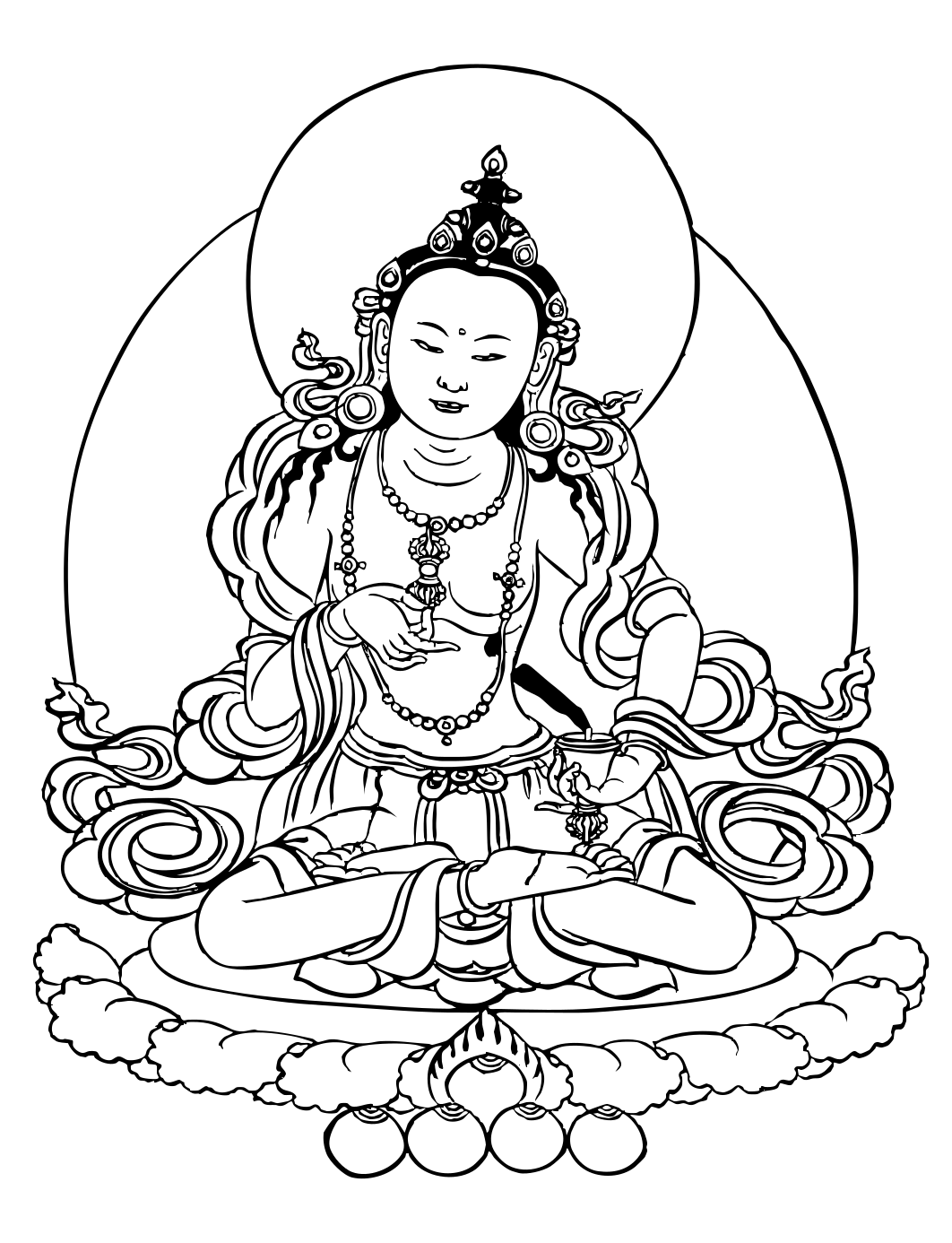
General Sūtra Section
The Absorption That Encapsulates All Merit
Toh 134
Imprint
Summary
Acknowledgments
Introduction

Notes
Glossary
Bibliography
n.

Notes

n.1

The catalogue of the Narthang Kangyur (F.94a) says that the Tshalpa (tshal pa) catalogue lists this text as having two chapters (le’u), but that the Great Fifth Dalai Lama considered this to be a scribal error. Neverheless, the 16th century Tibetan commentator Pekar Zangpo (pad dkar bzang po, p 193) does identify a thematic distinction, writing that the first chapter deals with the nature of the absorption while the second explains its causes and the benefits of training in it. Curiously, however, both the Narthang and Degé catalogues also list the text as having no less than 50 le’u. It may be that in this and similar catalogue entries (see also Dharmachakra 2016, Introduction i.15) the term le’u is being used to denote “episodes” or “scenes,” rather than in its more usual sense of formal sections or chapters.

i.7
n.2

The fragment attests to the Sanskrit names Uttara and Vimalakīrtirāja, as it includes a small portion of their dialogue. See Salomon 2014, p. 7, and Harrison et al. 2016.

i.16
n.3

The Degé Kangyur, in common with the other Kangyurs predominantly of the Tshalpa tradition, here reads dgon par bgyi ba lta bu ni ’jig rten gnas pa lags so, which is difficult to interpret in the context. This (and some other details of this passage) appear less erroneous in the Kangyurs of the Thempangma tradition. The Stok Palace (stog pho brang) manuscript Kangyur reads dgum par bgyi ba lta bu ni … which is the reading we have translated here.

2.54
n.4

Tib: gang kho na na gnas pa de kho nar ’gags pa. “Remaining in themselves and ceasing in themselves” is our best guess at translating this obscure phrase.

2.123
n.5

The occurrence in this passage of the term bar ma dor yongs su myang ngan las ’da’ ba / anantarā­parinirvāyī is the only occurrence in any of the Kangyur sūtra sections, except for one mention in the longer Prajñā­pāramitā­sūtras in relation to the Buddha’s qualities. The term is included in the Mahā­vyutpatti (section 46, 1015), and the sgra sbyor bam po gnyis pa makes it clear that the Tibetans interpreted it as attaining the śrāvaka’s nirvāṇa in the interval between one life and the next (antara­parinirvāṇi zhes bya ba phyir mi ’ong ba srid pa gcig nas ’phos pa pha rol tu yang ma skyes par srid pa bar mdo’i tshe dgra bcom pa’i ’bras bu mngon du byas nas mya ngan las ’da’ bas na bar ma dor yongs su mya ngan las ’da’ ba zhes bya). According to Edgerton the Pāli sources interpret the term as meaning simply “attaining parinirvāṇa prematurely” i.e. in the middle of life, and the Prajñā­pāramitā occurrence could be interpreted as prematurely in the sense of before having perfected the qualities. Here it could be interpreted either simply as attaining nirvāṇa “without any interval,” i.e. immediately, or possibly as in the interval after death; in both cases the implication is, of course, that the bodhisattva will not continue to live to benefit beings.

2.134
n.6

Tib: bdag gi sdug bsngal dang ’dra bar ’dod pa (or, in the Stok Palace Kangyur, bdag gis sdug bsngal …). The meaning of this expression is unclear to us.

2.142
n.7

Tib: sgra dang sgra ma yin pa so sor brtag pa la mkhas pa. The Tibetan sgra has a wide range of meanings, including “sound,” “voice,” “speech,” “language,” “word,” “term,” and “grammar.” It is not clear what this expression means in the context of this sentence.

2.181
n.8

Tib: snying rje ni kun tu spyod pa med pa’i mtshan nyid do. This way of defining compassion is surprising; it could possibly carry the sense of not having a fixed type of conduct, though this is not clear.

2.205

Glossary

abodes of Brahmā
  • tshangs pa’i gnas
  • ཚངས་པའི་གནས།
  • brahmavihāra

Love, compassion, joy, equanimity.

,
Āmrapālī
  • a mras bsrungs pa
  • ཨ་མྲས་བསྲུངས་པ།
  • āmrapālī

A famous and beautiful patron of the Buddha’s, courtesan in the city of Vaiśālī.

, , ,
Āmrapālī’s great grove
  • a mras bsrungs pa’i tshal chen po
  • ཨ་མྲས་བསྲུངས་པའི་ཚལ་ཆེན་པོ།
  • āmrapālīvana

The grove donated to the Buddha by the courtesan Āmrapālī.

,
Ānanda
  • kun dga’ bo
  • ཀུན་དགའ་བོ།
  • ānanda

A major śrāvaka disciple and personal attendant of the Buddha Śākyamuni during the last twenty-five years of his life. He was a cousin of the Buddha (according to the Mahāvastu, he was a son of Śuklodana, one of the brothers of King Śuddhodana, which means he was a brother of Devadatta; other sources say he was a son of Amṛtodana, another brother of King Śuddhodana, which means he would have been a brother of Aniruddha).

Ānanda, having always been in the Buddha’s presence, is said to have memorized all the teachings he heard and is celebrated for having recited all the Buddha’s teachings by memory at the first council of the Buddhist saṅgha, thus preserving the teachings after the Buddha’s parinirvāṇa. The phrase “Thus did I hear at one time,” found at the beginning of the sūtras, usually stands for his recitation of the teachings. He became a patriarch after the passing of Mahākāśyapa.

, , , , , , ,
Anantamati
  • blo gros mtha’ yas
  • བློ་གྲོས་མཐའ་ཡས།
  • anantamati
beryl
  • bai dU rya
  • བཻ་དཱུ་རྱ།
  • vaiḍūrya
,
bodhisattva collection
  • byang chub sems dpa’i sde snod
  • བྱང་ཆུབ་སེམས་དཔའི་སྡེ་སྣོད།
  • bodhi­sattva­piṭaka

The sūtras and teachings of the bodhisattva vehicle in general (not to be confused with the sūtra of the same name, Toh 56, in the Ratnakūṭa).

Brahmā
  • tshangs pa
  • ཚངས་པ།
  • brahmā

A high-ranking deity presiding over a divine world; he is also considered to be the lord of the Sahā world (our universe). Though not considered a creator god in Buddhism, Brahmā occupies an important place as one of two gods (the other being Indra/Śakra) said to have first exhorted the Buddha Śākyamuni to teach the Dharma. The particular heavens found in the form realm over which Brahmā rules are often some of the most sought-after realms of higher rebirth in Buddhist literature. Since there are many universes or world systems, there are also multiple Brahmās presiding over them. His most frequent epithets are “Lord of the Sahā World” (sahāṃpati) and Great Brahmā (mahābrahman).

, , , , , , , , , ,
Cakravāla
  • khor yug
  • ཁོར་ཡུག
  • cakravāla

Means “Periphery.” Name of mountain range that surrounds the world according to Buddhist cosmology.

Caryamati
  • spyod pa’i blo gros
  • སྤྱོད་པའི་བློ་གྲོས།
  • caryamati
Constant Stable Diligence
  • rtag tu brtson ’grus brtan
  • རྟག་ཏུ་བརྩོན་འགྲུས་བརྟན།
, ,
Delighting in Emanations
  • rab ’phrul, ’phrul dga’
  • འཕྲུལ་དགའ།, རབ་འཕྲུལ།
  • nirmāṇarata, sunirmita

The fifth (second highest) of the six levels of gods of the Desire Realm.

Dharmamati
  • chos kyi blo gros
  • ཆོས་ཀྱི་བློ་གྲོས།
  • dharmamati
Dīpaṃkara
  • mar me mdzad
  • མར་མེ་མཛད།
  • dīpaṃkara
eight unfree states
  • mi khom pa brgyad
  • མི་ཁོམ་པ་བརྒྱད།
  • aṣṭākṣaṇa

Lives led in circumstances that do not provide the freedom to practice the Buddhist path, i.e., the realms of (1) the hells, (2) pretas, (3) animals, and (4) long-lived gods; (in the human realm) among (5) barbarians, (6) extremists, and (7) in places where the Buddhist teachings do not exist; and (8) without adequate faculties to understand the teachings where they do exist.

,
Ever Ecstatic
  • rtag tu myos
  • རྟག་ཏུ་མྱོས།
  • saḍāmāda

Name of a class of gods on the slopes of Sumeru.

Four Great Kings
  • rgyal po chen po bzhi
  • རྒྱལ་པོ་ཆེན་པོ་བཞི།
  • caturmahārāja

Four gods who live on the lower slopes (fourth level) of Mount Meru in the eponymous Heaven of the Four Great Kings (Cāturmahā­rājika, rgyal chen bzhi’i ris) and guard the four cardinal directions. Each is the leader of a nonhuman class of beings living in his realm. They are Dhṛtarāṣṭra, ruling the gandharvas in the east; Virūḍhaka, ruling over the kumbhāṇḍas in the south; Virūpākṣa, ruling the nāgas in the west; and Vaiśravaṇa (also known as Kubera) ruling the yakṣas in the north. Also referred to as Guardians of the World or World Protectors (lokapāla, ’jig rten skyong ba).

Free of Demons
  • bdud bral
  • བདུད་བྲལ།
, , ,
Garland Bearer
  • lag na phreng thogs
  • ལག་ན་ཕྲེང་ཐོགས།
  • mālādhāra

Name of a class of gods, a group of yakṣa associated with the Four Great Kings.

,
Gautama
  • go’u ta ma
  • གོའུ་ཏ་མ།
  • gautama
,
Gopā
  • sa ’tsho ma
  • ས་འཚོ་མ།
  • gopā

The maiden whom the Buddha married while he was still a bodhisattva.

great sage
  • drang srong chen po
  • དྲང་སྲོང་ཆེན་པོ།
, , , , , , , , , ,
Heaven Entirely Free of Strife
  • rab ’thab bral
  • རབ་འཐབ་བྲལ།
  • suyāma
Heaven Free of Strife
  • ’thab bral
  • འཐབ་བྲལ།
  • yāma

The third (fourth highest) of the six levels of gods of the Desire Realm.

,
Heaven of the Thirty-three
  • sum cu rtsa gsum pa
  • སུམ་ཅུ་རྩ་གསུམ་པ།
  • trayatriṃśa

The second (fifth highest) of the six levels of gods of the Desire Realm.

,
incantation
  • gzungs
  • གཟུངས།
  • dhāraṇī

The term dhāraṇī has the sense of something that “holds” or “retains,” and so it can refer to the special capacity of practitioners to memorize and recall detailed teachings. It can also refer to a verbal expression of the teachings‍—an incantation, spell, or mnemonic formula‍—that distills and “holds” essential points of the Dharma and is used by practitioners to attain mundane and supramundane goals. The same term is also used to denote texts that contain such formulas.

Īṣādhāra
  • gshol mda’ ’dzin
  • གཤོལ་མདའ་འཛིན།
  • īṣādhāra

Name of a class of gods, as well as one of the ranges of mountains around Sumeru.

, ,
Joyous Heaven
  • dga’ ldan
  • དགའ་ལྡན།
  • tuṣita

Tuṣita (or sometimes Saṃtuṣita), literally “Joyous” or “Contented,” is one of the six heavens of the desire realm (kāmadhātu). In standard classifications, such as the one in the Abhidharmakośa, it is ranked as the fourth of the six counting from below. This god realm is where all future buddhas are said to dwell before taking on their final rebirth prior to awakening. There, the Buddha Śākyamuni lived his preceding life as the bodhisattva Śvetaketu. When departing to take birth in this world, he appointed the bodhisattva Maitreya, who will be the next buddha of this eon, as his Dharma regent in Tuṣita. For an account of the Buddha’s previous life in Tuṣita, see The Play in Full (Toh 95), 2.12, and for an account of Maitreya’s birth in Tuṣita and a description of this realm, see The Sūtra on Maitreya’s Birth in the Heaven of Joy, (Toh 199).

,
King of Many Arrangements
  • bkod pa mang po’i rgyal po
  • བཀོད་པ་མང་པོའི་རྒྱལ་པོ།
,
Krakucchanda
  • ’khor ba ’jig
  • འཁོར་བ་འཇིག
  • krakucchanda

The first buddha of our eon; the fifth buddha of the “seven generations of buddhas” (sangs rgyas rab bdun); there are variants of the Sanskrit (Kakutsunda, Kukucchanda) and the Tibetan log pa da sel seems to refer to the same buddha.

Layman Kṛṣṇa
  • dge bsnyen nag po’i mchog
  • དགེ་བསྙེན་ནག་པོའི་མཆོག
  • upāsaka kṛṣṇa
Mahācakravāla
  • khor yug chen po
  • ཁོར་ཡུག་ཆེན་པོ།
  • mahācakravāla

Means “Great Periphery.” Name of mountain range that surrounds the world according to Buddhist cosmology.

Mahāmeru
  • lhun po chen po
  • ལྷུན་པོ་ཆེན་པོ།
  • mahāmeru
Mahāmucilinda
  • btang zung chen po
  • བཏང་ཟུང་ཆེན་པོ།
  • mahāmucilinda
Maitreya
  • byams pa
  • བྱམས་པ།
  • maitreya

The bodhisattva Maitreya is an important figure in many Buddhist traditions, where he is unanimously regarded as the buddha of the future era. He is said to currently reside in the heaven of Tuṣita, as Śākyamuni’s regent, where he awaits the proper time to take his final rebirth and become the fifth buddha in the Fortunate Eon, reestablishing the Dharma in this world after the teachings of the current buddha have disappeared. Within the Mahāyāna sūtras, Maitreya is elevated to the same status as other central bodhisattvas such as Mañjuśrī and Avalokiteśvara, and his name appears frequently in sūtras, either as the Buddha’s interlocutor or as a teacher of the Dharma. Maitreya literally means “Loving One.” He is also known as Ajita, meaning “Invincible.”

For more information on Maitreya, see, for example, the introduction to Maitreya’s Setting Out (Toh 198).

Mañjuśrī
  • ’jam dpal, ’jam dpal gzhon nur gyur pa
  • འཇམ་དཔལ་གཞོན་ནུར་གྱུར་པ།, འཇམ་དཔལ།
  • mañjuśrī, mañjuśrī­kumāra­bhūta

Mañjuśrī is one of the “eight close sons of the Buddha” and a bodhisattva who embodies wisdom. He is a major figure in the Mahāyāna sūtras, appearing often as an interlocutor of the Buddha. In his most well-known iconographic form, he is portrayed bearing the sword of wisdom in his right hand and a volume of the Prajñā­pāramitā­sūtra in his left. To his name, Mañjuśrī, meaning “Gentle and Glorious One,” is often added the epithet Kumārabhūta, “having a youthful form.” He is also called Mañjughoṣa, Mañjusvara, and Pañcaśikha.

“Mañjuśrī the ever youthful,” a common epithet of Mañjuśrī.

, , , , , , , , , ,
Mañjuśrī­kumāra­bhūta
  • ’jam dpal, ’jam dpal gzhon nur gyur pa
  • འཇམ་དཔལ་གཞོན་ནུར་གྱུར་པ།, འཇམ་དཔལ།
  • mañjuśrī, mañjuśrī­kumāra­bhūta

Mañjuśrī is one of the “eight close sons of the Buddha” and a bodhisattva who embodies wisdom. He is a major figure in the Mahāyāna sūtras, appearing often as an interlocutor of the Buddha. In his most well-known iconographic form, he is portrayed bearing the sword of wisdom in his right hand and a volume of the Prajñā­pāramitā­sūtra in his left. To his name, Mañjuśrī, meaning “Gentle and Glorious One,” is often added the epithet Kumārabhūta, “having a youthful form.” He is also called Mañjughoṣa, Mañjusvara, and Pañcaśikha.

“Mañjuśrī the ever youthful,” a common epithet of Mañjuśrī.

, , , , , , , , , ,
Mastery Over Others’ Emanations
  • gzhan ’phrul dbang byed
  • གཞན་འཕྲུལ་དབང་བྱེད།
  • para­nirmita­vaśavartin

The highest of the six levels of gods of the Desire Realm.

Maudgalyāyana
  • maud gal gyi bu
  • མཽད་གལ་གྱི་བུ།
  • maudgalyāyana

One of the main śrāvaka disciples in the sūtras.

, , , , , , , , , ,
Meru
  • lhun po
  • ལྷུན་པོ།
  • meru

According to ancient Buddhist cosmology, this is the great mountain forming the axis of the universe. At its summit is Sudarśana, home of Śakra and his thirty-two gods, and on its flanks live the asuras. The mount has four sides facing the cardinal directions, each of which is made of a different precious stone. Surrounding it are several mountain ranges and the great ocean where the four principal island continents lie: in the south, Jambudvīpa (our world); in the west, Godānīya; in the north, Uttarakuru; and in the east, Pūrvavideha. Above it are the abodes of the desire realm gods. It is variously referred to as Meru, Mount Meru, Sumeru, and Mount Sumeru.

,
Mucilinda
  • btang bzung
  • བཏང་བཟུང་།
  • mucilinda
naked ascetics
  • gcer bu pa
  • གཅེར་བུ་པ།
  • nirgrantha

Ascetic religious practitioners, usually referring to Jains.

Nārāyaṇa
  • sred med kyi bu
  • སྲེད་མེད་ཀྱི་བུ།
  • nārāyaṇa

In the ancient Indian tradition, the son of the first man; later seen as a powerful avatar of Viṣṇu, but also as the progenitor of Brahmā. In Buddhist texts, he figures in various ways including (as he does in most of this text) as a bodhisattva, while still one of the most powerful gods of the Realm of Form (as in 1.21).

, , , , , , , , , ,
non-Buddhist
  • mu stegs can
  • མུ་སྟེགས་ཅན།
  • tīrthika

Those of other religious or philosophical orders, contemporary with the early Buddhist order, including Jains, Jaṭilas, Ājīvikas, and Cārvākas. Tīrthika (“forder”) literally translates as “one belonging to or associated with (possessive suffix –ika) stairs for landing or for descent into a river,” or “a bathing place,” or “a place of pilgrimage on the banks of sacred streams” (Monier-Williams). The term may have originally referred to temple priests at river crossings or fords where travelers propitiated a deity before crossing. The Sanskrit term seems to have undergone metonymic transfer in referring to those able to ford the turbulent river of saṃsāra (as in the Jain tīrthaṅkaras, “ford makers”), and it came to be used in Buddhist sources to refer to teachers of rival religious traditions. The Sanskrit term is closely rendered by the Tibetan mu stegs pa: “those on the steps (stegs pa) at the edge (mu).”

,
Palace of Victory
  • khang bzangs rnam par rgyal byed
  • ཁང་བཟངས་རྣམ་པར་རྒྱལ་བྱེད།
  • vijayanta prāsāda

The palace or meeting hall of the gods in the Heaven of the Thirty-three.

,
retention
  • gzungs
  • གཟུངས།
  • dhāraṇī

The term dhāraṇī has the sense of something that “holds” or “retains,” and so it can refer to the special capacity of practitioners to memorize and recall detailed teachings. It can also refer to a verbal expression of the teachings‍—an incantation, spell, or mnemonic formula‍—that distills and “holds” essential points of the Dharma and is used by practitioners to attain mundane and supramundane goals. The same term is also used to denote texts that contain such formulas.

,
roots of goodness
  • dge ba’i rtsa ba
  • དགེ་བའི་རྩ་བ།
  • kuśalamūla

According to most lists (specifically those of the Pāli and some Abhidharma traditions), the (three) roots of virtue or the roots of the good or wholesome states (of mind) are what makes a mental state good or bad; they are identified as the opposites of the three mental “poisons” of greed, hatred, and delusion. Actions based on the roots of virtue will eventually lead to future happiness. The Dharmasaṃgraha, however, lists the three roots of virtue as (1) the mind of awakening, (2) purity of thought, and (3) freedom from egotism (Skt. trīṇi kuśala­mūlāni | bodhi­cittotpādaḥ, āśayaviśuddhiḥ, ahaṃkāramama­kāraparityāgaśceti|).

Śakra
  • brgya byin
  • བརྒྱ་བྱིན།
  • śakra

The lord of the gods in the Heaven of the Thirty-Three (trāyastriṃśa). Alternatively known as Indra, the deity that is called “lord of the gods” dwells on the summit of Mount Sumeru and wields the thunderbolt. The Tibetan translation brgya byin (meaning “one hundred sacrifices”) is based on an etymology that śakra is an abbreviation of śata-kratu, one who has performed a hundred sacrifices. Each world with a central Sumeru has a Śakra. Also known by other names such as Kauśika, Devendra, and Śacipati.

, , , , , , , , , ,
Śāriputra
  • shA ri’i bu
  • ཤཱ་རིའི་བུ།
  • śāriputra

One of the Buddha’s primary śrāvaka followers, known as the compiler of the Abhidharma teachings.

, ,
seat of awakening
  • byang chub kyi snying po
  • བྱང་ཆུབ་ཀྱི་སྙིང་པོ།
  • bodhimaṇḍa

The place where the Buddha Śākyamuni achieved awakening and where every buddha will manifest the attainment of buddhahood. In our world this is understood to be located under the Bodhi tree, the Vajrāsana, in present-day Bodhgaya, India. It can also refer to the state of awakening itself.

, ,

Bibliography

Bibliography

’phags pa bsod nams thams cad bsdus pa’i ting nge ’dzin ces bya ba theg pa chen po’i mdo (Ārya­sarva­puṇya­samuccaya­samādhi­nāma­mahā­yāna­sūtra). Toh 134, Degé Kangyur, vol. 56 (mdo sde, na), folios 70b–121b.

’phags pa bsod nams thams cad bsdus pa’i ting nge ’dzin ces bya ba theg pa chen po’i mdo. bka’ ’gyur (dpe bsdur ma) [Comparative Edition of the Kangyur], krung go’i bod rig pa zhib ’jug ste gnas kyi bka’ bstan dpe sdur khang (The Tibetan Tripitaka Collation Bureau of the China Tibetology Research Center). 108 volumes. Beijing: krung go’i bod rig pa dpe skrun khang (China Tibetology Publishing House), 2006–9, vol. 56, p. 196–317.

’phags pa bsod nams thams cad bsdus pa’i ting nge ’dzin ces bya ba theg pa chen po’i mdo (Ārya­sarva­puṇya­samuccaya­samādhi­nāma­mahā­yāna­sūtra). sTog 107, Stok Palace (stog pho brang bris ma) Kangyur, vol. 63 (mdo sde, na), folios 80b–161b.

Pekar Zangpo (pad dkar bzang po). mdo sde spyi’i rnam bzhag. Beijing: mi rigs dpe skrun khang [Minorities Publishing House], 2006.

Dharmachakra Translation Committee (tr.). The Illusory Absorption (Māyopama­samādhi, Toh 130). 84000: Translating the Words of the Buddha, 2016.

Edgerton, Franklin. Buddhist Hybrid Sanskrit Grammar and Dictionary. New Haven: Yale University Press, 1953.

Harrison, Paul, Timothy Lenz, Qian Lin, and Richard Salomon. “A Gāndhārī Fragment of the Sarva­puṇya­samuccaya­samādhi­sūtra”. In Braarvig, Jens (ed.), Buddhist Manuscripts, Volume IV. Manuscripts in the Schøyen Collection. Oslo: Hermes Publishing, 2016.

Saloman, Richard. “Gāndhārī Manuscripts in the British Library, Schøyen and Other Collections.” In Harrison, Paul, and Jens-Uwe Hartmann (eds.), From Birch Bark to Digital Data: Recent Advances in Buddhist Manuscript Research. Papers Presented at the Conference Indic Buddhist Manuscripts: The State of the Field. Standord, June 15–19, 2009. Vienna: Österreichische Akademie der Wissenschaften, 2014.

༄༅།  །བསོད་ནམས་ཐམས་ཅད་བསྡུས་པའི་ཏིང་ངེ་འཛིན།
The Absorption That Encapsulates All Merit
Sarvapuṇya­samuccaya­samādhi
vajrasattva
s.

Summary

s.1

The Absorption That Encapsulates All Merit tells the story of Vimalatejā, a strongman renowned for his physical prowess, who visits the Buddha in order to compare abilities and prove that he is the mightier of the two. He receives an unexpected, humbling riposte in the form of a teaching by the Buddha on the inconceivable magnitude of the powers of awakened beings, going well beyond mere physical strength. The discussions that then unfold‍—largely between the Buddha, Vimalatejā, and the bodhisattva Nārāyaṇa‍—touch on topics including the importance of creating merit, the centrality of learning and insight, and the question of whether renunciation entails monasticism. Above all, however, Vimalatejā is led to see that the entirety of the Great Vehicle path hinges on the practice that forms the name of the sūtra, which is nothing other than the mind of awakening (bodhicitta).

ac.

Acknowledgments

ac.1

Translated by the Dharmachakra Translation Committee under the guidance of Chökyi Nyima Rinpoche. Zachary Beer produced the translation and wrote the introduction. Andreas Doctor compared the translation with the original Tibetan and edited the text. The translators are grateful to Khenpo Trokpa Tulku from Ka-Nying Shedrub Ling Monastery for his assistance in resolving several difficult passages.

This translation was sponsored by Shakya Dewa, and has been completed under the patronage and supervision of 84000: Translating the Words of the Buddha.

i.

Introduction

i.1

Like a number of other Great Vehicle sūtras, The Absorption That Encapsulates All Merit consists of a rich and at times disjointed amalgam of stories, teachings, and conversations. Although the sūtra begins in a seemingly historical setting in the vicinity of Vaiśālī, in the course of the narration we travel throughout our world system in times past, present, and future, as well as other world systems presided over by their respective awakened beings. Beginning in the voice of a general narrator who returns to describe supernatural events from a bird’s-eye view‍—earthquakes, cascading flowers, flashes of light, and the like‍—the text for the most part unfolds as a discussion, and thus emerges from the mouths of a cast of characters with whom we are gradually acquainted. Some of these characters are familiar: the Buddha, of course, and bodhisattvas like Mañjuśrī and Nārāyaṇa, as well as the śrāvakas Maudgalyāyana and Ānanda, who make brief guest appearances in what is largely a Great Vehicle ensemble.

The central plot surrounds the conversion and awakening of a newcomer, a “strongman” named Vimalatejā. The sūtra’s structure is framed loosely around an instruction by the Buddha that successfully converts Vimalatejā, and this instruction is the basis for the sūtra’s name.

i.2

The text commences in a typical way, with the description of a setting in India‍—a mansion in Āmrapālī’s grove in the area of Vaiśālī, where the Buddha is residing with his entourage of countless human and nonhuman beings. The Buddha gives a teaching that is not spelled out in the text, but which apparently is impressive enough to prompt Nārāyaṇa to rise up and praise its orator. Nārāyaṇa, who will serve as the major interlocutor for the remainder of the text, then exhorts the Buddha to expound further; first he presents a series of supplications to the Buddha, and subsequently a series of questions.

i.3

The supplications are noteworthy in that aside from purely soteriologically oriented prayers, they also include prayers for the preservation and sustained high reputation of the Buddhist community, indicating concerns from within the tradition about the place of Buddhists within society. The twenty-three questions that follow effectively span the entirety of what is involved in bodhisattva praxis. As a response to Nārāyaṇa’s extensive list of questions, the Buddha hints at a teaching that would constitute a complete answer to each and every one of Nārāyaṇa’s inquiries, and this teaching provides the sūtra’s name. Although the Buddha says nothing more about the teaching at this point, the exchange grounds the text thematically in the topic of merit, suggesting as it does that the entire bodhisattva spiritual path stands and falls with it.

i.4

The setting of the narrative then changes from Āmrapālī’s grove to a nearby place in the town of Vaiśālī, where the sūtra’s chief protagonist, Vimalatejā, is dwelling. Through the omnipresent narrator, we zoom in on this strongman as he is indulging in a bout of self-aggrandizement concerning his stature as a strong and powerful human being. He almost comes to the conclusion that there could be no one mightier than him in the world, before he remembers having heard of a special person named Gautama. Gautama is of course said to possess the ten strengths of an awakened being, which, if true, would certainly eclipse the merely physical and worldly might that Vimalatejā possesses. So he resolves to visit the Buddha to clear away his doubts. This sets up another major theme of the text, a playful inquiry into what it really means to be “strong.”

i.5

On this note, the story segues back to the Buddha’s encampment in Āmrapālī’s grove, where Vimalatejā arrives with his nose in the air. Noticing Vimalatejā’s presence and haughty attitude, the Buddha ventures into a lengthy, rather pertinent dialogue on the topic of power; although this discussion is carried out with Maudgalyāyana, it is directed entirely at Vimalatejā. The discussion consists of a set of progressively more astounding comparative descriptions that reveal the inimitable quality of the buddhas’ and bodhisattvas’ power which, as we‍—and Vimalatejā‍—come to see, is literally unrivalled in the world. Humbled and inspired to expand the scope of his own strength, which he had previously thought to be matchless, Vimalatejā then takes refuge in the Three Jewels and forms the resolve of a bodhisattva.

i.6

This leads us back to where the previous scene left off, before it was interrupted by the arrival of the self-inflated visitor. Nārāyaṇa, the interlocutor, returns to the questions he had asked the Buddha, and reminds him that he had not yet explained exactly what was referred to by the term the absorption that encapsulates all merit. The Buddha graciously bestows a reply, at which point we discover that the term refers to nothing other than the mind of awakening (bodhicitta).

i.7

The Buddha’s explanation then takes the form of four “introductions” to the topic at hand. These consist of another set of characteristically mind-boggling, evocative comparisons that build up to the conclusion that nothing‍—even within the powers of the gods Śakra and Brahma‍—could truly be more meritorious than engendering the mind of awakening. This effectively makes a link in very simple terms (it is fair to say that this sūtra is addressed to, and comprehended by, nonspecialists) between power, merit, and the bodhisattva endeavor. After a series of miracles, at which a huge portion of the audience forms the resolve set on awakening, an apparent first chapter comes to a close‍—apparent because, although all Kangyurs contain at this point the mention of a first chapter being concluded, some catalogues state that this may be an error of transcription with no thematic significance, corresponding as it does with a change of fascicles. No mention is made of subsequent chapters, as would usually be the case.

i.8

Chapter 2, or the second fascicle, begins with a long dialogue between the Buddha and Vimalatejā, in which the Buddha sets out to elaborate further on the principle of merit and how it is accumulated. This discussion centers around three practices identified by the Buddha as being ideal for the accumulation of merit: generosity, discipline, and learning. These provide a systematic framework for the expression of numerous Buddhist ethical and soteriological principles, and thus this passage could be said to be the weightiest in terms of religious doctrine.

i.9

Although the ideas within this passage are presented in fairly straightforward terms and largely in the form of mnemonic lists, they also extend beyond mere ethical behavior and delve into the Great Vehicle notion of insight (prajñā) into the empty nature of things. Bodhisattvas are exhorted, for instance, to become free of dualism, and such a nonconceptual mind-state will allow them to practice generosity with their own bodies. This is compared, in an evocative simile, to the way a tree allows its parts to be taken for various uses. This emphasis on insight will later be reinforced by the Buddha’s categorical statement that learning is the most crucial of the three endeavors.

i.10

Prior to this, however, the section on the accumulation of learning in chapter 2 is noteworthy in that it provides another layer in both the plotline and thematic content of the sūtra. This occurs when the Buddha recounts a story from his past life as the great sage Uttara, who sacrificed his own body in order to receive spiritual instruction. The recitation of this selfless action is potent enough to summon Vimalakīrtirāja, a buddha from an entirely different world system, who proceeds to expound, coincidentally, on the teaching known as the absorption that encapsulates all merit. Thus is introduced another major theme of the text, namely the importance of undergoing hardship for the sake of the Dharma.

i.11

The remainder of the Buddha Vimalakīrtirāja’s sermon is made up of another short set of mnemonic lists. After recounting these, the Buddha then articulates the moral of the story regarding the importance of fortitude in pursuing the Dharma, while also making an interesting comment about the presence of “Dharma treasures” hidden in various “mountains, mountain caverns, and trees,” which are awaiting revelation.

i.12

The Buddha then concludes the general discussion on the three practices, identifying learning as the most crucial practice. The conversation between Vimalatejā and the Buddha, which is now firmly grounded in the topic of insight and its pursuit, then turns to the notion of “acceptance that phenomena are unborn” (anutpattika­dharma­kṣānti) and what leads to it. This could be said to be the buildup to the major turning point in the sūtra’s storyline: at the conclusion of the discussion, Vimalatejā has an epiphany that leads him to levitate high up in the air, which in turn induces the Buddha to display a cosmic smile that illuminates the universe. Afterward the Buddha, prompted by Ānanda, relates the key moments in Vimalatejā’s past lives that brought him to where he is now, and furthermore prophesies Vimalatejā’s future awakening.

i.13

The arc of the story then segues again as Vimalatejā makes his debut as a teacher in response to a series of questions by Nārāyaṇa. In his answers, Vimalatejā demonstrates a remarkable, sudden penetration of profound Buddhist ideas, carrying the course of the discussion into the nature of nonduality and the imminence of awakened qualities within all beings. He is even led by Nārāyaṇa to comment on several challenging statements from other sūtras, such as the line, “Rely on the true meaning; do not rely on the words.” Vimalatejā answers these questions with ease and is commended by the Buddha. A conversation between Nārāyaṇa and Mañjuśrī now follows, in which the latter expounds on similar themes.

i.14

The final section shifts into a loose, communal atmosphere of shared insights, as various characters, including several new ones, chime in whenever they are inspired to make comments. First a god named Free of Demons delivers an oration that is notable for its exhortation that bodhisattvas should engage in seemingly unethical practices as part of their spiritual endeavor‍—even “demonic” ones‍—if they can do so without being polluted by them. This sets the stage for a long string of abstract and often paradoxical statements regarding bodhisattva practice that come in turn from the mouths of the Buddha, Mañjuśrī, and others. Mañjuśrī later makes a comment on the irrelevance of monasticism to the bodhisattva endeavor, reiterating that true insight should be regarded as the decisive factor as to whether or not a bodhisattva is considered a “renunciant.” This would seem to suggest that the sūtra’s expected audience may indeed have consisted of‍—or at least included‍—laypeople. It also suggests that the sūtra emerged from a milieu in which lay spirituality was encouraged and considered respectable. Finally the text concludes with an explanation by the Buddha on the way in which merit creates what are known as the marks of one hundred merits, as well as his announcement that his life will soon end.

i.15

In this way, The Absorption That Encapsulates All Merit presents a relatively simplified sampling of the rich philosophy and atmosphere of Great Vehicle Buddhism, while at the same time constituting a literary work that functions on several levels. On the narrative level, it is the story of a seemingly uneducated outsider named Vimalatejā, who has a spiritual awakening and then impresses the Buddhist establishment. On another level, it is a commentary on the nature of human power and merit, which we progressively come to see are rooted in insight. It also displays evidence from within the Buddhist tradition that its adherents were concerned about the preservation and positive reputation of their cultural institution. All of this unfolds in Āmrapālī’s grove near Vaiśālī where the Buddha timelessly dwells, and the Great Vehicle teachings emerge in constant revelation.

i.16

The Absorption That Encapsulates All Merit is extant in Tibetan and in two Chinese translations. In Sanskrit no complete version is known to have survived, but a fragment in Gāndhārī Prakrit, written in the Kharoṣṭhī script, is among the scrolls found in the Bamiyan area of western Gandhāra (in present-day Afghanistan), most of which date approximately from the late second to mid third century CE. The Tibetan version was translated from Sanskrit by Prajñāvarman, Śīlendrabodhi, Yeshé Dé, “and others,” in the late eighth or early ninth centuries. Although it is not one of the best known sūtras, it is quoted in at least two Indian treatises in the Tengyur, and citations of several different passages appear in a number of Tibetan commentaries.

The Translation

The Noble Great Vehicle Sūtra

The Absorption That Encapsulates All Merit

1.

Chapter 1

1.1

Homage to all buddhas and bodhisattvas!

1.2

Thus did I hear at one time. The Blessed One was dwelling in Vaiśālī in the mansion in Āmrapālī’s great grove, together with a great assembly of ten thousand monks. All these monks were foe-destroyers whose defilements were exhausted. They were without afflictions and controlled. Their minds were perfectly free, their insight perfectly liberated. They were noble beings, great elephants, successful and accomplished. They had laid down their burden and fulfilled their aims. They had eliminated the bondages of existence and, thanks to their correct knowledge, their minds were perfectly liberated. They had obtained supreme perfection in mastering all mental states.

1.3

There were also twenty thousand bodhisattvas, all of whom were nonreturners. These bodhisattvas had accomplished retention and were unhindered in their eloquence. They had attained the superknowledges and were adept in the practice of absorption. They had perfect mastery, moreover, in mindfulness, intelligence, realization, steadfastness, insight, and method. Foremost among these twenty thousand were the bodhisattva great being Caryamati, the bodhisattva great being Siṃhamati, the bodhisattva great being Uttaramati, the bodhisattva great being Viśeṣamati, the bodhisattva great being Vardamānamati, the bodhisattva great being Anantamati, the bodhisattva great being Dharmamati, the bodhisattva great being Maitreya, the bodhisattva great being Mañjuśrī­kumāra­bhūta, and the bodhisattva great being Nārāyaṇa. Together with them were forty thousand gods, all of whom were thoroughly immersed in the Great Vehicle, as well as Śakra, Brahmā, and many world protectors. Surrounded and revered by this retinue of many hundreds of thousands, the Blessed One taught the Dharma. On this occasion, the Blessed One’s teaching was particularly pithy and overwhelmed the masses of non-Buddhists.

1.4

Afterward the bodhisattva great being Nārāyaṇa rose up from his seat, draped his shawl over one shoulder, and knelt on his right knee. With his palms together, he bowed toward the Blessed One and supplicated him as follows.

“Blessed One, this teaching of yours is exceedingly pithy. It is exquisite indeed, and overwhelms everyone, including misguided non-Buddhists, the countless wandering mendicants, and the naked ascetics. Accordingly, Blessed One, please take the bodhisattva great beings under your care, please give your aid to the bodhisattva great beings, and please keep the bodhisattva great beings in your protection. Please arouse the bodhisattva great beings’ roots of goodness. Please exalt the bodhisattva great beings, delight them, and instruct them thoroughly. Please look after the Buddha’s legacy, the continuity of the bodhisattva great beings’ spiritual tradition.

1.5

“Please do not forsake sentient beings. Please show the path by which, with the aid of the teachings, one may pass beyond suffering. Please ensure that even though the thus-gone ones pass beyond suffering, the bodhisattva great beings do not stray from unsurpassed and perfectly complete awakening‍—that they do not stray at all. Please ensure that they always meet the Buddha, that they hear the Dharma, and that the Saṅgha is honored. Please ensure that they have mindfulness so as to not become forgetful, that they have intelligence so as to realize the intended meaning of the teachings, and that they become realized so as to accomplish realization of the truth. Please ensure that they have a sense of conscience in order to purify their minds, and that they have the keen sense of modesty they need in order to give up all negative actions. Please ensure that they have the steadfastness necessary for perfect conduct and religious observance. Please ensure that they have the bravery with which to eradicate their afflictions, and that they have the fortitude to be free of anxiety in the midst of any assembly.

1.6

“Blessed One, how come the bodhisattva great beings do not diminish in merit, in spirituality, in insight, and in wisdom? How do they become sufficiently stable in their altruism to prevent their mind of awakening from decreasing? How do they keep a solid sense of kinship with beings all the way through until they finally pass beyond suffering? How do they practice what they preach? How do they live for the sake of practicing the Buddha’s teachings in all their completeness, and thus without deceiving beings? How can they engage in every type of giving, and thus attain the untaught generosity? How can they live by the purity of the three sets of vows, and thus attain the untaught discipline?

1.7

“How can they, with no malevolence in their minds, remain impartial toward all beings, and thus attain the untaught patience? How can they accomplish all their aims with an indefatigable attitude, and thus attain the untaught diligence? How can they become skilled in mindfulness and vigilance, and, without dwelling in any type of concentration, absorption, or equipoise, attain the untaught concentration? How can they be free of any viewpoint, and, as they attain illumination regarding all the Buddha’s teachings, achieve the untaught wisdom? How can they exert themselves unrelentingly in attracting beings using the four means of drawing them in, and thus become exceedingly magnetizing? How can they endeavor to engage mentally with the transience of the life of gods and humans, and thus become free of expectations? How can they be as steadfast as a doorsill as they set their minds on omniscience itself and stay free of the wish to be a śrāvaka or solitary buddha?

1.8

“How can they stay under the influence of the Dharma and not the influence of their desires? How can they strive for the dominion of the Dharma rather than the dominion of humans and gods? How do they expound on the teachings using the words prescribed by the Buddha? How can they sustain themselves on the Dharma and not on material things? How can they become free of desire to possess anything? How can they be without enmity toward any being and thus become free of anger? How can they free themselves from the darkness of delusion regarding all phenomena and thus become free of delusion? How can they free themselves of the subsidiary disturbing emotions and thus genuinely transcend all demons? How can they become skilled in all the various ways of dedicating merit and thus gain skill in methods?”

1.9

The Blessed One then answered the bodhisattva great being Nārāyaṇa, lord of the trichiliocosm, “Excellent, Nārāyaṇa, excellent. It is excellent of you to have thought to ask such a question of the Thus-Gone One for the sake of the bodhisattvas. Accordingly, Nārāyaṇa, you should listen carefully and keep in mind what I am about to say. I will now explain how the bodhisattva great beings can attain all these particular qualities as well as others.”

The bodhisattva great being Nārāyaṇa said, “Wonderful, Blessed One!” He then listened attentively, as the Blessed One had advised him.

1.10

The Blessed One began, “Nārāyaṇa, there is something known as the bodhisattva great beings’ absorption that encapsulates all merit. Based on it, bodhisattva great beings’ merit will not be depleted, their dharmas will not diminish, their insight will not diminish, and their wisdom will not diminish. They will always meet the Buddha, hear the Dharma, and the Saṅgha will be honored. Based on it, they will be able to exert themselves in the four means of magnetizing, live by not forsaking any being, and become skilled in the various ways of dedicating merit, thus gaining skill in method. These and other special qualities will they attain.”

In this way, the Blessed One merely uttered the phrase absorption that encapsulates all merit, but did not describe it any further.

1.11

Living in Vaiśālī at that time was a mighty strongman named Vimalatejā. Now he began to think to himself, “I am someone who has the great strength that comes with being a mighty and powerful strongman. Among the beings in this world, there does not seem to be anyone who rivals me in power or vigor, so who could be superior to me, I wonder?”

He continued to ponder, “The monk Gautama is said to have a great deal of power. It is said that his power consists of the ten strengths, and that he has a body like that of Nārāyaṇa.” He then thought, “I should go find this monk Gautama. That way I can really make a comparison of this ‘Blessed One’ and myself, and resolve my doubts.”

1.12

So the mighty strongman Vimalatejā left the great city of Vaiśālī and went to the mansion in Āmrapālī’s great grove. There was the Thus-Gone One, the foe-destroyer, the completely perfect Buddha, surrounded and revered by his hundred-thousandfold retinue. Vimalatejā saw the great power with which the Buddha taught the Dharma. In his magnificent beauty the Buddha seemed like the lofty king of mountains in the midst of the ocean, and Vimalatejā could not stop looking at him. As soon as he laid eyes on the Blessed One, he felt pleased, delighted, and overjoyed. In this state, he touched the Blessed One’s feet, circled him, and then sat off to one side. He bowed‍—though to the Blessed One only‍—and with his palms together at his head, sat there with his attention on the Blessed One.

1.13

The Blessed One realized that the mighty strongman Vimalatejā’s state of mind was sincere. In order to tame Vimalatejā’s pride, self-importance, and arrogance, he asked the elder, great Maudgalyāyana, “Go and fetch me the arrow I shot for the sake of the Śākya maiden Gopā when I was a bodhisattva.”

The venerable Maudgalyāyana then replied to the Blessed One, “Where is that arrow? I do not see it.”

1.14

At that moment the Blessed One emitted a light known as Illumination from his right hand. This light illuminated the entire great trichiliocosm, and then it lit up the place where the arrow was, at the outer periphery of this buddhafield.

The Blessed One said to the venerable great Maudgalyāyana, “Do you see that arrow at the outer periphery of the world system?”

He replied, “Blessed One, yes, I do see it.”

“So, Maudgalyāyana, go and fetch it.”

“Certainly, Blessed One,” he replied.

1.15

Following the Blessed One’s orders, the venerable great Maudgalyāyana vanished in front of the entire assembly. And immediately, in one instant, one moment‍—like the span of time it takes a strong person to stretch out and retract his arm‍—he had retrieved the arrow from the outer periphery of the world system. He gave it to the Blessed One, and asked, “Blessed One, was the strength with which the Bodhisattva shot this arrow hereditary or miraculous?”

The Blessed One said, “Maudgalyāyana, the strength with which I shot it was hereditary; it was not shot with any miraculous strength. If it had been shot with miraculous power, Maudgalyāyana, it could have traveled infinitely to any of the countless universes.”

1.16

Maudgalyāyana said, “Blessed One, please describe the hereditary strength you had as a bodhisattva great being, which emerged out of the ripening of your merit.”

The Blessed One explained, “Maudgalyāyana, the strength of ten men is the same as the strength of one ox. The strength of ten oxen is the same as the strength of one blue ox. The strength of ten blue oxen is the same as the strength of one ordinary elephant. The strength of ten ordinary elephants is the same as the strength of one fearsome elephant. The strength of ten fearsome elephants is the same as the strength of one elephant akin to a female elephant. The strength of ten elephants akin to female elephants is the same as the strength of one wild elephant. The strength of ten wild elephants is the same as the strength of one elephant from the Vindhya Mountains. The strength of ten elephants from the Vindhya Mountains is the same as the strength of one blade-claw elephant. The strength of ten blade-claw elephants is the same as the strength of one Īṣādhāra elephant.

1.17

“The strength of ten Īṣādhāra elephants is the same as the strength of one collyrium-colored elephant. The strength of ten collyrium-colored elephants is the same as the strength of one battle elephant. The strength of ten battle elephants is the same as the strength of one blue elephant. The strength of ten blue elephants is the same as the strength of one yellow elephant. The strength of ten yellow elephants is the same as the strength of one red elephant. The strength of ten red elephants is the same as the strength of one gray elephant. The strength of ten gray elephants is the same as the strength of one white water-lily elephant. The strength of ten white water-lily elephants is the same as the strength of one white-lotus elephant. The strength of ten white-lotus elephants is the same as the strength of one red-lotus elephant. The strength of ten red-lotus elephants is the same as the strength of one elephant in rut. The strength of ten elephants in rut is the same as the strength of one great elephant in rut.

1.18

“The strength of ten great elephants in rut is the same as the strength of one clever maned lion. The strength of ten clever maned lions is the same as the strength of one strongman. The strength of ten strongmen is the same as the strength of one mighty strongman. The strength of ten mighty strongmen is the same as the strength of one man of supreme might. The strength of ten men of supreme might is the same as the strength of one man of incredibly supreme might. The strength of ten men of incredibly supreme might is the same as the strength of one dominant man. The strength of ten dominant men is the same as the strength of one incredibly dominant man. The strength of ten incredibly dominant men is the same as the strength of one celestial god. The strength of ten celestial gods is the same as the strength of one god who dwells in the immeasurable palace. The strength of ten gods dwelling in the immeasurable palace is the same as the strength of one Īṣādhāra god. The strength of ten Īṣādhāra gods is the same as the strength of one Garland Bearer god.

1.19

“The strength of ten Garland Bearer gods is the same as the strength of one Ever Ecstatic god. The strength of ten Ever Ecstatic gods is the same as the strength of one god from the classes of the Four Great Kings. The strength of all gods from the classes of the Four Great Kings is the same as the strength of one Kubera. The strength of ten Kuberas is the same as the strength of one god from the Heaven of the Thirty-three. The strength of ten gods from the Heaven of the Thirty-three is the same as the strength of one Śakra, lord of the gods. The strength of ten Śakras, lord of the gods, is the same as the strength of one god from the Heaven Free of Strife.

1.20

“The strength of all the gods from the Heaven Free of Strife is the same as the strength of one god from the Heaven Entirely Free of Strife. The strength of ten gods from the Heaven Entirely Free of Strife is the same as the strength of one god from the Joyous Heaven. The strength of all the gods in the Joyous Heaven is the same as the strength of one of the kings of the gods in the Wholly Joyous Heaven. The strength of ten of the kings of gods in the Wholly Joyous Heaven is the same as the strength of one god from Delighting in Emanations. The strength of all the gods in Delighting in Emanations is the same as the strength of one of the kings of the gods in Supreme Emanations. The strength of ten of the kings of the gods in Supreme Emanations is the same as the strength of one god in Mastery Over Others’ Emanations. The strength of all the gods in Mastery Over Others’ Emanations is the same as the strength of one Vaśavartin.

1.21

“The strength of ten Vaśavartins is the same as the strength of one god of the demonic legions. The strength of all the gods of the demonic legions is the same as the strength of one Wicked Demon. The strength of ten Wicked Demons is the same as the strength of one half-Nārāyaṇa. The strength of ten half-Nārāyaṇas is the same as the strength of one Nārāyaṇa. The strength of ten Nārāyaṇas is the same as the strength of one great Nārāyaṇa. The strength of ten great Nārāyaṇas is the same as the strength of one bodhisattva who has been definitively emerged for one hundred eons. The strength of ten bodhisattvas who have been definitively emerged for one hundred eons is the same as the strength of one bodhisattva who has been definitively emerged for one thousand eons. The strength of ten bodhisattvas who have been definitively emerged for one thousand eons is the same as the strength of one bodhisattva who has been definitively emerged for ten thousand eons. The strength of ten bodhisattvas who have been definitively emerged for ten thousand eons is the same as the strength of one bodhisattva who has been definitively emerged for one hundred thousand eons. The strength of ten bodhisattvas who have been definitively emerged for one hundred thousand eons is the same as the strength of one bodhisattva who has been definitively emerged for one million eons.

1.22

“The strength of ten bodhisattvas who have been definitively emerged for one million eons is the same as the strength of one bodhisattva who has been definitively emerged for ten million eons. The strength of ten bodhisattvas who have been definitively emerged for ten million eons is the same as the strength of one bodhisattva who has been definitively emerged for one hundred million eons. The strength of ten bodhisattvas who have been definitively emerged for one hundred million eons is the same as the strength of one bodhisattva who has been definitively emerged for one billion eons. The strength of ten bodhisattvas who have been definitively emerged for one billion eons is the same as the strength of one bodhisattva who has been definitively emerged for ten billion eons. The strength of ten bodhisattvas who have been definitively emerged for ten billion eons is the same as the strength of one bodhisattva who has been definitively emerged for one hundred billion eons. The strength of ten bodhisattvas who have been definitively emerged for one hundred billion eons is the same as the strength of one bodhisattva who has been definitively emerged for one trillion eons. The strength of ten bodhisattvas who have been definitively emerged for one trillion eons is the same as the strength of one bodhisattva who has been definitively emerged for ten trillion eons.

1.23

“The strength of ten bodhisattvas who have been definitively emerged for ten trillion eons is the same as the strength of one bodhisattva who has been definitively emerged for one hundred trillion eons. The strength of ten bodhisattvas who have been definitively emerged for one hundred trillion eons is the same as the strength of one bodhisattva who has achieved acceptance that phenomena are unborn. The strength of ten bodhisattvas who have achieved acceptance that phenomena are unborn is the same as the strength of one bodhisattva who dwells on the levels and has taken his or her last existence.

1.24

“Maudgalyāyana, with that sort of strength, as soon as such a bodhisattva great being takes birth, he or she will take seven steps. Maudgalyāyana, if the blessed buddhas who dwell in other universes did not consecrate the worlds where those bodhisattvas live with an adamantine nature, the uppermost 68,000 leagues of the earth’s surface in those world systems would be demolished when the bodhisattva took those seven steps after being born. Moreover, a surge from the body of water below, the size of a chariot axle, would bore through the earth and spring up above. Through the buddhas’ power, nonetheless, the earth is not destroyed, and no being is harmed. Such is the power, speed, strength, and ability of a bodhisattva great being in his or her last existence, immediately after birth.

1.25

“Maudgalyāyana, the strength of a bodhisattva great being in his or her last existence, immediately after birth, multiplied by ten, is the strength of a bodhisattva great being who has reached the prime of youth. A bodhisattva great being who possesses such strength then travels to the seat of awakening in order to awaken to complete buddhahood. As much power as that bodhisattva great being has before going to the seat of awakening, it is one hundred thousand times greater once he or she goes there, and through such power enters the seat of awakening.

1.26

“However, even greater than that is the limitless, immeasurable, indescribable, and inconceivable power with which he or she then truly and fully awakens to unsurpassed and perfectly complete buddhahood. Maudgalyāyana, say every being in every universe had the wish to awaken to complete buddhahood and that they all had the power of bodhisattvas. Such combined power would not measure up to a hundred thousandth of a single instance of the power that the thus-gone ones have to understand what is true or false. Indeed no analogy could be given for that power. It is by attaining such power that one becomes a thus-gone one, a foe-destroyer, a completely perfect buddha in possession of the ten powers.

1.27

“Maudgalyāyana, a bodhisattva’s power is comprised of the ripening of his or her roots of virtue from the past, no less and no more. It is neither miraculous nor magical. What sort of miraculous power does a bodhisattva great being possess? It is such that the bodhisattva is able to fit as many countless, infinite worlds as there are grains of sand in the Ganges into a single pore of skin on his big toe, without squashing even a single being. The bodhisattva great beings’ magical and miraculous powers, in this way, are truly boundless, inconceivable, unparalleled, and innumerable. The thus-gone ones are incomparable.

1.28

“Maudgalyāyana, if the powers of the thus-gone ones were displayed, even you would not believe them, let alone other people. Maudgalyāyana, when a bodhisattva ventures to the seat of awakening, the four elements of earth, water, fire, and wind become one and are consecrated as the element of space. Therefore the earth is not damaged, nor are any beings harmed.”

1.29

The mighty strongman Vimalatejā was astounded upon hearing what the Thus-Gone One had said about the bodhisattvas’ hereditary power; he was amazed and so delighted that he got goosebumps. Rising from his seat, he draped his shawl over one shoulder and knelt on his right knee. With his palms together, he bowed toward the Blessed One.

He said to the Blessed One, “Blessed One, upon hearing from the Blessed One about the power of the bodhisattvas, my pride and arrogance were humbled; indeed they have vanished entirely. Blessed One, I take refuge in the Buddha, the Dharma, and the Saṅgha of monks. I set my mind as well on unsurpassed and perfectly complete awakening for the aid and welfare of all sentient beings. May I also attain precisely the same ten powers as the thus-gone ones, the foe-destroyers, the completely perfect buddhas.”

1.30

Upon hearing the mighty Vimalatejā utter these words, ten thousand gods set their resolve on unsurpassed and perfectly complete awakening, saying, “Blessed One, on this occasion, may we, too, come to possess precisely the same powers as the thus-gone ones, the foe-destroyers, the completely perfect buddhas.”

1.31

The bodhisattva Nārāyaṇa now asked the Blessed One, “Blessed One, what is this absorption that encapsulates all merit, of which you uttered the name but said nothing more? Blessed One, please explain this absorption that encapsulates all merit so that bodhisattvas can indeed attain the absorption that encapsulates all merit.”

1.32

The Blessed One then answered the bodhisattva Nārāyaṇa, lord of the trichiliocosm, “Nārāyaṇa, there is no bodhisattva great being who forms the resolve toward unsurpassed and perfectly complete awakening without also taking possession of this absorption that encapsulates all merit. How is this? Because the arousal of the mind of awakening gathers together and includes all that is meritorious. Nārāyaṇa, consider how every spring, pool, pond, river, stream, lake, and waterhole is gathered together and included in the ocean. In the same way, Nārāyaṇa, everything that could possibly be meritorious‍—whether it comes about through generosity, through discipline, or through meditation, whether it is defiled or undefiled, mundane or transcendent, the meritorious actions of gods or humans‍—all of these are gathered together and included within the mind of awakening. Therefore, Nārāyaṇa, the son or daughter of noble family who wishes to gain possession of everything meritorious should arouse the mind of unsurpassed and perfectly complete awakening.

1.33

“Nārāyaṇa, consider the trichiliocosm. It gathers together and includes all the great jewel mountains, Meru and Mahāmeru, Mucilinda and Mahāmucilinda, Cakravāla and Mahācakravāla, as well as black mountains, grasses, shrubs, herbs, forests, villages, cities, towns, countries, kingdoms, royal palaces, the continent of Jambudvīpa, the eastern continent of Videha, the western continent of Godānīya, the northern continent of Uttarakuru, four-continent world systems, thousandfold world systems, millionfold world systems, great billionfold world systems, the desire realm, the form realm, the formless realm, the moon, the sun, the planets, and the stars, all of this, up to and including the billionfold four-continent world systems.

1.34

“In the same way, Nārāyaṇa, the initial moment a bodhisattva great being arouses the mind of awakening gathers together and includes every possible merit‍—the merit of ordinary beings, the merit from training, the merit not from training, the merit of solitary buddhas, and the merit of bodhisattvas. From these descriptions, Nārāyaṇa, you should understand how those beings who form the resolve toward unsurpassed and completely perfect awakening come to possess all merit.

1.35

“Nārāyaṇa, aside from those who have genuinely entered the Great Vehicle, the wheel-bearing monarch is said to have the most superior merit and insight among the beings in the world system of four continents. Imagine, Nārāyaṇa, that every being in the four-continent world system were now to acquire as much merit as a wheel-bearing monarch. If each and every being acquired precisely the same amount of merit as the wheel-bearing monarch, Nārāyaṇa, what do you think? Which quantity of merit is greater?”

Bodhisattva Nārāyaṇa then replied, “Blessed One, if a single wheel-bearing monarch’s quantity of merit is indeed so immense, what can I possibly say about that of all those innumerable beings?”

1.36

The Blessed One continued, “Nārāyaṇa, imagine you brought together as many beings as there are in a great trichiliocosm, and that each and every one acquired a wheel-bearing monarch’s quantity of merit. Or, let alone as many beings as there are in a great trichiliocosm acquiring a wheel-bearing monarch’s quantity of merit, Nārāyaṇa, what if all the beings in as many great trichiliocosms as there are grains of sand in the Ganges acquired a wheel-bearing monarch’s quantity of merit? What do you think, Nārāyaṇa? Would those beings have an even greater quantity of merit?”

The bodhisattva Nārāyaṇa responded, “Blessed One, if the merit of even one being with a quantity of merit on par with a wheel-bearing monarch is immeasurable and fathomless, what can I possibly say about innumerable beings who all have a wheel-bearing monarch’s quantity of merit?”

1.37

The Blessed One then said, “Nārāyaṇa, please pay heed and understand this well. The quantity of merit that a bodhisattva who arouses the mind of awakening for the first time comes to possess is far greater still, immeasurably greater. A wheel-bearing monarch’s quantity of merit is not even a hundredth the amount of that, in fact not even a thousandth, a hundred thousandth, a billionth, a ten billionth, or even a trillionth. Such a bodhisattva’s quantity of merit defies any description in terms of number, fraction, quantity, analogy, or causality. Nārāyaṇa, this was the first introduction to the absorption that encapsulates all merit.

1.38

“Furthermore, Nārāyaṇa, say that Brahmā, lord of the thousandfold universe, extended love throughout the thousandfold universe. What do you think, Nārāyaṇa? Say, on the other hand, some people made a gift of the seven precious substances filling the entire thousandfold universe. Which quantity of merit is greater‍—the amount of merit from such a gift, or that of Brahmā from engendering such love?”

Bodhisattva Nārāyaṇa answered, “Blessed One, Brahmā’s quantity of merit is much greater. Forget about the merit from the gift.”

1.39

“Nārāyaṇa, set aside the quantity of merit of Brahmā, lord of the thousandfold universe. Consider this, Nārāyaṇa. Imagine that Brahmā as lord of a millionfold universe extended love throughout that millionfold universe. On the other hand, Nārāyaṇa, say some people made a gift of the seven precious substances filling an entire millionfold universe. Which quantity of merit would be greater‍—the amount of merit from such a gift, or that of Brahmā?”

Bodhisattva Nārāyaṇa replied, “Blessed One, the quantity of merit associated with the love of Brahmā, lord of the millionfold universe, would be much greater. Forget about the merit from the gift.”

1.40

“Nārāyaṇa, set aside the quantity of merit of Brahmā, lord of the millionfold universe. Consider this, Nārāyaṇa. Imagine that Brahmā as lord of a great billionfold universe extended love throughout that billionfold universe. On the other hand, Nārāyaṇa, say some people made a gift of the seven precious substances filling that entire great billionfold universe. Nārāyaṇa, which quantity of merit would be greater‍—that of the gift, or Great Brahmā’s love?”

The bodhisattva Nārāyaṇa replied, “Blessed One, the quantity of merit made through the gift does not match even one hundredth of the amount of merit made by Great Brahmā in engendering such love. Indeed it bears no comparison.”

1.41

The Blessed One said, “Nārāyaṇa, set aside the quantity of merit made by Great Brahmā, lord of the great billionfold universe, in engendering love. Say you brought all the beings in the great trichiliocosm together, and all of them had the quantity of merit made by engendering the meditation of Great Brahmā’s love. The amount of merit of all those beings would still be far less than the quantity of merit made by a bodhisattva who first aroused the mind of awakening, and then, embracing an attitude of altruism, strove to liberate all beings, while practicing great love and great compassion without hypocrisy or pretense. In that case, Brahmā’s quantity of merit would not match even one hundredth of that of the bodhisattva; it does not even bear comparison. Nārāyaṇa, in this way, the quantity of merit of bodhisattva great beings who first give rise to the mind of awakening is unfathomable.

“From these descriptions, too, Nārāyaṇa, you should understand how a son or daughter of noble family who has set‍—or will set‍—their resolve on unsurpassed and perfectly complete awakening gathers together all merit. This, Nārāyaṇa, was the second introduction to the absorption that encapsulates all merit.

1.42

“Nārāyaṇa, tell me, how many world systems are there in the eastern direction? In the southern direction? The western? The northern? Below? Above? How many world systems are to be found in all ten directions?”

The bodhisattva Nārāyaṇa replied, “Blessed One, the amount is unfathomable. Well-Gone One, it is unfathomable. The number of world systems in the ten directions could not be expressed or conveyed.”

1.43

The Blessed One said, “Nārāyaṇa, even if we had one hundred thousand eons to try, using analogies, to demonstrate how many world systems there are in all ten directions, it would not be easy. Nonetheless, Nārāyaṇa, I will use an analogy in order to communicate this point, and in order that the absorption that encapsulates all merit may be brought to perfection, and in order that beings who desire merit may be granted a basis for obtaining that, and in order that the great diligence of beings on the vehicle of bodhisattvas may be brought to perfection.

1.44

“Nārāyaṇa, say that some people filled this great trichiliocosm‍—from the mass of water up to the summit of existence‍—with mustard seeds. Next, Nārāyaṇa, imagine that you then passed through as many world systems toward the east as there are mustard seeds. Each time you did that, you would remove one mustard seed. Even if in this way you finished all the mustard seeds, you still would not reach the limit of the world systems in the eastern direction. We could say the same about the southern direction, the western direction, the northern direction, the direction below, above, or indeed any of the ten directions.

1.45

“Nārāyaṇa, say that the same number of world systems as there are grains of sand in the Ganges were all filled with mustard seeds, and that some people took those individual seeds and split each single one into as many pieces as there were seeds. What do you think, Nārāyaṇa, could you count those seed fragments until you arrived at the total number?”

Bodhisattva Nārāyaṇa replied, “Blessed One, even if the beings on all four continents became like Śāriputra and had an eon in which to count them, they would not be able to arrive at the total number of pieces of one single seed, no need to mention the pieces of all the seeds.”

1.46

“Nārāyaṇa, imagine now that some people were to remove one piece of a mustard seed each time one of these people would pass through as many world systems in the eastern direction as there are pieces of a mustard seed. Nārāyaṇa, even if in this way they finished all the seed pieces, they still would not reach the total number of world systems in the eastern direction. We could say the same about the southern direction, the western direction, the northern direction, below, above, or indeed any of the ten directions.

1.47

“Nārāyaṇa, imagine similarly that some people filled the entirety of space that pervades all the world systems in the ten directions with the seven precious items, and made a gift of them. What do you think, Nārāyaṇa‍—based on that, would those people create a lot of merit?”

Bodhisattva Nārāyaṇa answered, “Blessed One, it would be unfathomable. Well-Gone One, it would be unfathomable.”

1.48

The Blessed One declared, “Nārāyaṇa, the gathered amount of merit produced through such a gift, as much as it may be, is still not even one hundredth of, and bears no comparison to, the amount of merit amassed by a bodhisattva great being who has first given rise to the mind of awakening and then, with a perfectly altruistic attitude free of hypocrisy or pretense, practices great love and compassion in pursuit of the liberation of all beings. Nārāyaṇa, just like the space element pervades everything that has material form, in the same way, Nārāyaṇa, the bodhisattva’s love pervades the world systems in all ten directions, as well as all buddha realms, as many as there are. The bodhisattva’s love extends out as well to all the beings present in those world systems.

1.49

“Now, say you took all the beings in those realms together, and each possessed a wheel-bearing monarch’s quantity of merit, or otherwise the amount of merit possessed by Śakra or Brahmā. Still far greater than this is the quantity of merit gathered when the seven steps are taken by a bodhisattva who is immersed in altruism, without hypocrisy or pretense, striving to liberate beings, engrossed in great compassion, and established in great love. Even if all beings possessed the amount of merit of a wheel-bearing monarch, or Śakra or Brahmā, it would not be on a par with this. Nārāyaṇa, this was the third introduction to the absorption that encapsulates all merit.

1.50

“Moreover, Nārāyaṇa, even if all beings included in the great billionfold universe had the same amount of merit as a wheel-bearing monarch, their collected merit would still not match one hundredth of the quantity of merit possessed by Śakra; it would not even bear comparison. Nārāyaṇa, even if all beings included in the great billionfold universe had the same amount of merit as Śakra, their collected merit would still not match one hundredth of the amount of merit possessed by Great Brahmā; it would not even bear comparison. Nārāyaṇa, even if all beings contained in the great billionfold universe had the same amount of merit as Great Brahmā, their collected merit would still not match one hundredth of the amount of merit possessed by Layman Kṛṣṇa; it would not even bear comparison. Nārāyaṇa, even if all beings contained in the great billionfold universe had the same amount of merit as Layman Kṛṣṇa, their collected insight, wisdom, and merit would still not match one hundredth of the amount possessed by Śāriputra; it would not even bear comparison.

1.51

“Nārāyaṇa, even if all beings contained in the great billionfold universe had the same amount of insight, wisdom, and merit as Śāriputra, their collected insight, wisdom, and merit would still not match one hundredth of the quantity possessed by a solitary buddha; it would not even bear comparison. Nārāyaṇa, even if all beings contained in the great billionfold universe had as much insight, wisdom, and merit as a solitary buddha, their collected insight, wisdom, and merit would still not match one hundredth of the amount possessed by a bodhisattva great being who has been definitively emerged for five hundred eons; it would not even bear comparison. We could continue this way. Nārāyaṇa, this was the fourth introduction to the absorption that encapsulates all merit.”

1.52

As this sermon was expounded, 32,000 people formed the resolve set on unsurpassed and completely perfect enlightenment. The great trichiliocosm system also shook in six ways. The music of human and divine instruments sounded, and a shower of human and divine flowers fell in clouds, until the whole earth was knee-deep in those clouds of flowers. And in unison, gods, humans, nāgas, yakṣas, gandharvas, demigods, garuḍas, kinnaras, mahoragas, Śakra, Brahmā, and the world protectors, all spoke these words:

1.53

“Blessed One, we are outdone by those sons or daughters of noble family who have formed, who form, and those who will form the resolve set on unsurpassed and perfectly complete awakening. Blessed One, we will work for the sake of those beings. According to our understanding of what the Blessed One has said, anyone who does not set out toward unsurpassed and completely perfect awakening will not manifest out of the absorption that encapsulates all merit, nor will any of them genuinely immerse themselves in that absorption that encapsulates all merit. On the other hand, Blessed One, anyone who forms the resolve set on unsurpassed and completely perfect awakening will certainly manifest out of the absorption that encapsulates all merit, and become genuinely immersed in that absorption that encapsulates all merit.”

This concludes the first chapter. [B2]

2.

Chapter 2

2.1

Then the mighty strongman Vimalatejā inquired of the Blessed One, “Blessed One, what are the instructions for attaining this absorption that encapsulates all merit?”

The Blessed One replied to the mighty strongman Vimalatejā, “Son of noble family, there is one single instruction for attaining this absorption that encapsulates all merit. What is it? It is to not forsake the omniscient mind. Son of noble family, through this instruction alone will one attain the absorption that encapsulates all merit.

2.2

“Son of noble family, there could also be said to be two instructions for attaining the absorption that encapsulates all merit. What are these two? They are to be unrelenting in seeking out oral instructions, and to assimilate those instructions correctly, just as one hears them. Son of noble family, through these two instructions will one attain the absorption that encapsulates all merit.

2.3

“Moreover, son of noble family, there could be said to be three instructions for attaining the absorption that encapsulates all merit. What are these three? They are to give up negativity, to bring about positive qualities, and to be skilled in dedicating merit. Son of noble family, through these three instructions will one attain the absorption that encapsulates all merit.

2.4

“Son of noble family, there could also be said to be four instructions for attaining the absorption that encapsulates all merit. What are these four? Purity in discipline, purity in view, purity in mind, and purity in insight. Son of noble family, through these four instructions will one attain the absorption that encapsulates all merit.

2.5

“Son of noble family, there could also be said to be five instructions for attaining the absorption that encapsulates all merit. What are these five? To embrace awakening altruistically; to speak honestly always; to be without hypocrisy; to be free of envy; and to have an attitude of impartiality toward all beings. Son of noble family, through these five instructions will one attain the absorption that encapsulates all merit.

2.6

“Son of noble family, there could also be said to be six instructions for attaining the absorption that encapsulates all merit. What are these six? To study under a spiritual guide; to give up negative companions; not to be a community leader; to dwell in isolated places; not to give up great love; and to engender great compassion toward all beings. Son of noble family, through these six instructions will one attain the absorption that encapsulates all merit.

2.7

“Son of noble family, there could also be said to be seven instructions for attaining the absorption that encapsulates all merit. What are these seven? To exert oneself in tranquility; to be skilled in insight; to have comprehension of causes; to be expert in dependent origination; to reach genuine accomplishment; to exert oneself in the path of accumulations; and to be assiduous in training on the path. Son of noble family, through these seven instructions will one attain the absorption that encapsulates all merit.

2.8

“Son of noble family, there could also be said to be eight instructions for attaining the absorption that encapsulates all merit. What are these eight? To make one’s body pliable; to make one’s mind pliable; to have discernment of sensations; to scrutinize phenomena; to avoid giving rise to negative and unwholesome qualities; to give up the negative and unwholesome qualities that have already come about; to engender wholesome qualities that have not yet come about; and to constantly maintain and refine wholesome qualities that have come about. Son of noble family, through these eight instructions will one attain the absorption that encapsulates all merit.

2.9

“Son of noble family, there could also be said to be nine instructions for attaining the absorption that encapsulates all merit. What are these nine? To discern the unending nature of the past, the unending nature of the future, and the unending nature of what is occurring in the present; to discern illusory phenomena; to comprehend the sameness of the three times; to gain spiritual acceptance of how phenomena truly are; not to abandon emptiness; to familiarize oneself with the absence of marks and thereby become free of expectations; and to take rebirth intentionally. Son of noble family, through these nine instructions will one attain the absorption that encapsulates all merit.

2.10

“Son of noble family, there could also be said to be ten instructions for attaining the absorption that encapsulates all merit. What are these ten? To have interest in the absence of self; to accept the absence of a soul; to be fully convinced about the absence of persons; to have trust in impermanence; to perceive all rebirths as though they were hellish states; to perceive the aggregates as though they were executioners; to perceive the elements as though they were poisonous snakes; to perceive the sense bases as though they were vacant cities; to perceive existences with an attitude of renunciation; and to perceive the gateways to liberation with a sense of familiarity. Son of noble family, through these ten instructions will one attain the absorption that encapsulates all merit.”

2.11

The mighty strongman Vimalatejā then said to the Blessed One, “Blessed One, those bodhisattva great beings who seek to gather an accumulation of merit correctly will listen to this absorption that encapsulates all merit. Those bodhisattva great beings who seek to increase their merit will listen to this absorption that encapsulates all merit. Those bodhisattva great beings who seek to attain an inconceivable amount of merit will listen and devote themselves to this absorption that encapsulates all merit. Those bodhisattva great beings who seek to attain inexhaustible merit will exert themselves in this absorption. Those bodhisattva great beings who seek to attain an ocean of merit will take up this absorption; they will uphold it, read it, and explain it. Those bodhisattva great beings who seek to acquire the ‘marks of one hundred merits’ will exert themselves in the practice of meditating on this absorption.”

2.12

The mighty strongman Vimalatejā then continued his questions to the Blessed One: “Blessed One, how is it that a bodhisattva great being should endeavor in order to perfect such qualities as these‍—inexhaustible merit, ocean-like merit, inconceivable merit, the accumulation of merit, and the marks of one hundred merits?”

The Blessed One answered the strongman Vimalatejā, “Son of noble family, there are three things that constitute the foundation of merit, the accumulation of merit, the gathering of merit, the expansion of merit, the inexhaustibility of merit, inconceivable merit, and ocean-like merit. What are these three? They are the accumulations of generosity, discipline, and learning.

2.13

“Son of noble family, how should bodhisattva great beings endeavor in accumulating generosity, you ask? Son of noble family, bodhisattva great beings should not accept anything unless they can imagine giving it away and have an attitude of generosity toward it. They should not keep any possession unless they are willing to give it away. They should not keep any attendants or any retinue that creates a feeling of attachment when others ask for it. Bodhisattvas should not accept a kingdom that they would be unable to give away when others ask for it. They should not accept any such things, whether enjoyments, wealth, material objects, or precious items, whatever they may be.

2.14

“Furthermore, son of noble family, bodhisattva great beings should think in this way: ‘I will give this very body of mine away to all beings, and if I can give this away, what need to mention external, material things?’ And also: ‘If there is anyone who could make use of anything I have, I will give that thing to that being, without any resentment or regret. I will give my arms to those who want arms, my legs to those who want legs, and my eyes to those who want eyes. I will give away my flesh to those who want flesh, my blood to those who want blood, my marrow to those who want marrow, all parts of my body to those who want them, and even my head to those who want a head. Of course the same thing goes for physical possessions such as my wealth, grain, gold, silver, gems, jewelry, horses, elephants, chariots, riding mounts, villages, cities, towns, countries, kingdoms, palaces, marketplaces, mountain hamlets, male and female servants, employees, sons, daughters, wives, or retinue.

2.15

“ ‘Furthermore, if there is anyone whose aims could be met with anything that I may have, I will give it to that being; I will give it away without any sense of resentment or regret, nor any hope for reward. I will do so no matter what. Beyond this, I will do nothing but help beings, be compassionate and loving to them, and work to bring them together. May I reach awakening, and then do everything so that these beings realize all dharmas.’ Son of noble family, any bodhisattva who arouses such an attitude is truly a bodhisattva.

2.16

“In addition, son of noble family, bodhisattvas have no concern for life or limb. Even at the cost of their lives, they will not become involved with any negative actions. They will not sustain themselves through any sort of wicked sustenance in order to nourish their physical bodies. They will not become angry with anyone, even at the cost of their lives. They will not become involved in anything unwholesome for the sake of valuables. They will not instigate fights and quarrels for the sake of attendants and retinue. They will not deceive others for the sake of their wives, sons, or daughters. They will not develop a covetous or greedy attitude toward others’ valuables. Since they have few desires, they do not give rise to even one moment of an unwholesome mind-state, let alone many moments.

2.17

“Endeavoring in this way, they leave behind intense desire and attachment. Leaving behind intense desire and attachment, they stop pursuing ambitions. When they do not pursue ambitions, they strive in what is genuine. Striving in what is genuine, they attain genuine progress. Once they make genuine progress, they will remain in genuine practice. When they abide in the genuine, they will please the genuine spiritual guides, so that they can follow, keep company with, and serve them. Following, keeping company with, and serving the spiritual guides in this way, they learn from them the teachings of genuine certainty. Learning these teachings, moreover, they will put them into practice. Then, having entered into the genuine Dharma, they can help all beings who are immersed in mistaken practices. Endeavoring to help beings, they will no longer fall into mistakenness. Once they are immersed in what is right, they will become expert in beings’ various superior and inferior capacities, and correct and incorrect ways of understanding. Son of noble family, in this way, bodhisattvas who engage in the accumulation of generosity will attain extraordinary qualities of this kind.

2.18

“Furthermore, son of noble family, bodhisattva great beings should perceive inner and outer phenomena as one, and not perceive them dualistically. There is no duality between what constitutes the element of earth internally and what constitutes the earth element externally; it should not be dualized. How so, you may ask? This body is like grass, a tree, a wall, or the scenery along a road: it is inactive, actionless, inanimate, insubstantial, and composed of elements. If someone were to cut it, chop it, or strike it with a cudgel, sword, stick, or lump of dirt, one should not give rise to the idea, ‘I am experiencing this.’ One should not be concerned about one’s body, nor attached to one’s life. Moreover, not only should one keep the resolve not to have harsh or angry feelings toward such beings, one should have an attitude of loving kindness for them as well.

2.19

“Son of noble family, take the analogy of a medicinal tree. Say a part of its roots are taken, or its trunk, or branches, or bark, or leaves, or flowers, or fruits, or core. It does not have such thoughts as, ‘You can take from my roots but not my trunk,’ or ‘You can take from my trunk but not my roots,’ or ‘You can take from my branches but not my leaves,’ or ‘You can take from my leaves but not my branches.’ Nor does it think, ‘You can take from my twigs, flowers, fruits, bark, and core, but not from what is not my core,’ or ‘You can take from what is not my core, but not from my core.’ Indeed the medicinal tree forms no such thoughts whatsoever.

2.20

“Nonetheless, while being free of concepts, the medicinal tree heals people from grave, medium, or lesser maladies. In the same way, son of noble family, bodhisattva great beings should see their bodies, made of the four major elements, as being like medicinal trees: whatever any being needs, they should let them take it. They let those in need of arms take their arms, those in need of legs take their legs, those in need of eyes take their eyes, those in need of meat take their flesh, those in need of blood take their blood, those in need of bones take their bones, those in need of marrow take their marrow, those in need of a head take their head, or those in need of all their limbs and organs take them all.

2.21

“Son of noble family, bodhisattva great beings who think in this way, with such an accumulation of generosity, emerge definitively through their inexhaustible merit. When these bodhisattva great beings give something, they dedicate the act entirely so that miserly beings may develop consummate generosity. They dedicate it entirely so that destitute beings may achieve great prosperity. When they give away all their limbs and organs, they dedicate the merit so that all beings might possess all their limbs and organs intact.

2.22

“There are, nonetheless, three things to which they will never dedicate an act of generosity. What are these three? They will never dedicate it toward attaining the gratification of desire, political gain, wealth, or power. They will never dedicate it so that they themselves may acquire merit. They will never dedicate it in order to attain the state of a śrāvaka or a solitary buddha.

2.23

“When they practice generosity, they dedicate the act of giving toward perfecting four types of purification. What are these four types of purification to be perfected? They dedicate their generosity toward the purification of the buddhafields. They dedicate it to the purification of the community of bodhisattvas. They dedicate it toward bringing all beings to maturity. They dedicate it toward purifying omniscient wisdom. That is how bodhisattva great beings dedicate their generosity toward the perfection of four types of purification.

2.24

“Furthermore, son of noble family, bodhisattva great beings stabilize their generosity and do not let it become exhausted. How might the bodhisattvas’ generosity become exhausted, you ask? Son of noble family, the generosity of bodhisattvas will become exhausted if it is associated with four traits. What are these four? Not dedicating; lacking skill in method; aiming for lower rebirths; and associating with negative companions. Son of noble family, the generosity of bodhisattvas will become exhausted if it is associated with these four traits.

2.25

“On the other hand, son of noble family, if the generosity of bodhisattva great beings is associated with four other traits, it will be stabilized and not become exhausted. What are these four? To fully dedicate the act toward unsurpassed and completely perfect awakening; to be skilled in method; to strive for spiritual dominion; and to follow a spiritual guide. Son of noble family, the generosity of bodhisattva great beings will be stabilized and not become exhausted if it is associated with these four traits.

2.26

“Moreover, son of noble family, bodhisattva great beings practice generosity while actualizing four things. What are these four? Not to give up the mind of awakening; to be loving to beings; not to go against the word of the thus-gone ones; and not to hope for a reward from the ripening of one’s spiritual or material generosity. Son of noble family, bodhisattva great beings should practice generosity while actualizing these four things.

2.27

“Furthermore, son of noble family, bodhisattva great beings should practice generosity to establish beings in three things. What are these three? To establish all beings in awakening; to establish them in the Dharma teachings; and to establish all beings in unsurpassed happiness. Son of noble family, bodhisattva great beings should practice generosity to establish beings in these three things.

2.28

“In addition, son of noble family, bodhisattva great beings should practice generosity in pursuit of two things. What are these two? Great prosperity and a generous attitude. Bodhisattva great beings should practice generosity in pursuit of these two things.

“Moreover, son of noble family, bodhisattva great beings should practice generosity to abandon two things. What are these two? Attachment and stinginess. Son of noble family, bodhisattva great beings should practice generosity to abandon these two things.

2.29

“Furthermore, son of noble family, bodhisattva great beings should practice generosity in order to perfect two things. What are these two? Insight and wisdom. Son of noble family, in order to perfect these two things should bodhisattva great beings practice generosity.

“Moreover, son of noble family, bodhisattva great beings should practice generosity in order to attain two things. What are these two? Knowledge of extinction, and knowledge of nonarising. Son of noble family, in order to attain these two things should bodhisattvas practice generosity.

2.30

“In addition, son of noble family, any act of generosity carried out by a bodhisattva may be of four kinds. What four? Generosity with an impartial attitude; generosity without expecting reward in the form of ripening; generosity dedicated to awakening; and generosity that perfects gentleness, calmness, and tranquility. Son of noble family, these four ways of giving constitute the bodhisattva great beings’ ways of generosity.

“Therefore, son of noble family, a bodhisattva who wishes to manifest inexhaustible merit should endeavor in these sorts of accumulations of generosity.”

2.31

The mighty strongman Vimalatejā then said to the Blessed One, “Blessed One, the way the Thus-Gone One has expounded on the accumulation of generosity so that others can apprehend all buddhadharmas is truly marvelous. Blessed One, those bodhisattva great beings who possess such an accumulation of generosity as this will not diminish in merit, will not diminish in wisdom, nor will they diminish in insight.”

2.32

The Blessed One replied, “Indeed, son of noble family. It is just as you have said. Those bodhisattva great beings who possess such an accumulation of generosity as this manifest inexhaustible and ocean-like merit. Since they possess noble qualities, they will not fall destitute. Since they possess the lineage of Dharma, they will also be prosperous. Since they possess the seven riches, they will also be wealthy. Since they have the marks of one hundred merits, they possess great merit as well. Since they nurture all beings, they are also a field of merit.”

2.33

The Blessed One then continued to address the mighty strongman Vimalatejā, “Son of noble family, what is the bodhisattvas’ accumulation of discipline, you ask? It is not to let discipline deteriorate and not to give up the training. It is to have compassion for those with faulty discipline, and sincere respect for those who are disciplined. It is to carry out and follow the path of the ten virtuous deeds correctly‍—with purity in regard to the three physical disciplines, with purity in regard to the four verbal disciplines, and with purity in regard to the three mental disciplines‍—as well as leading others to this path and establishing others in it.

2.34

“It is not to praise oneself; not to belittle others; to embody the various types of discipline; not to be conceited about one’s discipline; not to lose one’s endeavor; not to stray from the qualities of an ascetic or from having few possessions; to preserve the lineage of the noble ones; to guard one’s mind; not to find fault in others’ confusion; not to do anything negative; to feel aversion for the unfolding of existence; to lead others into the roots of virtue; to rejoice in others’ deeds; not to have the character of a pleasure-seeker; not to abandon life in solitude; to assist those who are unwell and be pleased and joyous to do so; to follow one’s words with actions; to be tolerant of those who are disrespectful; and not to become full of oneself when people are respectful, nor arrogant or discouraged when meeting with gain or loss, fame or disrepute, praise or slander, pleasure or pain.

2.35

“It is to give up attachment and anger; not to hold grudges; to stay loving at all times without ever stopping; to keep an impartial attitude toward both friends and enemies; not to cling to the component of discipline as supreme; not to dedicate one’s merit toward other vehicles; not to pay homage to other gods; to be free of any type of view; to quell both latent and manifest afflictions; to give up regret; to be free of remorse; to delight in giving everything away; to be free from attachment to any mode of birth; to take rebirth in existence intentionally; to be tolerant of the unpleasant; to apply diligence; to take hold of the mind; to be undistracted from the object of one’s observation; to be accepting of and not intimidated by the unborn nature of phenomena. Son of noble family, such is the bodhisattvas’ accumulation of discipline.

2.36

“With this accumulation of discipline as a foundation, they do not lapse in their training, even if it costs them their lives. They do not maintain discipline for the sake of gaining political authority. They do not maintain discipline to reach the higher realms, the state of Śakra, or the state of Brahmā; not for wealth, not for power, not for caste, not for fame, not for renown, acclaim, or to be eulogized; not to gain anything, not to garner respect, not to prolong their lives, not for clothing, not for food, not for bedding or cushions, not to be cured of an ailment, and not for medicines. They do not maintain discipline based on the eyes, ears, nose, tongue, or body. They do not maintain discipline based on form, sound, smell, taste, texture, or mental phenomena. They do not maintain discipline based on form, feeling, perception, formation, or consciousness.

2.37

“They do not maintain discipline based on the desire realm. They do not maintain discipline based on the form realm. They do not maintain discipline based on the formless realm. They do not maintain discipline out of fear of becoming a hell being. They do not maintain discipline out of fear of taking birth as an animal. They do not maintain discipline out of fear of, and to seek a refuge from, the world of the Lord of Death. They do not maintain discipline out of fear of being a poor human being. They do not maintain discipline out of fear of being a poor god, or being a poor nāga, yakṣa, divine spirit, demigod, garuḍa, kinnara, or mahoraga.

2.38

“They do, however, maintain discipline in order to preserve the Buddha’s tradition. They maintain discipline to preserve the lineage of the Buddha, to preserve the lineage of the Dharma, and to preserve the lineage of the Saṅgha. They maintain discipline in order to transcend birth, aging, sickness, death, pain, lamentation, suffering, mental dissatisfaction, and strife. They maintain discipline out of the wish to liberate all beings. They maintain discipline out of the wish to bring aid, happiness, fulfillment, and welfare to all beings. They maintain discipline out of the wish to preserve the Buddha’s teachings. They maintain discipline out of the wish that the wheel of Dharma be turned. They maintain discipline out of the wish that the Saṅgha of noble ones be assembled. They maintain discipline wishing that the lineage of the Buddha be unbroken, wishing that the lineage of the Dharma be unbroken, and wishing that the lineage of the Saṅgha be unbroken.

2.39

“They maintain discipline out of the wish to participate in the lineage of noble ones. They maintain discipline out of the wish for divine superknowledge, out of the wish for absorption, out of the wish for insight, out of the wish for liberation, and out of the wish to perceive the wisdom of liberation. They maintain discipline out of the wish for miraculous powers, and out of the wish for magical powers. This type of discipline is unimpaired, undamaged, uncorrupted, undistorted, stable, self-reliant, perfected, well considered, unsullied, unblemished, immaculate, fragrant, extolled by the wise, praised by all buddhas, free of defect, and constitutes the essential spiritual practice in accord with the Dharma.

2.40

“In possession of this component of discipline, there are ten things from which they will not fall away. What are those ten things? They will not fall away from the dominion of the wheel-bearing monarch, while at the same time conscientiously striving for awakening. They will not fall away from the state of Śakra, while at the same time conscientiously striving for awakening, and wishing only to behold the buddhas. They will not fall away from the state of Brahmā, while still conscientiously striving for awakening. They will not fall away from beholding the Buddha, as they have attained faith based on understanding. They will not fall away from hearing the Dharma, as they put the teachings into practice assiduously just as they have learned them. They will not fall away from understanding of the bodhisattva vow. They will not fall away from unabated confidence, as they seek to understand everything with regard to the roots of virtue. They will not fall away from concentration. They will not fall away from being extolled by all the buddhas, solitary buddhas, śrāvakas, and bodhisattvas. They will not fall away from attaining swift superknowledge and perfecting the wisdom of omniscience. Bodhisattva great beings who possess this component of discipline will not fall away from these ten things.

2.41

“Bodhisattva great beings who are established in the component of discipline in this way are forever revered by the gods, always extolled by nāgas, perpetually honored by yakṣas, always worshipped by gandharvas, and constantly venerated by the lord of nāgas and by demigods. They are always respected by the ruling caste, priests, merchants, and householders. The wise always hasten to their presence. The buddhas always keep them in mind. The whole world, including the gods, forever reveres them as teachers. And they have constant love for all beings.

2.42

“Bodhisattva great beings who genuinely uphold the component of discipline in this way will not migrate into four states. Which four states? They will not migrate to the unfree states, unless it is in order to bring beings to maturity. They will not migrate to states in buddhafields where no buddha dwells. They will not migrate to states of birth in families that have wrong views. They will not migrate to any of the lower states. It is thus that bodhisattva great beings who genuinely and properly uphold the component of discipline will not migrate to these four states.

2.43

“Moreover, bodhisattva great beings who genuinely uphold the component of discipline in this way will not deviate from four things. What are those four things? They will not deviate whatsoever from the mind of complete awakening. They will not deviate from recollecting the Buddha. They will not deviate whatsoever from the Dharma, which they have learned and mastered. They will not deviate whatsoever from remembering the incalculable eons. In this way, bodhisattva great beings who genuinely uphold the component of discipline will not deviate from these four things.

༄༅།  །བསོད་ནམས་ཐམས་ཅད་བསྡུས་པའི་ཏིང་ངེ་འཛིན།
The Absorption That Encapsulates All Merit
Sarvapuṇya­samuccaya­samādhi
vajrasattva
s.

Summary

s.1

The Absorption That Encapsulates All Merit tells the story of Vimalatejā, a strongman renowned for his physical prowess, who visits the Buddha in order to compare abilities and prove that he is the mightier of the two. He receives an unexpected, humbling riposte in the form of a teaching by the Buddha on the inconceivable magnitude of the powers of awakened beings, going well beyond mere physical strength. The discussions that then unfold‍—largely between the Buddha, Vimalatejā, and the bodhisattva Nārāyaṇa‍—touch on topics including the importance of creating merit, the centrality of learning and insight, and the question of whether renunciation entails monasticism. Above all, however, Vimalatejā is led to see that the entirety of the Great Vehicle path hinges on the practice that forms the name of the sūtra, which is nothing other than the mind of awakening (bodhicitta).

ac.

Acknowledgments

ac.1

Translated by the Dharmachakra Translation Committee under the guidance of Chökyi Nyima Rinpoche. Zachary Beer produced the translation and wrote the introduction. Andreas Doctor compared the translation with the original Tibetan and edited the text. The translators are grateful to Khenpo Trokpa Tulku from Ka-Nying Shedrub Ling Monastery for his assistance in resolving several difficult passages.

This translation was sponsored by Shakya Dewa, and has been completed under the patronage and supervision of 84000: Translating the Words of the Buddha.

i.

Introduction

i.1

Like a number of other Great Vehicle sūtras, The Absorption That Encapsulates All Merit consists of a rich and at times disjointed amalgam of stories, teachings, and conversations. Although the sūtra begins in a seemingly historical setting in the vicinity of Vaiśālī, in the course of the narration we travel throughout our world system in times past, present, and future, as well as other world systems presided over by their respective awakened beings. Beginning in the voice of a general narrator who returns to describe supernatural events from a bird’s-eye view‍—earthquakes, cascading flowers, flashes of light, and the like‍—the text for the most part unfolds as a discussion, and thus emerges from the mouths of a cast of characters with whom we are gradually acquainted. Some of these characters are familiar: the Buddha, of course, and bodhisattvas like Mañjuśrī and Nārāyaṇa, as well as the śrāvakas Maudgalyāyana and Ānanda, who make brief guest appearances in what is largely a Great Vehicle ensemble.

The central plot surrounds the conversion and awakening of a newcomer, a “strongman” named Vimalatejā. The sūtra’s structure is framed loosely around an instruction by the Buddha that successfully converts Vimalatejā, and this instruction is the basis for the sūtra’s name.

i.2

The text commences in a typical way, with the description of a setting in India‍—a mansion in Āmrapālī’s grove in the area of Vaiśālī, where the Buddha is residing with his entourage of countless human and nonhuman beings. The Buddha gives a teaching that is not spelled out in the text, but which apparently is impressive enough to prompt Nārāyaṇa to rise up and praise its orator. Nārāyaṇa, who will serve as the major interlocutor for the remainder of the text, then exhorts the Buddha to expound further; first he presents a series of supplications to the Buddha, and subsequently a series of questions.

i.3

The supplications are noteworthy in that aside from purely soteriologically oriented prayers, they also include prayers for the preservation and sustained high reputation of the Buddhist community, indicating concerns from within the tradition about the place of Buddhists within society. The twenty-three questions that follow effectively span the entirety of what is involved in bodhisattva praxis. As a response to Nārāyaṇa’s extensive list of questions, the Buddha hints at a teaching that would constitute a complete answer to each and every one of Nārāyaṇa’s inquiries, and this teaching provides the sūtra’s name. Although the Buddha says nothing more about the teaching at this point, the exchange grounds the text thematically in the topic of merit, suggesting as it does that the entire bodhisattva spiritual path stands and falls with it.

i.4

The setting of the narrative then changes from Āmrapālī’s grove to a nearby place in the town of Vaiśālī, where the sūtra’s chief protagonist, Vimalatejā, is dwelling. Through the omnipresent narrator, we zoom in on this strongman as he is indulging in a bout of self-aggrandizement concerning his stature as a strong and powerful human being. He almost comes to the conclusion that there could be no one mightier than him in the world, before he remembers having heard of a special person named Gautama. Gautama is of course said to possess the ten strengths of an awakened being, which, if true, would certainly eclipse the merely physical and worldly might that Vimalatejā possesses. So he resolves to visit the Buddha to clear away his doubts. This sets up another major theme of the text, a playful inquiry into what it really means to be “strong.”

i.5

On this note, the story segues back to the Buddha’s encampment in Āmrapālī’s grove, where Vimalatejā arrives with his nose in the air. Noticing Vimalatejā’s presence and haughty attitude, the Buddha ventures into a lengthy, rather pertinent dialogue on the topic of power; although this discussion is carried out with Maudgalyāyana, it is directed entirely at Vimalatejā. The discussion consists of a set of progressively more astounding comparative descriptions that reveal the inimitable quality of the buddhas’ and bodhisattvas’ power which, as we‍—and Vimalatejā‍—come to see, is literally unrivalled in the world. Humbled and inspired to expand the scope of his own strength, which he had previously thought to be matchless, Vimalatejā then takes refuge in the Three Jewels and forms the resolve of a bodhisattva.

i.6

This leads us back to where the previous scene left off, before it was interrupted by the arrival of the self-inflated visitor. Nārāyaṇa, the interlocutor, returns to the questions he had asked the Buddha, and reminds him that he had not yet explained exactly what was referred to by the term the absorption that encapsulates all merit. The Buddha graciously bestows a reply, at which point we discover that the term refers to nothing other than the mind of awakening (bodhicitta).

i.7

The Buddha’s explanation then takes the form of four “introductions” to the topic at hand. These consist of another set of characteristically mind-boggling, evocative comparisons that build up to the conclusion that nothing‍—even within the powers of the gods Śakra and Brahma‍—could truly be more meritorious than engendering the mind of awakening. This effectively makes a link in very simple terms (it is fair to say that this sūtra is addressed to, and comprehended by, nonspecialists) between power, merit, and the bodhisattva endeavor. After a series of miracles, at which a huge portion of the audience forms the resolve set on awakening, an apparent first chapter comes to a close‍—apparent because, although all Kangyurs contain at this point the mention of a first chapter being concluded, some catalogues state that this may be an error of transcription with no thematic significance, corresponding as it does with a change of fascicles. No mention is made of subsequent chapters, as would usually be the case.

i.8

Chapter 2, or the second fascicle, begins with a long dialogue between the Buddha and Vimalatejā, in which the Buddha sets out to elaborate further on the principle of merit and how it is accumulated. This discussion centers around three practices identified by the Buddha as being ideal for the accumulation of merit: generosity, discipline, and learning. These provide a systematic framework for the expression of numerous Buddhist ethical and soteriological principles, and thus this passage could be said to be the weightiest in terms of religious doctrine.

i.9

Although the ideas within this passage are presented in fairly straightforward terms and largely in the form of mnemonic lists, they also extend beyond mere ethical behavior and delve into the Great Vehicle notion of insight (prajñā) into the empty nature of things. Bodhisattvas are exhorted, for instance, to become free of dualism, and such a nonconceptual mind-state will allow them to practice generosity with their own bodies. This is compared, in an evocative simile, to the way a tree allows its parts to be taken for various uses. This emphasis on insight will later be reinforced by the Buddha’s categorical statement that learning is the most crucial of the three endeavors.

i.10

Prior to this, however, the section on the accumulation of learning in chapter 2 is noteworthy in that it provides another layer in both the plotline and thematic content of the sūtra. This occurs when the Buddha recounts a story from his past life as the great sage Uttara, who sacrificed his own body in order to receive spiritual instruction. The recitation of this selfless action is potent enough to summon Vimalakīrtirāja, a buddha from an entirely different world system, who proceeds to expound, coincidentally, on the teaching known as the absorption that encapsulates all merit. Thus is introduced another major theme of the text, namely the importance of undergoing hardship for the sake of the Dharma.

i.11

The remainder of the Buddha Vimalakīrtirāja’s sermon is made up of another short set of mnemonic lists. After recounting these, the Buddha then articulates the moral of the story regarding the importance of fortitude in pursuing the Dharma, while also making an interesting comment about the presence of “Dharma treasures” hidden in various “mountains, mountain caverns, and trees,” which are awaiting revelation.

i.12

The Buddha then concludes the general discussion on the three practices, identifying learning as the most crucial practice. The conversation between Vimalatejā and the Buddha, which is now firmly grounded in the topic of insight and its pursuit, then turns to the notion of “acceptance that phenomena are unborn” (anutpattika­dharma­kṣānti) and what leads to it. This could be said to be the buildup to the major turning point in the sūtra’s storyline: at the conclusion of the discussion, Vimalatejā has an epiphany that leads him to levitate high up in the air, which in turn induces the Buddha to display a cosmic smile that illuminates the universe. Afterward the Buddha, prompted by Ānanda, relates the key moments in Vimalatejā’s past lives that brought him to where he is now, and furthermore prophesies Vimalatejā’s future awakening.

i.13

The arc of the story then segues again as Vimalatejā makes his debut as a teacher in response to a series of questions by Nārāyaṇa. In his answers, Vimalatejā demonstrates a remarkable, sudden penetration of profound Buddhist ideas, carrying the course of the discussion into the nature of nonduality and the imminence of awakened qualities within all beings. He is even led by Nārāyaṇa to comment on several challenging statements from other sūtras, such as the line, “Rely on the true meaning; do not rely on the words.” Vimalatejā answers these questions with ease and is commended by the Buddha. A conversation between Nārāyaṇa and Mañjuśrī now follows, in which the latter expounds on similar themes.

i.14

The final section shifts into a loose, communal atmosphere of shared insights, as various characters, including several new ones, chime in whenever they are inspired to make comments. First a god named Free of Demons delivers an oration that is notable for its exhortation that bodhisattvas should engage in seemingly unethical practices as part of their spiritual endeavor‍—even “demonic” ones‍—if they can do so without being polluted by them. This sets the stage for a long string of abstract and often paradoxical statements regarding bodhisattva practice that come in turn from the mouths of the Buddha, Mañjuśrī, and others. Mañjuśrī later makes a comment on the irrelevance of monasticism to the bodhisattva endeavor, reiterating that true insight should be regarded as the decisive factor as to whether or not a bodhisattva is considered a “renunciant.” This would seem to suggest that the sūtra’s expected audience may indeed have consisted of‍—or at least included‍—laypeople. It also suggests that the sūtra emerged from a milieu in which lay spirituality was encouraged and considered respectable. Finally the text concludes with an explanation by the Buddha on the way in which merit creates what are known as the marks of one hundred merits, as well as his announcement that his life will soon end.

i.15

In this way, The Absorption That Encapsulates All Merit presents a relatively simplified sampling of the rich philosophy and atmosphere of Great Vehicle Buddhism, while at the same time constituting a literary work that functions on several levels. On the narrative level, it is the story of a seemingly uneducated outsider named Vimalatejā, who has a spiritual awakening and then impresses the Buddhist establishment. On another level, it is a commentary on the nature of human power and merit, which we progressively come to see are rooted in insight. It also displays evidence from within the Buddhist tradition that its adherents were concerned about the preservation and positive reputation of their cultural institution. All of this unfolds in Āmrapālī’s grove near Vaiśālī where the Buddha timelessly dwells, and the Great Vehicle teachings emerge in constant revelation.

i.16

The Absorption That Encapsulates All Merit is extant in Tibetan and in two Chinese translations. In Sanskrit no complete version is known to have survived, but a fragment in Gāndhārī Prakrit, written in the Kharoṣṭhī script, is among the scrolls found in the Bamiyan area of western Gandhāra (in present-day Afghanistan), most of which date approximately from the late second to mid third century CE. The Tibetan version was translated from Sanskrit by Prajñāvarman, Śīlendrabodhi, Yeshé Dé, “and others,” in the late eighth or early ninth centuries. Although it is not one of the best known sūtras, it is quoted in at least two Indian treatises in the Tengyur, and citations of several different passages appear in a number of Tibetan commentaries.

The Translation

The Noble Great Vehicle Sūtra

The Absorption That Encapsulates All Merit

1.

Chapter 1

1.1

Homage to all buddhas and bodhisattvas!

1.2

Thus did I hear at one time. The Blessed One was dwelling in Vaiśālī in the mansion in Āmrapālī’s great grove, together with a great assembly of ten thousand monks. All these monks were foe-destroyers whose defilements were exhausted. They were without afflictions and controlled. Their minds were perfectly free, their insight perfectly liberated. They were noble beings, great elephants, successful and accomplished. They had laid down their burden and fulfilled their aims. They had eliminated the bondages of existence and, thanks to their correct knowledge, their minds were perfectly liberated. They had obtained supreme perfection in mastering all mental states.

1.3

There were also twenty thousand bodhisattvas, all of whom were nonreturners. These bodhisattvas had accomplished retention and were unhindered in their eloquence. They had attained the superknowledges and were adept in the practice of absorption. They had perfect mastery, moreover, in mindfulness, intelligence, realization, steadfastness, insight, and method. Foremost among these twenty thousand were the bodhisattva great being Caryamati, the bodhisattva great being Siṃhamati, the bodhisattva great being Uttaramati, the bodhisattva great being Viśeṣamati, the bodhisattva great being Vardamānamati, the bodhisattva great being Anantamati, the bodhisattva great being Dharmamati, the bodhisattva great being Maitreya, the bodhisattva great being Mañjuśrī­kumāra­bhūta, and the bodhisattva great being Nārāyaṇa. Together with them were forty thousand gods, all of whom were thoroughly immersed in the Great Vehicle, as well as Śakra, Brahmā, and many world protectors. Surrounded and revered by this retinue of many hundreds of thousands, the Blessed One taught the Dharma. On this occasion, the Blessed One’s teaching was particularly pithy and overwhelmed the masses of non-Buddhists.

1.4

Afterward the bodhisattva great being Nārāyaṇa rose up from his seat, draped his shawl over one shoulder, and knelt on his right knee. With his palms together, he bowed toward the Blessed One and supplicated him as follows.

“Blessed One, this teaching of yours is exceedingly pithy. It is exquisite indeed, and overwhelms everyone, including misguided non-Buddhists, the countless wandering mendicants, and the naked ascetics. Accordingly, Blessed One, please take the bodhisattva great beings under your care, please give your aid to the bodhisattva great beings, and please keep the bodhisattva great beings in your protection. Please arouse the bodhisattva great beings’ roots of goodness. Please exalt the bodhisattva great beings, delight them, and instruct them thoroughly. Please look after the Buddha’s legacy, the continuity of the bodhisattva great beings’ spiritual tradition.

1.5

“Please do not forsake sentient beings. Please show the path by which, with the aid of the teachings, one may pass beyond suffering. Please ensure that even though the thus-gone ones pass beyond suffering, the bodhisattva great beings do not stray from unsurpassed and perfectly complete awakening‍—that they do not stray at all. Please ensure that they always meet the Buddha, that they hear the Dharma, and that the Saṅgha is honored. Please ensure that they have mindfulness so as to not become forgetful, that they have intelligence so as to realize the intended meaning of the teachings, and that they become realized so as to accomplish realization of the truth. Please ensure that they have a sense of conscience in order to purify their minds, and that they have the keen sense of modesty they need in order to give up all negative actions. Please ensure that they have the steadfastness necessary for perfect conduct and religious observance. Please ensure that they have the bravery with which to eradicate their afflictions, and that they have the fortitude to be free of anxiety in the midst of any assembly.

1.6

“Blessed One, how come the bodhisattva great beings do not diminish in merit, in spirituality, in insight, and in wisdom? How do they become sufficiently stable in their altruism to prevent their mind of awakening from decreasing? How do they keep a solid sense of kinship with beings all the way through until they finally pass beyond suffering? How do they practice what they preach? How do they live for the sake of practicing the Buddha’s teachings in all their completeness, and thus without deceiving beings? How can they engage in every type of giving, and thus attain the untaught generosity? How can they live by the purity of the three sets of vows, and thus attain the untaught discipline?

1.7

“How can they, with no malevolence in their minds, remain impartial toward all beings, and thus attain the untaught patience? How can they accomplish all their aims with an indefatigable attitude, and thus attain the untaught diligence? How can they become skilled in mindfulness and vigilance, and, without dwelling in any type of concentration, absorption, or equipoise, attain the untaught concentration? How can they be free of any viewpoint, and, as they attain illumination regarding all the Buddha’s teachings, achieve the untaught wisdom? How can they exert themselves unrelentingly in attracting beings using the four means of drawing them in, and thus become exceedingly magnetizing? How can they endeavor to engage mentally with the transience of the life of gods and humans, and thus become free of expectations? How can they be as steadfast as a doorsill as they set their minds on omniscience itself and stay free of the wish to be a śrāvaka or solitary buddha?

1.8

“How can they stay under the influence of the Dharma and not the influence of their desires? How can they strive for the dominion of the Dharma rather than the dominion of humans and gods? How do they expound on the teachings using the words prescribed by the Buddha? How can they sustain themselves on the Dharma and not on material things? How can they become free of desire to possess anything? How can they be without enmity toward any being and thus become free of anger? How can they free themselves from the darkness of delusion regarding all phenomena and thus become free of delusion? How can they free themselves of the subsidiary disturbing emotions and thus genuinely transcend all demons? How can they become skilled in all the various ways of dedicating merit and thus gain skill in methods?”

1.9

The Blessed One then answered the bodhisattva great being Nārāyaṇa, lord of the trichiliocosm, “Excellent, Nārāyaṇa, excellent. It is excellent of you to have thought to ask such a question of the Thus-Gone One for the sake of the bodhisattvas. Accordingly, Nārāyaṇa, you should listen carefully and keep in mind what I am about to say. I will now explain how the bodhisattva great beings can attain all these particular qualities as well as others.”

The bodhisattva great being Nārāyaṇa said, “Wonderful, Blessed One!” He then listened attentively, as the Blessed One had advised him.

1.10

The Blessed One began, “Nārāyaṇa, there is something known as the bodhisattva great beings’ absorption that encapsulates all merit. Based on it, bodhisattva great beings’ merit will not be depleted, their dharmas will not diminish, their insight will not diminish, and their wisdom will not diminish. They will always meet the Buddha, hear the Dharma, and the Saṅgha will be honored. Based on it, they will be able to exert themselves in the four means of magnetizing, live by not forsaking any being, and become skilled in the various ways of dedicating merit, thus gaining skill in method. These and other special qualities will they attain.”

In this way, the Blessed One merely uttered the phrase absorption that encapsulates all merit, but did not describe it any further.

1.11

Living in Vaiśālī at that time was a mighty strongman named Vimalatejā. Now he began to think to himself, “I am someone who has the great strength that comes with being a mighty and powerful strongman. Among the beings in this world, there does not seem to be anyone who rivals me in power or vigor, so who could be superior to me, I wonder?”

He continued to ponder, “The monk Gautama is said to have a great deal of power. It is said that his power consists of the ten strengths, and that he has a body like that of Nārāyaṇa.” He then thought, “I should go find this monk Gautama. That way I can really make a comparison of this ‘Blessed One’ and myself, and resolve my doubts.”

1.12

So the mighty strongman Vimalatejā left the great city of Vaiśālī and went to the mansion in Āmrapālī’s great grove. There was the Thus-Gone One, the foe-destroyer, the completely perfect Buddha, surrounded and revered by his hundred-thousandfold retinue. Vimalatejā saw the great power with which the Buddha taught the Dharma. In his magnificent beauty the Buddha seemed like the lofty king of mountains in the midst of the ocean, and Vimalatejā could not stop looking at him. As soon as he laid eyes on the Blessed One, he felt pleased, delighted, and overjoyed. In this state, he touched the Blessed One’s feet, circled him, and then sat off to one side. He bowed‍—though to the Blessed One only‍—and with his palms together at his head, sat there with his attention on the Blessed One.

1.13

The Blessed One realized that the mighty strongman Vimalatejā’s state of mind was sincere. In order to tame Vimalatejā’s pride, self-importance, and arrogance, he asked the elder, great Maudgalyāyana, “Go and fetch me the arrow I shot for the sake of the Śākya maiden Gopā when I was a bodhisattva.”

The venerable Maudgalyāyana then replied to the Blessed One, “Where is that arrow? I do not see it.”

1.14

At that moment the Blessed One emitted a light known as Illumination from his right hand. This light illuminated the entire great trichiliocosm, and then it lit up the place where the arrow was, at the outer periphery of this buddhafield.

The Blessed One said to the venerable great Maudgalyāyana, “Do you see that arrow at the outer periphery of the world system?”

He replied, “Blessed One, yes, I do see it.”

“So, Maudgalyāyana, go and fetch it.”

“Certainly, Blessed One,” he replied.

1.15

Following the Blessed One’s orders, the venerable great Maudgalyāyana vanished in front of the entire assembly. And immediately, in one instant, one moment‍—like the span of time it takes a strong person to stretch out and retract his arm‍—he had retrieved the arrow from the outer periphery of the world system. He gave it to the Blessed One, and asked, “Blessed One, was the strength with which the Bodhisattva shot this arrow hereditary or miraculous?”

The Blessed One said, “Maudgalyāyana, the strength with which I shot it was hereditary; it was not shot with any miraculous strength. If it had been shot with miraculous power, Maudgalyāyana, it could have traveled infinitely to any of the countless universes.”

1.16

Maudgalyāyana said, “Blessed One, please describe the hereditary strength you had as a bodhisattva great being, which emerged out of the ripening of your merit.”

The Blessed One explained, “Maudgalyāyana, the strength of ten men is the same as the strength of one ox. The strength of ten oxen is the same as the strength of one blue ox. The strength of ten blue oxen is the same as the strength of one ordinary elephant. The strength of ten ordinary elephants is the same as the strength of one fearsome elephant. The strength of ten fearsome elephants is the same as the strength of one elephant akin to a female elephant. The strength of ten elephants akin to female elephants is the same as the strength of one wild elephant. The strength of ten wild elephants is the same as the strength of one elephant from the Vindhya Mountains. The strength of ten elephants from the Vindhya Mountains is the same as the strength of one blade-claw elephant. The strength of ten blade-claw elephants is the same as the strength of one Īṣādhāra elephant.

1.17

“The strength of ten Īṣādhāra elephants is the same as the strength of one collyrium-colored elephant. The strength of ten collyrium-colored elephants is the same as the strength of one battle elephant. The strength of ten battle elephants is the same as the strength of one blue elephant. The strength of ten blue elephants is the same as the strength of one yellow elephant. The strength of ten yellow elephants is the same as the strength of one red elephant. The strength of ten red elephants is the same as the strength of one gray elephant. The strength of ten gray elephants is the same as the strength of one white water-lily elephant. The strength of ten white water-lily elephants is the same as the strength of one white-lotus elephant. The strength of ten white-lotus elephants is the same as the strength of one red-lotus elephant. The strength of ten red-lotus elephants is the same as the strength of one elephant in rut. The strength of ten elephants in rut is the same as the strength of one great elephant in rut.

1.18

“The strength of ten great elephants in rut is the same as the strength of one clever maned lion. The strength of ten clever maned lions is the same as the strength of one strongman. The strength of ten strongmen is the same as the strength of one mighty strongman. The strength of ten mighty strongmen is the same as the strength of one man of supreme might. The strength of ten men of supreme might is the same as the strength of one man of incredibly supreme might. The strength of ten men of incredibly supreme might is the same as the strength of one dominant man. The strength of ten dominant men is the same as the strength of one incredibly dominant man. The strength of ten incredibly dominant men is the same as the strength of one celestial god. The strength of ten celestial gods is the same as the strength of one god who dwells in the immeasurable palace. The strength of ten gods dwelling in the immeasurable palace is the same as the strength of one Īṣādhāra god. The strength of ten Īṣādhāra gods is the same as the strength of one Garland Bearer god.

1.19

“The strength of ten Garland Bearer gods is the same as the strength of one Ever Ecstatic god. The strength of ten Ever Ecstatic gods is the same as the strength of one god from the classes of the Four Great Kings. The strength of all gods from the classes of the Four Great Kings is the same as the strength of one Kubera. The strength of ten Kuberas is the same as the strength of one god from the Heaven of the Thirty-three. The strength of ten gods from the Heaven of the Thirty-three is the same as the strength of one Śakra, lord of the gods. The strength of ten Śakras, lord of the gods, is the same as the strength of one god from the Heaven Free of Strife.

1.20

“The strength of all the gods from the Heaven Free of Strife is the same as the strength of one god from the Heaven Entirely Free of Strife. The strength of ten gods from the Heaven Entirely Free of Strife is the same as the strength of one god from the Joyous Heaven. The strength of all the gods in the Joyous Heaven is the same as the strength of one of the kings of the gods in the Wholly Joyous Heaven. The strength of ten of the kings of gods in the Wholly Joyous Heaven is the same as the strength of one god from Delighting in Emanations. The strength of all the gods in Delighting in Emanations is the same as the strength of one of the kings of the gods in Supreme Emanations. The strength of ten of the kings of the gods in Supreme Emanations is the same as the strength of one god in Mastery Over Others’ Emanations. The strength of all the gods in Mastery Over Others’ Emanations is the same as the strength of one Vaśavartin.

1.21

“The strength of ten Vaśavartins is the same as the strength of one god of the demonic legions. The strength of all the gods of the demonic legions is the same as the strength of one Wicked Demon. The strength of ten Wicked Demons is the same as the strength of one half-Nārāyaṇa. The strength of ten half-Nārāyaṇas is the same as the strength of one Nārāyaṇa. The strength of ten Nārāyaṇas is the same as the strength of one great Nārāyaṇa. The strength of ten great Nārāyaṇas is the same as the strength of one bodhisattva who has been definitively emerged for one hundred eons. The strength of ten bodhisattvas who have been definitively emerged for one hundred eons is the same as the strength of one bodhisattva who has been definitively emerged for one thousand eons. The strength of ten bodhisattvas who have been definitively emerged for one thousand eons is the same as the strength of one bodhisattva who has been definitively emerged for ten thousand eons. The strength of ten bodhisattvas who have been definitively emerged for ten thousand eons is the same as the strength of one bodhisattva who has been definitively emerged for one hundred thousand eons. The strength of ten bodhisattvas who have been definitively emerged for one hundred thousand eons is the same as the strength of one bodhisattva who has been definitively emerged for one million eons.

1.22

“The strength of ten bodhisattvas who have been definitively emerged for one million eons is the same as the strength of one bodhisattva who has been definitively emerged for ten million eons. The strength of ten bodhisattvas who have been definitively emerged for ten million eons is the same as the strength of one bodhisattva who has been definitively emerged for one hundred million eons. The strength of ten bodhisattvas who have been definitively emerged for one hundred million eons is the same as the strength of one bodhisattva who has been definitively emerged for one billion eons. The strength of ten bodhisattvas who have been definitively emerged for one billion eons is the same as the strength of one bodhisattva who has been definitively emerged for ten billion eons. The strength of ten bodhisattvas who have been definitively emerged for ten billion eons is the same as the strength of one bodhisattva who has been definitively emerged for one hundred billion eons. The strength of ten bodhisattvas who have been definitively emerged for one hundred billion eons is the same as the strength of one bodhisattva who has been definitively emerged for one trillion eons. The strength of ten bodhisattvas who have been definitively emerged for one trillion eons is the same as the strength of one bodhisattva who has been definitively emerged for ten trillion eons.

1.23

“The strength of ten bodhisattvas who have been definitively emerged for ten trillion eons is the same as the strength of one bodhisattva who has been definitively emerged for one hundred trillion eons. The strength of ten bodhisattvas who have been definitively emerged for one hundred trillion eons is the same as the strength of one bodhisattva who has achieved acceptance that phenomena are unborn. The strength of ten bodhisattvas who have achieved acceptance that phenomena are unborn is the same as the strength of one bodhisattva who dwells on the levels and has taken his or her last existence.

1.24

“Maudgalyāyana, with that sort of strength, as soon as such a bodhisattva great being takes birth, he or she will take seven steps. Maudgalyāyana, if the blessed buddhas who dwell in other universes did not consecrate the worlds where those bodhisattvas live with an adamantine nature, the uppermost 68,000 leagues of the earth’s surface in those world systems would be demolished when the bodhisattva took those seven steps after being born. Moreover, a surge from the body of water below, the size of a chariot axle, would bore through the earth and spring up above. Through the buddhas’ power, nonetheless, the earth is not destroyed, and no being is harmed. Such is the power, speed, strength, and ability of a bodhisattva great being in his or her last existence, immediately after birth.

1.25

“Maudgalyāyana, the strength of a bodhisattva great being in his or her last existence, immediately after birth, multiplied by ten, is the strength of a bodhisattva great being who has reached the prime of youth. A bodhisattva great being who possesses such strength then travels to the seat of awakening in order to awaken to complete buddhahood. As much power as that bodhisattva great being has before going to the seat of awakening, it is one hundred thousand times greater once he or she goes there, and through such power enters the seat of awakening.

1.26

“However, even greater than that is the limitless, immeasurable, indescribable, and inconceivable power with which he or she then truly and fully awakens to unsurpassed and perfectly complete buddhahood. Maudgalyāyana, say every being in every universe had the wish to awaken to complete buddhahood and that they all had the power of bodhisattvas. Such combined power would not measure up to a hundred thousandth of a single instance of the power that the thus-gone ones have to understand what is true or false. Indeed no analogy could be given for that power. It is by attaining such power that one becomes a thus-gone one, a foe-destroyer, a completely perfect buddha in possession of the ten powers.

1.27

“Maudgalyāyana, a bodhisattva’s power is comprised of the ripening of his or her roots of virtue from the past, no less and no more. It is neither miraculous nor magical. What sort of miraculous power does a bodhisattva great being possess? It is such that the bodhisattva is able to fit as many countless, infinite worlds as there are grains of sand in the Ganges into a single pore of skin on his big toe, without squashing even a single being. The bodhisattva great beings’ magical and miraculous powers, in this way, are truly boundless, inconceivable, unparalleled, and innumerable. The thus-gone ones are incomparable.

1.28

“Maudgalyāyana, if the powers of the thus-gone ones were displayed, even you would not believe them, let alone other people. Maudgalyāyana, when a bodhisattva ventures to the seat of awakening, the four elements of earth, water, fire, and wind become one and are consecrated as the element of space. Therefore the earth is not damaged, nor are any beings harmed.”

1.29

The mighty strongman Vimalatejā was astounded upon hearing what the Thus-Gone One had said about the bodhisattvas’ hereditary power; he was amazed and so delighted that he got goosebumps. Rising from his seat, he draped his shawl over one shoulder and knelt on his right knee. With his palms together, he bowed toward the Blessed One.

He said to the Blessed One, “Blessed One, upon hearing from the Blessed One about the power of the bodhisattvas, my pride and arrogance were humbled; indeed they have vanished entirely. Blessed One, I take refuge in the Buddha, the Dharma, and the Saṅgha of monks. I set my mind as well on unsurpassed and perfectly complete awakening for the aid and welfare of all sentient beings. May I also attain precisely the same ten powers as the thus-gone ones, the foe-destroyers, the completely perfect buddhas.”

1.30

Upon hearing the mighty Vimalatejā utter these words, ten thousand gods set their resolve on unsurpassed and perfectly complete awakening, saying, “Blessed One, on this occasion, may we, too, come to possess precisely the same powers as the thus-gone ones, the foe-destroyers, the completely perfect buddhas.”

1.31

The bodhisattva Nārāyaṇa now asked the Blessed One, “Blessed One, what is this absorption that encapsulates all merit, of which you uttered the name but said nothing more? Blessed One, please explain this absorption that encapsulates all merit so that bodhisattvas can indeed attain the absorption that encapsulates all merit.”

1.32

The Blessed One then answered the bodhisattva Nārāyaṇa, lord of the trichiliocosm, “Nārāyaṇa, there is no bodhisattva great being who forms the resolve toward unsurpassed and perfectly complete awakening without also taking possession of this absorption that encapsulates all merit. How is this? Because the arousal of the mind of awakening gathers together and includes all that is meritorious. Nārāyaṇa, consider how every spring, pool, pond, river, stream, lake, and waterhole is gathered together and included in the ocean. In the same way, Nārāyaṇa, everything that could possibly be meritorious‍—whether it comes about through generosity, through discipline, or through meditation, whether it is defiled or undefiled, mundane or transcendent, the meritorious actions of gods or humans‍—all of these are gathered together and included within the mind of awakening. Therefore, Nārāyaṇa, the son or daughter of noble family who wishes to gain possession of everything meritorious should arouse the mind of unsurpassed and perfectly complete awakening.

1.33

“Nārāyaṇa, consider the trichiliocosm. It gathers together and includes all the great jewel mountains, Meru and Mahāmeru, Mucilinda and Mahāmucilinda, Cakravāla and Mahācakravāla, as well as black mountains, grasses, shrubs, herbs, forests, villages, cities, towns, countries, kingdoms, royal palaces, the continent of Jambudvīpa, the eastern continent of Videha, the western continent of Godānīya, the northern continent of Uttarakuru, four-continent world systems, thousandfold world systems, millionfold world systems, great billionfold world systems, the desire realm, the form realm, the formless realm, the moon, the sun, the planets, and the stars, all of this, up to and including the billionfold four-continent world systems.

1.34

“In the same way, Nārāyaṇa, the initial moment a bodhisattva great being arouses the mind of awakening gathers together and includes every possible merit‍—the merit of ordinary beings, the merit from training, the merit not from training, the merit of solitary buddhas, and the merit of bodhisattvas. From these descriptions, Nārāyaṇa, you should understand how those beings who form the resolve toward unsurpassed and completely perfect awakening come to possess all merit.

1.35

“Nārāyaṇa, aside from those who have genuinely entered the Great Vehicle, the wheel-bearing monarch is said to have the most superior merit and insight among the beings in the world system of four continents. Imagine, Nārāyaṇa, that every being in the four-continent world system were now to acquire as much merit as a wheel-bearing monarch. If each and every being acquired precisely the same amount of merit as the wheel-bearing monarch, Nārāyaṇa, what do you think? Which quantity of merit is greater?”

Bodhisattva Nārāyaṇa then replied, “Blessed One, if a single wheel-bearing monarch’s quantity of merit is indeed so immense, what can I possibly say about that of all those innumerable beings?”

1.36

The Blessed One continued, “Nārāyaṇa, imagine you brought together as many beings as there are in a great trichiliocosm, and that each and every one acquired a wheel-bearing monarch’s quantity of merit. Or, let alone as many beings as there are in a great trichiliocosm acquiring a wheel-bearing monarch’s quantity of merit, Nārāyaṇa, what if all the beings in as many great trichiliocosms as there are grains of sand in the Ganges acquired a wheel-bearing monarch’s quantity of merit? What do you think, Nārāyaṇa? Would those beings have an even greater quantity of merit?”

The bodhisattva Nārāyaṇa responded, “Blessed One, if the merit of even one being with a quantity of merit on par with a wheel-bearing monarch is immeasurable and fathomless, what can I possibly say about innumerable beings who all have a wheel-bearing monarch’s quantity of merit?”

1.37

The Blessed One then said, “Nārāyaṇa, please pay heed and understand this well. The quantity of merit that a bodhisattva who arouses the mind of awakening for the first time comes to possess is far greater still, immeasurably greater. A wheel-bearing monarch’s quantity of merit is not even a hundredth the amount of that, in fact not even a thousandth, a hundred thousandth, a billionth, a ten billionth, or even a trillionth. Such a bodhisattva’s quantity of merit defies any description in terms of number, fraction, quantity, analogy, or causality. Nārāyaṇa, this was the first introduction to the absorption that encapsulates all merit.

1.38

“Furthermore, Nārāyaṇa, say that Brahmā, lord of the thousandfold universe, extended love throughout the thousandfold universe. What do you think, Nārāyaṇa? Say, on the other hand, some people made a gift of the seven precious substances filling the entire thousandfold universe. Which quantity of merit is greater‍—the amount of merit from such a gift, or that of Brahmā from engendering such love?”

Bodhisattva Nārāyaṇa answered, “Blessed One, Brahmā’s quantity of merit is much greater. Forget about the merit from the gift.”

1.39

“Nārāyaṇa, set aside the quantity of merit of Brahmā, lord of the thousandfold universe. Consider this, Nārāyaṇa. Imagine that Brahmā as lord of a millionfold universe extended love throughout that millionfold universe. On the other hand, Nārāyaṇa, say some people made a gift of the seven precious substances filling an entire millionfold universe. Which quantity of merit would be greater‍—the amount of merit from such a gift, or that of Brahmā?”

Bodhisattva Nārāyaṇa replied, “Blessed One, the quantity of merit associated with the love of Brahmā, lord of the millionfold universe, would be much greater. Forget about the merit from the gift.”

1.40

“Nārāyaṇa, set aside the quantity of merit of Brahmā, lord of the millionfold universe. Consider this, Nārāyaṇa. Imagine that Brahmā as lord of a great billionfold universe extended love throughout that billionfold universe. On the other hand, Nārāyaṇa, say some people made a gift of the seven precious substances filling that entire great billionfold universe. Nārāyaṇa, which quantity of merit would be greater‍—that of the gift, or Great Brahmā’s love?”

The bodhisattva Nārāyaṇa replied, “Blessed One, the quantity of merit made through the gift does not match even one hundredth of the amount of merit made by Great Brahmā in engendering such love. Indeed it bears no comparison.”

1.41

The Blessed One said, “Nārāyaṇa, set aside the quantity of merit made by Great Brahmā, lord of the great billionfold universe, in engendering love. Say you brought all the beings in the great trichiliocosm together, and all of them had the quantity of merit made by engendering the meditation of Great Brahmā’s love. The amount of merit of all those beings would still be far less than the quantity of merit made by a bodhisattva who first aroused the mind of awakening, and then, embracing an attitude of altruism, strove to liberate all beings, while practicing great love and great compassion without hypocrisy or pretense. In that case, Brahmā’s quantity of merit would not match even one hundredth of that of the bodhisattva; it does not even bear comparison. Nārāyaṇa, in this way, the quantity of merit of bodhisattva great beings who first give rise to the mind of awakening is unfathomable.

“From these descriptions, too, Nārāyaṇa, you should understand how a son or daughter of noble family who has set‍—or will set‍—their resolve on unsurpassed and perfectly complete awakening gathers together all merit. This, Nārāyaṇa, was the second introduction to the absorption that encapsulates all merit.

1.42

“Nārāyaṇa, tell me, how many world systems are there in the eastern direction? In the southern direction? The western? The northern? Below? Above? How many world systems are to be found in all ten directions?”

The bodhisattva Nārāyaṇa replied, “Blessed One, the amount is unfathomable. Well-Gone One, it is unfathomable. The number of world systems in the ten directions could not be expressed or conveyed.”

1.43

The Blessed One said, “Nārāyaṇa, even if we had one hundred thousand eons to try, using analogies, to demonstrate how many world systems there are in all ten directions, it would not be easy. Nonetheless, Nārāyaṇa, I will use an analogy in order to communicate this point, and in order that the absorption that encapsulates all merit may be brought to perfection, and in order that beings who desire merit may be granted a basis for obtaining that, and in order that the great diligence of beings on the vehicle of bodhisattvas may be brought to perfection.

1.44

“Nārāyaṇa, say that some people filled this great trichiliocosm‍—from the mass of water up to the summit of existence‍—with mustard seeds. Next, Nārāyaṇa, imagine that you then passed through as many world systems toward the east as there are mustard seeds. Each time you did that, you would remove one mustard seed. Even if in this way you finished all the mustard seeds, you still would not reach the limit of the world systems in the eastern direction. We could say the same about the southern direction, the western direction, the northern direction, the direction below, above, or indeed any of the ten directions.

1.45

“Nārāyaṇa, say that the same number of world systems as there are grains of sand in the Ganges were all filled with mustard seeds, and that some people took those individual seeds and split each single one into as many pieces as there were seeds. What do you think, Nārāyaṇa, could you count those seed fragments until you arrived at the total number?”

Bodhisattva Nārāyaṇa replied, “Blessed One, even if the beings on all four continents became like Śāriputra and had an eon in which to count them, they would not be able to arrive at the total number of pieces of one single seed, no need to mention the pieces of all the seeds.”

1.46

“Nārāyaṇa, imagine now that some people were to remove one piece of a mustard seed each time one of these people would pass through as many world systems in the eastern direction as there are pieces of a mustard seed. Nārāyaṇa, even if in this way they finished all the seed pieces, they still would not reach the total number of world systems in the eastern direction. We could say the same about the southern direction, the western direction, the northern direction, below, above, or indeed any of the ten directions.

1.47

“Nārāyaṇa, imagine similarly that some people filled the entirety of space that pervades all the world systems in the ten directions with the seven precious items, and made a gift of them. What do you think, Nārāyaṇa‍—based on that, would those people create a lot of merit?”

Bodhisattva Nārāyaṇa answered, “Blessed One, it would be unfathomable. Well-Gone One, it would be unfathomable.”

1.48

The Blessed One declared, “Nārāyaṇa, the gathered amount of merit produced through such a gift, as much as it may be, is still not even one hundredth of, and bears no comparison to, the amount of merit amassed by a bodhisattva great being who has first given rise to the mind of awakening and then, with a perfectly altruistic attitude free of hypocrisy or pretense, practices great love and compassion in pursuit of the liberation of all beings. Nārāyaṇa, just like the space element pervades everything that has material form, in the same way, Nārāyaṇa, the bodhisattva’s love pervades the world systems in all ten directions, as well as all buddha realms, as many as there are. The bodhisattva’s love extends out as well to all the beings present in those world systems.

1.49

“Now, say you took all the beings in those realms together, and each possessed a wheel-bearing monarch’s quantity of merit, or otherwise the amount of merit possessed by Śakra or Brahmā. Still far greater than this is the quantity of merit gathered when the seven steps are taken by a bodhisattva who is immersed in altruism, without hypocrisy or pretense, striving to liberate beings, engrossed in great compassion, and established in great love. Even if all beings possessed the amount of merit of a wheel-bearing monarch, or Śakra or Brahmā, it would not be on a par with this. Nārāyaṇa, this was the third introduction to the absorption that encapsulates all merit.

1.50

“Moreover, Nārāyaṇa, even if all beings included in the great billionfold universe had the same amount of merit as a wheel-bearing monarch, their collected merit would still not match one hundredth of the quantity of merit possessed by Śakra; it would not even bear comparison. Nārāyaṇa, even if all beings included in the great billionfold universe had the same amount of merit as Śakra, their collected merit would still not match one hundredth of the amount of merit possessed by Great Brahmā; it would not even bear comparison. Nārāyaṇa, even if all beings contained in the great billionfold universe had the same amount of merit as Great Brahmā, their collected merit would still not match one hundredth of the amount of merit possessed by Layman Kṛṣṇa; it would not even bear comparison. Nārāyaṇa, even if all beings contained in the great billionfold universe had the same amount of merit as Layman Kṛṣṇa, their collected insight, wisdom, and merit would still not match one hundredth of the amount possessed by Śāriputra; it would not even bear comparison.

1.51

“Nārāyaṇa, even if all beings contained in the great billionfold universe had the same amount of insight, wisdom, and merit as Śāriputra, their collected insight, wisdom, and merit would still not match one hundredth of the quantity possessed by a solitary buddha; it would not even bear comparison. Nārāyaṇa, even if all beings contained in the great billionfold universe had as much insight, wisdom, and merit as a solitary buddha, their collected insight, wisdom, and merit would still not match one hundredth of the amount possessed by a bodhisattva great being who has been definitively emerged for five hundred eons; it would not even bear comparison. We could continue this way. Nārāyaṇa, this was the fourth introduction to the absorption that encapsulates all merit.”

1.52

As this sermon was expounded, 32,000 people formed the resolve set on unsurpassed and completely perfect enlightenment. The great trichiliocosm system also shook in six ways. The music of human and divine instruments sounded, and a shower of human and divine flowers fell in clouds, until the whole earth was knee-deep in those clouds of flowers. And in unison, gods, humans, nāgas, yakṣas, gandharvas, demigods, garuḍas, kinnaras, mahoragas, Śakra, Brahmā, and the world protectors, all spoke these words:

1.53

“Blessed One, we are outdone by those sons or daughters of noble family who have formed, who form, and those who will form the resolve set on unsurpassed and perfectly complete awakening. Blessed One, we will work for the sake of those beings. According to our understanding of what the Blessed One has said, anyone who does not set out toward unsurpassed and completely perfect awakening will not manifest out of the absorption that encapsulates all merit, nor will any of them genuinely immerse themselves in that absorption that encapsulates all merit. On the other hand, Blessed One, anyone who forms the resolve set on unsurpassed and completely perfect awakening will certainly manifest out of the absorption that encapsulates all merit, and become genuinely immersed in that absorption that encapsulates all merit.”

This concludes the first chapter. [B2]

2.

Chapter 2

2.1

Then the mighty strongman Vimalatejā inquired of the Blessed One, “Blessed One, what are the instructions for attaining this absorption that encapsulates all merit?”

The Blessed One replied to the mighty strongman Vimalatejā, “Son of noble family, there is one single instruction for attaining this absorption that encapsulates all merit. What is it? It is to not forsake the omniscient mind. Son of noble family, through this instruction alone will one attain the absorption that encapsulates all merit.

2.2

“Son of noble family, there could also be said to be two instructions for attaining the absorption that encapsulates all merit. What are these two? They are to be unrelenting in seeking out oral instructions, and to assimilate those instructions correctly, just as one hears them. Son of noble family, through these two instructions will one attain the absorption that encapsulates all merit.

2.3

“Moreover, son of noble family, there could be said to be three instructions for attaining the absorption that encapsulates all merit. What are these three? They are to give up negativity, to bring about positive qualities, and to be skilled in dedicating merit. Son of noble family, through these three instructions will one attain the absorption that encapsulates all merit.

2.4

“Son of noble family, there could also be said to be four instructions for attaining the absorption that encapsulates all merit. What are these four? Purity in discipline, purity in view, purity in mind, and purity in insight. Son of noble family, through these four instructions will one attain the absorption that encapsulates all merit.

2.5

“Son of noble family, there could also be said to be five instructions for attaining the absorption that encapsulates all merit. What are these five? To embrace awakening altruistically; to speak honestly always; to be without hypocrisy; to be free of envy; and to have an attitude of impartiality toward all beings. Son of noble family, through these five instructions will one attain the absorption that encapsulates all merit.

2.6

“Son of noble family, there could also be said to be six instructions for attaining the absorption that encapsulates all merit. What are these six? To study under a spiritual guide; to give up negative companions; not to be a community leader; to dwell in isolated places; not to give up great love; and to engender great compassion toward all beings. Son of noble family, through these six instructions will one attain the absorption that encapsulates all merit.

2.7

“Son of noble family, there could also be said to be seven instructions for attaining the absorption that encapsulates all merit. What are these seven? To exert oneself in tranquility; to be skilled in insight; to have comprehension of causes; to be expert in dependent origination; to reach genuine accomplishment; to exert oneself in the path of accumulations; and to be assiduous in training on the path. Son of noble family, through these seven instructions will one attain the absorption that encapsulates all merit.

2.8

“Son of noble family, there could also be said to be eight instructions for attaining the absorption that encapsulates all merit. What are these eight? To make one’s body pliable; to make one’s mind pliable; to have discernment of sensations; to scrutinize phenomena; to avoid giving rise to negative and unwholesome qualities; to give up the negative and unwholesome qualities that have already come about; to engender wholesome qualities that have not yet come about; and to constantly maintain and refine wholesome qualities that have come about. Son of noble family, through these eight instructions will one attain the absorption that encapsulates all merit.

2.9

“Son of noble family, there could also be said to be nine instructions for attaining the absorption that encapsulates all merit. What are these nine? To discern the unending nature of the past, the unending nature of the future, and the unending nature of what is occurring in the present; to discern illusory phenomena; to comprehend the sameness of the three times; to gain spiritual acceptance of how phenomena truly are; not to abandon emptiness; to familiarize oneself with the absence of marks and thereby become free of expectations; and to take rebirth intentionally. Son of noble family, through these nine instructions will one attain the absorption that encapsulates all merit.

2.10

“Son of noble family, there could also be said to be ten instructions for attaining the absorption that encapsulates all merit. What are these ten? To have interest in the absence of self; to accept the absence of a soul; to be fully convinced about the absence of persons; to have trust in impermanence; to perceive all rebirths as though they were hellish states; to perceive the aggregates as though they were executioners; to perceive the elements as though they were poisonous snakes; to perceive the sense bases as though they were vacant cities; to perceive existences with an attitude of renunciation; and to perceive the gateways to liberation with a sense of familiarity. Son of noble family, through these ten instructions will one attain the absorption that encapsulates all merit.”

2.11

The mighty strongman Vimalatejā then said to the Blessed One, “Blessed One, those bodhisattva great beings who seek to gather an accumulation of merit correctly will listen to this absorption that encapsulates all merit. Those bodhisattva great beings who seek to increase their merit will listen to this absorption that encapsulates all merit. Those bodhisattva great beings who seek to attain an inconceivable amount of merit will listen and devote themselves to this absorption that encapsulates all merit. Those bodhisattva great beings who seek to attain inexhaustible merit will exert themselves in this absorption. Those bodhisattva great beings who seek to attain an ocean of merit will take up this absorption; they will uphold it, read it, and explain it. Those bodhisattva great beings who seek to acquire the ‘marks of one hundred merits’ will exert themselves in the practice of meditating on this absorption.”

2.12

The mighty strongman Vimalatejā then continued his questions to the Blessed One: “Blessed One, how is it that a bodhisattva great being should endeavor in order to perfect such qualities as these‍—inexhaustible merit, ocean-like merit, inconceivable merit, the accumulation of merit, and the marks of one hundred merits?”

The Blessed One answered the strongman Vimalatejā, “Son of noble family, there are three things that constitute the foundation of merit, the accumulation of merit, the gathering of merit, the expansion of merit, the inexhaustibility of merit, inconceivable merit, and ocean-like merit. What are these three? They are the accumulations of generosity, discipline, and learning.

2.13

“Son of noble family, how should bodhisattva great beings endeavor in accumulating generosity, you ask? Son of noble family, bodhisattva great beings should not accept anything unless they can imagine giving it away and have an attitude of generosity toward it. They should not keep any possession unless they are willing to give it away. They should not keep any attendants or any retinue that creates a feeling of attachment when others ask for it. Bodhisattvas should not accept a kingdom that they would be unable to give away when others ask for it. They should not accept any such things, whether enjoyments, wealth, material objects, or precious items, whatever they may be.

2.14

“Furthermore, son of noble family, bodhisattva great beings should think in this way: ‘I will give this very body of mine away to all beings, and if I can give this away, what need to mention external, material things?’ And also: ‘If there is anyone who could make use of anything I have, I will give that thing to that being, without any resentment or regret. I will give my arms to those who want arms, my legs to those who want legs, and my eyes to those who want eyes. I will give away my flesh to those who want flesh, my blood to those who want blood, my marrow to those who want marrow, all parts of my body to those who want them, and even my head to those who want a head. Of course the same thing goes for physical possessions such as my wealth, grain, gold, silver, gems, jewelry, horses, elephants, chariots, riding mounts, villages, cities, towns, countries, kingdoms, palaces, marketplaces, mountain hamlets, male and female servants, employees, sons, daughters, wives, or retinue.

2.15

“ ‘Furthermore, if there is anyone whose aims could be met with anything that I may have, I will give it to that being; I will give it away without any sense of resentment or regret, nor any hope for reward. I will do so no matter what. Beyond this, I will do nothing but help beings, be compassionate and loving to them, and work to bring them together. May I reach awakening, and then do everything so that these beings realize all dharmas.’ Son of noble family, any bodhisattva who arouses such an attitude is truly a bodhisattva.

2.16

“In addition, son of noble family, bodhisattvas have no concern for life or limb. Even at the cost of their lives, they will not become involved with any negative actions. They will not sustain themselves through any sort of wicked sustenance in order to nourish their physical bodies. They will not become angry with anyone, even at the cost of their lives. They will not become involved in anything unwholesome for the sake of valuables. They will not instigate fights and quarrels for the sake of attendants and retinue. They will not deceive others for the sake of their wives, sons, or daughters. They will not develop a covetous or greedy attitude toward others’ valuables. Since they have few desires, they do not give rise to even one moment of an unwholesome mind-state, let alone many moments.

2.17

“Endeavoring in this way, they leave behind intense desire and attachment. Leaving behind intense desire and attachment, they stop pursuing ambitions. When they do not pursue ambitions, they strive in what is genuine. Striving in what is genuine, they attain genuine progress. Once they make genuine progress, they will remain in genuine practice. When they abide in the genuine, they will please the genuine spiritual guides, so that they can follow, keep company with, and serve them. Following, keeping company with, and serving the spiritual guides in this way, they learn from them the teachings of genuine certainty. Learning these teachings, moreover, they will put them into practice. Then, having entered into the genuine Dharma, they can help all beings who are immersed in mistaken practices. Endeavoring to help beings, they will no longer fall into mistakenness. Once they are immersed in what is right, they will become expert in beings’ various superior and inferior capacities, and correct and incorrect ways of understanding. Son of noble family, in this way, bodhisattvas who engage in the accumulation of generosity will attain extraordinary qualities of this kind.

2.18

“Furthermore, son of noble family, bodhisattva great beings should perceive inner and outer phenomena as one, and not perceive them dualistically. There is no duality between what constitutes the element of earth internally and what constitutes the earth element externally; it should not be dualized. How so, you may ask? This body is like grass, a tree, a wall, or the scenery along a road: it is inactive, actionless, inanimate, insubstantial, and composed of elements. If someone were to cut it, chop it, or strike it with a cudgel, sword, stick, or lump of dirt, one should not give rise to the idea, ‘I am experiencing this.’ One should not be concerned about one’s body, nor attached to one’s life. Moreover, not only should one keep the resolve not to have harsh or angry feelings toward such beings, one should have an attitude of loving kindness for them as well.

2.19

“Son of noble family, take the analogy of a medicinal tree. Say a part of its roots are taken, or its trunk, or branches, or bark, or leaves, or flowers, or fruits, or core. It does not have such thoughts as, ‘You can take from my roots but not my trunk,’ or ‘You can take from my trunk but not my roots,’ or ‘You can take from my branches but not my leaves,’ or ‘You can take from my leaves but not my branches.’ Nor does it think, ‘You can take from my twigs, flowers, fruits, bark, and core, but not from what is not my core,’ or ‘You can take from what is not my core, but not from my core.’ Indeed the medicinal tree forms no such thoughts whatsoever.

2.20

“Nonetheless, while being free of concepts, the medicinal tree heals people from grave, medium, or lesser maladies. In the same way, son of noble family, bodhisattva great beings should see their bodies, made of the four major elements, as being like medicinal trees: whatever any being needs, they should let them take it. They let those in need of arms take their arms, those in need of legs take their legs, those in need of eyes take their eyes, those in need of meat take their flesh, those in need of blood take their blood, those in need of bones take their bones, those in need of marrow take their marrow, those in need of a head take their head, or those in need of all their limbs and organs take them all.

2.21

“Son of noble family, bodhisattva great beings who think in this way, with such an accumulation of generosity, emerge definitively through their inexhaustible merit. When these bodhisattva great beings give something, they dedicate the act entirely so that miserly beings may develop consummate generosity. They dedicate it entirely so that destitute beings may achieve great prosperity. When they give away all their limbs and organs, they dedicate the merit so that all beings might possess all their limbs and organs intact.

2.22

“There are, nonetheless, three things to which they will never dedicate an act of generosity. What are these three? They will never dedicate it toward attaining the gratification of desire, political gain, wealth, or power. They will never dedicate it so that they themselves may acquire merit. They will never dedicate it in order to attain the state of a śrāvaka or a solitary buddha.

2.23

“When they practice generosity, they dedicate the act of giving toward perfecting four types of purification. What are these four types of purification to be perfected? They dedicate their generosity toward the purification of the buddhafields. They dedicate it to the purification of the community of bodhisattvas. They dedicate it toward bringing all beings to maturity. They dedicate it toward purifying omniscient wisdom. That is how bodhisattva great beings dedicate their generosity toward the perfection of four types of purification.

2.24

“Furthermore, son of noble family, bodhisattva great beings stabilize their generosity and do not let it become exhausted. How might the bodhisattvas’ generosity become exhausted, you ask? Son of noble family, the generosity of bodhisattvas will become exhausted if it is associated with four traits. What are these four? Not dedicating; lacking skill in method; aiming for lower rebirths; and associating with negative companions. Son of noble family, the generosity of bodhisattvas will become exhausted if it is associated with these four traits.

2.25

“On the other hand, son of noble family, if the generosity of bodhisattva great beings is associated with four other traits, it will be stabilized and not become exhausted. What are these four? To fully dedicate the act toward unsurpassed and completely perfect awakening; to be skilled in method; to strive for spiritual dominion; and to follow a spiritual guide. Son of noble family, the generosity of bodhisattva great beings will be stabilized and not become exhausted if it is associated with these four traits.

2.26

“Moreover, son of noble family, bodhisattva great beings practice generosity while actualizing four things. What are these four? Not to give up the mind of awakening; to be loving to beings; not to go against the word of the thus-gone ones; and not to hope for a reward from the ripening of one’s spiritual or material generosity. Son of noble family, bodhisattva great beings should practice generosity while actualizing these four things.

2.27

“Furthermore, son of noble family, bodhisattva great beings should practice generosity to establish beings in three things. What are these three? To establish all beings in awakening; to establish them in the Dharma teachings; and to establish all beings in unsurpassed happiness. Son of noble family, bodhisattva great beings should practice generosity to establish beings in these three things.

2.28

“In addition, son of noble family, bodhisattva great beings should practice generosity in pursuit of two things. What are these two? Great prosperity and a generous attitude. Bodhisattva great beings should practice generosity in pursuit of these two things.

“Moreover, son of noble family, bodhisattva great beings should practice generosity to abandon two things. What are these two? Attachment and stinginess. Son of noble family, bodhisattva great beings should practice generosity to abandon these two things.

2.29

“Furthermore, son of noble family, bodhisattva great beings should practice generosity in order to perfect two things. What are these two? Insight and wisdom. Son of noble family, in order to perfect these two things should bodhisattva great beings practice generosity.

“Moreover, son of noble family, bodhisattva great beings should practice generosity in order to attain two things. What are these two? Knowledge of extinction, and knowledge of nonarising. Son of noble family, in order to attain these two things should bodhisattvas practice generosity.

2.30

“In addition, son of noble family, any act of generosity carried out by a bodhisattva may be of four kinds. What four? Generosity with an impartial attitude; generosity without expecting reward in the form of ripening; generosity dedicated to awakening; and generosity that perfects gentleness, calmness, and tranquility. Son of noble family, these four ways of giving constitute the bodhisattva great beings’ ways of generosity.

“Therefore, son of noble family, a bodhisattva who wishes to manifest inexhaustible merit should endeavor in these sorts of accumulations of generosity.”

2.31

The mighty strongman Vimalatejā then said to the Blessed One, “Blessed One, the way the Thus-Gone One has expounded on the accumulation of generosity so that others can apprehend all buddhadharmas is truly marvelous. Blessed One, those bodhisattva great beings who possess such an accumulation of generosity as this will not diminish in merit, will not diminish in wisdom, nor will they diminish in insight.”

2.32

The Blessed One replied, “Indeed, son of noble family. It is just as you have said. Those bodhisattva great beings who possess such an accumulation of generosity as this manifest inexhaustible and ocean-like merit. Since they possess noble qualities, they will not fall destitute. Since they possess the lineage of Dharma, they will also be prosperous. Since they possess the seven riches, they will also be wealthy. Since they have the marks of one hundred merits, they possess great merit as well. Since they nurture all beings, they are also a field of merit.”

2.33

The Blessed One then continued to address the mighty strongman Vimalatejā, “Son of noble family, what is the bodhisattvas’ accumulation of discipline, you ask? It is not to let discipline deteriorate and not to give up the training. It is to have compassion for those with faulty discipline, and sincere respect for those who are disciplined. It is to carry out and follow the path of the ten virtuous deeds correctly‍—with purity in regard to the three physical disciplines, with purity in regard to the four verbal disciplines, and with purity in regard to the three mental disciplines‍—as well as leading others to this path and establishing others in it.

2.34

“It is not to praise oneself; not to belittle others; to embody the various types of discipline; not to be conceited about one’s discipline; not to lose one’s endeavor; not to stray from the qualities of an ascetic or from having few possessions; to preserve the lineage of the noble ones; to guard one’s mind; not to find fault in others’ confusion; not to do anything negative; to feel aversion for the unfolding of existence; to lead others into the roots of virtue; to rejoice in others’ deeds; not to have the character of a pleasure-seeker; not to abandon life in solitude; to assist those who are unwell and be pleased and joyous to do so; to follow one’s words with actions; to be tolerant of those who are disrespectful; and not to become full of oneself when people are respectful, nor arrogant or discouraged when meeting with gain or loss, fame or disrepute, praise or slander, pleasure or pain.

2.35

“It is to give up attachment and anger; not to hold grudges; to stay loving at all times without ever stopping; to keep an impartial attitude toward both friends and enemies; not to cling to the component of discipline as supreme; not to dedicate one’s merit toward other vehicles; not to pay homage to other gods; to be free of any type of view; to quell both latent and manifest afflictions; to give up regret; to be free of remorse; to delight in giving everything away; to be free from attachment to any mode of birth; to take rebirth in existence intentionally; to be tolerant of the unpleasant; to apply diligence; to take hold of the mind; to be undistracted from the object of one’s observation; to be accepting of and not intimidated by the unborn nature of phenomena. Son of noble family, such is the bodhisattvas’ accumulation of discipline.

2.36

“With this accumulation of discipline as a foundation, they do not lapse in their training, even if it costs them their lives. They do not maintain discipline for the sake of gaining political authority. They do not maintain discipline to reach the higher realms, the state of Śakra, or the state of Brahmā; not for wealth, not for power, not for caste, not for fame, not for renown, acclaim, or to be eulogized; not to gain anything, not to garner respect, not to prolong their lives, not for clothing, not for food, not for bedding or cushions, not to be cured of an ailment, and not for medicines. They do not maintain discipline based on the eyes, ears, nose, tongue, or body. They do not maintain discipline based on form, sound, smell, taste, texture, or mental phenomena. They do not maintain discipline based on form, feeling, perception, formation, or consciousness.

2.37

“They do not maintain discipline based on the desire realm. They do not maintain discipline based on the form realm. They do not maintain discipline based on the formless realm. They do not maintain discipline out of fear of becoming a hell being. They do not maintain discipline out of fear of taking birth as an animal. They do not maintain discipline out of fear of, and to seek a refuge from, the world of the Lord of Death. They do not maintain discipline out of fear of being a poor human being. They do not maintain discipline out of fear of being a poor god, or being a poor nāga, yakṣa, divine spirit, demigod, garuḍa, kinnara, or mahoraga.

2.38

“They do, however, maintain discipline in order to preserve the Buddha’s tradition. They maintain discipline to preserve the lineage of the Buddha, to preserve the lineage of the Dharma, and to preserve the lineage of the Saṅgha. They maintain discipline in order to transcend birth, aging, sickness, death, pain, lamentation, suffering, mental dissatisfaction, and strife. They maintain discipline out of the wish to liberate all beings. They maintain discipline out of the wish to bring aid, happiness, fulfillment, and welfare to all beings. They maintain discipline out of the wish to preserve the Buddha’s teachings. They maintain discipline out of the wish that the wheel of Dharma be turned. They maintain discipline out of the wish that the Saṅgha of noble ones be assembled. They maintain discipline wishing that the lineage of the Buddha be unbroken, wishing that the lineage of the Dharma be unbroken, and wishing that the lineage of the Saṅgha be unbroken.

2.39

“They maintain discipline out of the wish to participate in the lineage of noble ones. They maintain discipline out of the wish for divine superknowledge, out of the wish for absorption, out of the wish for insight, out of the wish for liberation, and out of the wish to perceive the wisdom of liberation. They maintain discipline out of the wish for miraculous powers, and out of the wish for magical powers. This type of discipline is unimpaired, undamaged, uncorrupted, undistorted, stable, self-reliant, perfected, well considered, unsullied, unblemished, immaculate, fragrant, extolled by the wise, praised by all buddhas, free of defect, and constitutes the essential spiritual practice in accord with the Dharma.

2.40

“In possession of this component of discipline, there are ten things from which they will not fall away. What are those ten things? They will not fall away from the dominion of the wheel-bearing monarch, while at the same time conscientiously striving for awakening. They will not fall away from the state of Śakra, while at the same time conscientiously striving for awakening, and wishing only to behold the buddhas. They will not fall away from the state of Brahmā, while still conscientiously striving for awakening. They will not fall away from beholding the Buddha, as they have attained faith based on understanding. They will not fall away from hearing the Dharma, as they put the teachings into practice assiduously just as they have learned them. They will not fall away from understanding of the bodhisattva vow. They will not fall away from unabated confidence, as they seek to understand everything with regard to the roots of virtue. They will not fall away from concentration. They will not fall away from being extolled by all the buddhas, solitary buddhas, śrāvakas, and bodhisattvas. They will not fall away from attaining swift superknowledge and perfecting the wisdom of omniscience. Bodhisattva great beings who possess this component of discipline will not fall away from these ten things.

2.41

“Bodhisattva great beings who are established in the component of discipline in this way are forever revered by the gods, always extolled by nāgas, perpetually honored by yakṣas, always worshipped by gandharvas, and constantly venerated by the lord of nāgas and by demigods. They are always respected by the ruling caste, priests, merchants, and householders. The wise always hasten to their presence. The buddhas always keep them in mind. The whole world, including the gods, forever reveres them as teachers. And they have constant love for all beings.

2.42

“Bodhisattva great beings who genuinely uphold the component of discipline in this way will not migrate into four states. Which four states? They will not migrate to the unfree states, unless it is in order to bring beings to maturity. They will not migrate to states in buddhafields where no buddha dwells. They will not migrate to states of birth in families that have wrong views. They will not migrate to any of the lower states. It is thus that bodhisattva great beings who genuinely and properly uphold the component of discipline will not migrate to these four states.

2.43

“Moreover, bodhisattva great beings who genuinely uphold the component of discipline in this way will not deviate from four things. What are those four things? They will not deviate whatsoever from the mind of complete awakening. They will not deviate from recollecting the Buddha. They will not deviate whatsoever from the Dharma, which they have learned and mastered. They will not deviate whatsoever from remembering the incalculable eons. In this way, bodhisattva great beings who genuinely uphold the component of discipline will not deviate from these four things.