The Dhāraṇī of Avalokiteśvara
Āvalokiteśvaranāmadhāraṇī
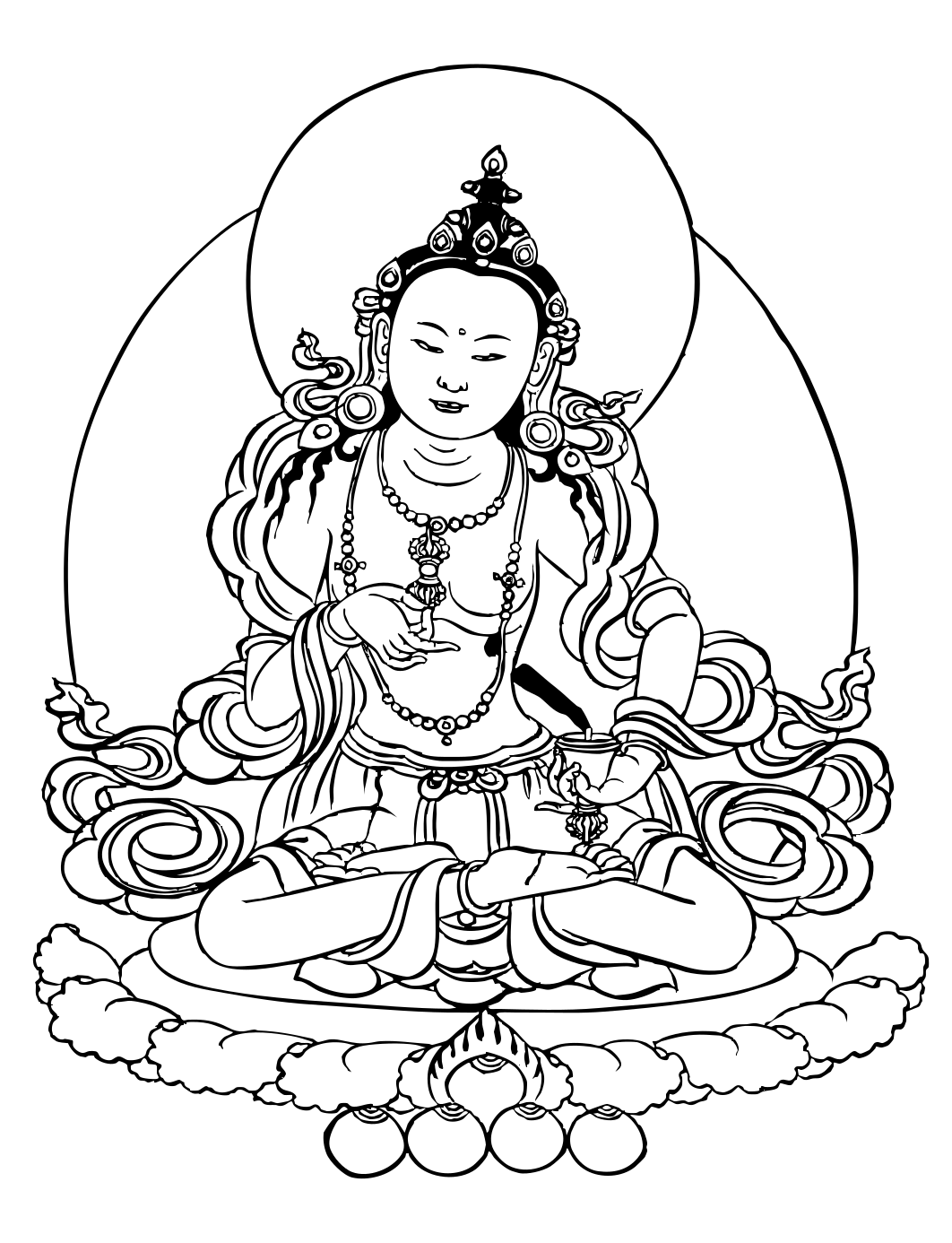
One of the “eight close sons of the Buddha,” he is also known as the bodhisattva who embodies compassion. In certain tantras, he is also the lord of the three families, where he embodies the compassion of the buddhas. In Tibet, he attained great significance as a special protector of Tibet, and in China, in female form, as Guanyin, the most important bodhisattva in all of East Asia.
The term dhāraṇī has the sense of something that “holds” or “retains,” and so it can refer to the special capacity of practitioners to memorize and recall detailed teachings. It can also refer to a verbal expression of the teachings—an incantation, spell, or mnemonic formula—that distills and “holds” essential points of the Dharma and is used by practitioners to attain mundane and supramundane goals. The same term is also used to denote texts that contain such formulas.
A set of circumstances that do not provide the freedom to practice the Buddhist path: being born in the realms of (1) the hells, (2) hungry ghosts (pretas), (3) animals, or (4) long-lived gods, or in the human realm among (5) barbarians or (6) extremists, (7) in places where the Buddhist teachings do not exist, or (8) without adequate faculties to understand the teachings where they do exist.
A class of tantric scripture that generally features elaborate rites directed toward both mundane goals—such as health, prosperity, and protection—and to the ultimate goal of liberation. In this class of tantra, the practitioners do not identify themselves with the deity as in other classes of tantra, but rather seek their power, assistance, and intervention in pursuit of their goals. The Mañjuśrīmūlakalpa and Amoghapāśakalparāja exemplify this class of tantra.
A god connected with Avalokiteśvara who appears as his companion.
A formula of words or syllables that are recited aloud or mentally in order to bring about a magical or soteriological effect or result. The term has been interpretively etymologized to mean “that which protects (trā) the mind (man)”.
In the general Mahāyāna teachings the mind of awakening (bodhicitta) is the intention to attain the complete awakening of a perfect buddha for the sake of all beings. On the level of absolute truth, the mind of awakening is the realization of the awakened state itself.
A goddess connected with Avalokiteśvara who appears as his companion.
spyan ras gzigs dbang phyug gi gzungs (Avalokiteśvaranāmadhāraṇī). Toh 696, Degé Kangyur vol. 93 (rgyud, rtsa), folios 147.b–148.a.
spyan ras gzigs dbang phyug gi gzungs (Avalokiteśvaranāmadhāraṇī). Toh 910, Degé Kangyur vol. 100 (gzungs, e), folios 242.a–242.b.
spyan ras gzigs dbang phyug gi gzungs. bka’ ’gyur (dpe bsdur ma) [Comparative Edition of the Kangyur], krung go’i bod rig pa zhib ’jug ste gnas kyi bka’ bstan dpe sdur khang (The Tibetan Tripitaka Collation Bureau of the China Tibetology Research Center). 108 volumes. Beijing: krung go’i bod rig pa dpe skrun khang (China Tibetology Publishing House), 2006–9, vol. 93, pp. 411–13.
spyan ras gzigs dbang phyug gi gzungs. Stok Palace Kangyur vol. 107 (rgyud, ma), folios 13.a–13.b.