The Chapter on the Heaven of the Thirty-Three
Trāyastriṃśatparivarta
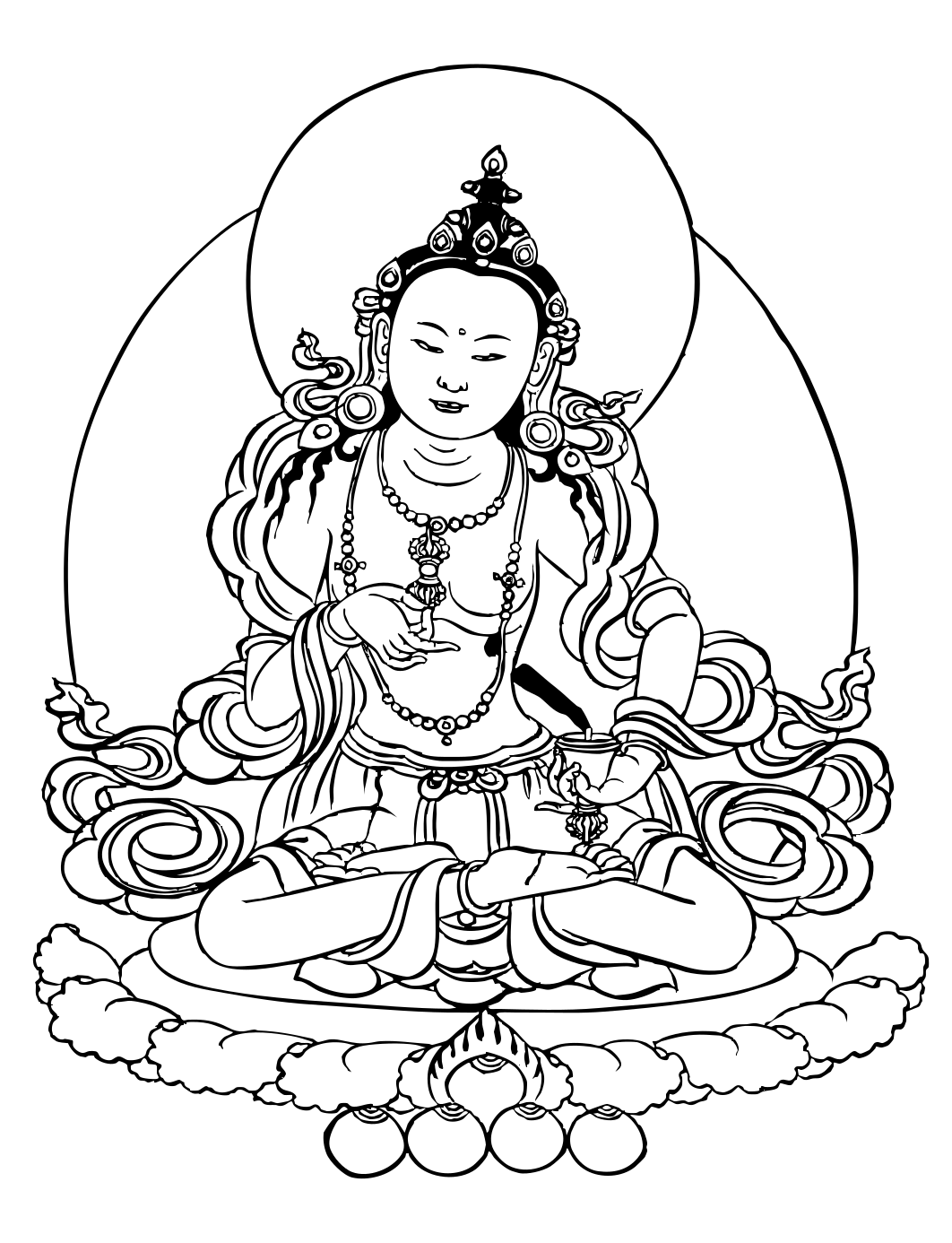
One of the three gateways to liberation; the ultimate absence of marks and signs in perceived objects.
One of the three gateways to liberation; the ultimate absence of any wish, desire, or aspiration, even those directed toward buddhahood.
A major śrāvaka disciple and personal attendant of the Buddha Śākyamuni during the last twenty-five years of his life. He was a cousin of the Buddha (according to the Mahāvastu, he was a son of Śuklodana, one of the brothers of King Śuddhodana, which means he was a brother of Devadatta; other sources say he was a son of Amṛtodana, another brother of King Śuddhodana, which means he would have been a brother of Aniruddha).
Ānanda, having always been in the Buddha’s presence, is said to have memorized all the teachings he heard and is celebrated for having recited all the Buddha’s teachings by memory at the first council of the Buddhist saṅgha, thus preserving the teachings after the Buddha’s parinirvāṇa. The phrase “Thus did I hear at one time,” found at the beginning of the sūtras, usually stands for his recitation of the teachings. He became a patriarch after the passing of Mahākāśyapa.
An ancient country whose territory spanned parts of what is today eastern Bihar and West Bengal.
A type of nonhuman being whose precise status is subject to different views, but is included as one of the six classes of beings in the sixfold classification of realms of rebirth. In the Buddhist context, asuras are powerful beings said to be dominated by envy, ambition, and hostility. They are also known in the pre-Buddhist and pre-Vedic mythologies of India and Iran, and feature prominently in Vedic and post-Vedic Brahmanical mythology, as well as in the Buddhist tradition. In these traditions, asuras are often described as being engaged in interminable conflict with the devas (gods).
The son of one of the seven brahmins who predicted that Śākyamuni would become a great king. He was one of the five companions with Śākyamuni in the beginning of his spiritual path, abandoning him when he gave up asceticism, but then becoming one of his first five pupils after his buddhahood. He was the last of the five to attain the realization of a “stream entrant” and became an arhat on hearing the Sūtra on the Characteristics of Selflessness (Anātmalakṣaṇasūtra), which was not translated into Tibetan. Aśvajit was the one who went to meet Śāriputra and Maudgalyāyana so they would become followers of the Buddha.
A king ruling in a world system to the northeast.
A precious stone frequently used in Buddhist analogies.
A park in Supreme Excellence where the buddha Possessing Multicolored Flowers resides.
A high-ranking deity presiding over a divine world; he is also considered to be the lord of the Sahā world (our universe). Though not considered a creator god in Buddhism, Brahmā occupies an important place as one of two gods (the other being Indra/Śakra) said to have first exhorted the Buddha Śākyamuni to teach the Dharma. The particular heavens found in the form realm over which Brahmā rules are often some of the most sought-after realms of higher rebirth in Buddhist literature. Since there are many universes or world systems, there are also multiple Brahmās presiding over them. His most frequent epithets are “Lord of the Sahā World” (sahāṃpati) and Great Brahmā (mahābrahman).
A god.
A buddha.
A god.
In Buddhist usage, a general term for non-Buddhist religious mendicants, often occurring together with parivrājakas and nirgranthas in stock lists of followers of non-Buddhist movements.
The essentially pure nature of mind is obscured and afflicted by various psychological defilements, which destroy the mind’s peace and composure and lead to unwholesome deeds of body, speech, and mind, acting as causes for continued existence in saṃsāra. Included among them are the primary afflictions of desire (rāga), anger (dveṣa), and ignorance (moha). It is said that there are eighty-four thousand of these negative mental qualities, for which the eighty-four thousand categories of the Buddha’s teachings serve as the antidote.
Kleśa is also commonly translated as “negative emotions,” “disturbing emotions,” and so on. The Pāli kilesa, Middle Indic kileśa, and Buddhist Hybrid Sanskrit kleśa all primarily mean “stain” or “defilement.” The translation “affliction” is a secondary development that derives from the more general (non-Buddhist) classical understanding of √kliś (“to harm,“ “to afflict”). Both meanings are noted by Buddhist commentators.
One of the three realms of saṃsāra, it is comprised of the traditional six realms of saṃsāra, from the hell realm to the realm of the gods, including the human realm. Rebirth in this realm is characterized by intense cravings via the five senses and their objects.
Trees in Gandhavati whose fragrance is diffused in a ten league radius.
A world system in the intermediate southwestern direction where the buddha named Radiating Light dwells.
A world system in the east where the buddha named Exalted King Who Holds a Splendid Jewel in His Hands dwells.
Clairaudience, one of the five or six higher perceptions.
One of the five or six “higher perceptions” (q.v.) as well as one of the “five eyes,” this is the supernormal ability to see to an unlimited distance, observe events on other worlds, see through mountains, etc. The five eyes consist of five different faculties of vision: the physical eye (
A series of progressively more subtle states of meditative realization or attainment. There are several presentations of these found in the canonical literature. One of the most common is as follows: (1) One observes form while the mind dwells at the level of the form realm. (2) One observes forms externally while discerning formlessness internally. (3) One dwells in the direct experience of the body’s pleasant aspect. (4) One dwells in the realization of the sphere of infinite space by transcending all conceptions of matter, resistance, and diversity. (5) Transcending the sphere of infinite space, one dwells in the realization of the sphere of infinite consciousness. (6) Transcending the sphere of infinite consciousness, one dwells in the realization of the sphere of nothingness. (7) Transcending the sphere of nothingness, one dwells in the realization of the sphere of neither perception nor nonperception. (8) Transcending the sphere of neither perception nor nonperception, one dwells in the realization of the cessation of conception and feeling.
Eighteen special features of a buddha’s behavior, realization, activity, and wisdom that are not shared by other beings.
One of the three gateways to liberation; the empty nature of phenomena.
A world system in the west where the buddha named Ratnasambhava dwells.
The buddha of a world system to the east.
A world system in the north where the buddha named Gift of Fearlessness dwells.
The five aggregates of form, feeling, perception, formations, and consciousness. On the individual level, the five aggregates refer to the basis upon which the mistaken idea of a self is projected. They are referred to as the “bases for appropriation” (Skt.
In Buddhist cosmology, the sphere of existence one level more subtle than our own (the desire realm), where beings, though subtly embodied, are not driven primarily by the urge for sense gratification.
In Buddhist cosmology, the sphere of existence two levels more subtle than our own (the desire realm), where beings are no longer physically embodied, and thus not subject to the sufferings that physical embodiment brings.
The four foundations or bases of miraculous power are determination, discernment, diligence, and absorption. These are among the thirty-seven factors of awakening.
Fearlessness in declaring that one has (1) awakened, (2) ceased all illusions, (3) taught the obstacles to awakening, and (4) shown the way to liberation.
A class of generally benevolent nonhuman beings who inhabit the skies, sometimes said to inhabit fantastic cities in the clouds, and more specifically to dwell on the eastern slopes of Mount Meru, where they are ruled by the Great King Dhṛtarāṣṭra. They are most renowned as celestial musicians who serve the gods. In the Abhidharma, the term is also used to refer to the mental body assumed by sentient beings during the intermediate state between death and rebirth. Gandharvas are said to live on fragrances (gandha) in the desire realm, hence the Tibetan translation dri za, meaning “scent eater.”
A world system in the intermediate northwestern direction where the buddha named Luminous Diffusion of Fragrance dwells.
The sacred river of North India.
A buddha who teaches the Dharma in a world system to the north.
The western continent of the human world according to traditional Indian cosmology, characterized as “rich in the resources of cattle.”
A buddha who teaches the Dharma in a world system to the south.
The third of the six heavens of the realm of desire. The Tibetan translation
The fifth of the six heavens of the desire realm. Its inhabitants magically create the objects of their own enjoyment.
Tuṣita (or sometimes Saṃtuṣita), literally “Joyous” or “Contented,” is one of the six heavens of the desire realm (kāmadhātu). In standard classifications, such as the one in the Abhidharmakośa, it is ranked as the fourth of the six counting from below. This god realm is where all future buddhas are said to dwell before taking on their final rebirth prior to awakening. There, the Buddha Śākyamuni lived his preceding life as the bodhisattva Śvetaketu. When departing to take birth in this world, he appointed the bodhisattva Maitreya, who will be the next buddha of this eon, as his Dharma regent in Tuṣita. For an account of the Buddha’s previous life in Tuṣita, see The Play in Full (Toh 95), 2.12, and for an account of Maitreya’s birth in Tuṣita and a description of this realm, see The Sūtra on Maitreya’s Birth in the Heaven of Joy, (Toh 199).
The highest heaven of the desire realm, the gods there possess the ability to control the magical creations of others.
One of the heavens of Buddhist cosmology, lowest among the six heavens of the desire realm (kāmadhātu, ’dod khams). Dwelling place of the Four Great Kings (caturmahārāja, rgyal chen bzhi), traditionally located on a terrace of Sumeru, just below the Heaven of the Thirty-Three. Each cardinal direction is ruled by one of the Four Great Kings and inhabited by a different class of nonhuman beings as their subjects: in the east, Dhṛtarāṣṭra rules the gandharvas; in the south, Virūḍhaka rules the kumbhāṇḍas; in the west, Virūpākṣa rules the nāgas; and in the north, Vaiśravaṇa rules the yakṣas.
In Buddhist cosmology, the Heaven of the Thirty-Three is the second lowest of the six heavens in the desire realm (kāmadhātu). Situated on the flat summit of Mount Sumeru, it lies above the Heaven of the Four Great Kings (Caturmahārājakāyika) and below the Yāma Heaven. It consists of thirty-three regions, each presided by one of thirty-three chief gods, and the overall ruler is Śakra. The presiding gods are divided into four groups named in the Abhidharmakośaṭīkā (Toh 4092): the eight gods of wealth, two Aśvin youths, eleven fierce ones, and twelve suns. The thirty-three regions themselves are enumerated and described in The Application of Mindfulness of the Sacred Dharma, Toh 287, 4.B.2 et seq.).
The higher perceptions are listed as either five or six. The first five are: clairvoyance (divine sight), divine hearing, knowing how to manifest miracles, remembering previous lives, and knowing what is in the minds of others. A sixth, knowing that all defects have been eliminated, is often added. The first five are attained through dhyāna, and are sometimes described as worldly, as they can be attained to some extent by non-Buddhist yogis. The sixth is supramundane and attained only by realization.
A buddha who teaches the Dharma in a world system to the east.
The name of the southern continent in Buddhist cosmology, which can signify either the known human world, or more specifically the Indian subcontinent, literally “the jambu island/continent.” Jambu is the name used for a range of plum-like fruits from trees belonging to the genus Szygium, particularly Szygium jambos and Szygium cumini, and it has commonly been rendered “rose apple,” although “black plum” may be a less misleading term. Among various explanations given for the continent being so named, one (in the Abhidharmakośa) is that a jambu tree grows in its northern mountains beside Lake Anavatapta, mythically considered the source of the four great rivers of India, and that the continent is therefore named from the tree or the fruit. Jambudvīpa has the Vajrāsana at its center and is the only continent upon which buddhas attain awakening.
One of the first Buddhist monasteries, located in a park outside Śrāvastī, the capital of the ancient kingdom of Kośala in northern India. This park was originally owned by Prince Jeta, hence the name Jetavana, meaning Jeta’s grove. The wealthy merchant Anāthapiṇḍada, wishing to offer it to the Buddha, sought to buy it from him, but the prince, not wishing to sell, said he would only do so if Anāthapiṇḍada covered the entire property with gold coins. Anāthapiṇḍada agreed, and managed to cover all of the park except the entrance, hence the name Anāthapiṇḍadasyārāmaḥ, meaning Anāthapiṇḍada’s park. The place is usually referred to in the sūtras as “Jetavana, Anāthapiṇḍada’s park,” and according to the Saṃghabhedavastu the Buddha used Prince Jeta’s name in first place because that was Prince Jeta’s own unspoken wish while Anāthapiṇḍada was offering the park. Inspired by the occasion and the Buddha’s use of his name, Prince Jeta then offered the rest of the property and had an entrance gate built. The Buddha specifically instructed those who recite the sūtras to use Prince Jeta’s name in first place to commemorate the mutual effort of both benefactors.
Anāthapiṇḍada built residences for the monks, to house them during the monsoon season, thus creating the first Buddhist monastery. It was one of the Buddha’s main residences, where he spent around nineteen rainy season retreats, and it was therefore the setting for many of the Buddha’s discourses and events. According to the travel accounts of Chinese monks, it was still in use as a Buddhist monastery in the early fifth century ᴄᴇ, but by the sixth century it had been reduced to ruins.
An epithet for softness, probably in reference, direct or metaphorical, to the down of the kācilindika bird (see Lamotte, Etienne. La Concentration de la Marche Héroïque. Peeters (1975), p. 261, n. 321).
’phags pa sum cu rtsa gsum pa’i le’u zhes bya ba theg pa chen po’i mdo (Āryatrāyastriṃśatparivartanāmamahāyānasūtra). Toh 223, Degé Kangyur vol. 63 (mdo sde, dza), folios 127.a–164.a.
’phags pa sum cu rtsa gsum pa’i le’u zhes bya ba theg pa chen po’i mdo. bka’ ’gyur (dpe bsdur ma) [Comparative Edition of the Kangyur], krung go’i bod rig pa zhib ’jug ste gnas kyi bka’ bstan dpe sdur khang (The Tibetan Tripitaka Collation Bureau of the China Tibetology Research Center). 108 volumes. Beijing: krung go’i bod rig pa dpe skrun khang (China Tibetology Publishing House), 2006–9, vol. 63, pp. 343–431.
’phags pa sum cu rtsa gsum pa’i le’u zhes bya ba theg pa chen po’i mdo. (Āryatrāyastriṃśatparivartanāmamahāyānasūtra). Stok Palace Kangyur vol. 60 (mdo sde, ta), folios 268.b–325.a.
Denkarma (pho brang stod thang ldan dkar gyi chos kyi ’gyur ro cog gi dkar chag). Toh 4364, Degé Tengyur vol. 206 (sna tshogs, jo), folios 294.b–310.a.
Herrmann-Pfandt, Adelheid. Die lHan kar ma: ein früher Katalog der ins Tibetische übersetzten buddhistischen Texte. Verlag der Österreichischen Akademie der Wissenschaften, 2008.
Phangthangma (dkar chag ’phang thang ma). Beijing: mi rigs dpe skrun khang, 2003.