༄༅། །བཅོམ་ལྡན་འདས་ཕྱག་ན་རྡོ་རྗེ་གོས་སྔོན་པོ་ཅན་གྱི་རྒྱུད།
The Tantra of the Blue-Clad Blessed Vajrapāṇi
Bhagavannīlāmbaradharavajrapāṇitantra
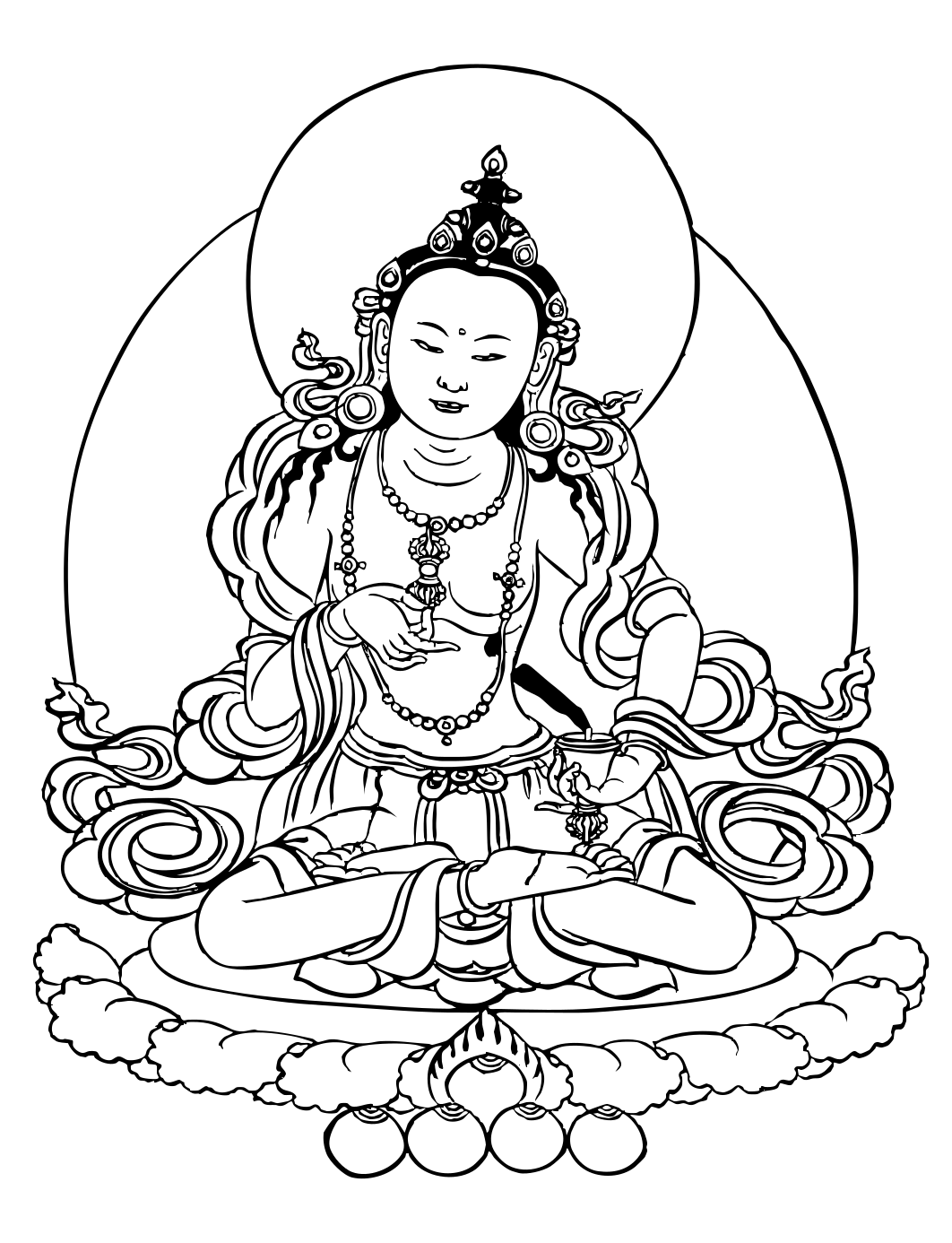
In a general sense, samādhi can describe a number of different meditative states. In the Mahāyāna literature, in particular in the Prajñāpāramitā sūtras, we find extensive lists of different samādhis, numbering over one hundred.
In a more restricted sense, and when understood as a mental state, samādhi is defined as the one-pointedness of the mind (cittaikāgratā), the ability to remain on the same object over long periods of time. The Drajor Bamponyipa (sgra sbyor bam po gnyis pa) commentary on the Mahāvyutpatti explains the term samādhi as referring to the instrument through which mind and mental states “get collected,” i.e., it is by the force of samādhi that the continuum of mind and mental states becomes collected on a single point of reference without getting distracted.
Another name of Śesa, the serpent upon whom Viṣṇu rests during the interlude between the destruction and recreation of the world.
This term in its broadest sense can refer to any being, whether human, animal, or nonhuman. However, it is often used to refer to a specific class of nonhuman beings, especially when bhūtas are mentioned alongside rākṣasas, piśācas, or pretas. In common with these other kinds of nonhumans, bhūtas are usually depicted with unattractive and misshapen bodies. Like several other classes of nonhuman beings, bhūtas take spontaneous birth. As their leader is traditionally regarded to be Rudra-Śiva (also known by the name Bhūta), with whom they haunt dangerous and wild places, bhūtas are especially prominent in Śaivism, where large sections of certain tantras concentrate on them.
A yakṣa.
Fire ritual.
“Conduct tantras,” the second, middle category of the three outer tantras according to the new translation (gsar ma) traditions; in old translation (rnying ma) classifications the term Upa- or Ubhaya-tantra is more often used.
The Sanskrit term vimāna can refer to a multistoried mansion or palace, or even an estate, but is more often used in the sense of a celestial chariot of the gods, sometimes taking the form of a multistoried palace; hence the Tibetan translation, khang brtsegs, literally “storied house.”
A tantric vow or commitment.
A bodhisattva in the Buddha Akṣobhya’s retinue in this tantra.
Used in several senses, elsewhere in this text translated as “incantation mantra,” but here referring to entire canonical texts used mainly for ritual purposes, structured around an incantation mantra in Sanskrit but also detailing its uses and the story of its origin.
A diagram drawn in tantric rituals.
Milk, yogurt, clarified butter, cow urine, and cow dung.
A type of evil spirit known to exert a harmful influence on the human body and mind. Grahas are closely associated with the planets and other astronomical bodies.
A yakṣa.
An epithet of the moon.
A type of incantation or spell used to accomplish a ritual goal. This can be associated with either ordinary attainments or those whose goal is awakening.
A type of dhāraṇī.
An alternate name for the yakṣa Kubera.
An alternate name for the yakṣa Jambhala.
A yakṣa.
A species of euphorbia used in burnt offerings to get rid of nāga influences.
A ritual offering of food and drink.
This is the object of ritual accomplishment, whatever is the focus and/or the goal of ritual activity. Also translated “target.”
A yakṣa.
Derived from the Sanskrit verb √sādh, “to accomplish,” the term sādhana most generically refers to any method that brings about the accomplishment of a desired goal. In Buddhist literature, the term is often specifically applied to tantric practices that involve ritual engagement with deities, mantra recitation, the visualized creation and dissolution of deity maṇḍalas, etc. Sādhanas are aimed at both actualizing spiritual attainments (siddhi) and reaching liberation. The Tibetan translation sgrub thabs means “method of accomplishment.”
A yakṣa.
A yakṣa in this tantra. Although yang dag is normally translated as “Viśuddha,” we have rendered it here as “Samprajñāna” since this is the Sanskrit rendering of this particular yakṣa’s name in the list of name mantras at 2.14.
A bodhisattva in the Buddha Akṣobhya’s retinue in this tantra.
A yakṣa.
A bodhisattva in the Buddha Akṣobhya’s retinue in this tantra.
A bodhisattva in the Buddha Akṣobhya’s retinue in this tantra.
A bodhisattva in the Buddha Akṣobhya’s retinue in this tantra.
A bodhisattva in the Buddha Akṣobhya’s retinue in this tantra.
A bodhisattva in the Buddha Akṣobhya’s retinue in this tantra.
Lit. “Fierce Vajra.”
A class of nonhuman beings who inhabit forests, mountainous areas, and other natural spaces, or serve as guardians of villages and towns, and may be propitiated for health, wealth, protection, and other boons, or controlled through magic. According to tradition, their homeland is in the north, where they live under the rule of the Great King Vaiśravaṇa.
Several members of this class have been deified as gods of wealth (these include the just-mentioned Vaiśravaṇa) or as bodhisattva generals of yakṣa armies, and have entered the Buddhist pantheon in a variety of forms, including, in tantric Buddhism, those of wrathful deities.
bcom ldan ’das phyag na rdo rje gos sngon po can gyi rgyud ces bya ba (Bhagavannīlāmbaradharavajrapāṇitantranāma). Toh 498, Degé Kangyur vol. 87 (rgyud ’bum, da), folios 158a.6–167a.3.
bcom ldan ’das phyag na rdo rje gos sngon po can gyi rgyud ces bya ba. bka’ ’gyur (dpe bsdur ma) [Comparative Edition of the Kangyur], krung go’i bod rig pa zhib ’jug ste gnas kyi bka’ bstan dpe sdur khang (The Tibetan Tripitaka Collation Bureau of the China Tibetology Research Center). 108 volumes. Beijing: krung go’i bod rig pa dpe skrun khang (China Tibetology Publishing House), 2006–9, vol. 87, 469–90.
Dalton, Jacob. “How Dhāraṇis were Proto-Tantric: Liturgies, Ritual Manuals, and the Origins of the Tantras.” In Tantric Traditions on the Move, edited by David B. Gray and Ryan R. Overbey. Oxford: Oxford University Press, 2016.
Davidson, Ronald M. Indian Esoteric Buddhism: A Social History of the Tantric Movement. New York: Columbia University Press, 2002.
Isaacson, Harunaga. “Observations on the Development of the Ritual of Initiation (abhiṣeka) in the Higher Buddhist Tantric Systems.” In Hindu and Buddhist Initiations in India and Nepal, edited by Astrid Zotter and Christof Zotter, 261–80. Wiesbaden: Harrassowitz Verlag, 2010.
Mayer, Robert. “The Importance of the Underworlds: Asuras’ Caves in Buddhism, and Some Other Themes in Early Buddhist Tantras Reminiscent of the Later Padmasambhava Legends.” Journal of the International Association for Tibetan Studies 3 (December 2007): 1–31.
Williams, Paul. Buddhist Thought: A Complete Introduction to the Indian Tradition. London: Routledge, 2000.