The Play in Full
Lalitavistara
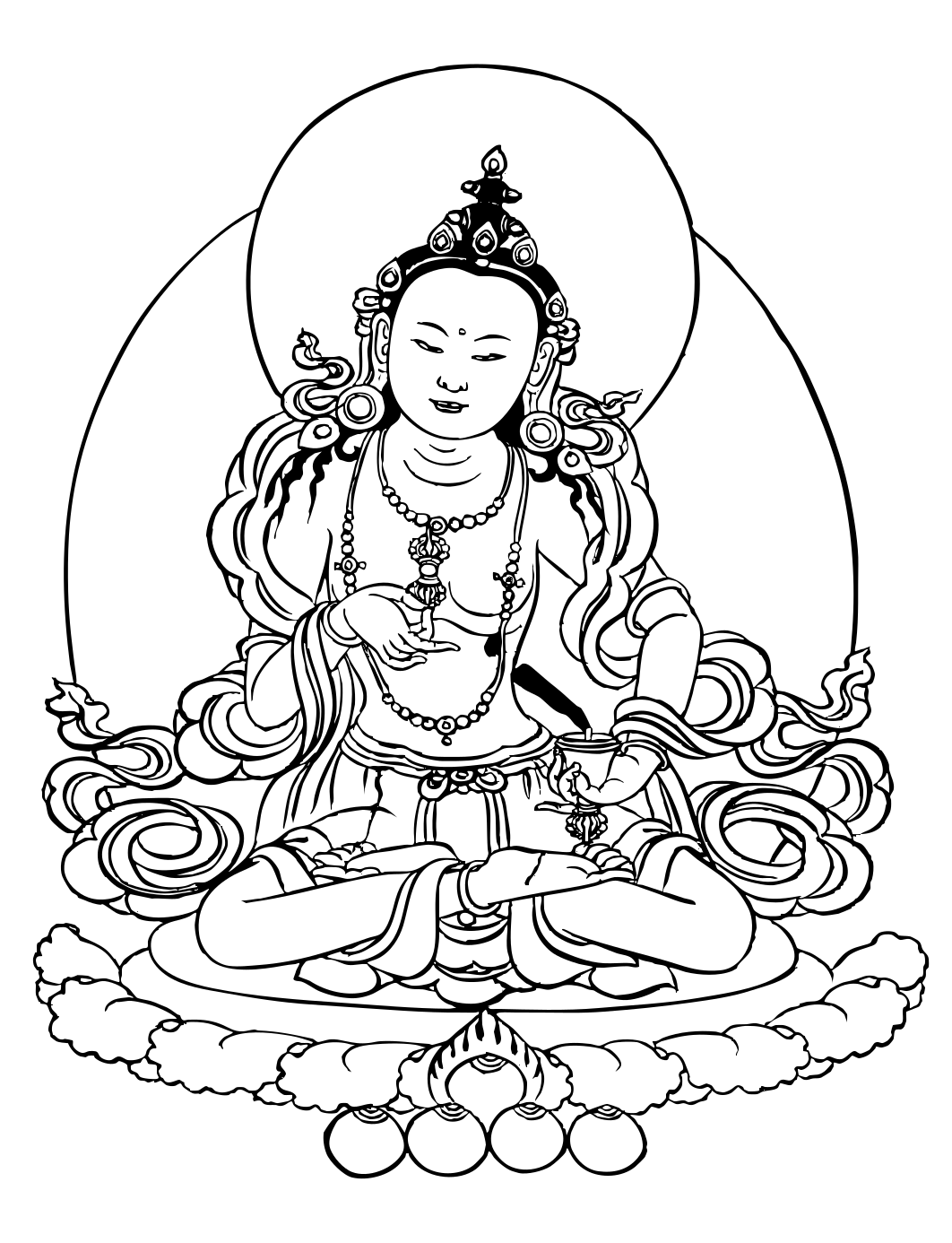
One of the gods gathered at King Śuddhodana’s residence before Prince Siddhārtha’s birth, said to be head god of the Ābhāsvara heaven.
An ancient title given to ascetics, monks, hermits, and saints, namely, those who have attained the realization of truth through their own contemplation and not by divine revelation. It is also used as an epithet of the Buddha Śākyamuni, and has also been rendered here as “Sage.”
In a general sense, samādhi can describe a number of different meditative states. In the Mahāyāna literature, in particular in the Prajñāpāramitā sūtras, we find extensive lists of different samādhis, numbering over one hundred.
In a more restricted sense, and when understood as a mental state, samādhi is defined as the one-pointedness of the mind (cittaikāgratā), the ability to remain on the same object over long periods of time. The Drajor Bamponyipa (sgra sbyor bam po gnyis pa) commentary on the Mahāvyutpatti explains the term samādhi as referring to the instrument through which mind and mental states “get collected,” i.e., it is by the force of samādhi that the continuum of mind and mental states becomes collected on a single point of reference without getting distracted.
One of Māra’s sons who developed faith in Prince Siddhārtha and tried to dissuade Māra from attacking him on the evening of his awakening.
The main palace of the abode of the yakṣas on Mount Sumeru. It is ruled by the great king Vaiśravaṇa, also known as Kubera.
Another name of Sūrya, the god of the sun, or the sun personified.
The king of elephants and Śakra’s mount, who makes offerings to Prince Siddhārtha upon learning of his intent to leave home.
A follower of a non-Buddhist mendicant movement founded by Makkhali Gosāla (fifth century ʙᴄᴇ). The ājīvikas adhered to a fatalist worldview according to which all beings eventually reach spiritual accomplishment by fate, rather than their own actions.
One of the monks attending this teaching in Śrāvastī, at Jeta’s Grove. He was one of the five companions who joined Prince Siddhārtha while practicing austerities and attended his first turning of the wheel of Dharma at the Deer Park, after the Buddha’s awakening. As he was the first to understand the teachings on the four truths, he received the name Ājñātakauṇḍinya, meaning “Kauṇḍinya who understood.” Also known simply as Kauṇḍinya.
A thus-gone one to whom the Bodhisattva made offerings in a past life.
One of the eight goddesses in the west, called upon to grant protection.
The most subtle form of deluded consciousness, which serves as the substratum for karmic seeds to be stored; likewise the substratum from which appearances manifest.
The resinous heartwood of the Aquilaria and Gyirnops evergreen trees in India and southeast Asia, also known as aloeswood (Agallochum).
A thus-gone one to whom the Bodhisattva made offerings in a past life.
One of the monks attending this teaching in Śrāvastī, at Jeta’s Grove.
One of the places the Buddha visited in the region of Gayā.
A major śrāvaka disciple and personal attendant of the Buddha Śākyamuni during the last twenty-five years of his life. He was a cousin of the Buddha (according to the Mahāvastu, he was a son of Śuklodana, one of the brothers of King Śuddhodana, which means he was a brother of Devadatta; other sources say he was a son of Amṛtodana, another brother of King Śuddhodana, which means he would have been a brother of Aniruddha).
Ānanda, having always been in the Buddha’s presence, is said to have memorized all the teachings he heard and is celebrated for having recited all the Buddha’s teachings by memory at the first council of the Buddhist saṅgha, thus preserving the teachings after the Buddha’s parinirvāṇa. The phrase “Thus did I hear at one time,” found at the beginning of the sūtras, usually stands for his recitation of the teachings. He became a patriarch after the passing of Mahākāśyapa.
One of the monks attending this teaching in Śrāvastī, at Jeta’s Grove.
A gatekeeper.
A wealthy merchant in the town of Śrāvastī, famous for his generosity to the poor, who became a patron of the Buddha Śākyamuni. He bought Prince Jeta’s Grove (Skt. Jetavana), to be the Buddha’s first monastery, a place where the monks could stay during the monsoon.
A vast legendary lake on the other side of the Himalayas. Only those with miraculous powers can go there. It is said to be the source of the world’s four great rivers. (Provisional 84000 definition. New definition forthcoming.)
A nāga king.
The name of an ascetic.
Lit. “Unobstructed.” One of the ten great śrāvaka disciples, famed for his meditative prowess and superknowledges. He was the Buddha's cousin—a son of Amṛtodana, one of the brothers of King Śuddhodana—and is often mentioned along with his two brothers Bhadrika and Mahānāma. Some sources also include Ānanda among his brothers.
One of the monks attending this teaching in Śrāvastī, at Jeta’s Grove.
One of the sons of Māra present on the eve of Prince Siddhārtha’s awakening.
Alternate name of Māra.
Lit. “god who moves above the earth.” Name of one of the sixty-four scripts mentioned by Prince Siddhārtha to his schoolmaster Viśvāmitra.
A town in the country of Maineya. Located six leagues away is the place where Chanda, Prince Siddhārtha’s servant, parted with him after his escape from home. It is said a memorial was later built here, known as “Chanda’s Return.”
One of the sons of Māra present on the eve of Prince Siddhārtha’s awakening.
A constellation in the west, personified as a semidivine being. Here called upon for protection.
One of the four main continents that surround Sumeru, the central mountain in classical Buddhist cosmology. It is the western continent, characterized as “rich in the resources of cattle,” thus its Tibetan name “using cattle.” It is circular in shape, measuring about 7,500 yojanas in circumference, and is flanked by two subsidiary continents. Humans who live there are very tall, about 24 feet (7.3 meters) on average, and live for 500 years. It is known by the names Godānīya, Aparāntaka, Aparagodānīya, or Aparagoyāna.
One of the eight goddesses in the east, called upon to grant protection.
The four applications of mindfulness are mindfulness (1) of the body, (2) of feelings, (3) of the mind, and (4) of phenomena. These four are part of the thirty-seven factors of awakening.
One of the sixteen gods guarding the seat of awakening.
The first spiritual teacher Prince Siddhārtha studied with after leaving his home.
One of the daughters of Māra present on the eve of Siddhārtha’s awakening.
A thus-gone one to whom the Bodhisattva made offerings in a past life.
A king, one of the Buddha’s former rebirths.
A constellation in the east, personified as a semidivine being. Here called upon for protection.
The greatest mathematician among the Śākyas. He was appointed as a judge to determine Prince Siddhārtha’s intellectual capabilities.
One of the five Pāṇḍava brothers. Son of Indra.
One of the eight goddesses in the west, called upon to grant protection.
One of the eight goddesses in the north, called upon to grant protection.
A constellation in the west, personified as a semidivine being. Here called upon for protection.
The famous great sage who went to visit Prince Siddhārtha when he was a newborn baby. He made predictions of his awakening as the Buddha and then cried when he realized he would not be alive to witness it.
A constellation in the east, personified as a semidivine being. Here called upon for protection.
Saraca asoca. A tree with aromatic blossoms, clustered together as orange, yellow, and red bunches of petals.
A mountain in the west, called upon to grant wealth and protection.
’phags pa rgya cher rol pa zhes bya ba theg pa chen po’i mdo (Āryalalitavistaranāmamahāyānasūtra). Toh 95, Degé Kangyur vol. 46 (mdo sde, kha), folios 1b–216b.
’phags pa rgya cher rol pa zhes bya ba theg pa chen po’i mdo. bka’ ’gyur (dpe bsdur ma) [Comparative Edition of the Kangyur], krung go’i bod rig pa zhib ’jug ste gnas kyi bka’ bstan dpe sdur khang (The Tibetan Tripitaka Collation Bureau of the China Tibetology Research Center). 108 volumes. Beijing: krung go’i bod rig pa dpe skrun khang (China Tibetology Publishing House), 2006–2009, vol 46, pp. 3–434.
Foucaux, Phillipe Édouard. Rgya Tch’er Rol Pa ou Développement des Jeux, Contenant l’Histoire du Bouddha Çakya-mouni. Première Partie—Texte Tibétain. Paris: Imprimerie Royale, 1847.
Hokazono, Kōichi (1994). Raritavisutara no Kenkyu. Volume 1 [study of Lalitavistara, chs. 1–14]. Tokyo: Daitō Shuppansha, 1994.
Hokazono, Kōichi (2019a). Raritavisutara no Kenkyu. Volume 2 [study of Lalitavistara, chs. 15–21]. Tokyo: Daitō Shuppansha, 2019.
Hokazono, Kōichi (2019b). Raritavisutara no Kenkyu. Volume 3 [study of Lalitavistara, chs. 22–27]. Tokyo: Daitō Shuppansha, 2019.
Lefmann, Salomon. Lalita Vistara. Halle: Verlag der Buchhandlung des Waisenhauses, 1882.
Mitra, R. L. (1853–1877). The Lalita Vistara or Memoirs of the Early Life of S’a’kya Siñha. Bibliotheca Indica: A Collection of Oriental Works, Old Series, nos. 51, 73, 143, 144, 145, 237. Calcutta: Asiatic Society of Bengal, 1853–1877.
Bays, Gwendolyn. The Voice of the Buddha, The Beauty of Compassion: The Lalitavistara Sutra. Tibetan Translation Series, vol. 2. Berkeley, CA: Dharma Publishing, 1983.
Foucaux, Phillipe Édouard (1848). Rgya Tch’er Rol Pa ou Développement des Jeux, Contenant l’Histoire du Bouddha Çakya-mouni: Traduit sur la version Tibétaine du Bkahhgyour, et revu sur l’original Sanscrit (Lalitavistara). Paris: Imprimerie Nationale, 1848.
Foucaux, Phillipe Édouard (1870). Étude sur le Lalita Vistara pour une édition critique du texte sanskrit, précédée d’ un coup d’oeil sur la publication des livres bouddhiques en Europe et dans l’Inde. Paris: Maisonneuve, 1870.
Foucaux, Phillipe Édouard (1884). Le Lalitavistara, Développement des Jeux: l’histoire traditionnelle de la vie du Bouddha Çakyamuni. Première partie. Annales du Musée Guimet, vol. 6 Paris: Ernest Leroux, 1884.
Foucaux, Phillipe Édouard (1892). Le Lalitavistara, Développement des Jeux: l’histoire traditionnelle de la vie du Bouddha Çakyamuni. Seconde partie: notes, variantes, et index. Annales du Musée Guimet, vol. 19. Paris: Ernest Leroux, 1892.
Lefmann, Salomon (1874). Lalitavistara: Erzählung von dem Leben und der Lehre des Çâkya Simha. Berlin: Dümmler, 1874.
Lenz, Robert. “Analyse du Lalita-Vistara-Pourana, l’un des principaux ouvrages sacrés des Bouddhistes de l’Asie centrale, contenant la vie de leur prophète, et écrit en Sanscrit.” Bulletin Scientifique publié par l’Académie impériale des Sciences de Saint-Pétersbourg I.7: 49–51; I.8: 57–63; I.9: 71–72; I.10: 75–78; I.11: 87–88; I.12: 92–96; I.13: 97–99. St. Petersburg: Académie impériale des sciences, 1836.
Miller, Robert. The Chapter on Schisms in the Saṅgha (Saṅghabhedavastu, Toh 1-17). 84000: Translating the Words of the Buddha, forthcoming.
Mitra, R. L. (1881–1886). The Lalita Vistara or Memoirs of the Early Life of S’a’kya Siñha, Translated from the Original Sanskrit. Bibliotheca Indica: A Collection of Oriental Works, New Series, nos. 455, 473, 575. Calcutta: Asiatic Society of Bengal, 1881–1886. Republished, Delhi: Sri Satguru Publications, 1998.
Silk, Jonathan A. “Serious Play: Recent Scholarship on the Lalitavistara.” Indo-Iranian Journal 65: 267–301. Leiden: Brill, 2022.
Vaidya, P. L. Lalitavistara. Buddhist Sanskrit Texts, vol. 1. Darbhanga: The Mithila Institute, 1958.
Winternitz, Maurice (1927). “The Lalita-Vistara.” In A History of Indian Literature, Vol. 2, 249–56. 3rd ed. Delhi: Munshiram Manoharlal, 1991.
Goswami, Bijoya. Lalitavistara. Bibliotheca Indica Series, vol. 320. Calcutta: The Asiatic Society, 2001.
Khosla, Sarla. Lalitavistara and the Evolution of Buddha Legend. New Delhi: Galaxy Publications, 1991.
Thomas, E. J. “The Lalitavistara and Sarvastivada.” Indian Historical Quarterly 16:2 (1940): 239–45.